Healthcare

Vitamin D Deficiency ICD-10 Code (E55.9): Coding Guide
E55.9 is the ICD-10 code for vitamin D deficiency. Covers screening (Z13.21), history, pregnancy, CPT 82306 vs...

Sep 29, 2026
1 min read

Jordan Taylor
September 29, 2026
Table of Contents
20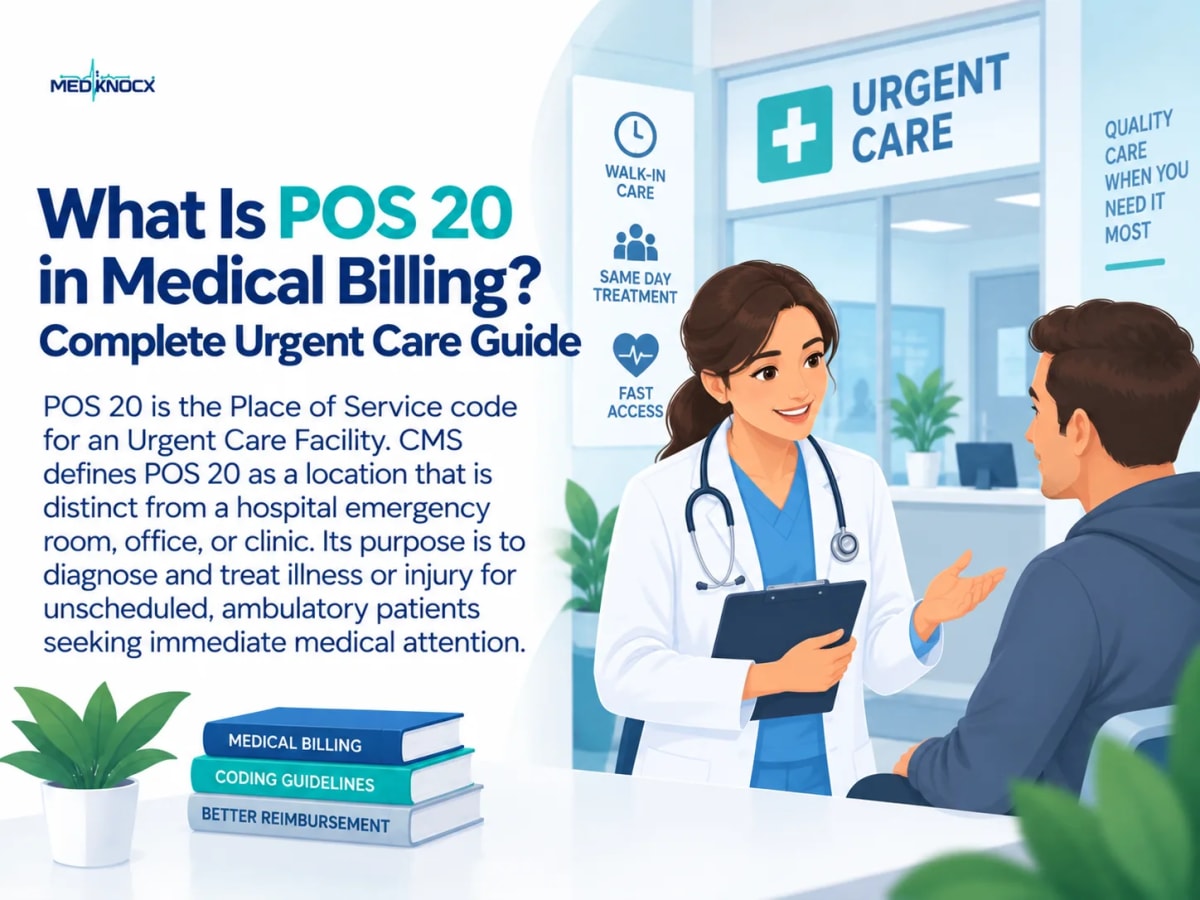
When a patient visits an urgent care facility for immediate medical attention, the claim needs to identify the correct place of service. POS 20 in medical billing is used to identify an urgent care facility.
The code tells the payer where the service was provided. It also helps distinguish urgent care from a physician's office and a hospital emergency room.
Using the correct POS code is an important part of accurate medical billing. In this guide, we explain what POS 20 means, when to use it, how it differs from other POS codes, and common urgent care billing mistakes.
POS 20 is the Place of Service code for an Urgent Care Facility.
CMS defines POS 20 as a location that is distinct from a hospital emergency room, office, or clinic. Its purpose is to diagnose and treat illness or injury for unscheduled, ambulatory patients seeking immediate medical attention. POS 20 became effective January 1, 2003.
In simple terms, POS 20 tells the payer that a healthcare service was provided in an urgent care facility.
POS codes are two-digit codes used on professional healthcare claims to identify the setting where a service was provided. CMS maintains the national POS code set used for professional claims.
POS 20 means Urgent Care Facility.
The important point is that POS 20 is specifically designed for an urgent care setting.
A patient may visit an urgent care center without a scheduled appointment because they need prompt treatment for an illness or injury. If the facility meets the applicable definition, POS 20 identifies that setting on the professional claim.
POS 20 is different from:
POS 11, Office
POS 17, Walk-in Retail Health Clinic
POS 22, On Campus-Outpatient Hospital
POS 23, Emergency Room-Hospital
The actual facility type should be verified before selecting the POS code.
POS 20 is used when healthcare services are provided in an urgent care facility to an unscheduled ambulatory patient seeking immediate medical attention.
Common urgent care services may include:
Evaluation and management services
Treatment of minor illnesses
Treatment of minor injuries
Diagnostic testing
Basic laboratory services
Wound treatment
Other medically necessary urgent care services
The correct CPT or HCPCS code still depends on the service performed.
The POS code only identifies the place of service.
A patient develops a fever and respiratory symptoms on the weekend. The patient visits an urgent care center without an appointment.
The provider evaluates the patient, performs the appropriate examination, and develops a treatment plan.
If the location meets the definition of an urgent care facility, POS 20 can identify the service location on the professional claim.
One of the most common comparisons is POS 20 vs POS 11.
POS 11 = Office
POS 20 = Urgent Care Facility
CMS describes POS 11 as an office setting and POS 20 as an urgent care facility that is distinct from an office or clinic.
A physician office can sometimes accept patients without appointments. That does not automatically make the location an urgent care facility.
The facility itself and the services it provides are important when determining the appropriate POS.
For example:
Example 1: A patient walks into a family physician's office for a same-day appointment. The setting may remain POS 11.
Example 2: A patient visits a dedicated urgent care facility without an appointment. POS 20 may apply.
The billing team should verify the actual facility type instead of selecting POS 20 simply because the patient was seen quickly.
Another important comparison is POS 20 vs POS 23.
CMS defines POS 23 as the portion of a hospital where emergency diagnosis and treatment of illness or injury are provided.
Urgent care and hospital emergency rooms can both provide immediate treatment. However, they are separate POS settings.
POS 20 identifies an urgent care facility.
POS 23 identifies the emergency room portion of a hospital.
The claim should reflect the actual location where the service was provided.
A provider should not use POS 23 simply because the patient needed urgent medical attention.
POS 17 represents a Walk-in Retail Health Clinic.
CMS describes POS 17 as a walk-in health clinic located within a retail operation. It provides ambulatory preventive and primary care services and is distinct from an office, urgent care facility, pharmacy, or independent clinic.
This distinction can be important for retail clinics located inside pharmacies, supermarkets, or other retail businesses.
A walk-in visit alone does not automatically mean POS 20.
POS 22 represents an On Campus-Outpatient Hospital.
POS 20 represents an Urgent Care Facility.
CMS maintains these as separate POS categories.
The billing team should determine whether the patient received care at an urgent care facility or a hospital outpatient department before selecting the code.
Accurate POS 20 billing starts with verifying the actual service location.
Confirm that the location qualifies as an urgent care facility.
Determine whether the patient received unscheduled ambulatory care for immediate medical attention.
Choose the code that accurately represents the service performed.
Enter POS 20 when the service was provided in an appropriate urgent care setting.
Check whether the service requires a modifier based on the circumstances of the encounter.
Make sure the medical record supports the service billed.
Review Medicare, Medicaid, or commercial payer policies before claim submission.
After submission, monitor the claim for rejections, denials, or requests for additional information.
CMS notes that POS information is used on professional claims to identify the setting in which a service was provided.
There is no single CPT code that represents every service provided in an urgent care facility.
The provider should report the CPT or HCPCS code that describes the actual service.
Depending on the encounter, this can include:
Evaluation and management codes
Diagnostic testing codes
Procedure codes
Laboratory services
Other eligible services
Two HCPCS codes are specifically associated with urgent care services:
S9083 represents a global fee for urgent care centers.
S9088 is an urgent care add-on code used with an E/M or procedure code to indicate urgent care operational costs.
However, these codes are payer-specific in their reimbursement treatment.
For example, Ambetter provider bulletins state that certain plans will reimburse S9083 and S9088 when billed with POS 20 beginning August 1, 2026. Claims submitted with another POS are subject to denial under those policies.
This is an example of why billers should check the specific payer's current policy instead of assuming that every insurer handles S9083 or S9088 the same way.
Modifier 25 can become relevant when an E/M service is reported on the same date as another procedure or service.
However, modifier 25 is not automatically required for every urgent care visit.
The provider's documentation must support a significant, separately identifiable E/M service when modifier 25 is reported.
The billing team should verify the applicable CPT guidance and payer requirements before adding the modifier.
POS 20 is part of the national POS code set used for professional claims.
CMS lists POS 20 as Urgent Care Facility and identifies it as a non-facility setting for Medicare Physician Fee Schedule purposes.
Medicare billing still requires the correct CPT or HCPCS code, diagnosis coding, documentation, medical necessity, and other applicable claim requirements.
A POS code does not determine payment by itself.
The applicable Medicare rules should be reviewed for the specific service.
POS information can affect how a payer processes a claim.
For Medicare Physician Fee Schedule services, CMS maintains facility and non-facility designations for POS codes. POS 20 is designated as a non-facility setting in the CMS POS database.
However, the POS code alone does not guarantee a specific reimbursement amount.
Payment can depend on:
CPT or HCPCS code
Insurance plan
Provider participation
Medical necessity
Patient benefits
Modifiers
Contract terms
Payer fee schedule
Documentation
Applicable payer policies
For this reason, medical billers should verify the payer's current reimbursement rules.
Incorrect POS reporting can create claim processing problems.
A biller may report POS 11 because the urgent care looks similar to a physician office.
The actual facility type should be verified before selecting the POS.
POS 23 represents a hospital emergency room.
An urgent care facility should not automatically be coded as POS 23 because the patient needed immediate attention.
A walk-in retail clinic can fall under POS 17.
A same-day office visit can remain POS 11.
A dedicated urgent care facility can use POS 20 when the applicable definition is met.
POS 20 identifies the location. It does not replace the procedure code.
The CPT or HCPCS code must accurately describe the service performed.
Adding modifiers without proper documentation can create claim issues.
Review the service, documentation, and payer rules before reporting a modifier.
S9083 and S9088 do not have identical reimbursement policies across all payers.
Always verify the applicable payer policy.
Use this checklist before submitting an urgent care claim.
Is the location actually an urgent care facility?
Is it distinct from a physician office, clinic, retail health clinic, and hospital emergency room?
Was the patient an ambulatory patient seeking immediate medical attention?
Does the procedure code accurately describe the service?
Does the place of service match the actual facility?
Are all reported modifiers supported by the documentation?
Does the medical record support the billed services?
Check the current Medicare, Medicaid, or commercial payer requirements.
Review patient information, provider data, diagnosis codes, procedure codes, POS, modifiers, and other claim fields.
Correct POS reporting helps the payer understand where the healthcare service was provided.
For urgent care billing, it also helps distinguish the encounter from:
Physician office visits
Retail clinic visits
Hospital outpatient services
Emergency room services
CMS maintains POS codes as the standard way to describe the setting of professional healthcare services.
Using the wrong POS can contribute to:
Claim rejections
Claim denials
Payment delays
Incorrect reimbursement
Additional claim review
Billing rework
When POS errors keep causing rework, a structured denial management process helps find where they start. Accurate location coding is therefore an important part of the medical billing process.
Here is a quick comparison:
CMS maintains separate definitions for these settings.
The correct code depends on the actual location and the applicable billing rules.
A patient develops a minor injury and visits a dedicated urgent care center without an appointment.
The provider evaluates the injury and performs the necessary treatment.
The medical record documents the encounter and services provided.
The billing team confirms that the facility qualifies as an urgent care facility. It then selects the appropriate CPT or HCPCS code and reports POS 20 to identify the service location.
The payer can then process the professional claim using the reported service and place-of-service information.
POS 20 in medical billing identifies an Urgent Care Facility.
CMS defines POS 20 as a location distinct from a hospital emergency room, office, or clinic. It is designed for diagnosing and treating illness or injury in unscheduled ambulatory patients seeking immediate medical attention.
The most important distinctions are:
POS 11: Office
POS 17: Walk-in Retail Health Clinic
POS 20: Urgent Care Facility
POS 23: Emergency Room-Hospital
Accurate POS reporting should always match the actual service setting.
For S9083 and S9088, payer-specific rules are especially important. Current Ambetter policies provide one example of how reimbursement can depend on POS 20 and the individual health plan.
Before submitting a claim, verify the facility type, CPT or HCPCS code, documentation, modifiers, POS 20, and payer requirements
POS 20 answers one question on the claim: where was the patient seen? If the answer is a dedicated urgent care facility treating walk-in patients who need prompt care, POS 20 is correct. If it was a physician office that happened to take a same-day visit, it's POS 11. A retail clinic inside a pharmacy or store is POS 17, and a hospital emergency department is POS 23.
The mistake that causes the most rework is choosing the POS based on how urgent the visit felt instead of what the location actually is. Set the POS once per location in your practice management system, confirm it matches how the site is enrolled with each payer, and let the CPT, diagnosis, and modifiers describe the visit itself.
If you bill S9083 or S9088, check each payer's policy before submitting. Some plans, including several Ambetter markets starting August 1, 2026, pay those codes only with POS 20 and deny them with any other place of service.
POS 20 is the Place of Service code for an Urgent Care Facility. CMS defines it as a location distinct from a hospital emergency room, office, or clinic that treats unscheduled ambulatory patients seeking immediate medical attention.
Place of Service 20 means that the applicable healthcare service was provided in an urgent care facility.
POS 20 is used to identify an urgent care facility on a professional healthcare claim when the applicable service was provided in that setting.
POS 11 represents an office. POS 20 represents an urgent care facility. A same-day or walk-in appointment at an office does not automatically make the service POS 20.
POS 20 represents an urgent care facility. POS 23 represents the emergency room portion of a hospital.
POS 17 represents a walk-in retail health clinic. POS 20 represents an urgent care facility. CMS specifically distinguishes retail clinics from urgent care facilities.
There is no single CPT code for all POS 20 services. The provider should report the CPT or HCPCS code that accurately describes the service performed.
S9083 represents a global fee for urgent care centers. S9088 is an urgent care add-on code used with an E/M or procedure code. Their reimbursement depends on payer policy.
POS 20 can affect claim processing and payment methodology. CMS designates POS 20 as a non-facility setting for Medicare Physician Fee Schedule purposes. However, the actual payment depends on the applicable service and payer rules.
Explore more medical billing guides, coding updates, and revenue cycle tips.
E55.9 is the ICD-10 code for vitamin D deficiency. Covers screening (Z13.21), history, pregnancy, CPT 82306 vs...
R53.1 is the ICD-10 code for weakness. Learn when to use M62.81, R54, R53.81, or R53.83 instead, and why R53.1...
R74.01 is the ICD-10 code for transaminitis and elevated ALT or AST. Learn R74.01 vs R74.8 and R94.5, drug-ind...