Healthcare
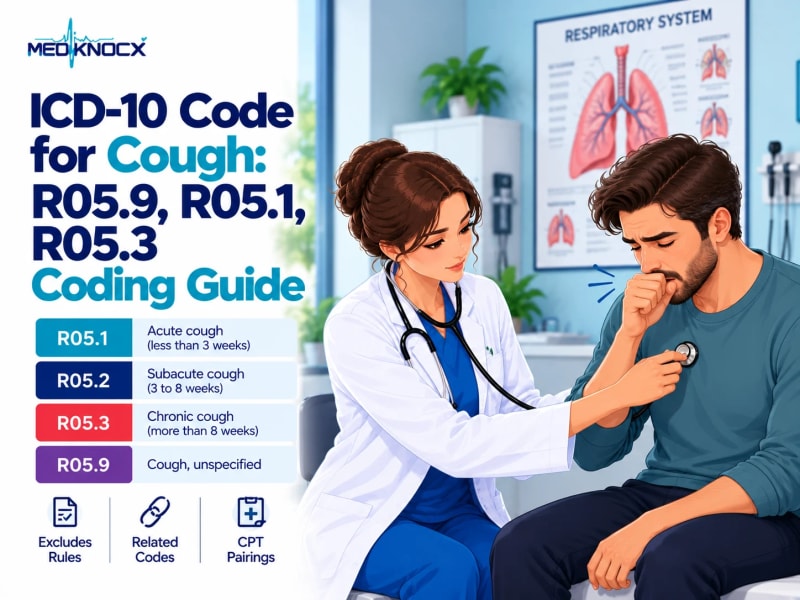
ICD-10 Code for Cough: R05.9, R05.1, R05.3 Coding Guide
ICD-10 codes for cough by duration: R05.1 acute, R05.2 subacute, R05.3 chronic, R05.9 unspecified. Plus Exclud...

Oct 2, 2026
1 min read

Jordan Taylor
October 3, 2026
Table of Contents
11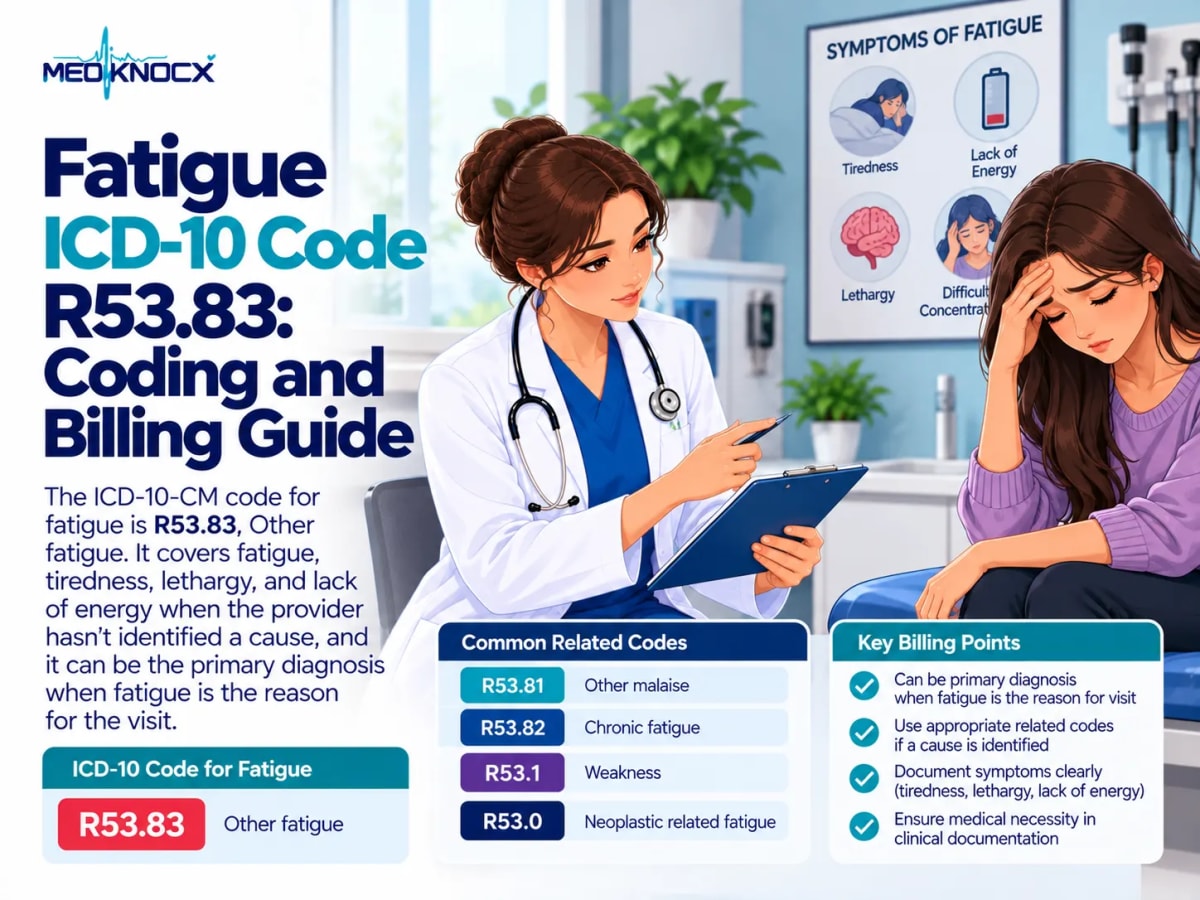
The ICD-10-CM code for fatigue is R53.83, Other fatigue. It covers fatigue, tiredness, lethargy, and lack of energy when the provider hasn't identified a cause, and it can be the primary diagnosis when fatigue is the reason for the visit. Malaise, a general sense of being unwell, is a separate code, R53.81, and chronic fatigue without a syndrome diagnosis is R53.82.
Fatigue is one of the most common reasons adults see a primary care provider, and it's also one of the easiest symptoms to code too broadly. Weakness isn't fatigue. Confirmed ME/CFS has its own code. Fatigue from pregnancy, heat, or recurrent depression is excluded from R53.83 altogether. And once a workup turns up anemia, hypothyroidism, or sleep apnea, that diagnosis usually replaces the fatigue code. This guide covers each of those decisions.
R53.83 sits in Chapter 18 under R53, malaise and fatigue, in the subcategory R53.8. Neither R53 nor R53.8 is billable. The Tabular List gives R53.83 four inclusion terms: fatigue NOS, lack of energy, lethargy, and tiredness. The Alphabetic Index also sends exhaustion, prostration, being overworked or overstrained, and lack of vitality here.
There's no acute fatigue code and no severity code. Mild, extreme, sudden, and general fatigue all use R53.83 unless the provider documents it as chronic.
Can R53.83 be a primary diagnosis? Yes. When fatigue is the reason for the visit and the provider hasn't established a cause, R53.83 is correctly listed first. That's the normal pattern for an initial fatigue workup. What it shouldn't do is stay first once a related diagnosis has been confirmed. As a principal inpatient diagnosis, it groups to MS-DRG 947 or 948, signs and symptoms with or without MCC.
Fatigue vs malaise. Fatigue is a lack of energy. Malaise is a general sense of being unwell or run down, often during or after an illness. R53.81 also covers debility and general physical deterioration. When the provider documents both as separate complaints, R53.81 and R53.83 can both be reported.
Fatigue vs weakness. Weakness is loss of strength; fatigue is loss of energy. "Tired all the time" is R53.83. "Legs feel weak on the stairs" is weakness, R53.1, or M62.81 when the exam documents reduced strength. Neither excludes the other, so both are coded when both are documented. Our weakness ICD-10 guide covers how R53.1, M62.81, and R54 are told apart.
Fatigue vs chronic fatigue. R53.82 is for fatigue the provider documents as chronic without diagnosing a syndrome. The code itself doesn't set a duration, so the word "chronic" in the note is what supports it. Chronic fatigue isn't the same as chronic fatigue syndrome.
Chronic fatigue syndrome and postviral fatigue. Diagnosed myalgic encephalomyelitis/chronic fatigue syndrome is G93.32, postviral fatigue syndrome is G93.31, and other post-infection fatigue syndromes are G93.39. R53.82 has an Excludes1 note for all three, so it comes off once one is diagnosed. The hallmark the provider usually documents for ME/CFS is post-exertional malaise, symptoms that worsen after physical or mental effort, as described in the CDC's clinical overview of ME/CFS. Without a documented syndrome diagnosis, the claim stays on R53.82 or R53.83.
Cancer-related fatigue. Fatigue from a malignancy or its treatment is R53.0, neoplastic (malignant) related fatigue, reported with the cancer code.
Age-related fatigue. When the provider attributes fatigue or frailty to aging, R54 applies, and it's excluded from the R53.8 codes. Patient age alone doesn't make it R54.
Sleepiness. Excessive sleepiness or drowsiness is a different symptom from fatigue, coded R40.0, somnolence, or to a sleep disorder the provider diagnoses.
Subcategory R53.8 carries an Excludes1 note. When fatigue is documented as due to one of these, the listed code replaces R53.81, R53.82, and R53.83:
The depression nuance. The note that trips coders up is depression. Fatigue due to recurrent depression (F33) is Excludes1, so R53.83 isn't added. Fatigue due to a single depressive episode (F32) is only Excludes2 under R53.83, which means R53.83 can be reported alongside the F32 code when the provider documents the fatigue as a separate concern being evaluated or treated. Most of the time, though, the provider is describing the depression's symptoms, and the F32 code alone tells the story.
Pregnancy-related exhaustion and fatigue is a common miss in OB and family practice. A pregnant patient with fatigue the provider attributes to the pregnancy is coded O26.81- with the trimester and a Z3A code, not R53.83. Fatigue documented as unrelated to the pregnancy is coded normally with Z33.1.
Fatigue is a symptom code. Once the provider documents a cause that routinely includes fatigue, that diagnosis is coded and R53.83 generally comes off.
The common mistake runs both ways. Leaving R53.83 on the claim after labs confirm anemia or hypothyroidism keeps a symptom code next to the condition that explains it. Coding a suspected cause before it's confirmed, such as "likely anemia" on an outpatient visit, isn't allowed; until it's confirmed, R53.83 is the right code. R53.83 stays alongside a diagnosis only when the provider documents the fatigue as a separate problem, for example fatigue out of proportion to well-controlled hypothyroidism.
Long COVID fatigue follows a specific sequencing rule. The ICD-10-CM Official Guidelines direct coders to report the specific symptom first, then U09.9, post COVID-19 condition. So fatigue after a past COVID infection is R53.83 followed by U09.9, with any other lasting symptoms, such as shortness of breath, coded before U09.9 as well. U09.9 isn't used during an active infection; that's U07.1. If the provider diagnoses ME/CFS or postviral fatigue syndrome after COVID, G93.32 or G93.31 replaces R53.83, still followed by U09.9.
Fatigue the provider attributes to cancer or its treatment is R53.0, neoplastic (malignant) related fatigue, reported with the cancer code. Fatigue from anemia caused by chemotherapy is coded to the anemia instead, D64.81, with the adverse effect code.
There's no CPT code for fatigue. CPT describes the visit and the workup; R53.83 explains why they were done.
Each test should connect to the fatigue in the note. "CBC, TSH, and ferritin to evaluate six weeks of fatigue" supports every line; "routine labs" doesn't, and that gap is behind a lot of lab denials on fatigue claims.
When fatigue comes up during an annual physical and the provider works it up as a separate problem, the preventive visit and a problem-oriented E/M with modifier 25 can both be billed. The preventive code carries the Z00 diagnosis, and the E/M carries R53.83.
• The complaint in plain terms: fatigue, tiredness, low energy, malaise, or weakness, since each codes differently
• Onset and duration, and whether the provider calls it chronic
• Effect on daily life: work, sleep, exercise tolerance
• Associated symptoms: weight change, mood, sleep quality, snoring, shortness of breath, fever
• Relevant context: pregnancy, recent COVID or other infection, cancer treatment, new medications, depression history
• The differential and the workup, with each test tied to the fatigue
• The assessment in words: fatigue, chronic fatigue, malaise, or a named cause
Most of these get caught before submission with a medical coding review that checks the code against the note and the Excludes rules. When lab or visit denials on fatigue claims keep returning, denial management traces them back to where the documentation or ordering gap starts.
R53.83, other fatigue, for fatigue with no documented cause.
Yes, when fatigue is the reason for the visit and no cause has been established. Once a related diagnosis is confirmed, that diagnosis goes first.
R53.83. All three are inclusion terms for it.
R53.81, other malaise. It also covers debility and general physical deterioration.
R53.83 and R53.81, when the provider documents both as separate complaints.
R53.1 for the weakness and R53.83 for the fatigue, when both are documented. R53.1 has no Excludes1 conflict with R53.83.
R53.82, chronic fatigue, unspecified. Diagnosed chronic fatigue syndrome is G93.32.
G93.32, myalgic encephalomyelitis/chronic fatigue syndrome. It can't be billed with R53.82.
R53.83 followed by U09.9, post COVID-19 condition.
O26.81-, pregnancy related exhaustion and fatigue, with the trimester as the sixth character.
R53.83 for exhaustion with no stated cause. Heat exhaustion is T67.5XXA, and exhaustion from excessive exertion is T73.3XXA.
No. CPT codes describe the visit and tests, such as 99214, 85025, or 84443; R53.83 is the diagnosis that supports them.
Explore more medical billing guides, coding updates, and revenue cycle tips.
ICD-10 codes for cough by duration: R05.1 acute, R05.2 subacute, R05.3 chronic, R05.9 unspecified. Plus Exclud...
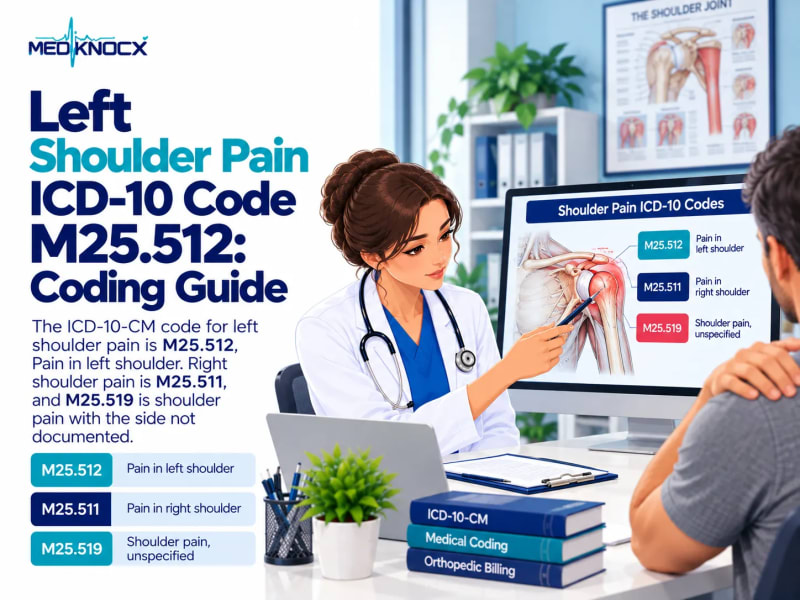
M25.512 is the ICD-10 code for left shoulder pain. See M25.511, M25.519, bilateral coding, scapula and clavicl...

Back pain ICD-10 codes by region: M54.50 low back pain, M54.6 mid back, M54.9, sciatica, radiculopathy, disc c...