Healthcare
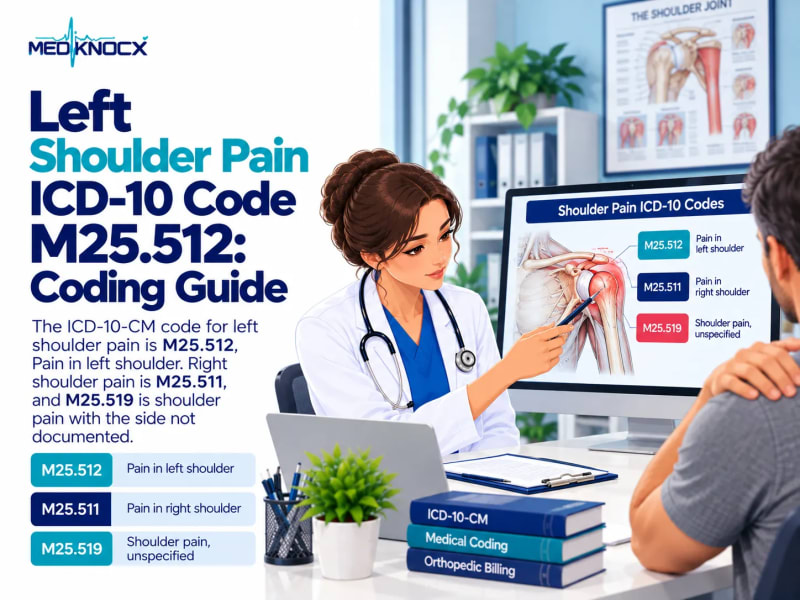
Left Shoulder Pain ICD-10 Code M25.512: Coding Guide
M25.512 is the ICD-10 code for left shoulder pain. See M25.511, M25.519, bilateral coding, scapula and clavicl...

Oct 2, 2026
1 min read

Jordan Taylor
October 2, 2026
Table of Contents
10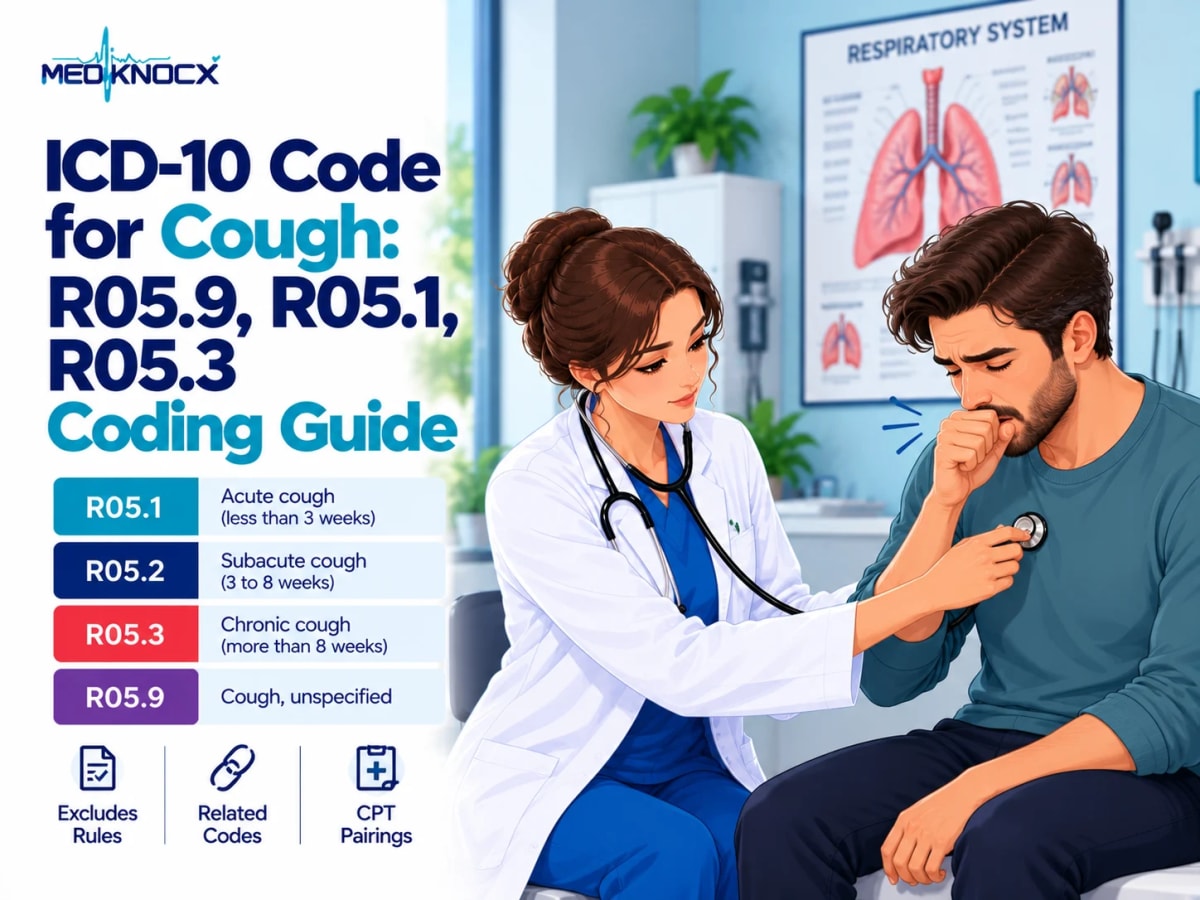
The ICD-10-CM code for cough depends on how long it's lasted. R05.1 is acute cough, under three weeks. R05.2 is subacute cough, three to eight weeks. R05.3 is chronic cough, more than eight weeks. R05.9, cough, unspecified, is for when the note doesn't give a duration. R05 itself isn't billable.
Duration is the deciding fact, not how the cough sounds. Dry, wet, hacking, barking, and productive coughs all use the same codes, chosen by time. And once the provider names a cause, such as bronchitis, asthma, reflux, or a cold, that diagnosis usually replaces the cough code altogether. This guide covers the R05 family, the diagnoses that take over from it, and the related symptom codes that often travel with a cough.
Until September 30, 2021, every cough claim used a single code, R05. The FY2022 ICD-10-CM update turned R05 into a header and split it by duration, because how long a cough has lasted is what drives the clinical workup. Claims still carrying R05 without a fourth character are rejected as invalid, and old superbills and EHR favorites are the usual culprits.
The codes sit in Chapter 18, symptoms and signs, under R00 to R09, symptoms involving the circulatory and respiratory systems. As symptom codes, they're correct when the provider hasn't established a cause, and they usually come off once one is confirmed. The old ICD-9 code was 786.2, which hasn't been valid since October 1, 2015.
R05.1, acute cough. Any stated duration under three weeks, even something as loose as "cough since Monday," supports R05.1. It's the usual code for a new cough in primary or urgent care when the provider hasn't diagnosed a cause.
R05.2, subacute cough. Three to eight weeks. This is the most underused code in the family. A cough that's hung on for five weeks after a cold is no longer acute and not yet chronic, and it belongs here rather than on R05.9.
R05.3, chronic cough. More than eight weeks. Its inclusion terms matter: a note that says persistent, refractory, or unexplained cough indexes straight to R05.3, even without a number of weeks.
R05.9, cough, unspecified. Only when the record gives no duration and no type. Once any timeframe appears anywhere in the note, including the history, R05.9 is no longer the most specific code available, and coding it anyway is the kind of pattern payer edits flag.
Post-viral or post-infectious cough. There's no separate post-viral code. Code it by duration: R05.2 for a cough lingering three to eight weeks after an infection, R05.3 once it's past eight weeks or documented as persistent. If the infection itself is still being treated, code the infection instead.
Dry, productive, hacking, or barking. The character of the cough doesn't change the code. A dry cough of two weeks and a productive cough of two weeks are both R05.1. When the provider documents abnormal sputum as its own finding, R09.3 can be added alongside. A barking cough in a child usually leads to a croup diagnosis, J05.0, which replaces the cough code.
Acute or chronic with no number. The words acute and chronic in the note are enough. "Chronic cough" supports R05.3 and "acute cough" supports R05.1 without a stated number of weeks; "subacute" supports R05.2.
Cough is part of a lot of conditions, and once the provider documents one, the cough isn't coded separately.
Isolated cough vs a respiratory infection. J06.9 and J00 describe a multi-symptom illness. A cough on its own, with no sore throat, congestion, or other upper respiratory findings, is R05.1, not J06.9. Billing a URI code for a lone cough describes something the note doesn't support.
Upper airway cough syndrome. Sometimes called postnasal drip syndrome, it isn't one code. Code the cause the provider documents, such as allergic rhinitis, chronic rhinitis, or chronic sinusitis; postnasal drip as a finding without a diagnosis is R09.82.
Suspected but unconfirmed COVID. Outpatient guidelines don't allow coding an uncertain diagnosis. Until COVID is confirmed, code the cough and other symptoms.
The hemoptysis rule is worth checking against your references. Cough with hemorrhage has been an Excludes2 note since the FY2022 expansion, so R04.2 can be reported alongside an R05 code when both are documented; when coughing up blood is the main complaint, R04.2 leads.
When there's no unifying diagnosis, each symptom the provider documents gets its own code.
So a "cough and congestion" visit with no diagnosis is the cough code by duration plus R09.81 or R09.89, depending on where the congestion is.
Cough syncope. R05.4 has a code-first note for R55, syncope and collapse, so R55 comes first and R05.4 follows. The note needs to say the fainting was triggered by coughing.
ACE inhibitor cough. A cough the provider attributes to lisinopril, enalapril, or another ACE inhibitor is an adverse effect. Code the cough first, by duration if documented (or R05.8 if the provider specifies it only as drug-induced), then T46.4X5A, adverse effect of angiotensin-converting enzyme inhibitors. Billing the cough without the T code leaves out the reason for the visit and the reason for the medication change.
Smoker's cough. J41.0, simple chronic bronchitis, which excludes the R05 codes. Add the tobacco use or dependence code the provider documents.
Whooping cough and exposure. Confirmed pertussis is coded from A37 by organism and whether pneumonia is present, such as A37.00 for Bordetella pertussis without pneumonia. Contact with someone who has pertussis, with no symptoms, is Z20.818.
Cough in pregnancy. A cough the provider documents as complicating the pregnancy uses a Chapter 15 code first, then the cough or its cause. If it's documented as unrelated to the pregnancy, the regular code is reported with Z33.1.
There's no CPT code for cough; CPT describes the visit and the workup, and the R05 code explains why. The duration code matters here, because it's what justifies the tests.
The pattern payers look for on R05.3 is a reasonable workup of the common causes: upper airway cough syndrome, asthma, and reflux. That isn't a coding rule, it's clinical guidance from chest physicians, but repeated chronic cough visits with no documented evaluation are where medical necessity questions start. R05.9 supports very little beyond the visit itself, so a chest CT ordered under R05.9 alone is a likely denial.
The reasoning behind the duration split, and the specialty societies that pushed for it, is covered in AAPC's write-up of the 2022 cough code changes.
Inpatient. When cough is the principal diagnosis, the case groups to MS-DRG 204, respiratory signs and symptoms. That's uncommon, since most admissions end with a diagnosis such as pneumonia or a COPD exacerbation.
• How long the cough has lasted, in days or weeks, or the words acute, subacute, chronic, or persistent
• Whether the cough is the only complaint or part of a wider respiratory illness
• Associated findings: fever, congestion, sore throat, sputum, wheezing, shortness of breath, blood
• Exposures and history: recent infection, smoking, ACE inhibitor use, reflux symptoms, allergies, sick contacts
• For chronic cough, which causes have been evaluated or treated
• The assessment in words: the cough with its duration, or the diagnosis once it's known
One field in the visit template, cough duration, prevents most cough coding errors on its own. Without it, the coder is left with R05.9.
Nearly all of these are caught before submission by a medical coding review that checks the code against the duration in the note. When imaging or testing denials keep returning on cough visits, denial management traces them back to the documentation or ordering step where they start.
It depends on duration: R05.1 acute (under 3 weeks), R05.2 subacute (3 to 8 weeks), R05.3 chronic (over 8 weeks), and R05.9 when no duration is documented.
Not on its own. Since October 1, 2021, R05 needs a fourth character.
Cough, unspecified, for when the note doesn't give a duration or type.
R05.3. Persistent, refractory, and unexplained cough are all inclusion terms for it.
R05.1, for a cough of less than three weeks.
The same duration-based R05 codes. Abnormal sputum documented as its own finding can be added as R09.3.
There's no separate code. Use R05.2 for three to eight weeks, R05.3 beyond eight weeks or when documented as persistent.
The cough code by duration plus R09.81 for nasal congestion or R09.89 for chest congestion, unless a diagnosis like a cold or URI explains both.
J45.991.
A37 by organism and pneumonia status, such as A37.00 for Bordetella pertussis without pneumonia. Exposure without symptoms is Z20.818.
J41.0, simple chronic bronchitis. It can't be billed with an R05 code.
No. CPT codes describe services such as a visit, chest X-ray (71046), or spirometry (94010); the R05 code is the diagnosis that supports them.
Explore more medical billing guides, coding updates, and revenue cycle tips.
M25.512 is the ICD-10 code for left shoulder pain. See M25.511, M25.519, bilateral coding, scapula and clavicl...

Back pain ICD-10 codes by region: M54.50 low back pain, M54.6 mid back, M54.9, sciatica, radiculopathy, disc c...
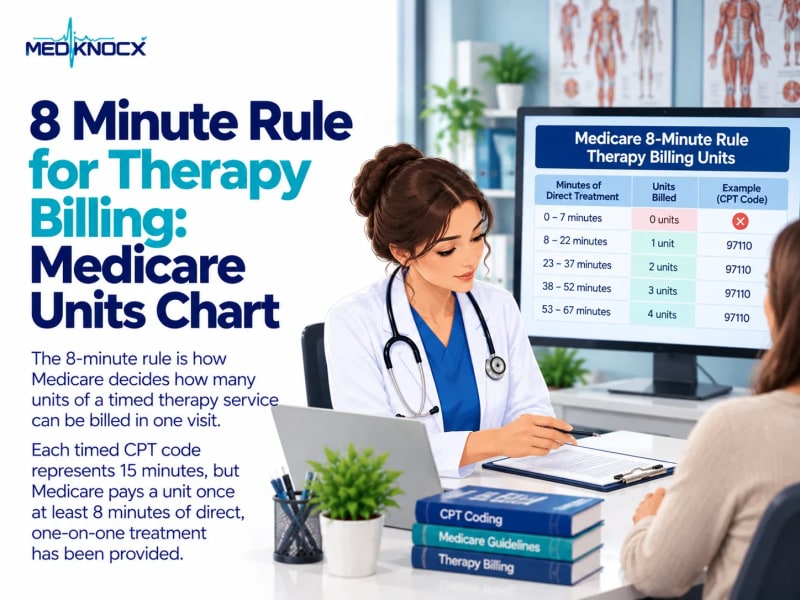
How the Medicare 8-minute rule works for PT, OT, and SLP billing: the units chart, timed vs untimed codes, mix...