Healthcare
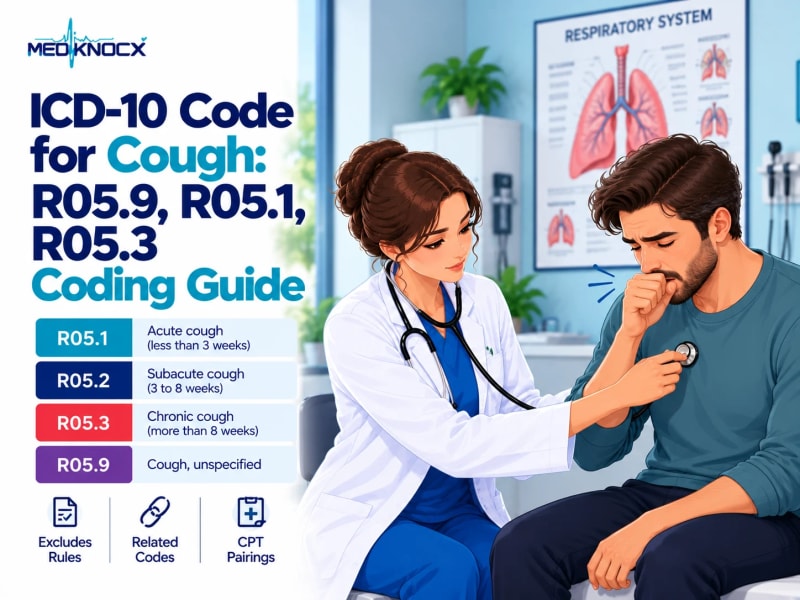
ICD-10 Code for Cough: R05.9, R05.1, R05.3 Coding Guide
ICD-10 codes for cough by duration: R05.1 acute, R05.2 subacute, R05.3 chronic, R05.9 unspecified. Plus Exclud...

Oct 2, 2026
1 min read

Jordan Taylor
October 2, 2026
Table of Contents
10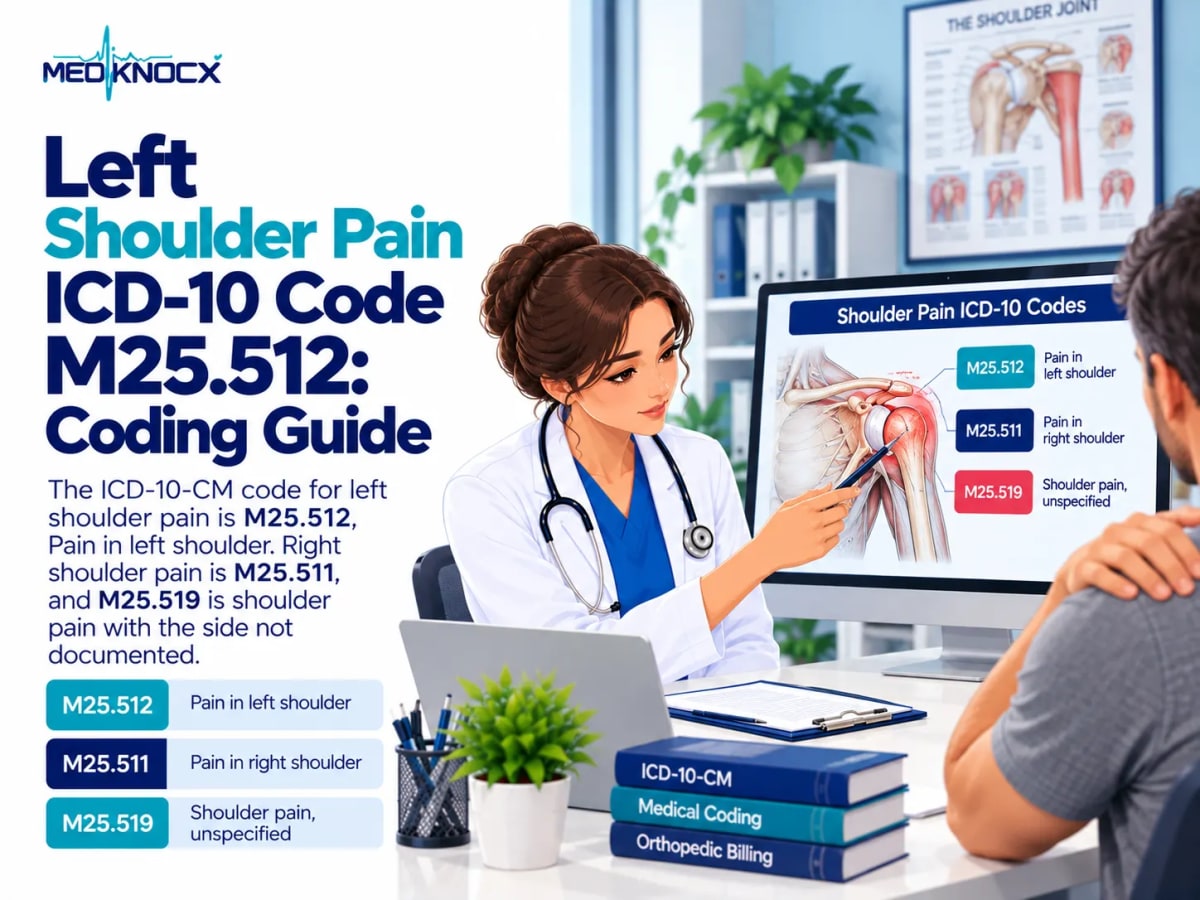
The ICD-10-CM code for left shoulder pain is M25.512, Pain in left shoulder. Right shoulder pain is M25.511, and M25.519 is shoulder pain with the side not documented. There's no bilateral code, so pain in both shoulders is reported with M25.511 and M25.512 together.
M25.512 is a symptom code. It fits a first visit, when the provider is still working out why the shoulder hurts, and it usually steps aside once a cause is found: rotator cuff tear, impingement, frozen shoulder, arthritis, or an injury. This guide covers the M25.51 codes, the diagnoses that replace them, pain in the areas around the shoulder that often gets coded wrong, and the billing details behind shoulder imaging, injections, and therapy.
M25.512 sits in Chapter 13 under M25, other joint disorders not elsewhere classified, in the subcategory M25.51, pain in shoulder. The last character is laterality: 1 for right, 2 for left, 9 for unspecified. M25.51 on its own isn't billable, and it's a common dropdown mistake that rejects at the clearinghouse.
Bilateral shoulder pain. ICD-10-CM has no bilateral shoulder pain code. When a code exists for each side but not for both, the guidelines direct coders to report the right and left codes separately, so pain in both shoulders is M25.511 and M25.512.
Unspecified side. M25.519 should be rare. Laterality can come from documentation by other clinicians, such as a radiology report, therapy note, or nursing note, as long as the treating provider documents the condition itself. That exception is spelled out in the ICD-10-CM Official Guidelines for Coding and Reporting, so a shoulder X-ray labeled "left" is enough to move the claim from M25.519 to M25.512.
Excludes2. Category M25.5 has an Excludes2 note for pain in the hand, fingers, foot, toes, and limb (M79.6-). Excludes2 means those conditions aren't part of M25.512 but can be reported with it when both are documented.
M25.512 is right when the provider documents left shoulder pain and no cause. "Left shoulder pain, rule out rotator cuff tear" is still M25.512 in an outpatient setting, because uncertain diagnoses aren't coded as confirmed. Once the provider documents the cause, that code takes over, and carrying M25.512 forward visit after visit is one of the most common shoulder coding errors.
For the right shoulder, the pattern is the same with a 1 in place of the 2, except for the dislocation codes: right shoulder dislocation is S43.004A, and left is S43.005A. That pair is easy to swap and some coding guides have it wrong.
Traumatic vs nontraumatic. The rotator cuff codes split by cause. M75.1- covers tears from degeneration or overuse, and its Excludes1 note sends traumatic tears to S46.01-. The two aren't reported together. A fall, a lift, or a sudden injury points to the S code with a seventh character (A initial, D subsequent, S sequela) and an external cause code; gradual onset points to M75.1-. When the note doesn't say, query rather than guess.
Patients point at a general area, and the code depends on where the provider places the pain.
Scapula pain is the one that varies most. Pain the provider places in the shoulder joint stays M25.51-. Pain between the blades is a thoracic spine code. Pain in the scapula itself, with no joint, spine, or muscle diagnosis, has no tidy symptom code, so a short query asking the provider to name the source usually leads to a cleaner claim.
M25.512 vs M79.602. M25.512 is joint pain. M79.602 is pain in the arm generally. They aren't interchangeable, and a shoulder injection billed under M79.602 can trip a diagnosis to procedure edit.
Cardiac referred pain. Left shoulder pain can be a sign of angina or a heart attack. When the provider attributes it to a cardiac cause, code the cardiac condition, not the shoulder. When the cause is still unknown and chest pain is also documented, the chest pain code applies alongside or instead of M25.512, depending on the note.
Chronic left shoulder pain. M25.512 plus G89.29, other chronic pain, when the provider documents the pain as chronic. The G89 code is added only when the note uses that language; a long history alone isn't enough.
Acute pain. G89.11 is acute pain due to trauma, added when the provider documents it. Acute shoulder pain with no injury and no chronic pain language stays M25.512 alone.
Which goes first. When the visit is for evaluating or treating the shoulder, M25.512 or the condition code is first. When the visit is purely for pain management and the underlying condition isn't being treated, the G89 code goes first and M25.512 follows.
After surgery. Routine, expected pain after a shoulder arthroscopy or repair isn't coded. Pain the provider documents as beyond the expected course uses G89.18, acute post-procedural pain, or G89.28 if it becomes chronic, with M25.512 for the site.
These are separate findings with their own codes, so they're reported when the provider documents them, with or without pain.
• Stiffness: M25.612 left, M25.611 right. If the provider diagnoses frozen shoulder, M75.02 or M75.01 replaces it.
• Instability: M25.312 left, M25.311 right, when no more specific cause such as recurrent dislocation (M24.41-) or a labral tear is documented.
• Weakness: decreased strength found on exam is M62.81, muscle weakness (generalized). If the weakness is from a rotator cuff tear, the tear code covers it.
There's no CPT code for "shoulder pain." CPT describes what was done; M25.512 explains why.
Laterality modifiers. Shoulder imaging and injections need RT or LT, and they should match the diagnosis. M25.512 with 20610-RT is a mismatch that payers edit. For injections into both shoulders, Medicare allows 20610 with modifier 50; some commercial plans want two lines with RT and LT instead.
Advanced imaging. CMS paused its Appropriate Use Criteria program for advanced imaging in 2024, so Medicare shoulder MRI claims don't currently need clinical decision support information. Commercial plans are a different story: most route shoulder MRI through a prior authorization program and want the duration of symptoms, exam findings, and a trial of conservative care in the request.
Physical therapy. Shoulder pain is one of the most common therapy diagnoses, and timed treatment units follow Medicare's counting rules; our 8-minute rule guide explains how units are calculated.
Inpatient. When M25.512 is the principal diagnosis, the case groups to MS-DRG 555 or 556, signs and symptoms of the musculoskeletal system and connective tissue.
• Side, stated plainly: left, right, or both
• Location within the shoulder: joint, AC joint, between the blades, upper arm
• Onset and mechanism: injury, overuse, gradual, unknown
• Duration, and whether the provider calls it acute or chronic
• Exam: range of motion, strength, tenderness, and special tests such as Neer, Hawkins, or empty can
• Imaging, when ordered or reviewed, and the provider's reading of it
• The assessment in words: left shoulder pain, or the diagnosis once it's known
• The plan: imaging, injection, therapy, referral, and why
A four-word note, "shoulder pain, refer PT," gives the coder no side and the payer no reason for therapy. The same visit documented with the side, two weeks of pain with overhead reaching, a painful arc and positive Hawkins test, and a therapy referral for strengthening supports M25.512 and the referral that goes with it.
Most of these get caught before submission with a medical coding review that checks laterality across the diagnosis, the procedure, and the modifier. When imaging or injection denials keep returning, denial management traces them back to the authorization or documentation step where they start.
M25.512, pain in left shoulder.
M25.511, pain in right shoulder.
There's no single code. Report M25.511 and M25.512 together.
Pain in unspecified shoulder, for when the side isn't documented anywhere in the record. It should be rare.
Yes. Its parent, M25.51, is not.
M25.512 plus G89.29 when the provider documents the pain as chronic.
Pain between the shoulder blades is M54.6. Pain the provider places in the shoulder joint is M25.512. Pain in the scapula itself without a diagnosis is worth a query.
AC or SC joint pain uses M25.512. A clavicle fracture is coded from S42.0-, such as S42.002A for the left side, initial encounter.
Stiffness of left shoulder, not elsewhere classified.
Primary osteoarthritis of the left shoulder.
Explore more medical billing guides, coding updates, and revenue cycle tips.
ICD-10 codes for cough by duration: R05.1 acute, R05.2 subacute, R05.3 chronic, R05.9 unspecified. Plus Exclud...
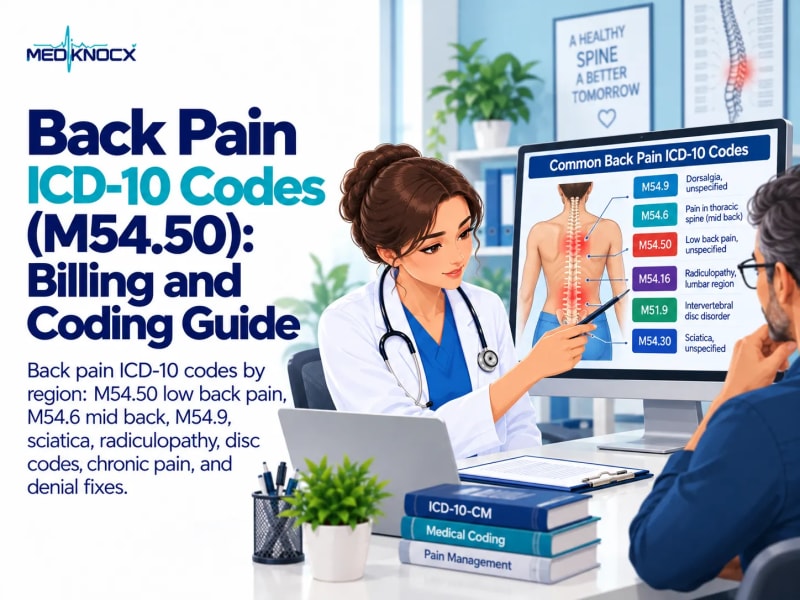
Back pain ICD-10 codes by region: M54.50 low back pain, M54.6 mid back, M54.9, sciatica, radiculopathy, disc c...
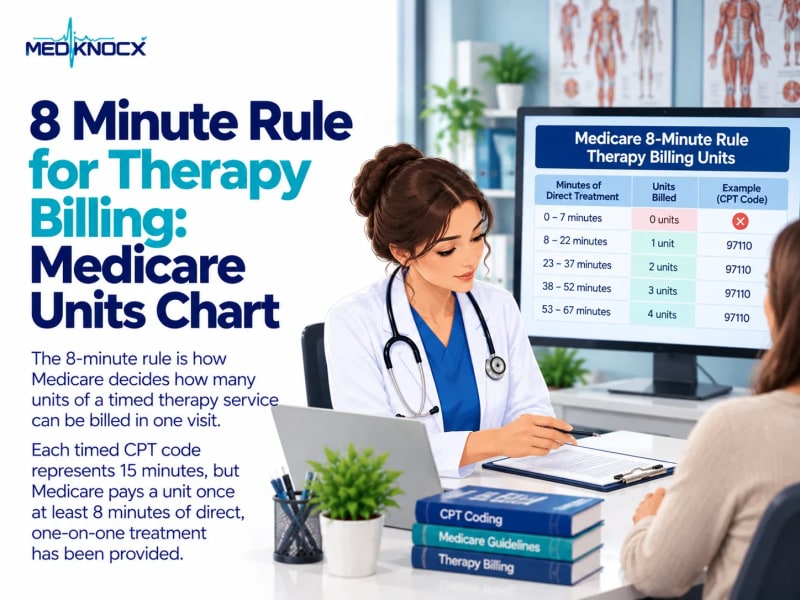
How the Medicare 8-minute rule works for PT, OT, and SLP billing: the units chart, timed vs untimed codes, mix...