Healthcare
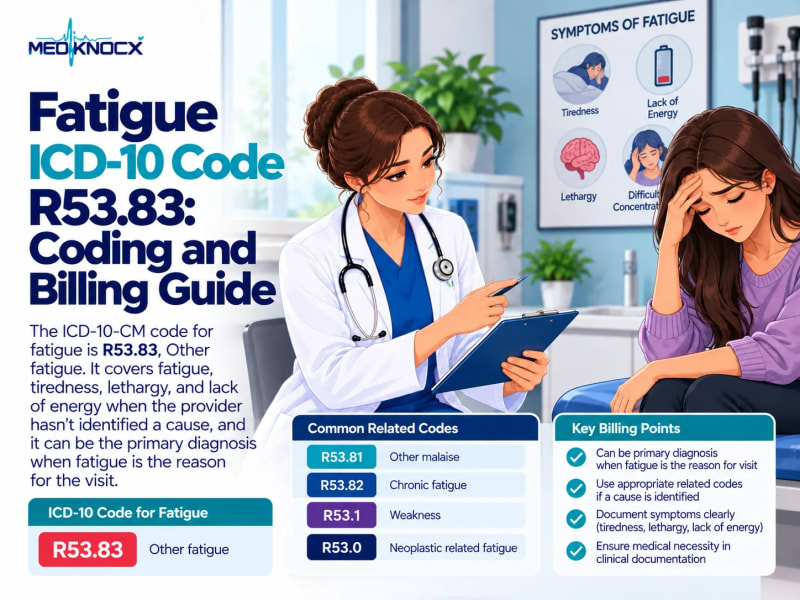
Fatigue ICD-10 Code R53.83: Coding and Billing Guide
R53.83 is the ICD-10 code for fatigue, tiredness, lethargy, and lack of energy. Learn R53.81 malaise, R53.82 c...

Oct 3, 2026
1 min read

Jordan Taylor
August 26, 2026
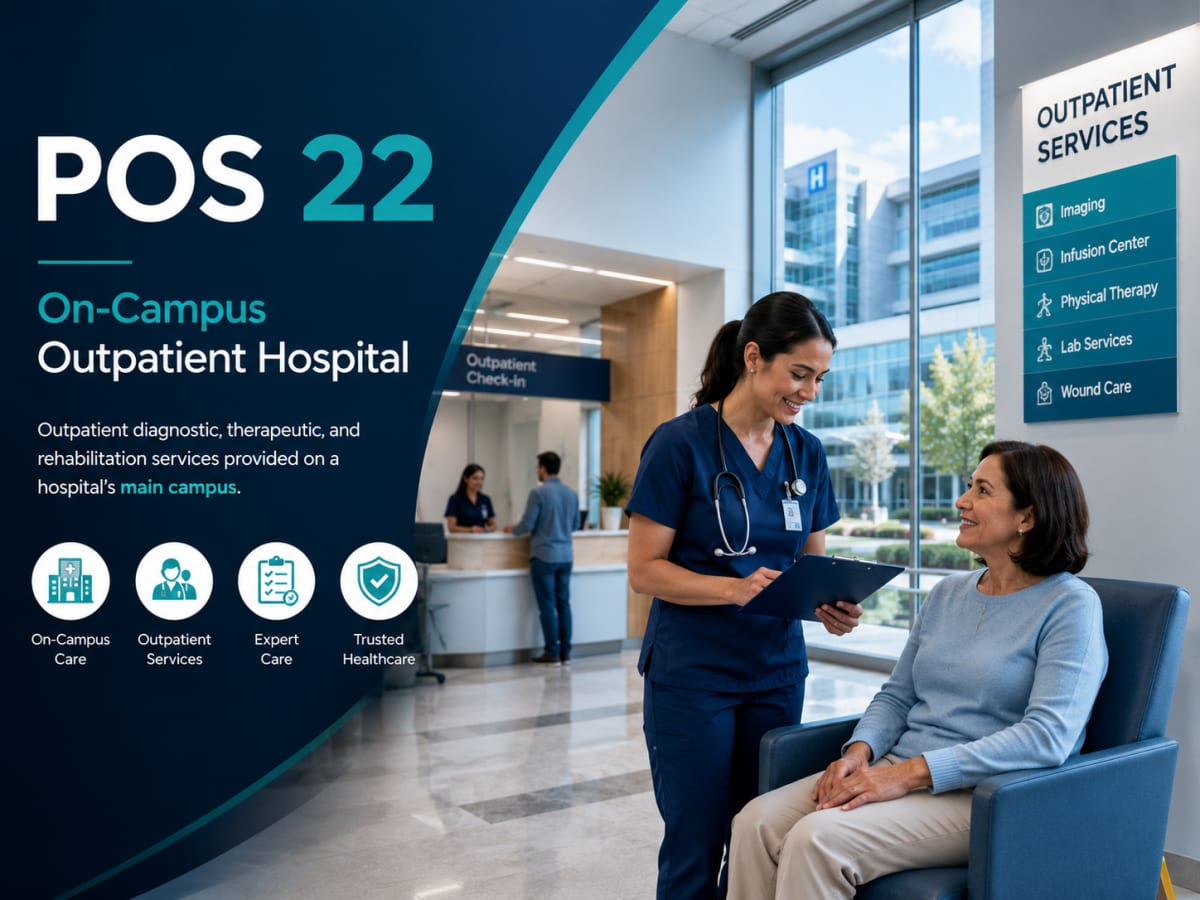
What Is POS 22 in Medical Billing? On-Campus Outpatient Hospital Guide
POS 22 stands for "On Campus-Outpatient Hospital." It's the place-of-service code used when a patient receives outpatient diagnostic, therapeutic, or rehabilitation services in a hospital-owned department located on the hospital's main campus, without being formally admitted. CMS split what used to be a single "outpatient hospital" code into POS 22 (on campus) and POS 19 (off campus) effective January 1, 2016. Mixing up on-campus and off-campus, or billing a hospital-owned clinic as if it were an independent office, is where most POS 22 denials and audit flags start.
CMS defines POS 22 as a portion of a hospital's main campus that provides diagnostic, therapeutic (surgical and nonsurgical), and rehabilitation services to patients who don't require hospitalization or institutionalization. Same-day imaging, infusion therapy, outpatient surgery centers attached to the hospital, wound care clinics, and hospital-based physical therapy departments are typical POS 22 settings.
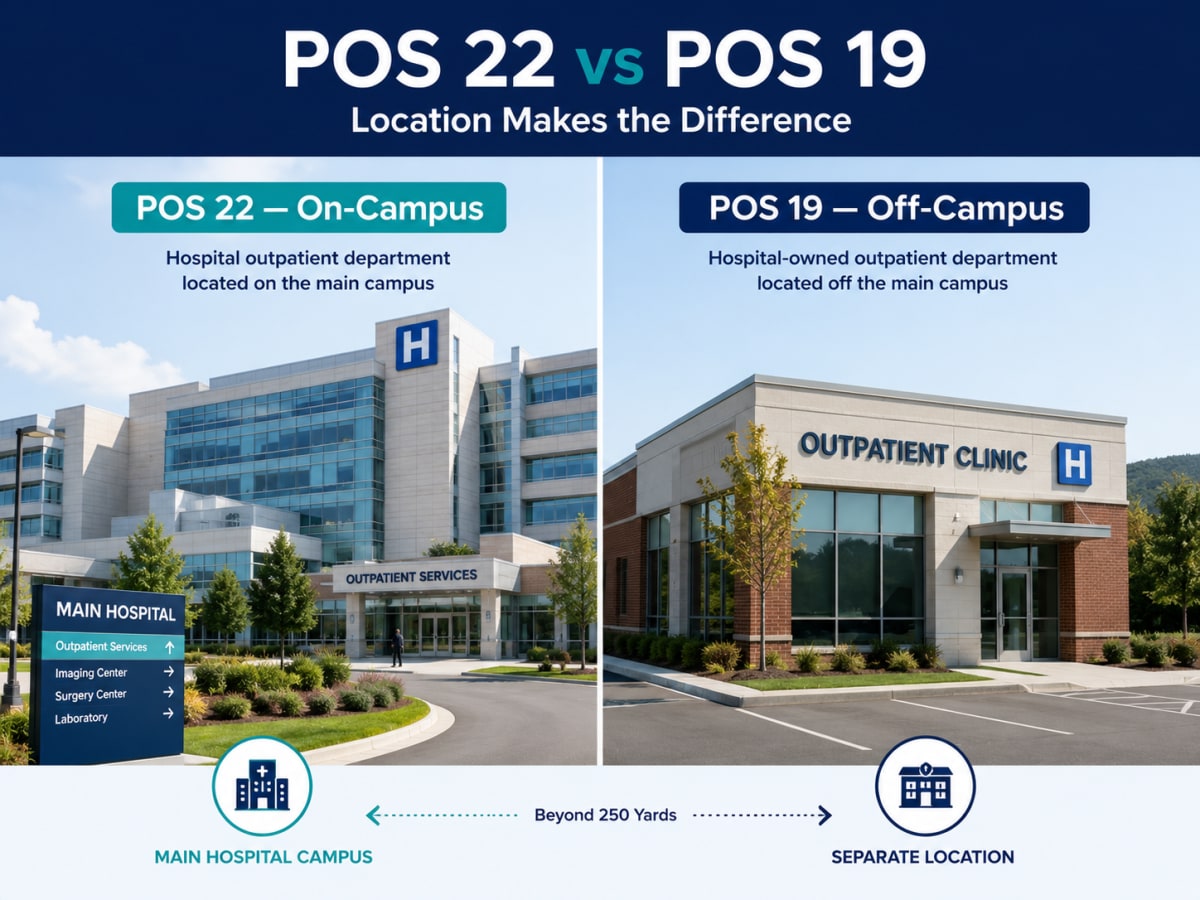
"On campus" has a specific meaning here, not a casual one. CMS generally defines a hospital's campus as the main buildings plus any areas within 250 yards of them, including structures connected by a covered walkway or tunnel. A department physically separated from the main hospital by more than that distance is off campus, which points to POS 19 instead, regardless of who owns it.
POS 22 vs. POS 19: On-Campus vs. Off-Campus
The PO and PN modifiers exist because of Section 603 of the Bipartisan Budget Act of 2015, which pushed CMS toward site-neutral payment for newer off-campus provider-based departments. That's the direct reason getting POS 22 versus POS 19 right matters financially: bill an off-campus, non-excepted department as POS 22, and the claim can be paid at the wrong rate entirely, not just flagged for review.
POS 22 vs. POS 11: Facility vs. Non-Facility Billing
POS 11 (Office) and POS 22 look similar on paper, since both describe outpatient, same-day care. The billing mechanics are different in almost every other way.
An independently owned physician office billing POS 11 submits one claim, and the professional payment includes a practice-expense component because the practice covers its own rent, staff, and equipment. A hospital-owned outpatient department billing POS 22 splits the claim in two: the physician bills a professional-fee claim, and the hospital separately bills a facility-fee claim under OPPS for the room, equipment, and support staff.
Because the hospital absorbs those overhead costs, the physician's own professional payment under POS 22 is lower than the same service billed as POS 11. That's a deliberate design in the Medicare Physician Fee Schedule, not a coding error. What it does not mean is that the total cost of the visit is lower. Add the hospital's separate facility-fee claim back in, and a POS 22 visit frequently costs more overall, including in patient out-of-pocket exposure, than the same service delivered in an independent office. Both things are true at once: lower physician payment, higher total cost of care.
The practical signal billers use to tell the two apart is ownership and structure: does the clinic operate under its own Tax ID, pay its own rent and staff, and bill independently (POS 11), or is it a hospital-employed department billing under the hospital's provider-based status (POS 22)? The legal test CMS actually applies is provider-based department status and campus location, but ownership and TIN structure is usually the fastest real-world clue.
A POS 22 encounter typically generates two separate claims:
The professional claim, submitted by the treating physician or other billing provider, paid at the facility rate under the Medicare Physician Fee Schedule.
The facility claim, submitted by the hospital, paid under the Outpatient Prospective Payment System (OPPS) for the room, equipment, and clinical support the hospital provided.
Exact payment amounts depend on the CPT/HCPCS code, the Ambulatory Payment Classification it groups into, and the specific fee schedule year, so don't quote a flat dollar figure internally. Verify current facility-rate and OPPS amounts through CMS's published fee schedules before estimating reimbursement on a POS 22 claim.
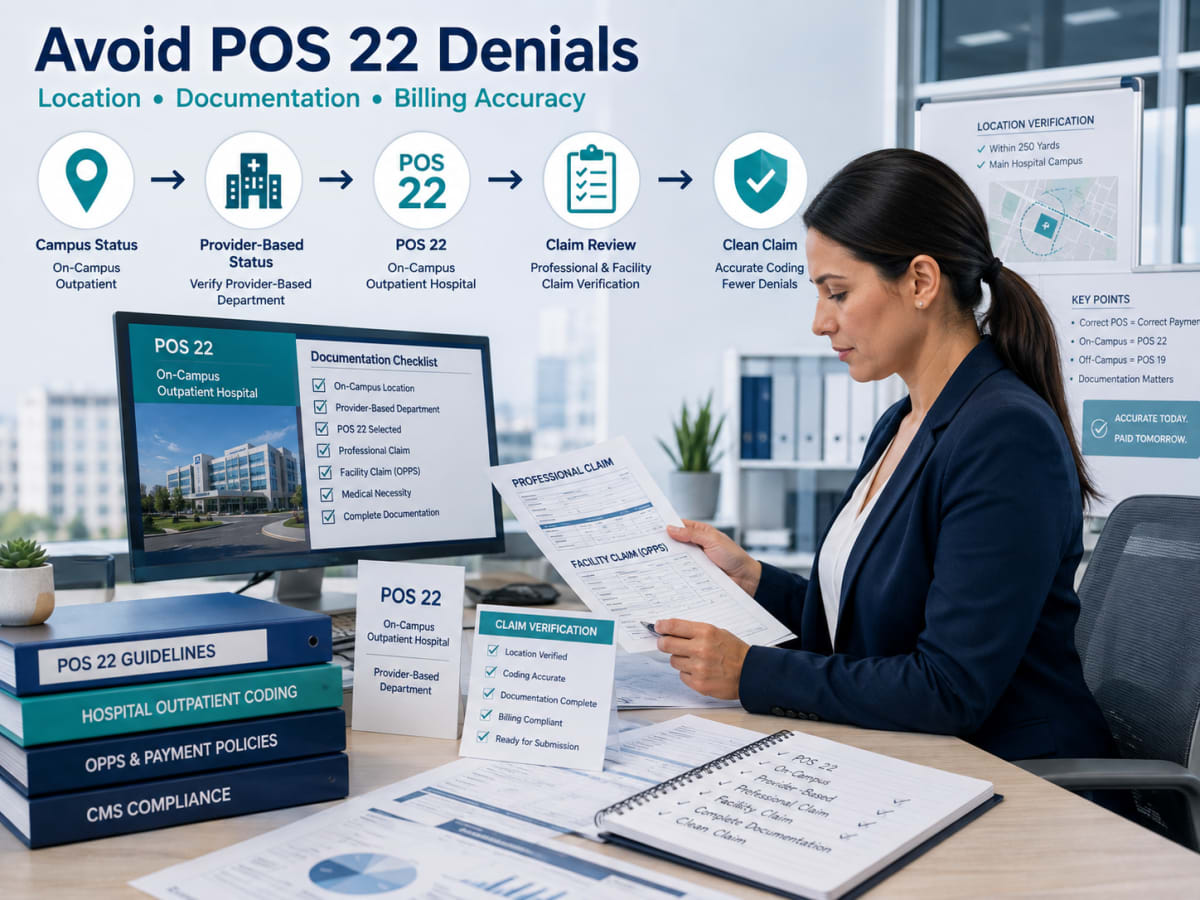
The note has to reflect where the service actually happened, including confirmation of on-campus status if the department's location is ever in question.
Records need to support that the patient wasn't formally admitted as an inpatient during the encounter.
Ownership and provider-based status of the department should be verifiable against the hospital's CMS enrollment, not just assumed from habit.
If a claim involves an off-campus location billed as POS 19, the excepted/non-excepted status and matching modifier (PO or PN) need to be documented alongside it.
Common Billing Errors with POS 22
Billing a hospital-owned, on-campus clinic as POS 11. This inflates the professional payment and is one of the fastest ways to trigger a post-payment audit.
Confusing POS 22 with POS 19. The two codes cover identical service types; only the physical location relative to the main campus tells them apart.
Confusing POS 22 with POS 21 or POS 23. POS 22 is outpatient, not inpatient (POS 21) and not emergency department (POS 23), even though all three can sit on the same hospital campus.
Coding an actual telehealth encounter as POS 22. If the visit was delivered remotely, POS 02 or POS 10 applies instead, not the on-campus outpatient code.
Missing the PO or PN modifier on a related off-campus claim. This one lives on the POS 19 side of the ledger, but it's the error that most often surfaces during a POS 22/19 documentation audit.
Confirm the department's campus status before the first claim goes out, not after a denial forces a review. Distance from the main buildings, not ownership alone, decides POS 22 versus POS 19.
Keep provider-based department documentation current with the hospital's CMS enrollment records, since payer audits check this directly.
Separate the professional and facility billing workflows clearly so the two claims stay consistent with each other and with the POS code used.
Train front-desk and scheduling staff to flag telehealth visits before they're coded, so a remote encounter never gets billed under an on-campus, in-person code by default.
Audit a sample of POS 22 claims quarterly against the underlying provider-based and campus documentation, since departments occasionally relocate without the billing team being looped in.
Pull the specific denial reason from the remittance advice before resubmitting anything.
If the denial questions the location, confirm the department's on-campus status against current CMS provider-based enrollment records.
If POS 22 and POS 19 appear to be in conflict on related claims, verify which modifier (PO or PN) the off-campus claim should carry and correct it.
If the professional and facility claims don't match, coordinate with the hospital's billing team before resubmitting either one.
Track recurring POS 22 denials by cause. A pattern usually points to one documentation or workflow gap, not a string of unrelated coding mistakes.
Hospital-based and hospitalist billing runs into POS 22 constantly, and getting the on-campus/off-campus and facility/non-facility distinctions right protects revenue on both the professional and facility side. If POS 22 is part of your hospitalist billing or broader revenue cycle management, and denials tied to this code keep showing up, our denial management services can trace them to the specific documentation or coding gap, and a billing audit will confirm whether the fix belongs on the professional side, the facility side, or both. For the related place-of-service codes covered elsewhere on this site, see what POS 21 means in medical billing and what POS 10 means in medical billing.
Talk to a Mediknocx billing specialist about your hospital-based claims. Request a Demo
POS 22 means "On Campus-Outpatient Hospital." It's used when a patient receives outpatient diagnostic, therapeutic, or rehabilitation care in a hospital-owned department on the hospital's main campus, without being admitted.
Both cover the same types of outpatient hospital services. POS 22 applies when the department is on the hospital's main campus, generally within about 250 yards of the main buildings. POS 19 applies when the department is off campus. The distinction matters because off-campus, non-excepted departments can be paid at a reduced, site-neutral rate under modifier PN.
The physician's professional payment is generally lower under POS 22 than POS 11, since the facility rate assumes the hospital, not the physician, is covering overhead like rent and staff. The hospital then bills a separate facility fee, which often makes the total cost of the visit higher overall, even though the physician's own payment is lower.
Not on its own. The PO and PN modifiers relevant to this topic apply to POS 19 (off-campus) claims, not POS 22 itself, to indicate whether the off-campus service is excepted or non-excepted from the site-neutral payment rate.
No. POS 22 assumes the patient was physically present in the on-campus outpatient department. A telehealth visit uses POS 02 or POS 10 depending on whether the patient joined from home, regardless of which hospital department is billing.
Explore more medical billing guides, coding updates, and revenue cycle tips.
R53.83 is the ICD-10 code for fatigue, tiredness, lethargy, and lack of energy. Learn R53.81 malaise, R53.82 c...
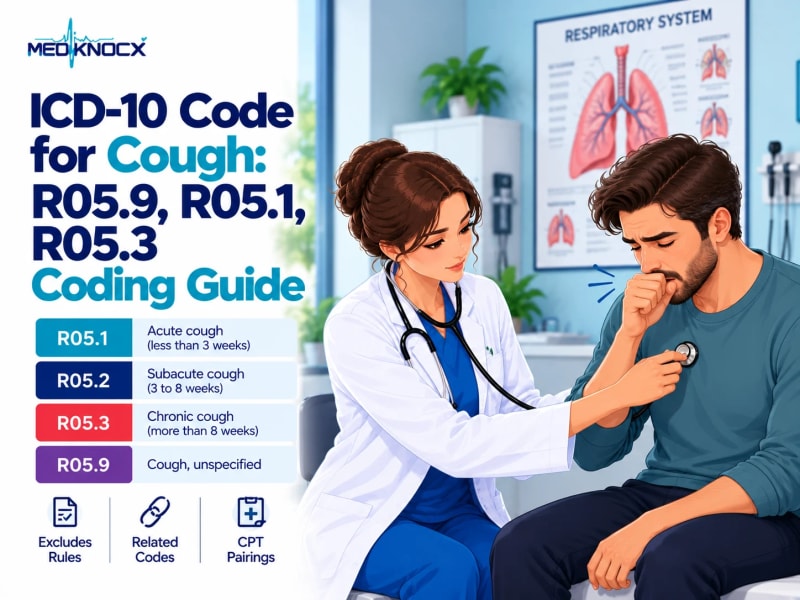
ICD-10 codes for cough by duration: R05.1 acute, R05.2 subacute, R05.3 chronic, R05.9 unspecified. Plus Exclud...
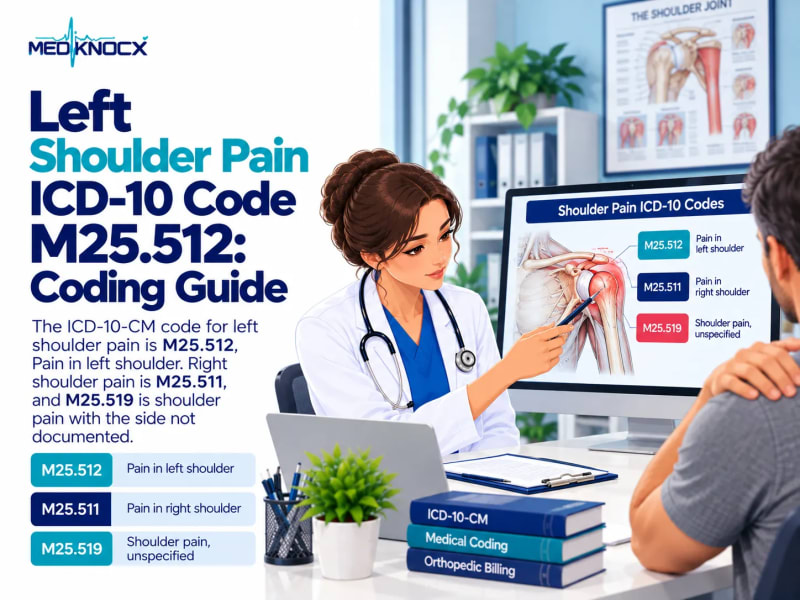
M25.512 is the ICD-10 code for left shoulder pain. See M25.511, M25.519, bilateral coding, scapula and clavicl...