Healthcare
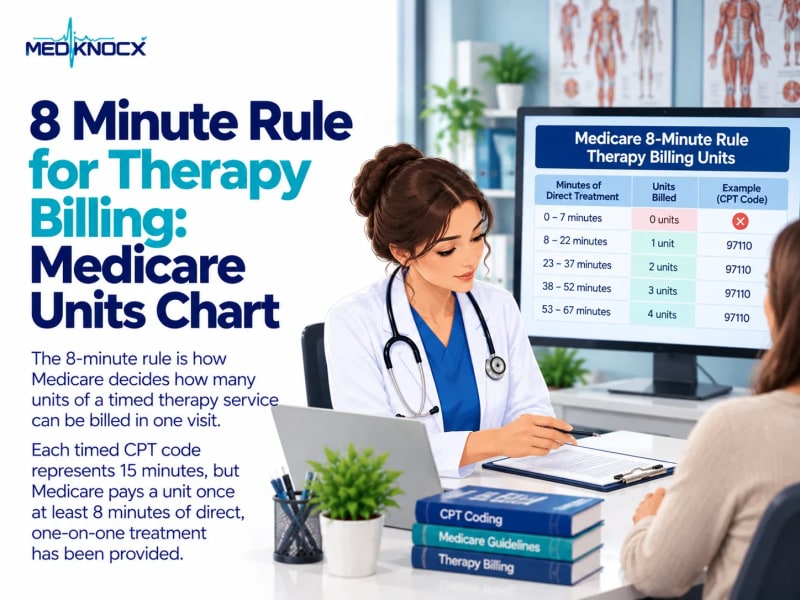
8 Minute Rule for Therapy Billing: Medicare Units Chart
How the Medicare 8-minute rule works for PT, OT, and SLP billing: the units chart, timed vs untimed codes, mix...

Oct 1, 2026
1 min read

Jordan Taylor
October 1, 2026
Table of Contents
10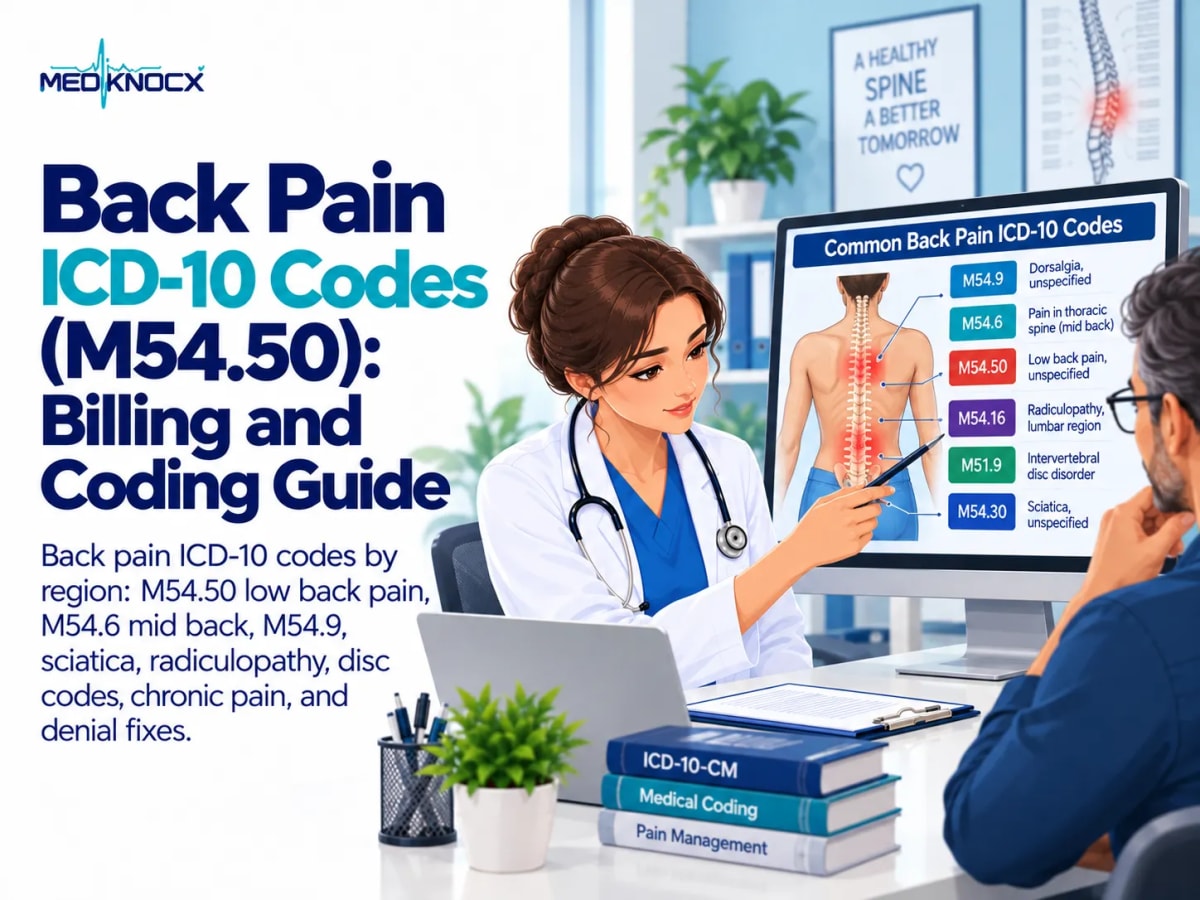
The ICD-10-CM code for low back pain, unspecified, is M54.50. Back pain with no region documented is M54.9, dorsalgia, unspecified, and mid or upper back pain is M54.6, pain in thoracic spine. The old low back pain code, M54.5, was split into M54.50, M54.51, and M54.59 on October 1, 2021, and claims still carrying it reject as invalid.
Back pain codes are symptom codes, and most of the real coding decisions come from what else the provider documents. Leg pain changes it to sciatica or lumbago with sciatica. A confirmed disc herniation, stenosis, or strain replaces the M54 code entirely. Chronic pain adds G89.29. This guide walks through each region, the codes that take over once a cause is found, and the billing rules for imaging, injections, therapy, and chiropractic care that back pain claims depend on.
M54.5 by itself is no longer a valid code. Neither are the headers M54, M54.1, M54.3, M54.4, and M54.8; each needs its full set of characters.
Until September 30, 2021, every low back pain claim used M54.5. The FY2022 ICD-10-CM update turned it into a header with three billable codes beneath it, and the change still trips up old superbills and EHR favorites lists.
M54.50, low back pain, unspecified. The code for "low back pain," "lumbago," "lumbalgia," or "lumbar pain" with nothing more. It's the right choice on a first visit before any workup, and for most low back complaints in primary care and urgent care.
M54.51, vertebrogenic low back pain. Pain the provider attributes to the vertebral endplates, often supported by MRI findings such as Modic changes. It isn't a laterality code; the "1" doesn't mean left. The coder assigns it when the provider documents vertebrogenic low back pain, and payers usually want the imaging behind it before they'll cover procedures linked to it, such as basivertebral nerve ablation.
M54.59, other low back pain. For low back pain the provider specifies further, with a description that doesn't fit M54.51 or a more specific diagnosis code. It isn't a right-side code either. If the note only says "low back pain," M54.59 isn't supported; M54.50 is.
The M54.5 category carries an Excludes1 note, so these aren't reported with an M54.5- code:
• Low back strain, S39.012-
• Low back pain due to intervertebral disc displacement, M51.2-
• Lumbago with sciatica, M54.4-
One more pairing to avoid, even though it comes from the disc side: M51.360 and M51.370 already describe disc degeneration with discogenic back pain, so adding M54.50 repeats the same pain and payers edit it out.
M54.6, pain in thoracic spine. Upper back pain, mid back pain, middle back pain, and pain between the shoulder blades all code here when there's no structural cause documented. The thoracic spine runs from T1 to T12, and the code doesn't split it further. Thoracic pain from a disc disorder is excluded and coded to M51 instead.
M54.2, cervicalgia. Neck pain. When the provider documents separate neck and thoracic pain, both M54.2 and M54.6 can be reported.
M54.9, dorsalgia, unspecified. Back pain or backache with no region documented. It's less specific than M54.50, so a note that says "low back" anywhere should never end up on M54.9. Heavy use of M54.9 usually points to documentation that isn't capturing region, which a quick provider query fixes.
M54.89, other dorsalgia. A rarely needed code for specified back pain that doesn't fit the other M54 codes.
Right-sided, left-sided, and bilateral back pain. M54.50, M54.51, M54.59, and M54.6 have no laterality. Right lower back pain and left lower back pain both code to M54.50 unless sciatica or radiculopathy is documented, and the side belongs in the note. Laterality only becomes part of the code with sciatica, lumbago with sciatica, or radiculopathy.
Flank pain isn't back pain. Since October 1, 2025, flank pain has its own codes in the abdominal pain category, R10.A0 to R10.A3. A note describing pain in the side or flank, rather than the spine, belongs there; our abdominal pain ICD-10 guide covers the new flank and CVA tenderness codes. Renal colic is N23.
Once leg pain enters the picture, the code changes, and this is where laterality matters.
The fifth character is 1 for right and 2 for left in both families. It's an easy pair to flip, and some billing guides have it backwards, so it's worth double-checking against the code set rather than memory.
Sciatica vs lumbago with sciatica. M54.3- is leg pain along the sciatic nerve without documented low back pain. M54.4- is low back pain plus sciatica, so it already includes the back pain and M54.50 isn't added. When the provider documents sciatica on both sides, report M54.41 and M54.42.
Radiculopathy, M54.1-. Radiculopathy is nerve root involvement, usually backed by exam findings or EMG, and it's coded by region: M54.12 cervical, M54.14 thoracic, M54.16 lumbar, M54.17 lumbosacral, M54.18 sacral and sacrococcygeal. These codes don't carry laterality; the side goes in the note.
When a disc or structural cause is confirmed, the M54 nerve codes give way. Sciatica or radiculopathy due to a disc disorder is coded to M51.1- (M51.16 lumbar, M51.17 lumbosacral), and radiculopathy from spondylosis is M47.2-. Both M54.3- and M54.4- exclude sciatica caused by a disc disorder, so the two families aren't reported together.
M54 codes are symptoms. When the provider documents the cause, that diagnosis is coded and the M54 code generally comes off.
Disc disorders, M51. The disc codes are split by what the disc is doing and where.
The sixth-character degeneration codes took effect October 1, 2024. M51.36 and M51.37 alone are no longer billable, and a note that says only "DDD" lands on the x9 code, which carries the least support. Herniation without nerve root involvement is M51.26 or M51.27, not a degeneration code.
Other structural causes:
Strain and injury. An acute low back strain from a documented mechanism is S39.012A for the initial encounter, S39.012D for follow-up, S39.012S for sequela, with the external cause codes for how it happened. Thoracic strain is S29.012-, neck strain S16.1XX-. A strain code replaces M54.50; the two aren't reported together.
Chronic back pain. There's no chronic low back pain code. Use the site code, such as M54.50, and add G89.29, other chronic pain, when the provider documents the pain as chronic. G89.4, chronic pain syndrome, is a separate diagnosis that the provider has to document by name; it isn't a synonym for long-lasting pain.
Acute, severe, and intractable back pain. None of these change the code. ICD-10-CM has no severity or acuity axis for back pain, so they belong in the note, where they support the visit level, imaging, and treatment. Acute pain from trauma can carry G89.11 when the provider documents it.
Which comes first, the site code or G89? It depends on why the patient is there. When the encounter is for evaluating or treating the back problem, the site or underlying condition code goes first and G89.29 follows. When the encounter is specifically for pain control or management, and the underlying cause isn't being treated, G89 goes first, followed by the site code. A procedure aimed at the underlying condition, such as a decompression for stenosis, is coded to that condition.
Acute on chronic. A flare of chronic low back pain is coded with the site code and G89.29, with the provider's note linking the flare to the known chronic problem.
Pregnancy. Back pain the provider attributes to the pregnancy uses O26.89-, other specified pregnancy related conditions, with the trimester as the sixth character (O26.891, O26.892, O26.893), followed by M54.50 for the location and a Z3A code for weeks. A preexisting spine condition complicating the pregnancy uses O99.89 with the spine diagnosis. Back pain documented as unrelated to the pregnancy is coded with the regular code and Z33.1.
Physical therapy. Back pain is one of the most common therapy diagnoses, and the units on those claims follow timed-code rules; our 8-minute rule guide covers how the units are counted.
Chiropractic. Medicare pays chiropractors only for manual manipulation to correct a subluxation. The claim lists the subluxation code first, such as M99.03 for the lumbar region, with the back pain or other condition after it, and 98940 to 98942 need the AT modifier for active treatment.
Acupuncture. Medicare covers acupuncture for chronic low back pain only: pain lasting at least 12 weeks, nonspecific (no identifiable systemic cause), and not associated with surgery or pregnancy. It allows up to 12 visits in 90 days, with 8 more if the patient improves, and no more than 20 a year. The covered diagnosis list is short and centered on nonspecific low back pain codes.
Inpatient. Medical back problems as the principal diagnosis group to MS-DRG 551 or 552, medical back problems with or without MCC.
• Region: cervical, thoracic, lumbar, lumbosacral, sacral
• Leg involvement and side: sciatica or radicular symptoms, right, left, or both
• Onset and duration: acute, subacute, or chronic, with a timeframe
• Mechanism: lifting injury, fall, no known trigger
• Exam: tenderness, range of motion, straight leg raise, reflexes, strength, sensation
• Imaging findings, when reviewed, and the provider's interpretation of them
• Red flags screened: fever, weight loss, bowel or bladder changes, progressive weakness, trauma
• The assessment in words: low back pain, sciatica, radiculopathy, or a named cause
• Treatment tried and planned, especially for imaging and injection authorizations
A note that ends with "back pain" after a full exam documenting left leg radicular symptoms and an MRI showing an L5-S1 herniation leaves the coder stuck on M54.9 or M54.50. One more line in the assessment, "L5-S1 disc herniation with left lumbosacral radiculopathy," supports M51.17 and every service ordered with it.
Almost all of these are fixed before submission by a medical coding review that checks code validity, Excludes1 pairs, and laterality against the note. When imaging and injection claims keep coming back, tracing them through denial management usually shows whether the gap is in authorization, documentation, or coding.
M54.50 for low back pain, M54.6 for mid or upper back pain, and M54.9 when no region is documented.
M54.50, low back pain, unspecified. M54.51 is for vertebrogenic low back pain and M54.59 for other specified low back pain.
No. Since October 1, 2021, M54.5 needs a fifth character: M54.50, M54.51, or M54.59.
No. M54.51 is vertebrogenic low back pain. None of the M54.5 codes carry laterality.
M54.41 for the right side, M54.42 for the left, and M54.40 when the side isn't documented. M54.50 isn't added.
M54.50 (or the more specific site code) plus G89.29, other chronic pain.
M54.6, pain in thoracic spine.
M54.16 for lumbar and M54.17 for lumbosacral. If a disc disorder causes it, M51.16 or M51.17 instead.
S39.012A for the initial encounter, with D or S for later encounters.
O26.89- with the trimester when the provider attributes it to the pregnancy, followed by M54.50 and a Z3A code.
Yes. Lumbago without sciatica is M54.50, and lumbago with sciatica is M54.4- by side.
Generally no. When a disc disorder with radiculopathy is documented as the cause, the disc code replaces the low back pain code.
Explore more medical billing guides, coding updates, and revenue cycle tips.
How the Medicare 8-minute rule works for PT, OT, and SLP billing: the units chart, timed vs untimed codes, mix...
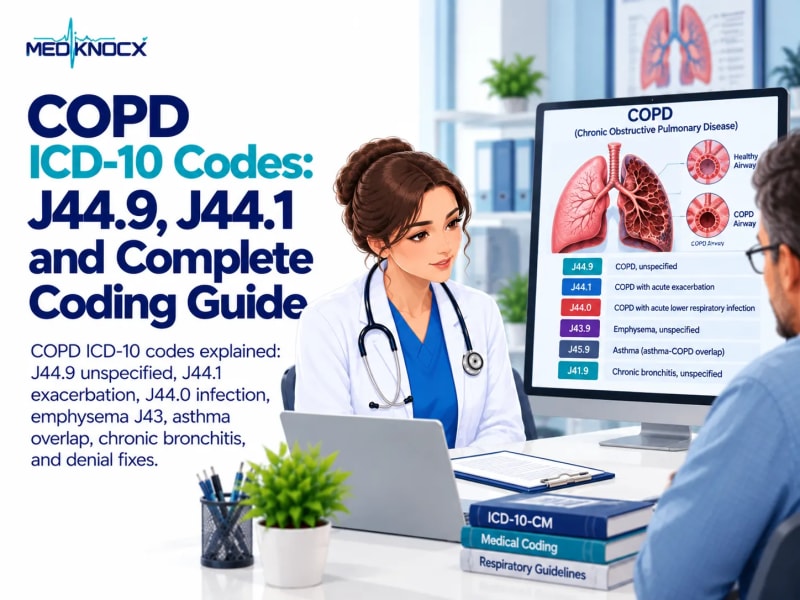
COPD ICD-10 codes explained: J44.9 unspecified, J44.1 exacerbation, J44.0 infection, emphysema J43, asthma ove...
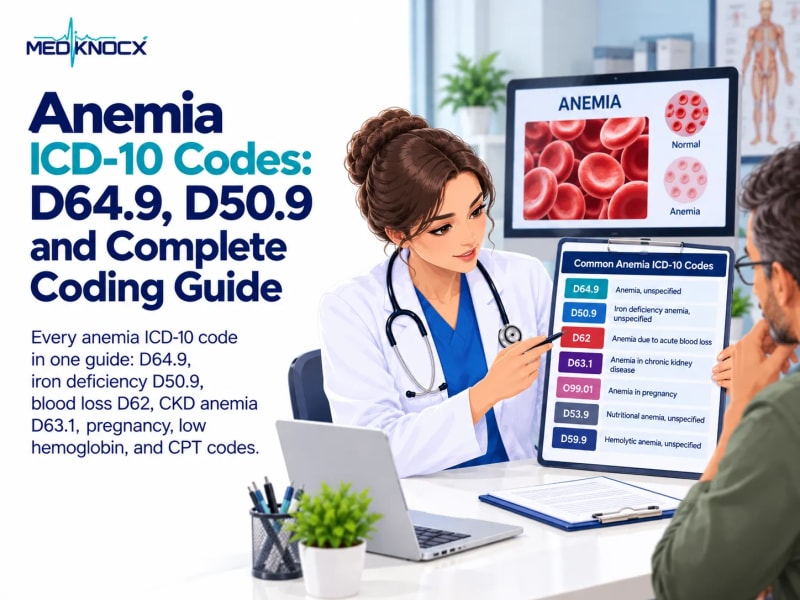
Every anemia ICD-10 code in one guide: D64.9, iron deficiency D50.9, blood loss D62, CKD anemia D63.1, pregnan...