Healthcare

COPD ICD-10 Codes: J44.9, J44.1 and Complete Coding Guide
COPD ICD-10 codes explained: J44.9 unspecified, J44.1 exacerbation, J44.0 infection, emphysema J43, asthma ove...

Sep 30, 2026
1 min read

Jordan Taylor
October 1, 2026
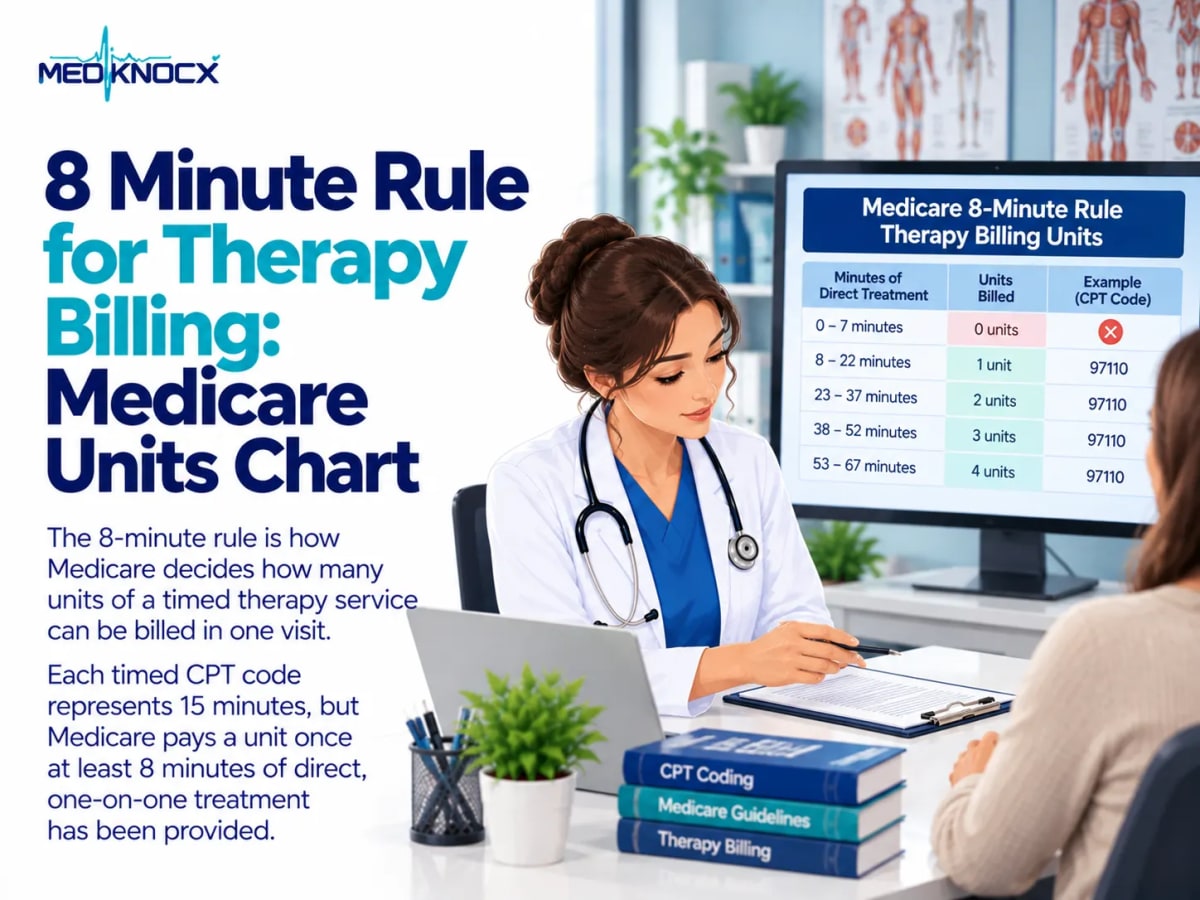
The 8-minute rule is how Medicare decides how many units of a timed therapy service can be billed in one visit. Each timed CPT code represents 15 minutes, but Medicare pays a unit once at least 8 minutes of direct, one-on-one treatment has been provided. To bill the units, add up all the timed minutes for the day, then use the chart below: 8 to 22 minutes is 1 unit, 23 to 37 is 2, 38 to 52 is 3, and so on.
It applies to physical therapy, occupational therapy, and speech-language pathology billed under Medicare Part B. Many commercial plans use a different method, the CPT rule of 8s, which counts each service separately and can produce a different number of units from the same session. Getting the two confused is one of the most common reasons therapy claims are overpaid, underpaid, or flagged on audit.
Medicare's method, set out in chapter 5 of the Medicare Claims Processing Manual, starts with one number: the total timed minutes for the visit. That total sets the maximum number of timed units that can be billed.
The pattern continues in 15-minute steps: each new unit starts at 8 minutes past the last full 15. A quick way to check it is to divide total timed minutes by 15; if the remainder is 8 or more, add one unit.
Two terms matter, and Medicare expects both in the note:
• Total timed code treatment minutes: the direct, one-on-one minutes spent on timed services only.
• Total treatment time: all the time spent treating the patient, including untimed services such as an evaluation or a supervised modality.
Only the first one goes into the chart. Untimed services are billed separately, one unit each, and added on top.
The 8-minute rule only applies to timed codes, the ones that describe a service in 15-minute increments and require direct, one-on-one contact. Untimed codes are billed once per visit no matter how long they take.
Two details to keep straight. Medicare pays G0283, not 97014, for unattended electrical stimulation. And 97010 is bundled for Medicare, so it's recorded but generally not separately paid. Most speech-language pathology treatment codes, including 92507, are untimed, which is why SLP billing feels so different from PT and OT.
1. Add up the timed minutes for every timed service in the visit.
2. Use the chart to find the total number of timed units allowed.
3. Give each service its full 15-minute units first.
4. Assign any leftover unit to the service with the most remaining minutes. If two services are tied, either one can take it.
5. Add one unit for each untimed service performed.
Example 1, a straightforward visit. 33 minutes of therapeutic exercise and 7 minutes of manual therapy is 40 timed minutes, which is 3 units. Therapeutic exercise gets 2 full units (30 minutes) and has 3 minutes left; manual therapy has 7. The third unit goes to manual therapy, because 7 is more than 3. Bill 97110 x 2 and 97140 x 1.
Example 2, mixed remainders. 18 minutes of therapeutic exercise and 5 minutes of manual therapy is 23 minutes, which is 2 units. Therapeutic exercise takes its full 15-minute unit and has 3 minutes left; manual therapy has 5. Neither leftover reaches 8 on its own, but together they make 8, so a second unit is allowed, and it goes to manual therapy because 5 is more than 3. Bill 97110 x 1 and 97140 x 1.
Example 3, a session under 8 minutes. 7 minutes of gait training alone is 0 billable units. The visit can still include an untimed service, but the gait training isn't billable to Medicare.
Example 4, timed and untimed together. 30 minutes of therapeutic exercise, 15 minutes of manual therapy, and 8 minutes of attended ultrasound is 53 timed minutes, or 4 units: 97110 x 2, 97140 x 1, 97035 x 1. Fifteen minutes of unattended electrical stimulation adds G0283 x 1, for 5 units in all.
Example 5, a service with less than 8 minutes still counts toward the total. 22 minutes of therapeutic activities and 6 minutes of neuromuscular reeducation is 28 minutes, or 2 units. Therapeutic activities gets 1 full unit with 7 left over; neuromuscular reeducation has 6. The second unit goes to therapeutic activities, so bill 97530 x 2 and no 97112, even though 97112 was performed.
The rule of 8s, sometimes called the AMA or CPT 8-minute rule, comes from CPT's own time convention: a unit of time is reached once the midpoint is passed, which is 8 minutes for a 15-minute code. The difference is that it's applied to each service separately, with no pooling of minutes across codes.
The same session can bill differently under each:
That's why the method has to come from the payer, not habit. Medicaid in particular varies by state, and some Medicare Advantage plans follow their own policy. Check the contract or the payer's therapy billing policy, and set the rule at the payer level in the billing system rather than leaving it to each therapist.
Where it applies. The 8-minute rule covers outpatient therapy billed under Medicare Part B in every setting: private practice, hospital outpatient departments, skilled nursing facilities billing Part B, CORFs, and outpatient home health. It applies the same way to PT, OT, and SLP.
What counts as timed minutes. Only direct, skilled, one-on-one time with the patient. Time spent setting up equipment before the patient arrives, waiting between exercises, unsupervised rest, and documentation done outside the session doesn't count. Assessing the patient's response during an intervention is part of the service.
Discipline modifiers. Every therapy line needs GP (physical therapy), GO (occupational therapy), or GN (speech-language pathology), based on the plan of care the service falls under.
Assistants: CQ and CO. Services furnished in whole or in part by a physical therapist assistant carry CQ; by an occupational therapy assistant, CO. Medicare pays those lines at 85 percent of the fee schedule. The modifier applies when the assistant provides more than 10 percent of the service, so assistant minutes have to be tracked separately from therapist minutes for the same code.
KX threshold. For 2026, the KX modifier threshold is $2,480 for PT and SLP combined and a separate $2,480 for OT. Once a patient's allowed charges pass it, claims need KX to attest that services are medically necessary; claims over the threshold without KX deny. Above $3,000, claims can be selected for targeted medical review.
Multiple procedure payment reduction. When more than one "always therapy" unit is billed on the same day, Medicare reduces the practice expense portion of the second and later units. It doesn't change how units are counted, but it explains why the second unit pays less than the first.
Medicare requires the treatment note to record total timed code treatment minutes and total treatment time. Recording minutes for each timed service is the practical standard too, because it's the only way a reviewer can check how the units were split.
A note that holds up shows:
• Minutes for each timed service, and who provided them (therapist or assistant)
• Total timed minutes and total treatment time
• The untimed services performed
• What was done in each intervention and why it needed a skilled therapist
• The patient's response and progress toward plan of care goals
When the minutes in the note don't add up to the units on the claim, the claim is unsupported, even if the treatment itself was appropriate. Many EHRs calculate units automatically, but the calculation is only as good as the minutes entered.
Group therapy. Treating two or more patients at the same time, when the therapist isn't giving any of them continuous one-on-one attention, is group therapy: 97150, one untimed unit per patient. Splitting a group session into timed codes for each patient is one of the most common audit findings in therapy billing.
Co-treatment. When a PT and an OT treat the same patient at the same time, Medicare doesn't allow both to bill the full session. The minutes are divided between them, either by splitting the session or by one discipline billing the whole of it, and each bills only the time it provided.
Most of these are setup problems rather than one-off mistakes: the wrong method configured for a payer, or assistant time not captured separately. A medical billing audit of a sample of therapy claims shows quickly whether units match the documented minutes. A pre-submission medical coding check catches modifier and code errors before claims go out, and when therapy claims keep returning on units or KX, denial management traces the pattern back to its source.
Medicare's method for billing timed therapy codes. A 15-minute unit can be billed once at least 8 minutes of direct treatment is provided, and the number of units is based on the total timed minutes in the visit.
Three units. 38 to 52 total timed minutes supports 3 units under the Medicare chart.
No. Evaluations and re-evaluations, such as 97161 to 97164, are untimed and billed as one unit regardless of length.
The 8-minute rule pools all timed minutes in the visit. The rule of 8s, from CPT, applies the 8-minute threshold to each service separately and doesn't combine remainders.
Some do and some don't. Many commercial plans and some state Medicaid programs use the rule of 8s, and some follow Medicare. Check each payer's policy.
Yes, it applies to PT, OT, and SLP under Medicare Part B. Most speech treatment codes are untimed, though, so it comes up less in SLP billing.
Not if it's the only timed service in the visit. If other timed services bring the total to 8 or more, the 7 minutes count toward the total and may earn a unit as a mixed remainder.
$2,480 for PT and SLP combined, and $2,480 for OT. Claims above it need the KX modifier.
CQ marks PT services furnished in whole or in part by a PTA, and CO marks OT services by an OTA. Medicare pays those services at 85 percent of the fee schedule.
Explore more medical billing guides, coding updates, and revenue cycle tips.
COPD ICD-10 codes explained: J44.9 unspecified, J44.1 exacerbation, J44.0 infection, emphysema J43, asthma ove...

Every anemia ICD-10 code in one guide: D64.9, iron deficiency D50.9, blood loss D62, CKD anemia D63.1, pregnan...

Learn what POS 20 means in medical billing, when to use it, POS 20 vs POS 11 and 23, CPT codes, Medicare billi...