Healthcare
POS 12 in Medical Billing - Home Visit Codes & Billing Guide
Learn what POS 12 means in medical billing, when to use it, home visit CPT codes, POS 10 vs 12, documentation ...

Sep 15, 2026
1 min read

Jordan Taylor
September 17, 2026
Table of Contents
12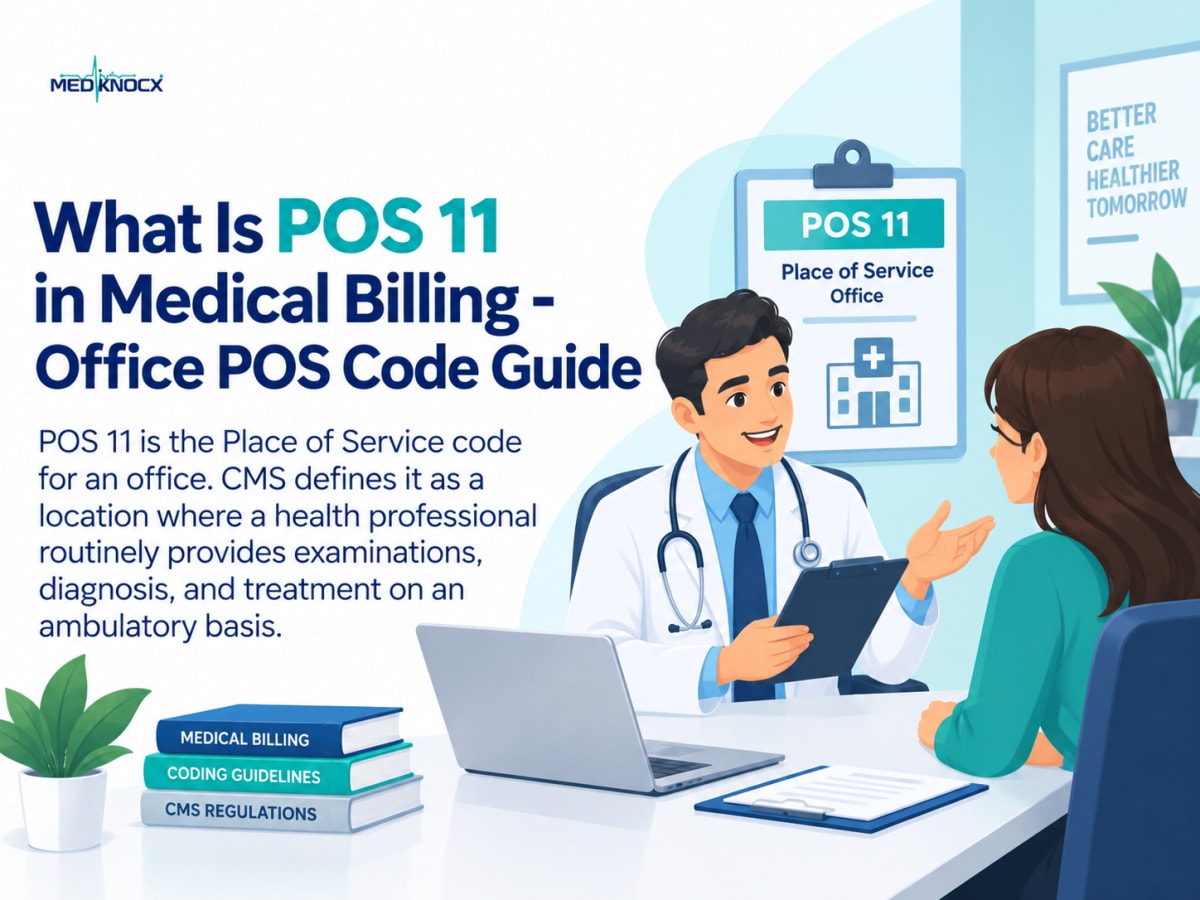
POS 11 means Office. It tells the payer that a qualifying healthcare service was provided in an office setting rather than at a hospital, patient's home, or another healthcare facility. CMS maintains the national Place of Service code set used on professional claims.
For most practices, POS 11 can cover everyday care such as office visits, follow-ups, preventive services, and other outpatient treatment. But the moment a service moves to a hospital outpatient department, home, or another location, the correct POS may change.
That's where billing teams can run into trouble. In this guide, we'll look at what POS 11 means, when to use it, when another POS code applies, how it relates to CPT and ICD-10-CM, and which common mistakes can cause claim problems.
POS 11 is the Place of Service code for an office. CMS defines it as a location where a health professional routinely provides examinations, diagnosis, and treatment on an ambulatory basis. The definition excludes settings that have their own POS codes, such as hospitals, skilled nursing facilities, and certain other healthcare facilities.
In simple terms, if a patient visits a qualifying physician office for care, POS 11 tells the payer that the service happened there.
For example, a patient visits a primary care physician for a follow-up appointment. The provider examines the patient, documents the visit, reports the appropriate procedure and diagnosis codes, and uses POS 11 when the service was provided in a qualifying office setting.
One important point is easy to miss:
POS 11 tells the payer where the service happened. It does not tell the payer what service was performed.
That's where the other claim codes come in:
POS 11: Where the service happened
CPT/HCPCS: What service was performed
ICD-10-CM: The diagnosis or condition associated with the service
These pieces should make sense together on the claim.
Use POS 11 when a qualifying professional service is provided in an office setting.
Common examples include:
Routine office visits
Follow-up appointments
Primary care visits
Specialist consultations
Preventive care
Chronic condition management
Office-based examinations
Certain minor procedures
Other eligible outpatient services
For example, a patient sees a dermatologist at the physician's office for a follow-up evaluation. If that location qualifies as an office under the applicable billing rules, the professional claim can report POS 11.
The important part is the actual service location.
Don't select POS 11 just because the provider normally works from an office. If the same provider treats a patient at a hospital outpatient department or the patient's home, another POS code may apply.
CMS Medicare guidance generally requires the POS to reflect the setting where the beneficiary received the face-to-face service. There are specific exceptions for patients who are registered hospital inpatients or outpatients.
POS 11 is not a general code for every outpatient service. The correct POS depends on where the service was provided.
Here are some common examples:
CMS maintains separate POS codes for these settings.
For example, a provider may perform an outpatient service, but that does not automatically make the claim POS 11. If the patient receives care in a hospital outpatient department, POS 19 or POS 22 may apply depending on the location.
This is one reason billing teams should verify the service location before submitting the claim.
Related reading:
What Is POS 12 in Medical Billing?
What Is POS 10 in Medical Billing?
What Is POS 21 in Medical Billing?
What Is POS 22 in Medical Billing?
These three codes can be confusing because they can all appear in outpatient billing.
POS 11 represents a qualifying office setting where a healthcare professional provides ambulatory care.
POS 19 identifies an off-campus outpatient hospital setting.
POS 22 identifies an outpatient department located on a hospital's main campus.
So, consider two patients receiving similar services.
One visits a physician in an independent office. The other visits a hospital outpatient department.
The service itself may look similar, but the place of service is different.
This distinction matters because CMS payment rules can treat services differently depending on the setting.
POS 11 is not a CPT code.
Think of the claim as answering three basic questions:
Where?
POS 11 identifies the office setting.
What?
CPT or HCPCS identifies the service, procedure, or item being billed.
Why?
ICD-10-CM identifies the diagnosis or condition associated with the service.
For example, a physician may report an evaluation and management service for a patient with a documented medical condition. The CPT code describes the service, the ICD-10-CM code supports the diagnosis, and POS 11 identifies the qualifying office setting.
The codes should support the same encounter.
If the medical record shows that the patient was treated in a hospital outpatient department but the claim reports POS 11, the billing team should investigate the mismatch before submission.
POS codes give the payer important information about the setting where a professional service was provided.
That information can affect how a claim is processed and, depending on the service and payer, how payment is calculated.
For Medicare services paid under the Physician Fee Schedule, CMS uses POS information to distinguish the setting in which the service was provided. CMS also has different payment considerations for facility and non-facility settings.
But there is no single fixed POS 11 reimbursement rate.
Payment can depend on factors such as:
CPT or HCPCS code
Payer
Fee schedule
Provider contract
Modifier
Patient coverage
Facility or non-facility setting
CMS also tells providers to check individual payer policies for reimbursement rules related to POS codes.
So, changing a POS code simply to obtain a different payment is not a safe billing strategy. The code should accurately represent the service setting.
If you're working with professional claims, POS 11 can appear on the CMS-1500 claim form.
CMS identifies Item 24B as the Place of Service field. For Medicare Physician Fee Schedule services, the POS generally reflects the setting where the patient received the face-to-face service.
For example, when a qualifying face-to-face service takes place in an office, POS 11 is generally reported in the POS field.
CMS also uses the service location information on the claim to support the reported place of service.
For electronic professional claims, the 837P format is used. CMS identifies POS information at the claim/service-line level for professional billing.
This makes POS verification an important part of the claim-scrubbing process.
Even simple POS coding can cause problems when the service location is not checked carefully.
A hospital outpatient department may require POS 19 or POS 22 instead of POS 11.
If the provider actually treats the patient in a private residence, POS 12 may apply.
Telehealth has separate POS codes, including POS 02 and POS 10. The correct reporting depends on the telehealth setting and applicable payer requirements.
A provider may work at several locations. Automatically assigning POS 11 to every claim can create location mismatches.
The medical record, service location, CPT/HCPCS code, and POS should support the same encounter.
CMS maintains the national POS code set, but individual payers may have specific reimbursement policies. Billing teams should check the requirements of the payer processing the claim.
CMS guidance also notes that a claim with an invalid or incompatible POS can be returned for correction.
You don't need a complicated process to catch most POS mistakes.
Before submitting the claim, check:
Verify Location → Select POS → Match CPT/HCPCS → Check Diagnosis → Review Documentation → Check Payer Rules → Submit
For practices with multiple locations, keep the service locations properly mapped in the practice management or billing system.
It also helps to review claims when providers work across different settings. A physician may see patients in an independent office on one day and a hospital outpatient location on another. The POS should follow the applicable service setting.
Regular claim audits can also reveal repeated POS errors before they turn into a larger denial pattern.
Before submitting a claim, ask:
Is the actual service location confirmed?
Does POS 11 match that location?
Does the CPT/HCPCS code match the service?
Does the diagnosis support the encounter?
Does the documentation support the reported service?
Are applicable modifiers correct?
Have payer-specific requirements been checked?
Has the claim passed billing edits?
A few seconds of verification before submission can save much more time later.
POS 11 may be only two digits, but getting those two digits right matters.
If a qualifying service was provided in an office, POS 11 tells the payer where that care took place. The bigger picture is making sure the POS, CPT/HCPCS code, diagnosis, documentation, and payer requirements all line up.
For practices handling a large number of claims, checking the service location before submission is a simple step that can prevent avoidable billing problems and unnecessary claim follow-up.
Explore more medical billing guides, coding updates, and revenue cycle tips.
Learn what POS 12 means in medical billing, when to use it, home visit CPT codes, POS 10 vs 12, documentation ...
POS 22 marks on-campus hospital outpatient services. See how it differs from POS 19 and POS 11, how split bill...
POS 10 marks telehealth delivered to a patient's home. See how it differs from POS 02, which modifiers to use,...