Healthcare
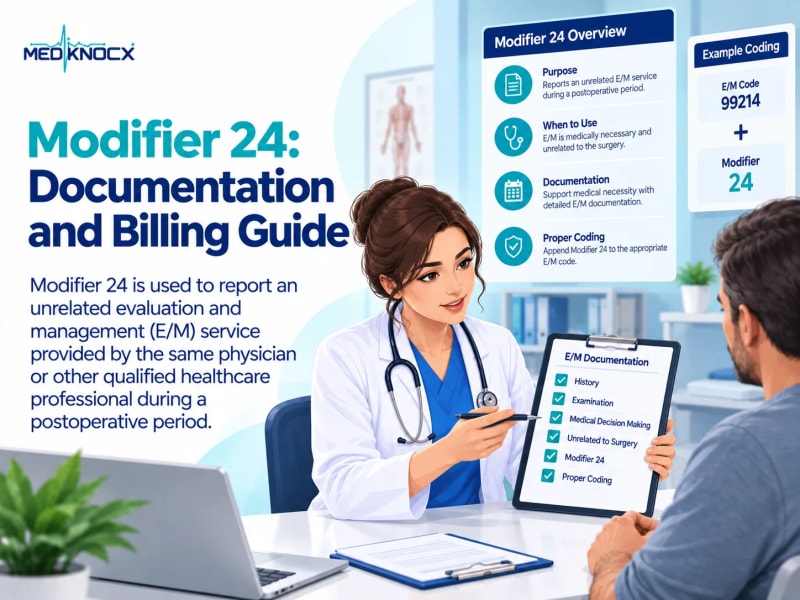
Modifier 24: Documentation and Billing Guide
Modifier 24 reports an unrelated E/M service by the same physician or qualified healthcare professional during...

Sep 24, 2026
1 min read

Jordan Taylor
September 25, 2026
Table of Contents
18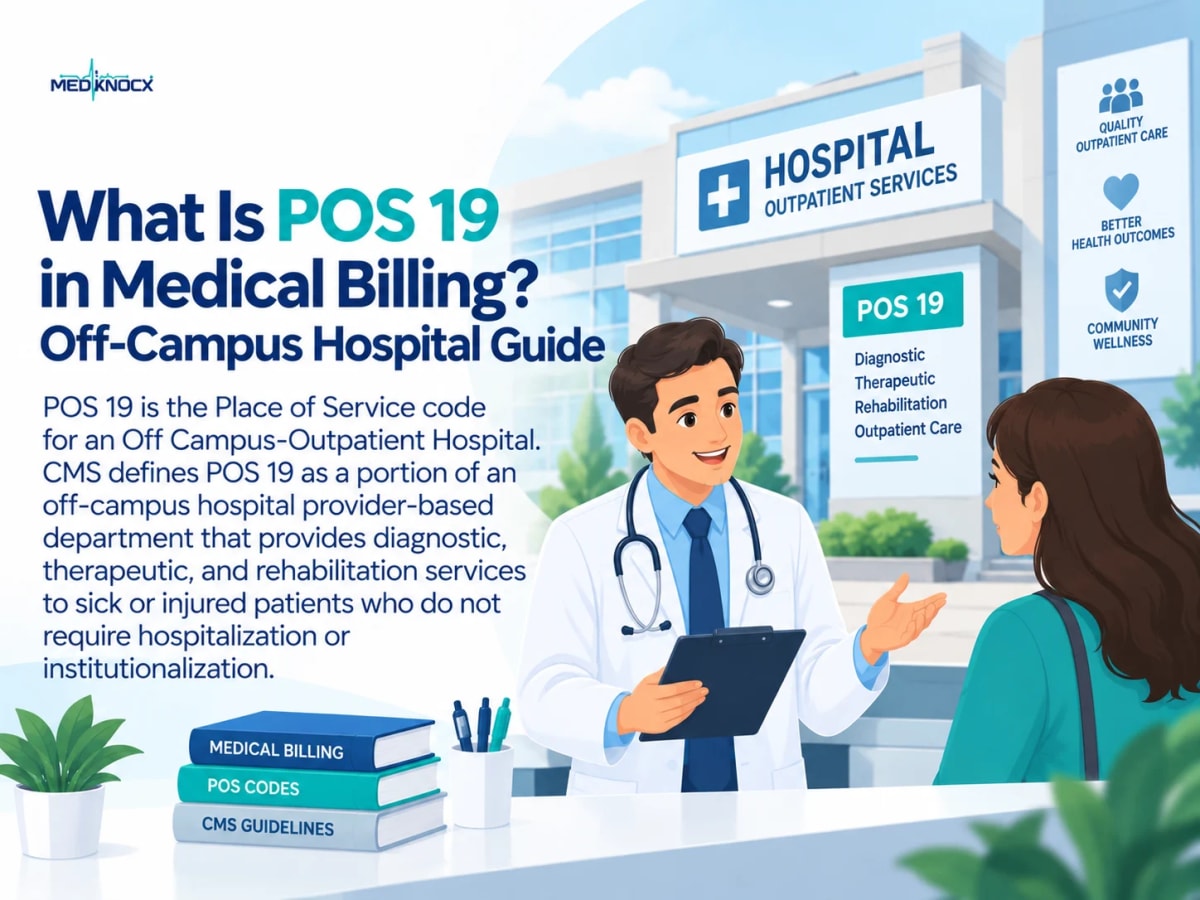
When a healthcare service is provided through an off-campus hospital outpatient department, the claim needs to identify the correct place of service. POS 19 in medical billing is used to identify an Off Campus-Outpatient Hospital setting.
The correct POS code gives the payer important information about where the service was provided. It can also affect how Medicare processes professional services under the Physician Fee Schedule.
In this guide, we explain what POS 19 means, when to use it, how it differs from POS 11 and POS 22, how it affects Medicare billing, and how to avoid common billing errors.
POS 19 is the Place of Service code for an Off Campus-Outpatient Hospital.
CMS defines POS 19 as a portion of an off-campus hospital provider-based department that provides diagnostic, therapeutic, and rehabilitation services to sick or injured patients who do not require hospitalization or institutionalization. POS 19 became effective January 1, 2016.
In simple terms, POS 19 tells the payer that the service was provided through an off-campus outpatient hospital setting.
POS codes are two-digit codes reported on professional healthcare claims to identify the setting where a service was provided.
POS 19 means Off Campus-Outpatient Hospital.
The code is used for an outpatient hospital setting that is located away from the hospital's main campus and meets the applicable provider-based department requirements.
For example, a hospital may operate an outpatient clinic at another location. If the location qualifies as an off-campus hospital provider-based department, POS 19 may be appropriate for professional services provided to a registered hospital outpatient.
The exact claim requirements can depend on the service, patient status, and payer.
POS 19 is used when the applicable service is associated with an off-campus outpatient hospital setting.
Examples of services provided in these settings may include:
Diagnostic services
Therapeutic services
Surgical or nonsurgical services
Rehabilitation services
Outpatient evaluation and treatment
Other eligible hospital outpatient services
The POS code does not replace the CPT or HCPCS code. Instead, it tells the payer about the service location.
A hospital operates an outpatient department at a location away from its main campus.
A patient visits that department for an outpatient medical service and is registered as a hospital outpatient.
The professional claim needs to report the appropriate outpatient hospital POS code based on the applicable Medicare or payer rules. For an off-campus outpatient setting, this can be POS 19.
POS 19 and POS 22 are closely related, but they identify different hospital outpatient settings.
CMS defines POS 19 as an off-campus hospital provider-based department and POS 22 as a portion of the hospital's main campus providing outpatient services.
POS 22 is used for an On Campus-Outpatient Hospital.
It identifies an outpatient area located on the hospital's main campus.
The main distinction is the hospital location:
POS 19: Off-campus outpatient hospital
POS 22: On-campus outpatient hospital
Both can involve diagnostic, therapeutic, and rehabilitation services.
The billing team must determine the correct setting before reporting the POS code.
Another common comparison is POS 19 vs POS 11.
POS 11 represents an Office.
POS 19 represents an Off Campus-Outpatient Hospital.
The distinction is important because a hospital may have physician offices and provider-based outpatient departments at similar locations.
CMS states that when a physician maintains separate office space that is not considered a provider-based department, POS 11 can apply. For hospital outpatient services, POS 19 or POS 22 is generally used depending on the applicable campus setting.
An off-campus outpatient hospital is an outpatient hospital department located away from the hospital's main campus.
It may provide services such as:
Diagnostic testing
Therapy
Rehabilitation
Outpatient treatment
Other hospital outpatient services
The department's provider-based status and the patient's registration status can matter when determining the appropriate billing treatment.
Therefore, billers should not select POS 19 simply because a location is owned by a hospital.
The actual status of the location and the applicable billing rules should be verified.
Accurate POS 19 billing requires more than entering the two-digit code.
Determine where the patient received the service.
Verify whether the location qualifies as the applicable hospital provider-based department.
Determine whether the service relates to an off-campus or on-campus outpatient hospital setting.
For Medicare billing, determine whether the patient is registered as a hospital outpatient.
CMS explains that hospital outpatient status can affect the POS reported on professional claims.
Report the procedure or service that accurately describes the care provided.
Use POS 19 when the applicable requirements for an off-campus outpatient hospital setting are met.
Check the POS, CPT or HCPCS code, modifiers, diagnosis codes, patient information, and other required claim data.
Submit the claim and monitor it for rejections, denials, or payer requests.
POS 19 is particularly important in Medicare professional billing.
CMS states that when a physician or practitioner provides services to a hospital outpatient, the applicable outpatient hospital POS code is used. For an off-campus setting, this is generally POS 19, while POS 22 applies to an on-campus setting.
CMS also states that when a physician or practitioner furnishes services to a hospital outpatient, payment under the Physician Fee Schedule is made at the facility rate.
This means POS reporting can have a direct relationship with Medicare payment methodology.
Yes, POS reporting can affect how Medicare processes professional services.
Under the Medicare Physician Fee Schedule, some services have different facility and non-facility payment rates. CMS explains that POS is generally used to identify the setting where the beneficiary receives the face-to-face service.
For hospital outpatients, however, CMS has specific rules. POS 19 and POS 22 identify hospital outpatient settings, and the facility rate applies under the applicable Physician Fee Schedule rules.
However, POS 19 does not guarantee a specific reimbursement amount.
Payment can also depend on:
CPT or HCPCS code
Medicare coverage
Medical necessity
Modifiers
Provider status
Patient status
Applicable payment rules
Payer requirements
Commercial insurers and Medicaid programs can have their own policies, so billing teams should verify the applicable payer guidance.
POS codes are an important part of professional claims.
CMS identifies the POS field as Item 24B on the CMS-1500 claim form. The electronic equivalent is reported through the appropriate 837P claim structure.
For services paid under the Physician Fee Schedule, CMS instructs providers to report the appropriate POS code for the setting.
For hospital outpatients, CMS identifies:
POS 19: Off Campus-Outpatient Hospital
POS 22: On Campus-Outpatient Hospital
The hospital campus distinction can become important when determining whether an outpatient department is on or off campus.
However, billers should not rely on a simple distance rule alone.
The correct POS depends on the applicable CMS definitions and the status of the hospital department.
A billing team should verify:
Hospital campus status
Provider-based department status
Department location
Patient registration status
Applicable Medicare rules
This is safer than automatically assigning POS 19 based only on the physical distance from the main hospital building.
Incorrect POS reporting can cause claim processing problems.
A biller may select POS 22 because the department belongs to a hospital.
The hospital affiliation alone does not determine whether POS 19 or POS 22 applies.
An off-campus hospital outpatient department should not automatically be treated as a physician office.
POS 11 may apply when the physician maintains separate office space that is not considered a provider-based department under the applicable rules.
Medicare has specific POS rules for patients registered as hospital inpatients or outpatients.
CMS states that the appropriate hospital POS code can apply even when the face-to-face service occurs somewhere else.
A hospital-owned location is not automatically POS 19.
The location and department must meet the applicable requirements.
Medicare rules do not automatically apply in the same way to every commercial payer.
Always check the payer's current billing requirements.
Use this checklist before submitting a claim.
Where did the service occur?
Is the location a hospital provider-based department?
Is it an off-campus or on-campus outpatient location?
Was the patient registered as a hospital outpatient?
Does the CPT or HCPCS code accurately describe the service?
Does POS 19 correctly represent the applicable outpatient setting?
Check whether any required modifier applies to the service.
Review current Medicare, Medicaid, or commercial payer requirements.
Check patient data, provider information, diagnosis codes, procedure codes, POS, and other claim fields before submission.
POS coding gives the payer information about the setting associated with a professional service.
For Medicare, the POS can also affect the payment methodology under the Physician Fee Schedule.
An incorrect POS can therefore create:
Claim processing issues
Incorrect payment
Denials
Rework
Payment delays
Compliance concerns
CMS specifically identifies facility versus non-facility reimbursement as an area where incorrect POS coding can lead to payment problems.
Accurate POS reporting is therefore an important part of medical billing and revenue cycle management.
Here is a quick comparison:
CMS maintains these as separate Place of Service codes.
The correct code should be based on the actual applicable setting and payer rules.
A hospital operates an outpatient rehabilitation department at a location away from its main campus.
A Medicare patient visits the department for an outpatient rehabilitation service.
The provider documents the service in the medical record. The billing team verifies the department's status and the patient's outpatient registration.
The professional claim is then coded with the appropriate CPT or HCPCS code and the applicable POS.
If the setting meets the requirements for an off-campus outpatient hospital, POS 19 identifies that setting.
POS 19 in medical billing identifies an Off Campus-Outpatient Hospital.
It is used for applicable hospital provider-based outpatient departments located away from the hospital's main campus.
The most important distinction is between:
POS 19: Off Campus-Outpatient Hospital
For Medicare professional claims, POS reporting can also affect the applicable Physician Fee Schedule payment methodology. CMS states that hospital outpatient services associated with POS 19 or POS 22 are paid at the facility rate under the applicable PFS rules.
Before submitting a claim, verify the location, department status, patient status, CPT or HCPCS code, POS, and payer requirements.
POS 19 is the Place of Service code for an Off Campus-Outpatient Hospital.
It means the applicable healthcare service is associated with an off-campus hospital outpatient setting.
POS 19 is used for applicable services provided through an off-campus hospital provider-based outpatient department.
POS 19 represents an off-campus outpatient hospital. POS 22 represents an on-campus outpatient hospital.
POS 11 represents an office. POS 19 represents an off-campus outpatient hospital setting. The provider-based status of the department can be important when determining the appropriate POS.
POS 19 can affect Medicare payment methodology. CMS states that applicable hospital outpatient services reported with POS 19 or POS 22 are paid at the facility rate under the Physician Fee Schedule.
Yes. POS codes are reported on professional claims to identify the setting where healthcare services are provided. CMS includes POS information in the CMS-1500 and 837P claim requirements.
POS 19 specifically identifies an off-campus outpatient hospital setting. POS 22 identifies an on-campus outpatient hospital setting.
POS 19 is part of the national POS code set used on professional claims. However, commercial payer policies can differ, so the payer's current requirements should be checked before claim submission.
Explore more medical billing guides, coding updates, and revenue cycle tips.
Modifier 24 reports an unrelated E/M service by the same physician or qualified healthcare professional during...
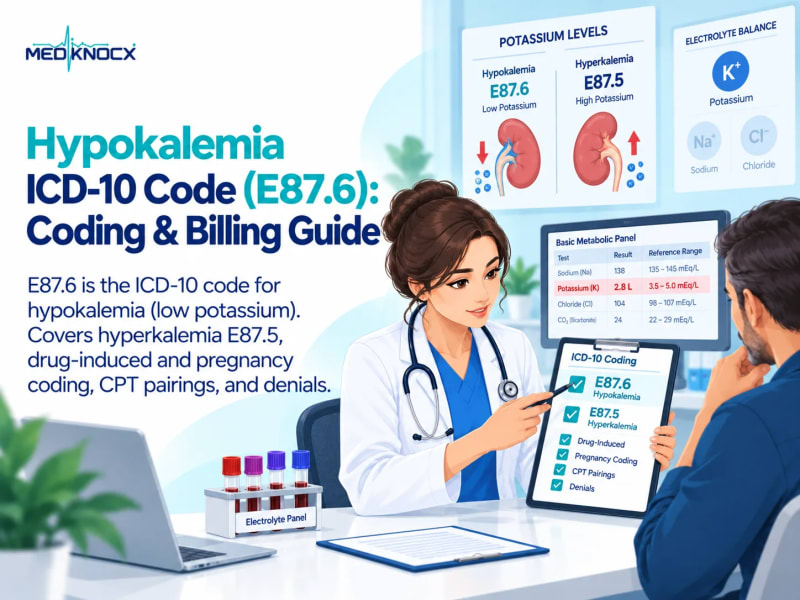
E87.6 is the ICD-10 code for hypokalemia (low potassium). Covers hyperkalemia E87.5, drug-induced and pregnanc...
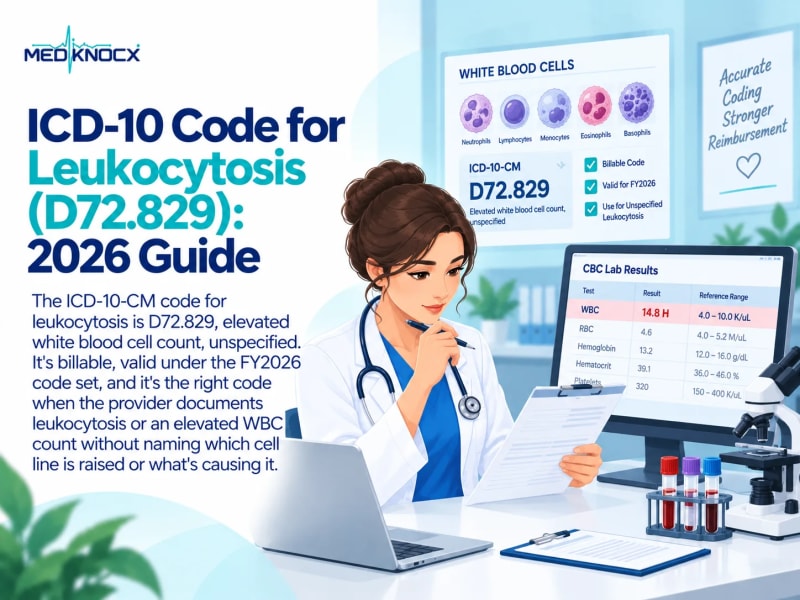
D72.829 is the ICD-10 code for leukocytosis. Learn when to use it, the specific D72.82 codes, leukopenia codes...