Healthcare
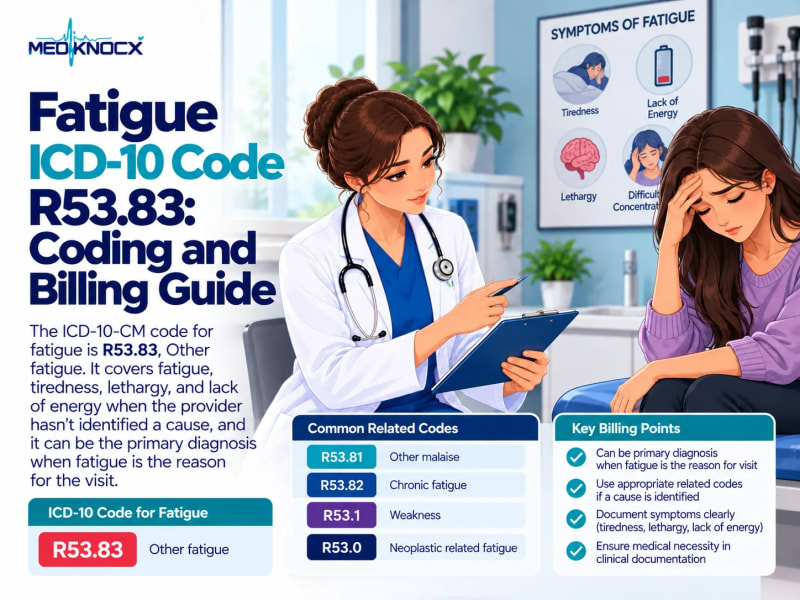
Fatigue ICD-10 Code R53.83: Coding and Billing Guide
R53.83 is the ICD-10 code for fatigue, tiredness, lethargy, and lack of energy. Learn R53.81 malaise, R53.82 c...

Oct 3, 2026
1 min read

Jordan Taylor
August 26, 2026
POS 10 stands for "Telehealth Provided in Patient's Home." It's the place-of-service code you enter on a claim when a covered telehealth visit is delivered to a patient sitting in their own residence, not a clinic, hospital, or other facility. CMS added the code effective January 1, 2022, specifically to separate home-based telehealth from every other telehealth setting. Getting POS 10 right matters because it changes how the visit gets paid, and mixing it up with POS 02 or POS 12 is one of the more common ways behavioral health and primary care practices lose reimbursement on telehealth claims.
POS 10 applies when the patient connects to a covered telehealth service from their home: a house, apartment, or a temporary residence like a short-term rental where they're currently living. It does not apply if the patient is at a clinic, hospital, skilled nursing facility, workplace, or school, even if the visit itself is delivered by telehealth.
Both the provider and the patient generally need to be located in the United States or a U.S. territory for the claim to qualify. The code sits in Box 24B of the CMS-1500 form and has no equivalent field on the institutional UB-04.
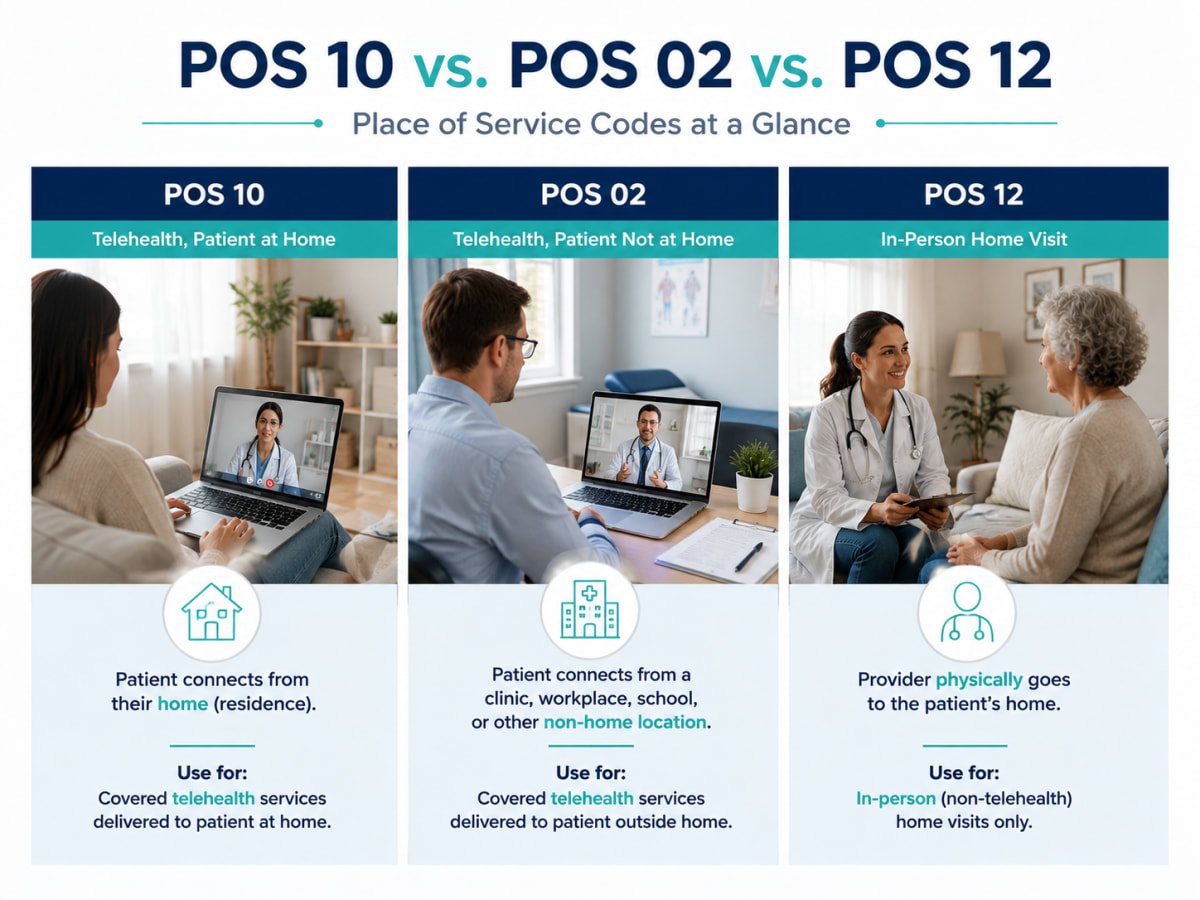
Before POS 10 existed, POS 02 was the default for any telehealth visit regardless of where the patient was sitting. That's exactly why the two codes still get confused today: older workflows and some legacy EHR templates were built around POS 02 doing double duty.
Under the Medicare Physician Fee Schedule, POS 10 is paid at the non-facility rate, the same rate tier as an in-office visit (POS 11). POS 02 is generally tied to the facility rate, which runs lower. That gap is the financial reason POS 10 exists in the first place: a home-based telehealth visit costs the practice roughly what an in-office visit costs to deliver, so CMS pays it accordingly.
Exact rates depend on the CPT code, locality, and current fee schedule year, so don't rely on a flat dollar figure. Check the current Medicare Physician Fee Schedule Look-Up Tool for the specific code and locality before quoting a number internally, and confirm commercial payer contracts separately since they don't always mirror Medicare's facility/non-facility split.
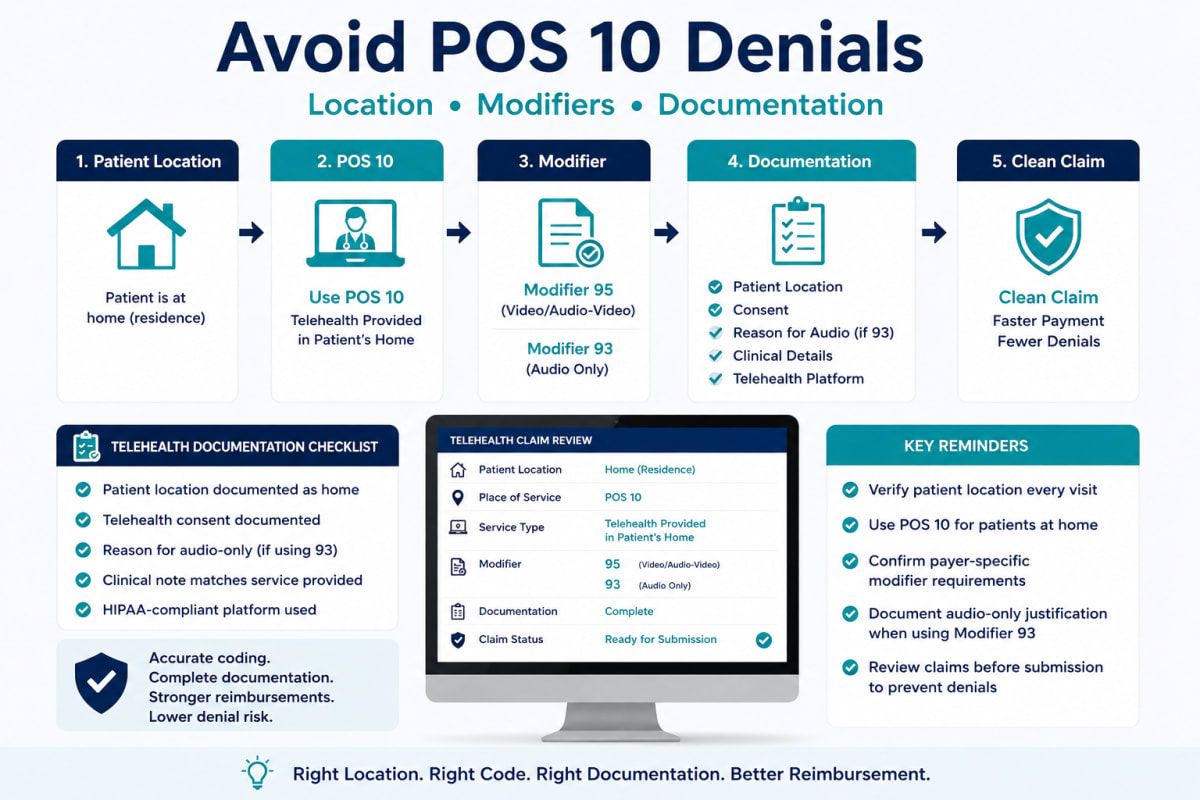
Modifier 95 covers standard synchronous audio-video telehealth and is what most commercial payers expect paired with POS 10.
Modifier 93 applies to audio-only visits when video was available but unused or declined. The note needs to state that video was an option and why it wasn't used.
Modifier GT still shows up in some payer contracts, but it's largely legacy and specific to Critical Access Hospital Method II billing rather than standard home telehealth.
Confirm which modifier a given payer actually requires before submitting. Medicare and commercial plans don't always align on this point, and a mismatched modifier is one of the fastest ways to trigger an automated denial.
A clean POS 10 claim needs a note that supports the code, not just a checkbox. That means:
The patient's home location, stated explicitly rather than assumed
The technology platform used, confirmed as HIPAA-compliant
Documented consent for the telehealth visit
The reason video wasn't used, if billing modifier 93 for audio-only
Clinical content that meets the same documentation standard as an in-person visit for the same CPT code
Confirm the CPT code itself is on the current year's CMS telehealth services list before billing it under POS 10. A code that isn't covered for telehealth gets denied regardless of how clean the rest of the documentation is.
Using POS 02 for a home visit. The patient was at home, but the claim was coded as if they weren't, which can trigger a facility-rate underpayment instead of an outright denial.
Confusing POS 10 with POS 12. One is telehealth, the other is an in-person home visit. Mixing them up misrepresents how the service was actually delivered.
Billing the newer telemedicine-specific CPT range to Medicare. Medicare generally expects standard E/M codes (99202-99215) with POS 10, not the separate CPT telemedicine code set some commercial payers accept.
Missing the modifier a payer requires. Some payers mandate modifier 95, others accept it as optional; failing to check first produces avoidable denials.
Skipping the audio-only justification. Billing modifier 93 without documenting why video wasn't used is treated as incomplete documentation, not a minor omission.
Verify the patient's location at the start of the visit and document it directly in the note, not just in scheduling software.
Check the current CMS telehealth services list for the CPT code before the claim goes out, since covered codes change from year to year.
Confirm each payer's modifier requirement ahead of billing rather than defaulting to whatever the last claim used.
Build the audio-only justification into the visit template so it's captured in real time instead of reconstructed after a denial.
Keep provider telehealth credentialing current with each payer, since a lapsed enrollment produces a denial that has nothing to do with the coding itself.
How to Handle a Denied POS 10 Claim
Pull the exact denial reason from the remittance advice instead of guessing.
If it's a location or documentation denial, check whether the note actually states the patient was at home.
If it's a modifier mismatch, confirm the payer's current policy and correct the modifier before resubmitting.
If the CPT code itself was flagged as non-covered for telehealth, verify it against this year's CMS telehealth list before appealing.
Track recurring POS 10 denials by reason code. A cluster of the same denial usually points to one workflow fix, not a dozen unrelated claims.
POS 10 shows up constantly in telemedicine billing, and it's especially common in behavioral health billing, where home-based telehealth has become a normal part of care delivery. If POS 10 denials keep showing up in your reports, our denial management services can trace them back to the specific workflow gap, and a billing audit will confirm whether the root cause is coding, documentation, or a payer policy your team hasn't updated for. For the inpatient counterpart to this topic, see what POS 21 means in medical billing.
Talk to a Mediknocx billing specialist about your telehealth claims. Request a Demo
No. POS 10 is a standard CMS place of service code, but most commercial payers and Medicaid programs recognize it too. Modifier requirements can still differ by payer, so confirm before billing.
POS 10 means the patient joined the telehealth visit from home. POS 02 means the patient joined from somewhere else, like a clinic or workplace. The setting, not the technology used, is what determines the code.
Generally yes, since POS 10 is tied to the non-facility rate under the Medicare Physician Fee Schedule, while POS 02 is tied to the facility rate. Exact amounts depend on the CPT code and locality, so verify current rates rather than assuming a fixed gap.
Most commercial payers expect it for standard audio-video telehealth visits. Some plans treat it as optional rather than mandatory, so check the specific payer's policy before dropping it.
Yes, with modifier 93, but the note needs to document that video was available and why it wasn't used. Audio-only coverage rules for non-behavioral-health visits are also tied to periodic legislative extensions, so confirm current-year status before relying on it.
Explore more medical billing guides, coding updates, and revenue cycle tips.
R53.83 is the ICD-10 code for fatigue, tiredness, lethargy, and lack of energy. Learn R53.81 malaise, R53.82 c...

ICD-10 codes for cough by duration: R05.1 acute, R05.2 subacute, R05.3 chronic, R05.9 unspecified. Plus Exclud...

M25.512 is the ICD-10 code for left shoulder pain. See M25.511, M25.519, bilateral coding, scapula and clavicl...