Healthcare
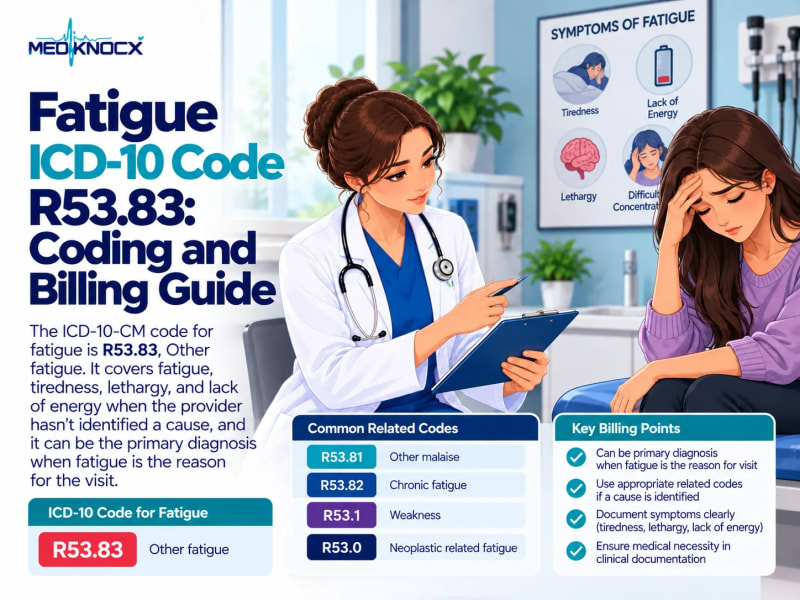
Fatigue ICD-10 Code R53.83: Coding and Billing Guide
R53.83 is the ICD-10 code for fatigue, tiredness, lethargy, and lack of energy. Learn R53.81 malaise, R53.82 c...

Oct 3, 2026
1 min read

Jordan Taylor
August 19, 2026
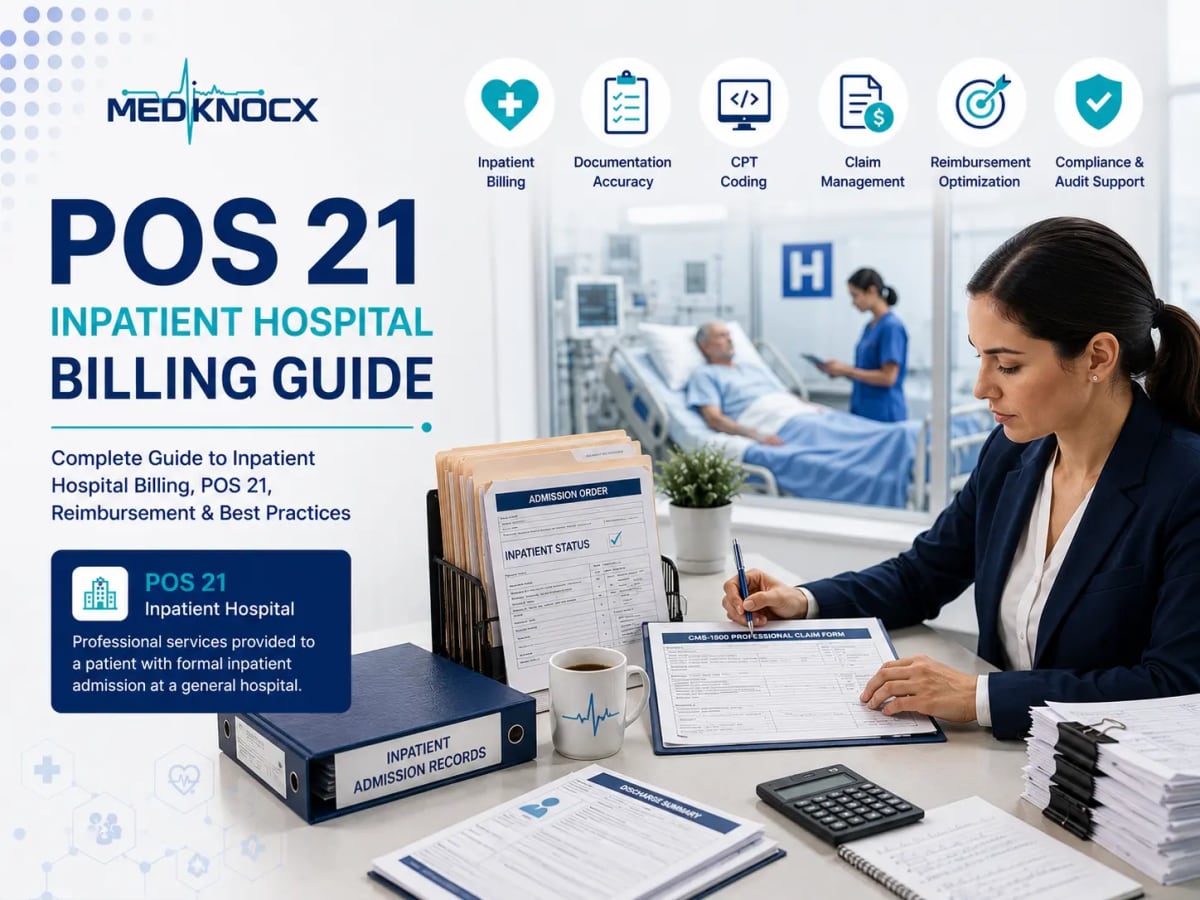
POS 21 stands for "Inpatient Hospital" and appears on professional claims (CMS-1500, Box 24B) when a patient receives treatment after formal admission to a hospital. The Centers for Medicare and Medicaid Services define it this way: "A facility, other than psychiatric, which primarily provides diagnostic, therapeutic (both surgical and non-surgical), and rehabilitation services by, or under, the supervision of physicians to patients admitted for a variety of medical conditions."
The key word here is admitted. A patient must have formal inpatient admission status, not just an overnight stay or observation status. This one code choice affects how much your practice gets reimbursed, which payers will process the claim, and whether the claim gets rejected entirely. Billing teams that misuse POS 21 lose 20 to 50 percent of reimbursement or trigger outright denials.
Inpatient hospital services under POS 21 include surgeries, intensive care, physician consultations, diagnostic imaging, and extended care for chronic conditions. A patient admitted for a cardiac bypass procedure gets POS 21. A patient in a surgical recovery unit receives POS 21. A patient admitted for diabetes management and insulin adjustment over several days uses POS 21.
What POS 21 does not cover matters just as much. If a patient arrives at the emergency room, gets evaluated, treated, and sent home the same day, that is POS 23 (Emergency Room), not POS 21. If a patient stays overnight for observation but never receives a formal admission order, that is POS 22 (On Campus Outpatient Hospital), not POS 21. The difference between POS 21 and POS 22 is whether a physician formally admitted the patient to the hospital for inpatient status. No formal admission order means observation status, and observation always codes to POS 22, even if the patient never leaves the building.
This distinction directly affects reimbursement. Medicare pays facility rates for POS 21 because the hospital bills its overhead separately on a UB-04 institutional claim. Outpatient codes (POS 22) trigger lower non-facility rates on the physician fee schedule. Misclassifying observation patients as POS 21 can result in overpayment claims from payers demanding refunds months later.
Billers often confuse POS 21 with codes that look similar but apply to different settings. Understanding the boundaries prevents costly mistakes.
POS 21 vs. POS 22 (On Campus Outpatient Hospital): The dividing line is the formal inpatient admission order. If a physician admits the patient as an inpatient, use POS 21. If no inpatient order exists, use POS 22. Hospitals sometimes keep patients under observation overnight specifically to avoid the cost of an inpatient admission. When this happens, the claim still requires POS 22, not POS 21.
POS 21 vs. POS 23 (Emergency Room): Emergency room visits always use POS 23, even if the patient is later admitted to the hospital as an inpatient. The emergency room service itself happens in POS 23; the inpatient stay under POS 21 begins when the physician issues an admission order.
POS 21 vs. POS 31 (Skilled Nursing Facility): A patient discharged from an inpatient hospital stay to a nursing facility for rehabilitation receives POS 21 for the hospital portion and POS 31 for the SNF portion. These are separate codes for separate settings.
POS 21 vs. POS 51 (Inpatient Psychiatric Facility): POS 21 explicitly excludes psychiatric facilities. Inpatient psychiatric admissions use POS 51. This distinction matters because different payer contracts, billing rules, and authorization requirements apply to psychiatric versus medical inpatient care.
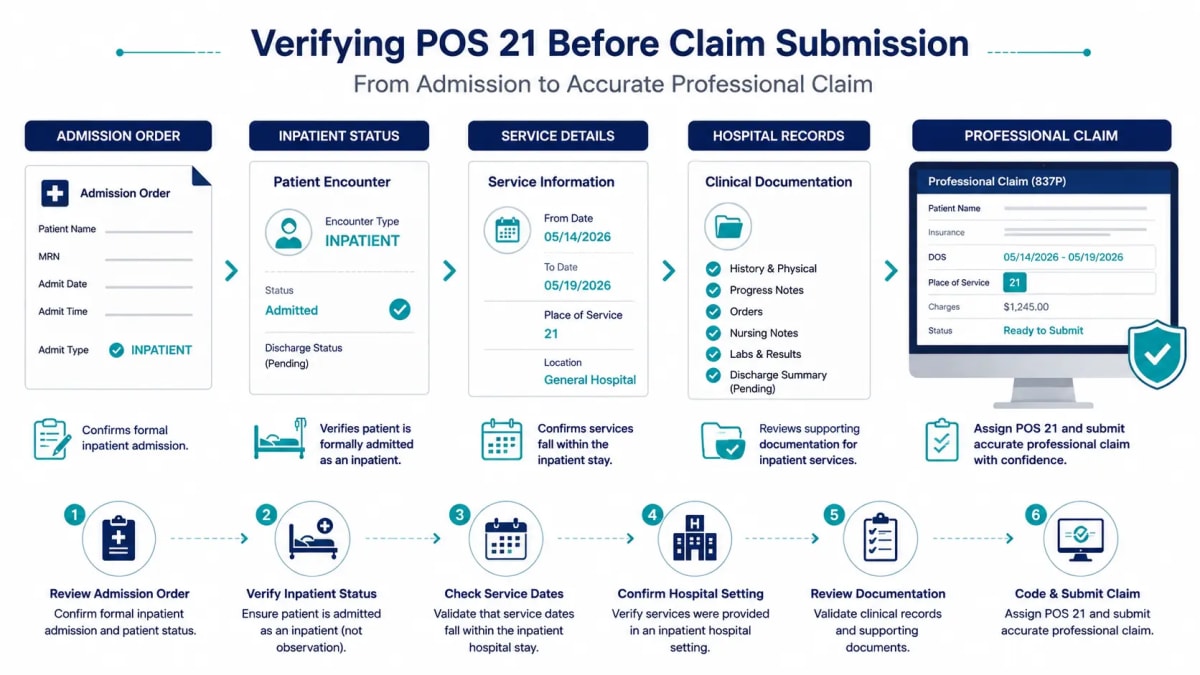
When to Use POS 21 on Claims
Use POS 21 for any professional service delivered to a patient with documented inpatient hospital admission status. This includes physician consultations, diagnostic tests, surgical procedures, and daily evaluation and management visits during the stay.
The patient must have an active inpatient admission. A patient who arrived three days ago and is still hospitalized under an admission order qualifies. A patient who was discharged yesterday does not. Once discharge happens, any follow-up care (even if the patient returns to the hospital later) codes to the appropriate outpatient place of service, not POS 21.
The facility where the service happens must be a general hospital. Psychiatric hospitals use POS 51. Indian Health Service facilities use POS 05 or 06. Military treatment facilities use POS 26. Using POS 21 for services delivered in these other settings triggers claim denials.
Some payers impose the "two-midnight rule" for Medicare inpatient admissions. If the patient's stay is expected to span at least two midnights, bill it as inpatient (POS 21). If the expected stay is less than two midnights, bill it as observation (POS 22) even if the patient actually stays overnight. Check your MAC (Medicare Administrative Contractor) guidance and individual payer policies because the two-midnight rule is a Medicare-specific medical necessity rule, not a universal standard.
Misusing POS 21 ranks among the top place-of-service mistakes that billing teams make. These errors consistently trigger denials, payment delays, and compliance issues.
Error 1: Coding observation patients as POS 21. A patient stays in the hospital overnight under observation status, never receives a formal inpatient admission, and the billing team codes it to POS 21 anyway. The claim gets denied or adjusted to POS 22 rates, which pay less. Verify the admission type before coding. Ask the hospital whether the patient has an inpatient admission order or observation status.
Error 2: Using POS 21 after discharge. A patient was admitted on Monday and discharged on Wednesday. The billing team submits a follow-up visit on Thursday using POS 21 because the patient was "just" in the hospital. Follow-up services after discharge never use POS 21. Use the appropriate outpatient code (usually POS 11 for office or POS 19/22 for hospital outpatient, depending on where the service happens).
Error 3: Not verifying inpatient status. Billing teams assume a patient is inpatient because the case is complex or the patient stayed overnight. Assumptions cause errors. Verify inpatient status against the hospital's admission paperwork or electronic records. A one-line note on a progress note saying "admitted" is not sufficient if the hospital's admission/discharge log shows the patient was actually under observation.
Error 4: Coding psychiatric inpatient care to POS 21. A patient admitted to the psychiatric unit of a general hospital still uses POS 51, not POS 21. The CMS definition explicitly excludes psychiatric services. Using POS 21 for psychiatric inpatient care violates coding rules and triggers denials.
Error 5: Mixing POS 21 with other place-of-service codes on the same claim. If a patient received services in the emergency room (POS 23) and was then admitted as an inpatient, bill the ER services to POS 23 and the inpatient services to POS 21 on separate claim lines. Never combine them under one place-of-service code.
Using the correct place-of-service code directly impacts how much a practice receives. POS 21 triggers facility rates under the Medicare Physician Fee Schedule because the hospital bills facility overhead separately. Outpatient codes like POS 22 trigger non-facility rates, which are lower. The difference between facility and non-facility rates on the same CPT code can be 20 to 40 percent.
Beyond Medicare, payers have their own reimbursement policies tied to place of service. Some Medicaid programs pay higher rates for inpatient services than outpatient. Some commercial plans require prior authorization for inpatient but not outpatient services. A single digit error on the claim (21 vs. 22) can change the entire payment logic.
Insurance companies also use place-of-service codes to track whether a practice follows billing regulations. If your claims show a pattern of misusing POS 21 for observation patients, the payer may flag your account for an audit. Audits cost time, staff resources, and potentially result in overpayment demands.
Additionally, POS 21 claims trigger specific coding rules. Modifier requirements, global period rules, and bundling edits differ between place-of-service codes. Using the wrong code can cause legitimate services to be bundled or rejected by payer contracts that apply only to certain places of service.
Prevent place-of-service errors by building verification and audit steps into your billing workflow.
Step 1: Verify admission status before billing. Contact the hospital's admitting office or access the electronic record to confirm whether the patient has inpatient admission status or observation status. Do not rely on assumptions or shorthand notes. Get written confirmation if possible.
Step 2: Maintain accurate admission and discharge documentation. Keep copies of the hospital's admission order, daily census, and discharge summary. These documents prove the dates and status of the inpatient stay if a payer denies or questions the claim later.
Step 3: Create a POS 21 verification checklist. Before submitting any claim using POS 21, verify that the patient was formally admitted (not observation), the service occurred during the admission period, the service was delivered by or under physician supervision, and the facility is a general hospital (not psychiatric or other specialty facility). Require billing staff to initial the checklist before claim submission.
Step 4: Audit claims quarterly. Pull a random sample of POS 21 claims and verify admission status against hospital records. If you find errors, retrain your billing team on the specific mistake (e.g., "we coded three observation cases to POS 21 last month; here is how to verify status correctly").
Step 5: Communicate with the hospital. If your practice bills for physicians who work in a hospital, establish a direct line to the hospital's billing or health information department. Ask them to flag observation cases so your team catches them before claim submission. Some hospitals send daily rosters identifying which patients are inpatient versus observation.
Step 6: Check payer policies. Not all payers follow the same rules for POS 21. Medicare has the two-midnight rule. Some state Medicaid programs have different rules. Some commercial plans require pre-authorization for inpatient services. Read each payer's billing guide for place-of-service-specific requirements.
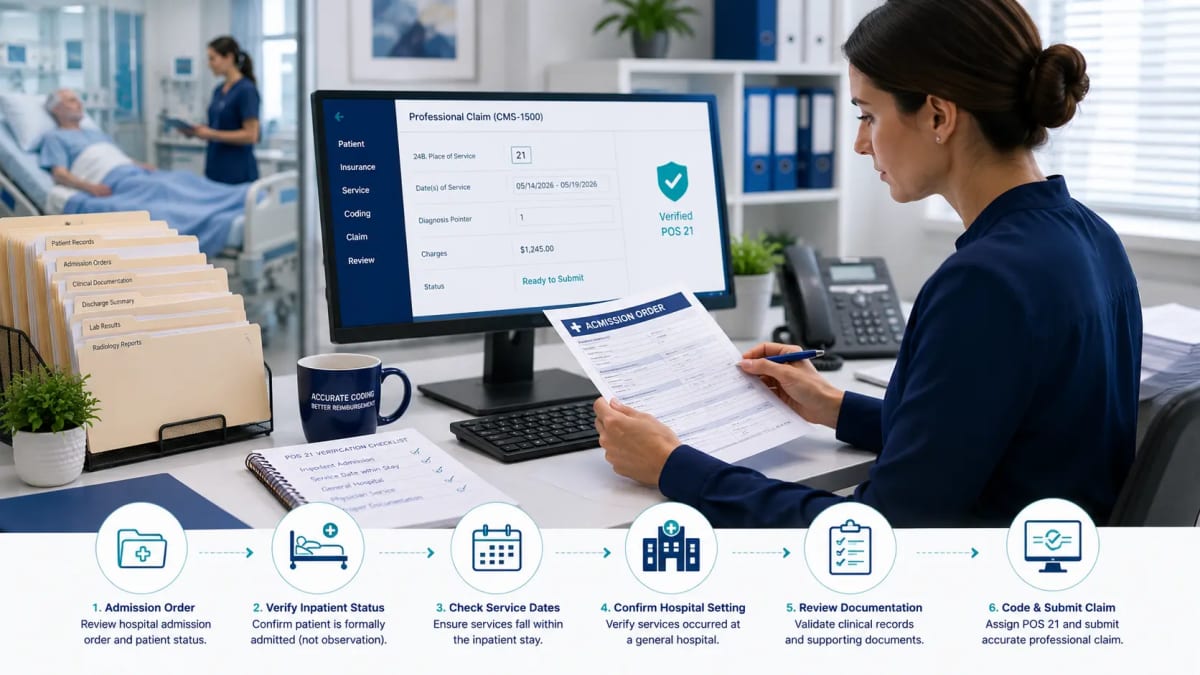
How to Handle Denied POS 21 Claims
Even careful billing teams receive occasional POS 21 denials. When this happens, act quickly to recover the claim.
Review the denial reason. The remittance advice (RA) or electronic explanation of benefits (EOB) should state why the claim was denied. Common reasons include "patient not in inpatient status on date of service," "place of service not appropriate for this service," or "observation status does not cover this service." The denial reason guides your correction.
Verify admission status. Pull the hospital's records and confirm when the inpatient admission began and ended. If the claim was submitted for a date outside the admission window (after discharge, for example), correct the service date or request a different place-of-service code if the service was actually outpatient.
Determine whether the patient was actually inpatient. If the denial states the patient was under observation, contact the hospital and confirm the admission type. If the hospital confirms observation status, your practice may owe a refund to the payer. Do not resubmit the same claim to POS 21 if the patient was actually observation; instead, resubmit to POS 22 (if the hospital was on-campus) or the appropriate outpatient code.
Resubmit with corrected information. Once you have corrected the place-of-service code or service date, resubmit the claim to the payer with documentation supporting the correction. Include a brief note explaining the change (e.g., "Claim resubmitted with corrected place of service. Attached is the hospital's admission record confirming inpatient status on 01/15/2026").
Track denial patterns. If you receive multiple POS 21 denials from the same payer or the same reason, it signals a training gap or process breakdown. Address the root cause so future claims don't get denied the same way.
Conclusion
POS 21 is the standard code for inpatient hospital services on professional claims, and getting it right directly affects your practice's revenue. The key distinction is formal inpatient admission status. A patient must have an admission order to qualify for POS 21, not just an overnight stay or observation. Verify admission status before billing, maintain documentation, and audit claims regularly to catch errors before they become denials.
Misusing POS 21 for observation patients, coding services after discharge, or mixing it with psychiatric admissions triggers predictable denials that cost your practice money and staff time. By following the verification steps and best practices outlined above, your billing team can eliminate most POS 21 errors and protect your revenue.
Ready to strengthen your medical billing processes and reduce claim denials? Mediknocx offers denial management services and medical billing audits designed to catch place-of-service errors and recover lost revenue. Book a free billing audit and see how we can improve your clean claim rate and cash flow.
Explore more medical billing guides, coding updates, and revenue cycle tips.
R53.83 is the ICD-10 code for fatigue, tiredness, lethargy, and lack of energy. Learn R53.81 malaise, R53.82 c...
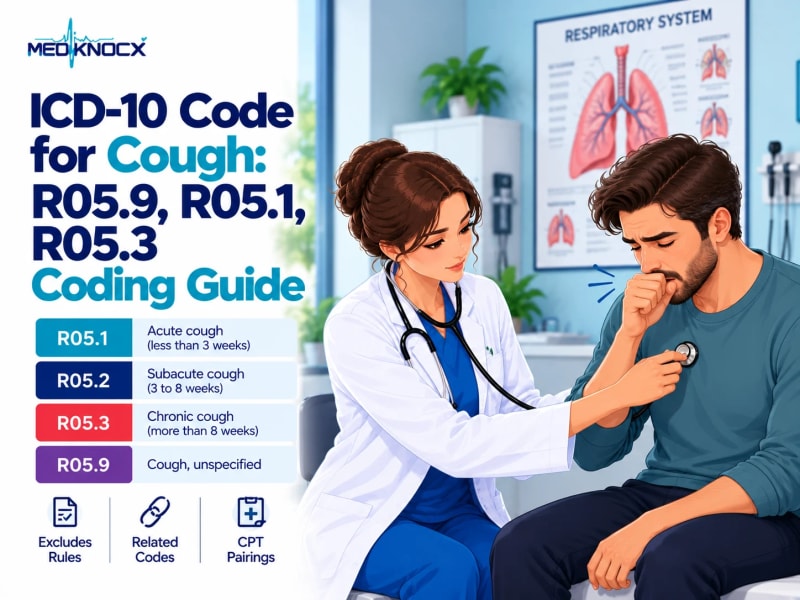
ICD-10 codes for cough by duration: R05.1 acute, R05.2 subacute, R05.3 chronic, R05.9 unspecified. Plus Exclud...
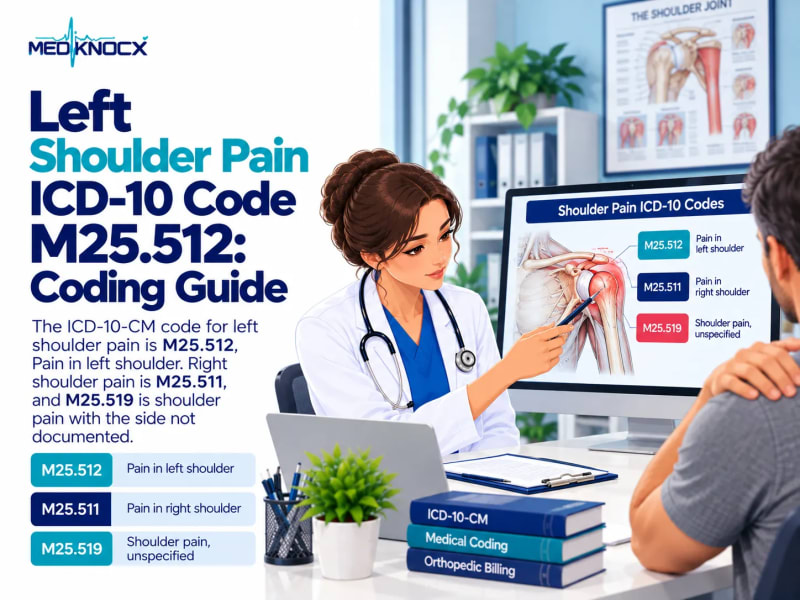
M25.512 is the ICD-10 code for left shoulder pain. See M25.511, M25.519, bilateral coding, scapula and clavicl...