Healthcare
Anemia ICD-10 Codes: D64.9, D50.9 and Complete Coding Guide
Every anemia ICD-10 code in one guide: D64.9, iron deficiency D50.9, blood loss D62, CKD anemia D63.1, pregnan...

Sep 30, 2026
1 min read

Jordan Taylor
September 30, 2026
Table of Contents
11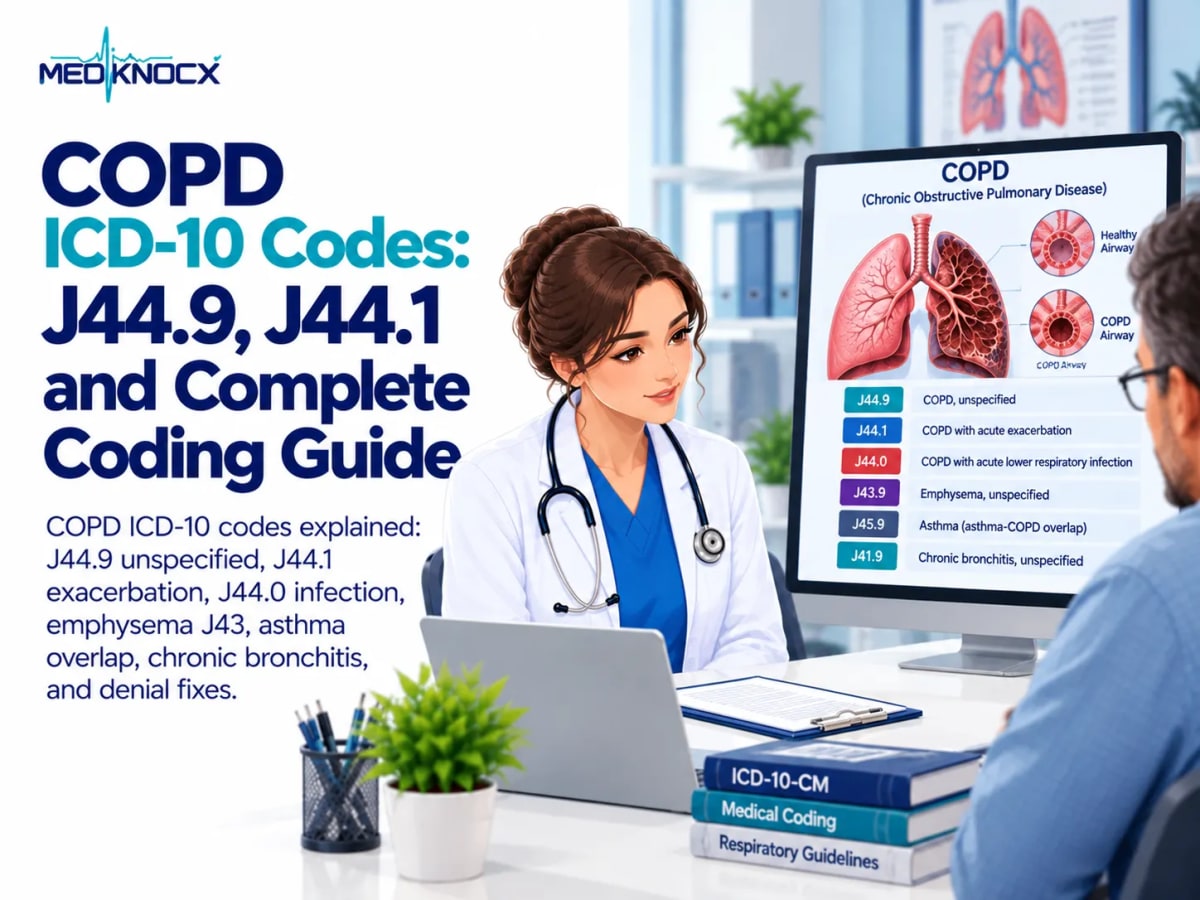
The ICD-10-CM code for chronic obstructive pulmonary disease, unspecified, is J44.9. COPD with an acute exacerbation is J44.1, and COPD with an acute lower respiratory infection, such as pneumonia or acute bronchitis, is J44.0. Those three cover most COPD claims, and J44.0 and J44.1 can be reported together when the patient has both an infection and a flare.
The harder decisions sit next to them. Emphysema is a type of COPD with its own category, J43, and often replaces J44 rather than joining it. Asthma with COPD has specific rules that many billing teams still get wrong. Chronic bronchitis codes differently depending on whether there's airway obstruction. And COPD claims carry risk adjustment and DRG weight, so the documentation behind them gets reviewed closely. This guide covers each of those.
Category J44 itself, and J44.8, are headers and can't go on a claim. J44.9 is the fallback when COPD is documented with nothing more specific, and it's the most overused code in the group.
J44, other chronic obstructive pulmonary disease, sits in Chapter 10 under chronic lower respiratory diseases. Its inclusion list explains why so many different phrases land here: asthma with COPD, chronic asthmatic (obstructive) bronchitis, chronic bronchitis with airway obstruction, chronic bronchitis with emphysema, chronic emphysematous bronchitis, chronic obstructive asthma, chronic obstructive bronchitis, and chronic obstructive tracheobronchitis all code to J44. So "obstructive lung disease," "chronic obstructive airways disease," and "chronic obstructive lung disease" in a note are all COPD for coding purposes.
The category also carries a use additional code instruction for tobacco and exposure history, which is easy to skip and matters for risk adjustment and quality reporting:
• F17.2- for nicotine dependence (F17.210 for cigarettes, uncomplicated)
• Z87.891 for a history of nicotine dependence
• Z72.0 for tobacco use
• Z77.22 for exposure to environmental tobacco smoke
• Z57.- for occupational exposure to dust or other risk factors
J44.9 is correct when COPD is documented and stable, with no exacerbation, no acute infection, and no more specific type named. "COPD without exacerbation" is J44.9.
Severity isn't coded. Mild, moderate, severe, very severe, GOLD stage 1 to 4, and end-stage COPD all use the same codes. Severity still belongs in the note, because it supports the E/M level, oxygen and pulmonary rehab coverage, and risk adjustment review.
"History of COPD" is usually still COPD. COPD is a chronic, progressive disease that doesn't resolve, so a patient with a past COPD diagnosis who's still being managed is coded J44.9 (or the more specific code), not a history code. A family history of COPD is Z82.5, family history of asthma and other chronic lower respiratory diseases.
The official guidelines draw a clear line: an acute exacerbation is a worsening or decompensation of the chronic condition. It is not the same thing as an infection on top of COPD, even though an infection can trigger one.
J44.1, COPD with (acute) exacerbation. Used when the provider documents a COPD exacerbation, flare, or decompensated COPD. The word "acute" is a nonessential modifier in the code title, so "COPD exacerbation" alone supports J44.1. What supports it clinically is worsening beyond day-to-day variation, usually increased breathlessness, cough, or sputum, with a change in treatment such as steroids, antibiotics, or more frequent bronchodilators.
J44.0, COPD with (acute) lower respiratory infection. Used when a patient with COPD has pneumonia, acute bronchitis, or another lower respiratory infection. J44.0 carries a code-also instruction, so the infection is coded too.
Both together. J44.1 has an Excludes2 note for J44.0, which means both can be reported when the provider documents an infection and an exacerbation. Common combinations:
For inpatient sequencing, the reason for admission decides which goes first. When pneumonia and COPD exacerbation both meet the definition of principal diagnosis, guidelines allow either, and the choice moves the claim between the pneumonia and COPD DRG families.
Symptoms are integral. Shortness of breath, wheezing, cough, and increased sputum are part of a COPD exacerbation and aren't coded separately. Hypoxemia is different; it isn't integral, and it's covered below.
Emphysema. Emphysema is a specific form of COPD and has its own category, J43. When the provider documents COPD with emphysema, AHA Coding Clinic directs J43 alone, most often J43.9, rather than J43 plus J44.9, since the emphysema code already describes the more specific disease. That same guidance applies to a COPD exacerbation in a patient with emphysema: J43 has no exacerbation subcode, and Coding Clinic assigns J43.9. The exception is chronic bronchitis with emphysema, which is specifically included in J44, so a patient documented with both chronic obstructive bronchitis and emphysema codes to J44, and to J44.1 when exacerbated.
Chronic bronchitis. It depends on obstruction. Chronic bronchitis with airway obstruction, chronic obstructive bronchitis, and chronic bronchitis with COPD are all included in J44. Chronic bronchitis without obstruction is J41.0 (simple), J41.1 (mucopurulent), or J42 (unspecified). An exacerbation of chronic obstructive bronchitis is J44.1. Recurrent acute bronchitis without chronic bronchitis or COPD is coded as acute bronchitis each time.
Asthma with COPD, or asthma COPD overlap. J44 includes asthma with COPD and has a code-also note for the type of asthma. How that plays out:
That third row trips up a lot of teams. Coding Clinic has said unspecified asthma isn't a "type" of asthma, so pairing J44.9 with J45.909 for asthma COPD overlap isn't correct. Unspecified asthma in acute exacerbation is different: J45.901 is added because it identifies the exacerbated state.
Bronchiectasis. COPD with bronchiectasis codes to category J47, not J44. J47.1 covers bronchiectasis with exacerbation and J47.0 with acute lower respiratory infection.
Bronchiolitis obliterans, J44.81. Used for obliterative bronchiolitis and bronchiolitis obliterans syndrome, often after a lung, heart-lung, or stem cell transplant. The transplant complication code, such as T86.810 for lung transplant rejection, is sequenced first when it applies.
These aren't part of the COPD code, so they're reported separately when the provider documents and addresses them.
COPD with hypoxia. "COPD with hypoxia" or "hypoxemic" in the note is J44.x plus R09.02. If the provider goes further and diagnoses chronic hypoxic respiratory failure, J96.11 replaces R09.02. Both conditions add weight to the claim, and both need their own documented findings, such as oxygen saturation or blood gas values, to hold up on review.
Type 2 myocardial infarction. When a COPD exacerbation causes a supply and demand MI, the COPD code goes first and I21.A1 follows, per the code-first note under I21.A1.
Other lung disease. "Chronic lung disease" without a named disease isn't automatically COPD. Code what the provider specifies, and query when the note only says chronic lung disease in a patient who clearly has COPD on spirometry.
Spirometry-confirmed obstruction in the note is what supports COPD across all of these, and it's what reviewers look for first when a COPD diagnosis is questioned.
Inpatient. COPD as the principal diagnosis groups to MS-DRG 190, 191, or 192, chronic obstructive pulmonary disease with MCC, with CC, or without CC or MCC. J44.1 is itself a CC when reported as a secondary diagnosis.
Risk adjustment. J44 and J43 codes map to CMS-HCC V28 HCC 280, chronic obstructive pulmonary disease, interstitial lung disorders, and other chronic lung disorders. HCCs reset every year, so COPD has to be documented and addressed at a face-to-face visit each calendar year to count. A problem list entry isn't enough; the note should show the condition is being monitored, evaluated, assessed, or treated, such as "COPD, stable on tiotropium, spirometry reviewed, continue current inhaler."
• The diagnosis in words: COPD, emphysema, chronic obstructive bronchitis, or asthma COPD overlap
• Status: stable, exacerbation, or with an acute infection, and what the infection is
• Supporting evidence: spirometry results, oxygen saturation, imaging when relevant
• Asthma type, if asthma is also present, since it decides whether a J45 code is added
• Related conditions: hypoxemia, respiratory failure, oxygen use, pulmonary hypertension
• Tobacco status: current smoker, former smoker, pack-years
• Treatment and plan: inhalers, steroids, antibiotics, oxygen, rehab, follow-up
Most of these are selection errors caught before submission by a medical coding review that checks the code against the note. COPD is also one of the most common conditions in chronic care management billing, where monthly care coordination for patients with COPD and another chronic condition can be billed on its own. And when pulmonary rehab, oxygen, or DME claims keep denying, trace the pattern through denial management to find whether it's documentation, qualification testing, or coding.
• CMS, ICD-10-CM official code files and guidelines, FY2026 code set effective October 1, 2025, with the April 1, 2026 update
• CMS, MS-DRG classifications and software, version 43
• AHA Coding Clinic for ICD-10-CM/PCS, 2017, first and fourth quarters, on asthma with COPD and emphysema with COPD
J44.9, chronic obstructive pulmonary disease, unspecified, when there's no exacerbation, infection, or more specific type documented.
J44.1. The word "acute" doesn't need to appear; "COPD exacerbation" supports it.
COPD with an acute lower respiratory infection, such as pneumonia or acute bronchitis. The infection is coded as well.
Yes, when the provider documents both an acute lower respiratory infection and a COPD exacerbation.
J43.9 (or a more specific J43 code) alone, since emphysema is a specific form of COPD.
The J44 code plus the J45 code for the asthma type when the type is documented. With asthma of unspecified type, J44.89 alone; J45.909 isn't added.
J42 for unspecified chronic bronchitis without obstruction, J41.0 or J41.1 for simple or mucopurulent. Chronic bronchitis with airway obstruction or COPD is J44.
J44.0 plus the pneumonia code, such as J18.9, and J44.1 as well if an exacerbation is documented.
No. Severity and GOLD stage don't change the code; they belong in the documentation.
The J44 code plus R09.02 for hypoxemia, or J96.11 if the provider diagnoses chronic respiratory failure with hypoxia.
Explore more medical billing guides, coding updates, and revenue cycle tips.
Every anemia ICD-10 code in one guide: D64.9, iron deficiency D50.9, blood loss D62, CKD anemia D63.1, pregnan...
Learn what POS 20 means in medical billing, when to use it, POS 20 vs POS 11 and 23, CPT codes, Medicare billi...

E55.9 is the ICD-10 code for vitamin D deficiency. Covers screening (Z13.21), history, pregnancy, CPT 82306 vs...