Healthcare
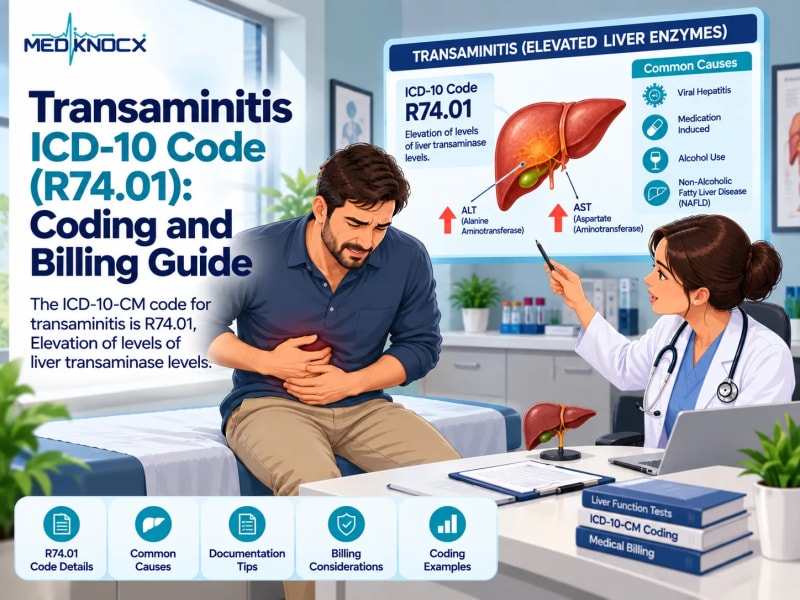
Transaminitis ICD-10 Code (R74.01): Coding and Billing Guide
R74.01 is the ICD-10 code for transaminitis and elevated ALT or AST. Learn R74.01 vs R74.8 and R94.5, drug-ind...

Sep 28, 2026
1 min read

Jordan Taylor
September 28, 2026
Table of Contents
11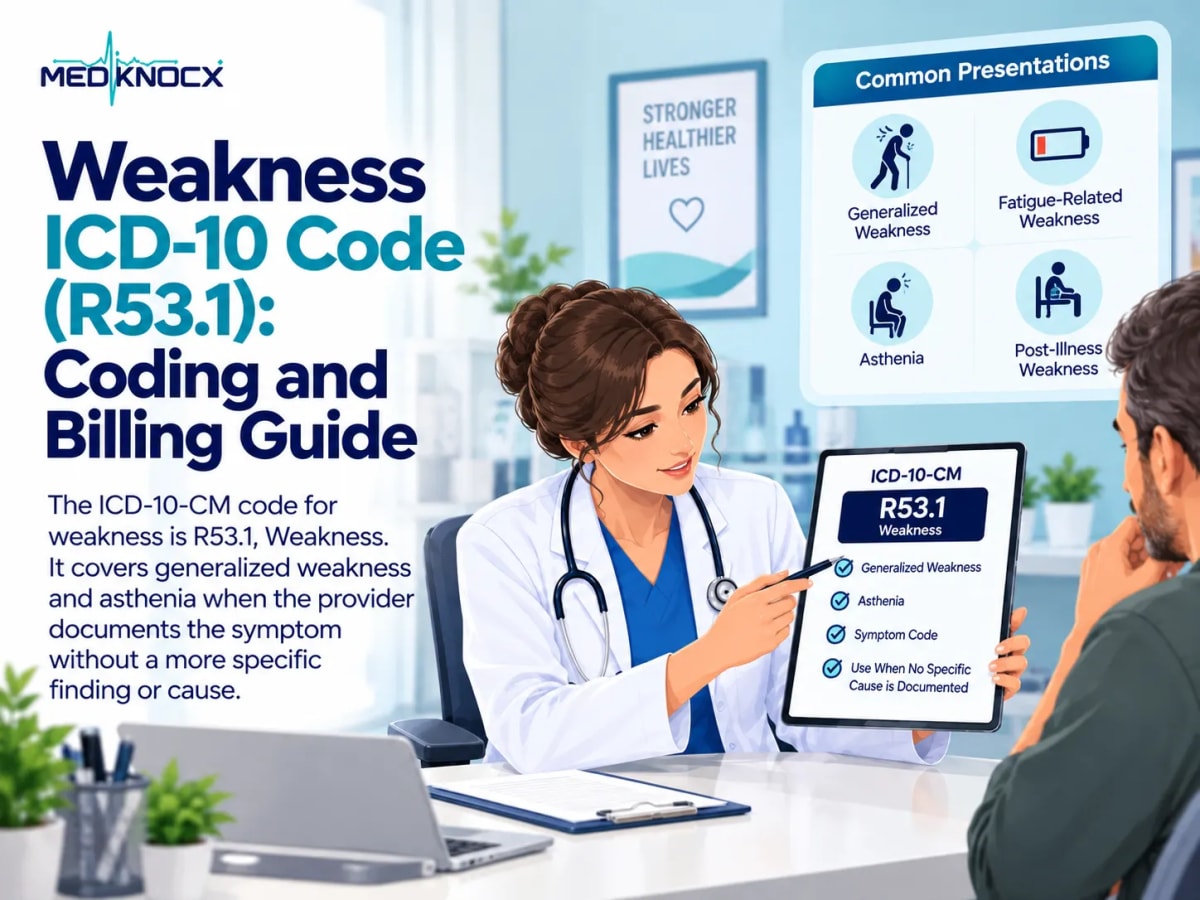
The ICD-10-CM code for weakness is R53.1, Weakness. It covers generalized weakness and asthenia when the provider documents the symptom without a more specific finding or cause. It's billable, and it's been part of ICD-10-CM since the code set began in 2015.
The decision that matters is whether R53.1 is the right weakness code at all. Documented muscle weakness on exam is M62.81. Weakness the provider attributes to aging is R54. Fatigue and lack of energy are R53.83, and general malaise or debility is R53.81. R53.1 carries an Excludes1 note against M62.81, R54, and sarcopenia, so it can't sit on the same claim as any of them. This guide explains how to tell them apart and how each one holds up on physical therapy and primary care claims.
R53.1 sits in Chapter 18 under R53, malaise and fatigue. Its inclusion term is asthenia NOS, and the Alphabetic Index sends "weakness, generalized" here. There's no acute, chronic, or severity variant.
The part most guides miss is the Excludes1 note. R53.1 can't be reported with:
• M62.81, muscle weakness (generalized)
• M62.84, sarcopenia
• R54, age-related weakness and senile asthenia
Excludes1 means the conditions are mutually exclusive, not just "usually coded separately." When the note supports one of those three, it replaces R53.1 rather than joining it. A claim carrying R53.1 alongside M62.81 isn't more thorough; it's contradictory, and payer edits treat it that way.
The patient's words are often the same in every case: "I feel weak." The code depends on what the provider found and concluded.
R53.1 vs M62.81. This is the distinction that matters most. R53.1 is the symptom as reported, generalized weakness without a measurable finding. M62.81 is decreased muscle strength that the provider has actually assessed, typically graded on exam, such as 4/5 strength in the hip flexors bilaterally. If the exam documents reduced strength, it's M62.81. If the note describes feeling weak with a normal strength exam, or no strength exam, it's R53.1.
R53.1 vs R54. R54 applies when the provider attributes the weakness or frailty to aging: "age-related debility," "frailty of old age," "senile asthenia." Patient age alone doesn't make it R54. An 84-year-old with new weakness that's being worked up is still R53.1 until the provider says otherwise.
R53.1 vs R53.83. Weakness is loss of strength; fatigue is loss of energy. "Tired all the time, no energy" is R53.83. "Legs feel weak climbing stairs" is weakness. When the provider documents both as separate complaints, both can be coded, since R53.83 isn't in the R53.1 Excludes1 list.
R53.1 vs R53.81. R53.81 is malaise and debility, a general sense of being unwell or run down, often after illness. It's broader than weakness and fits notes like "generalized debility after hospitalization."
M62.84, sarcopenia. Used when the provider diagnoses sarcopenia, usually based on reduced muscle mass and strength in an older adult. It excludes R53.1 as well.
Weakness on one side of the body, in one limb, or in the face often points to a neurologic cause, and those have their own codes.
When the provider documents focal weakness with no diagnosis yet, the coder follows the exact wording in the Alphabetic Index rather than defaulting to R53.1, and queries if a neurologic cause is being considered but not stated. Facial weakness is the one focal symptom with a clear dedicated code.
R53.1 is a symptom code. Once the provider confirms the cause, that diagnosis is coded, and weakness that's part of it comes off. Common examples:
• Anemia (D64.9 or the specific type)
• Hypothyroidism (E03.9)
• Low potassium (E87.6)
• Dehydration (E86.0)
• Myasthenia gravis (G70.00 or G70.01)
• Deconditioning after illness, coded from the provider's wording and often reported with R53.81
Weakness stays on the claim only if the provider treats it as its own problem, for instance weakness out of proportion to the diagnosis or weakness being addressed with physical therapy. Electrolyte causes come up often; our hypokalemia ICD-10 guide covers how E87.6 is coded and sequenced.
Rehab is where the R53.1 versus M62.81 choice has the most financial weight. Therapy is paid for treating a measurable deficit, and M62.81 describes one: reduced strength that the evaluation grades and the plan of care targets. R53.1 describes a complaint. Many payers, and most therapy medical reviewers, look for M62.81 or a functional code as the treatment diagnosis rather than R53.1.
A well-built therapy claim usually carries:
• The underlying condition the referring provider documents, such as a hip fracture aftercare code, heart failure, or Parkinson disease
• M62.81 when the evaluation documents graded strength deficits
• A functional code where it applies: R26.2 difficulty walking, R26.81 unsteadiness on feet, R26.89 other gait abnormality, or Z91.81 history of falling
The evaluation needs objective numbers (manual muscle test grades, timed tests, gait measures), and progress notes need to show those numbers changing. A plan that says "generalized weakness, strengthening program" without measurements is what gets therapy claims denied.
In a primary care workup, R53.1 supports the office visit and common labs until a cause is found: CBC (85025), comprehensive metabolic panel (80053), TSH (84443), and vitamin B12 (82607), for example. The note should say why each test was ordered.
On inpatient claims, R53.1 as the principal diagnosis groups to MS-DRG 947 or 948, signs and symptoms with or without MCC. That's uncommon because most admissions for weakness end with a diagnosis, such as a urinary infection, dehydration, or stroke, and that diagnosis should be principal at discharge.
• The complaint in the patient's terms, and whether it's weakness, fatigue, or both
• Onset and course: sudden or gradual, days or months, getting worse or stable
• Distribution: generalized, one side, one limb, face
• A strength exam: graded where possible, since it decides R53.1 versus M62.81
• Function: walking, stairs, getting up from a chair, falls
• The provider's impression in words: generalized weakness, muscle weakness, deconditioning, age-related debility, or a diagnosed cause
• The plan: labs, imaging, referral, or therapy, and why
The most common gap is a normal-looking claim built on a thin note: "weakness" in the assessment, no strength exam, and a therapy referral. The coder can only choose R53.1, and the therapy claim that follows starts on weak ground.
All of these are selection errors that a pre-submission medical coding review catches by checking the code against the exam. When therapy claims keep coming back on medical necessity, trace them through denial management to see whether the gap is in the referral, the evaluation, or the coding.
• CMS, ICD-10-CM official code files and guidelines, FY2026 code set effective October 1, 2025, with the April 1, 2026 update
• CMS, MS-DRG classifications and software, version 43
R53.1, Weakness, for generalized weakness or asthenia without a more specific finding or cause.
R53.1. If the provider documents reduced muscle strength on exam, M62.81, muscle weakness (generalized), applies instead.
R53.1 is the reported symptom. M62.81 is muscle weakness the provider has assessed on exam. They can't be billed together.
No. R53.1 has an Excludes1 note for M62.81, as well as for R54 and M62.84.
R54, age-related physical debility, when the provider attributes it to aging. Otherwise R53.1 or M62.81 based on the note.
R53.83, other fatigue. Malaise and debility are R53.81.
R29.810.
For hemiplegia or hemiparesis as a lasting effect of a stroke, I69.35- by side and dominance. During an acute stroke, the weakness is part of the I63 code.
M62.81 with the underlying condition, and a functional code such as R26.2 or R26.81 where it applies, backed by graded strength measures.
Yes. It's a billable code in the current ICD-10-CM code set.
Explore more medical billing guides, coding updates, and revenue cycle tips.
R74.01 is the ICD-10 code for transaminitis and elevated ALT or AST. Learn R74.01 vs R74.8 and R94.5, drug-ind...
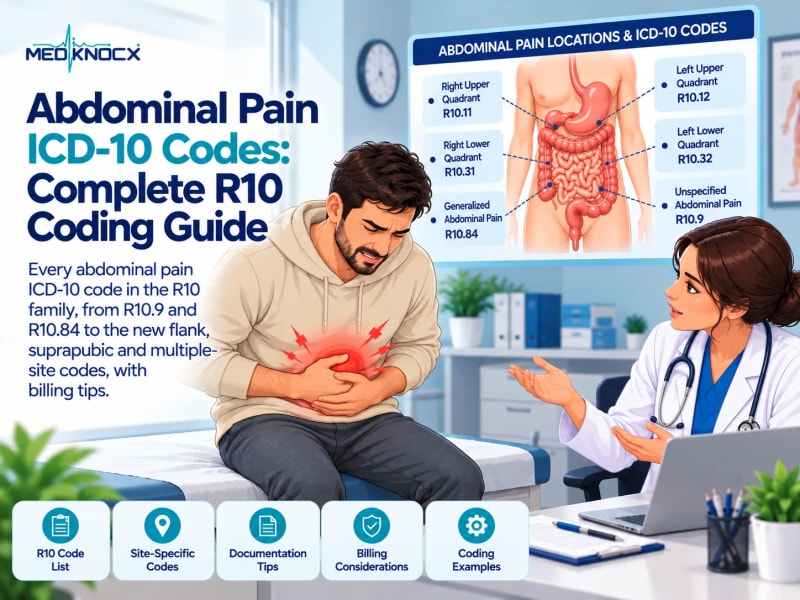
Every abdominal pain ICD-10 code in the R10 family, from R10.9 and R10.84 to the new flank, suprapubic and mul...

R19.7 is the ICD-10 code for diarrhea, unspecified. Learn when to use K52.9, A09, K58.0, K59.1, C. diff and tr...