Healthcare
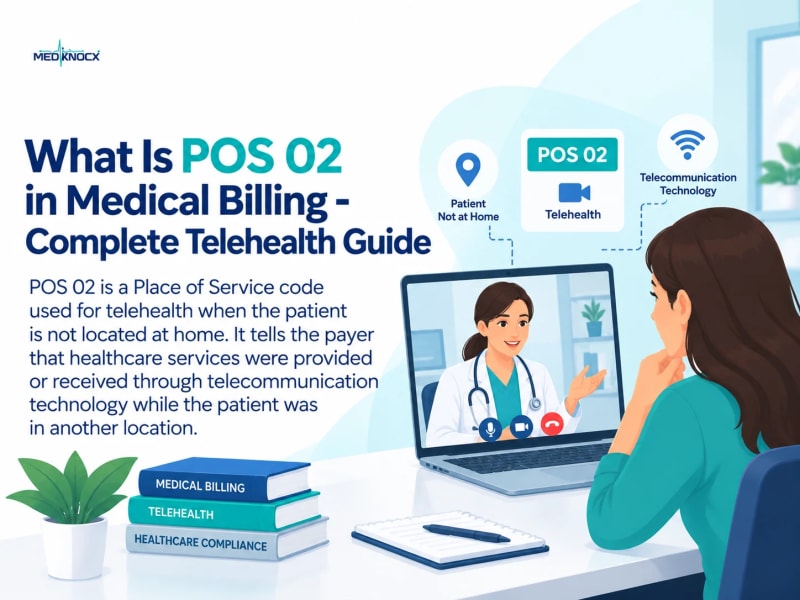
What Is POS 02 in Medical Billing - Complete Telehealth Guide
Learn what POS 02 means in medical billing, when to use it for telehealth, how it differs from POS 10, and com...

Sep 18, 2026
1 min read

Jordan Taylor
August 5, 2026
Table of Contents
16
CPT Code 99396 reports a comprehensive preventive medicine evaluation and management (E/M) service for an established patient aged 40 to 64 years. The service includes an age and gender appropriate history, physical examination, preventive counseling, risk factor assessment, and personalized health recommendations. Accurate ICD-10-CM coding and medical coding services, proper modifier usage, complete documentation, and payer-specific billing guidelines are essential to prevent claim denials and ensure timely reimbursement.
This guide explains everything you need to know about CPT Code 99396, including when to use it, who can bill it, covered services, ICD-10-CM pairing, Medicare coverage, Modifier 25 and Modifier 33 requirements, common claim denials, documentation best practices, and proven strategies to improve reimbursement while maintaining compliance. If your practice struggles with reimbursement issues, our Denial Management Services can help reduce preventable denials and improve first-pass claim acceptance.
CPT Code 99396 is a preventive medicine service code used for an established patient between 40 and 64 years of age.
Unlike problem oriented E/M codes, CPT 99396 focuses on preventive healthcare. The purpose of the visit is to assess the patient's overall health, identify risk factors, update medical history, perform an appropriate examination, and recommend preventive screenings or counseling.
The code represents a comprehensive preventive visit rather than treatment for a specific illness.
Patients often receive these visits annually, although coverage depends on the payer's policy.
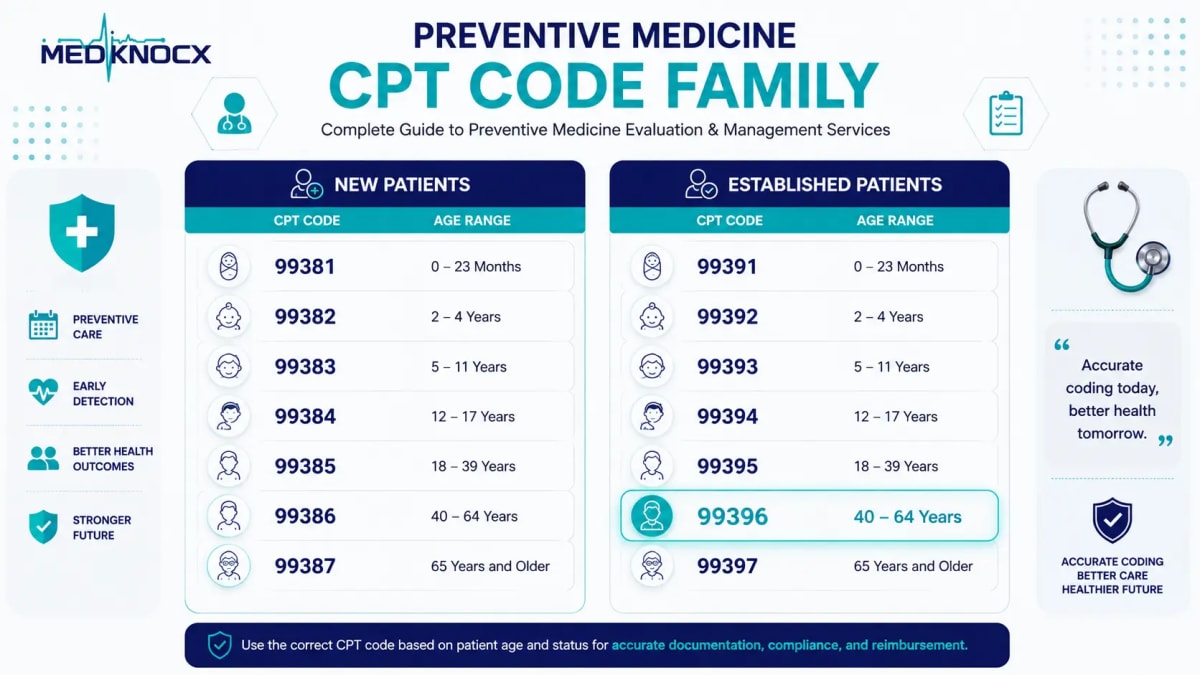
Preventive Medicine CPT Code Family
Quick Tip: An established patient has received professional services from the physician or another physician of the same specialty within the same group practice during the previous three years, according to the CPT® Evaluation and Management guidelines.
Understanding what CPT Code 99396 covers helps practices code preventive visits correctly and avoid billing errors.
A preventive visit typically includes:
Comprehensive age appropriate medical history
Family history review
Social history review
Preventive physical examination
Vital signs assessment
Risk factor identification
Health risk assessment
Counseling on healthy lifestyle choices
Preventive screening recommendations
Immunization review
Personalized preventive care plan
The provider may also discuss topics such as nutrition, exercise, tobacco cessation, alcohol use, and recommended cancer screenings based on the patient's age and risk factors.
CPT Code 99396 does not automatically include:
Evaluation of a new medical complaint
Management of chronic diseases
Diagnostic procedures
Minor surgical procedures
Laboratory testing
Diagnostic imaging
Separate counseling services reported with other CPT codes when appropriate, including CPT Code 99401 when documentation supports a distinct preventive counseling service
If the provider evaluates a significant new or existing medical problem during the same visit, a separate problem oriented E/M service may be reported when documentation supports it.
Several qualified healthcare professionals may report CPT Code 99396 when they perform and document the preventive service according to payer requirements.
Eligible providers may include:
Family medicine physicians
Internal medicine physicians
General practitioners
Nurse practitioners
Physician assistants
Obstetrician gynecologists
Preventive medicine physicians
Other qualified healthcare professionals recognized by the payer
Always verify payer specific credentialing requirements before billing preventive medicine services.
Depending on payer policy, CPT Code 99396 may be billed in settings such as:
Physician offices
Primary care clinics
Community health centers
Hospital outpatient departments
Rural Health Clinics according to payer rules
The place of service should accurately reflect where the preventive visit occurred.
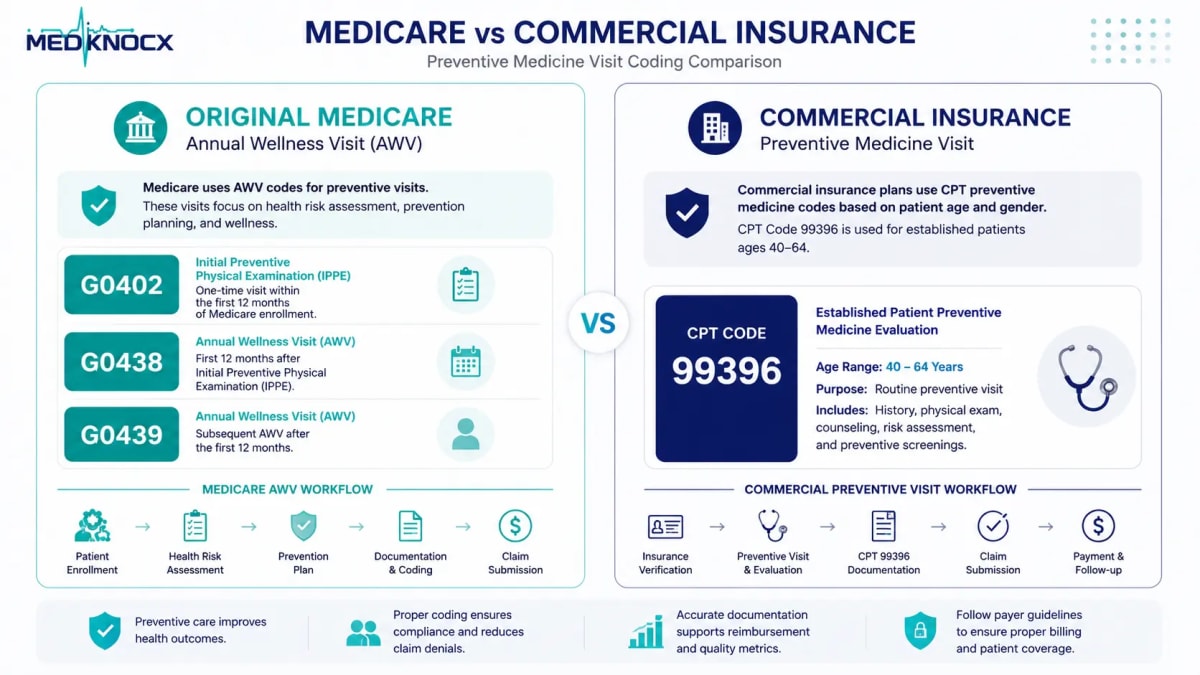
Original Medicare generally does not reimburse preventive medicine CPT codes 99381 through 99397.
Instead, Medicare provides coverage for specific preventive wellness services using dedicated HCPCS codes.
These services differ from CPT Code 99396 because they focus on preventive planning rather than a comprehensive preventive physical examination.
Medicare Advantage plans may choose to cover preventive physical examinations beyond Original Medicare benefits.
Coverage varies by plan.
Always verify patient eligibility and plan benefits before submitting a claim.
Providers offering Chronic Care Management should also verify Medicare coverage requirements for CCM services before billing preventive and chronic care services during the same period.
When Original Medicare excludes CPT Code 99396 because it is a statutory benefit exclusion, an Advance Beneficiary Notice (ABN) is generally voluntary rather than mandatory.
Providers should follow current CMS guidance and their organization's compliance policies when determining whether an ABN is appropriate.
Many commercial insurance plans cover preventive services under the Affordable Care Act (ACA) when patients receive services from participating providers.
Coverage depends on several factors, including:
Health plan benefits
Network participation
Patient eligibility
Frequency limitations
Medical necessity requirements for additional services
Some insurers allow one preventive visit per calendar year, while others apply a 365 day interval.
Understanding this distinction prevents unnecessary claim denials.
Calendar Year vs 365 Day Rule
Scheduling a preventive visit too early is a common reason for payer denials.
Practices should verify preventive visit eligibility before the appointment.
Selecting the correct diagnosis code supports medical necessity and improves claim accuracy.
Common ICD-10-CM codes include:
Additional screening diagnosis codes may also apply depending on the preventive services performed.
Examples include:
Z13.220 for lipid disorder screening
Z12.11 for colorectal cancer screening
Other screening or preventive diagnosis codes supported by the patient's clinical documentation
Providers should assign diagnosis codes that accurately reflect the services documented during the encounter.
Improper diagnosis sequencing may delay reimbursement or trigger payer edits.
For condition-specific diagnosis coding examples, see our guides on ICD-10 Code for Benign Prostatic Hyperplasia (BPH) and ICD-10 Code for UTI.
A patient may schedule a preventive visit but also require evaluation of a separate medical condition.
In these situations, providers may report CPT Code 99396 together with an appropriate problem oriented E/M code when documentation clearly supports both services.
To report both services correctly:
Document the preventive examination separately.
Document the problem oriented evaluation separately.
Show that the additional work was significant and medically necessary.
Apply Modifier 25 to the problem oriented E/M code when payer guidelines require it.
Providers should avoid double counting the same work under both codes.
For preventive services covered under the Affordable Care Act, incorrect use of Modifier 25 may affect the patient's cost sharing responsibility. Practices should understand payer specific billing policies before reporting both services.
Another modifier that may apply in preventive care is Modifier 33, which identifies eligible preventive services when required by the payer.
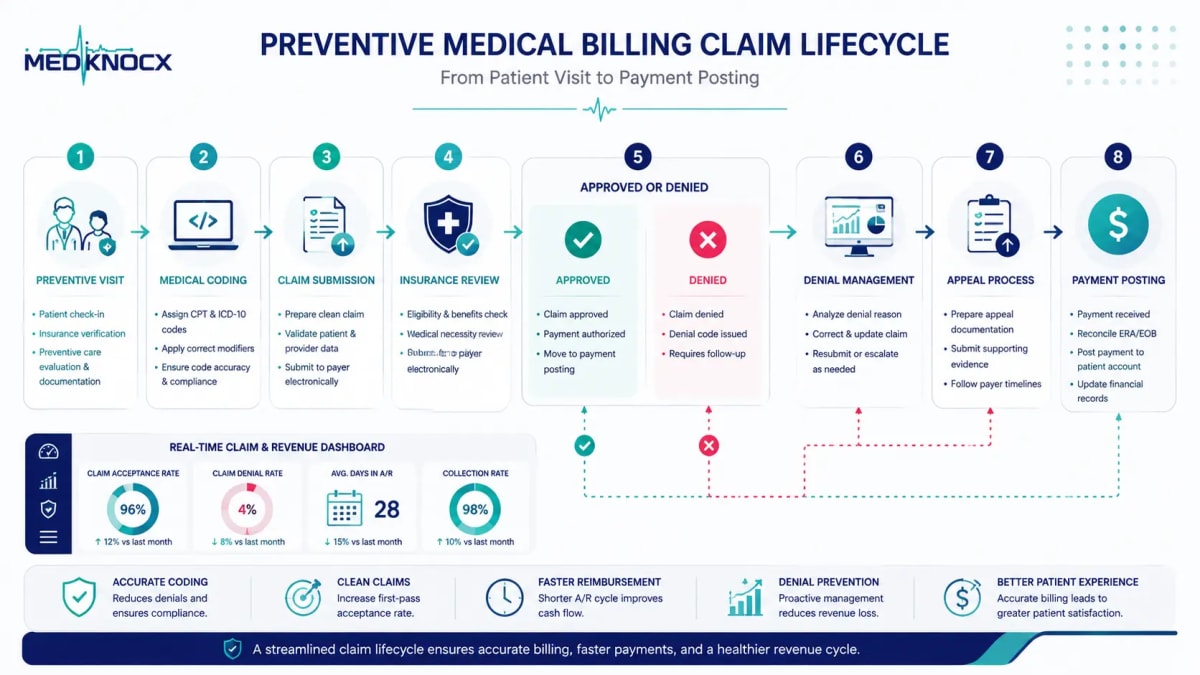
Even when providers document preventive visits correctly, claims may still face rejection or denial. Most denials result from avoidable billing mistakes, incorrect coding, or payer policy violations.
Understanding the cause helps billing team correct issues quickly and improve first-pass claim acceptance.
The exact CARC and RARC codes vary by payer. Always review the payer's remittance advice and claim policy before appealing a denial.
Reduce denials by following these best practices:
Verify insurance eligibility before the visit.
Confirm preventive benefit frequency.
Select the correct patient status.
Pair CPT and ICD-10-CM codes accurately.
Review documentation before claim submission.
Use claim scrubbing tools to identify errors.
Monitor payer edits regularly.
Appeal incorrect denials with supporting documentation.
A structured denial management process improves reimbursement and reduces administrative work.
There is no standard national price for CPT Code 99396.
The amount paid depends on several factors, including:
Insurance payer
Geographic location
Provider contract
Place of service
Medicare locality
Commercial fee schedules
Avoid relying on estimated reimbursement figures from blogs or unofficial sources.
Instead, verify payment using trusted resources such as:
Commercial payer fee schedules
FAIR Health Consumer cost estimator
Your organization's contracted reimbursement rates
Checking official payment sources provides more accurate reimbursement expectations than generalized price ranges.
In most situations, CPT Code 99396 is not routinely reported for telehealth because the code describes a comprehensive preventive medicine service that generally includes an in-person physical examination.
However, telehealth coverage continues to evolve.
Some commercial insurance plans may reimburse preventive counseling delivered through telehealth, while others require an in-person visit.
Before billing telehealth services, practices should verify:
Current payer policy
Federal and state regulations
Place of service requirements
Telehealth modifier requirements
Documentation standards
Never assume all preventive visits qualify for telehealth reimbursement.
Always confirm coverage before claim submission.
Choosing the correct preventive code prevents billing errors and payer edits.
Patient age determines the appropriate preventive medicine code.
These services are not interchangeable.
Preventive medicine codes and preventive counseling codes serve different purposes.
Providers should report the code that best matches the documented service. When coding similar preventive services, accurate medical coding helps ensure proper code selection and reduces billing errors.
Complete documentation supports accurate coding and reduces audit risk.
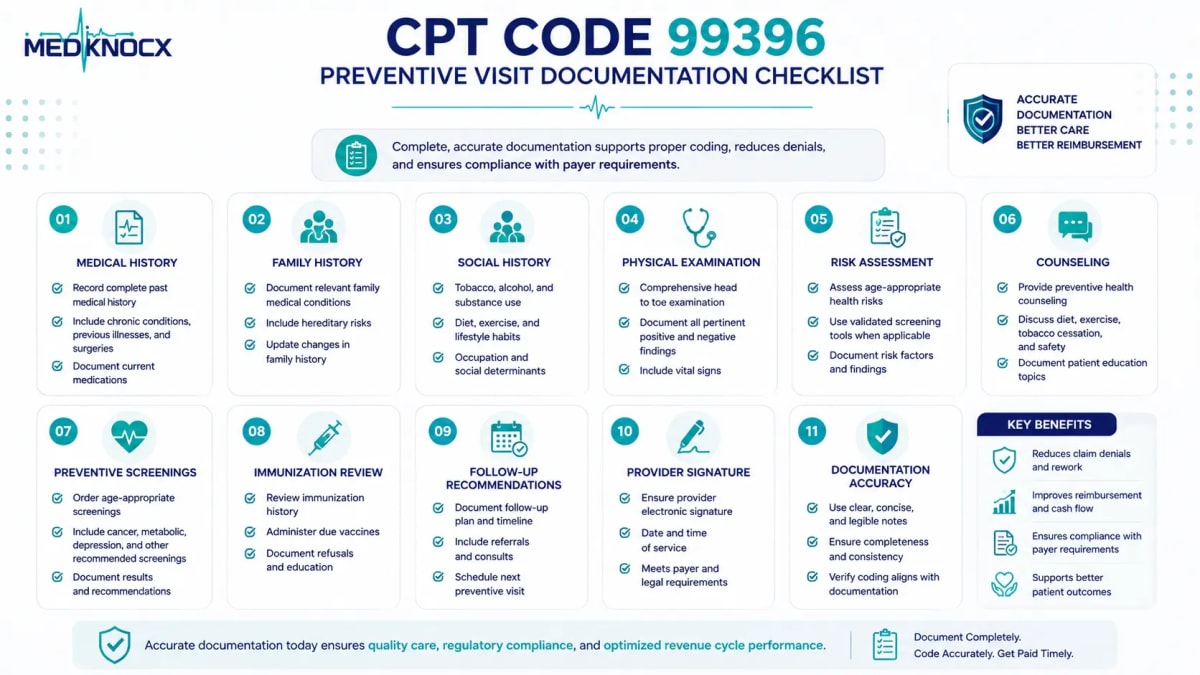
Every preventive visit should include:
✔ Chief purpose of preventive visit
✔ Comprehensive medical history
✔ Family history
✔ Social history
✔ Medication review
✔ Allergy review
✔ Preventive physical examination
✔ Risk factor assessment
✔ Counseling provided
✔ Recommended screenings
✔ Immunization review
✔ Follow-up recommendations
✔ Provider signature
If a separate problem-oriented E/M service is reported, document it independently to support accurate coding and reimbursement.
Add-On Screening Codes Commonly Reported With CPT 99396
Depending on the patient's condition and payer policy, providers may report additional screening services during the preventive visit.
Common examples include:
These services require separate documentation and must satisfy payer billing requirements.
Medical necessity and documentation remain essential for reimbursement.
Preventive medicine services receive regular attention during payer audits.
Common compliance risks include:
Reporting the wrong age-based CPT code
Incorrect patient status
Insufficient documentation
Upcoding preventive visits
Billing problem-oriented services without separate documentation
Improper Modifier 25 use
Duplicate billing
Missing preventive diagnosis codes
Regular coding audits help practices identify billing trends before they affect revenue.
Compliance reviews also improve documentation quality and reduce future denials.
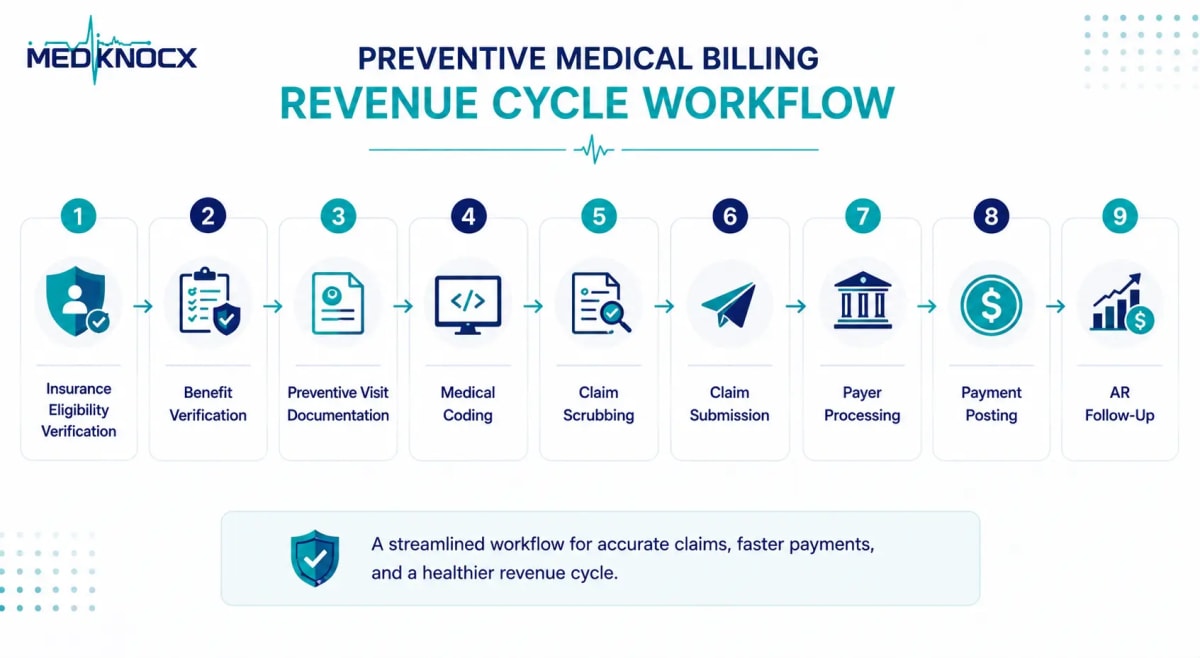
Practices can reduce preventable denials by following a consistent workflow.
Verify patient insurance eligibility.
Confirm preventive visit benefits and frequency.
Review patient history before the appointment.
Document the preventive service completely.
Assign accurate CPT and ICD-10-CM codes.
Apply modifiers only when supported.
Use claim scrubbing software before submission.
Monitor claim status after submission.
Respond quickly to payer requests.
Appeal incorrect denials with supporting documentation.
This workflow improves claim accuracy and strengthens revenue cycle performance.
Sources
This article is based on guidance from authoritative healthcare resources, including:
Practices should also review individual payer policies because coverage and billing requirements may vary.

Improve Preventive Visit Billing Accuracy with Mediknocx
Accurate preventive medicine billing requires more than selecting the correct CPT code. It also depends on proper documentation, diagnosis coding, modifier usage, payer compliance, and proactive denial prevention.
Mediknocx helps healthcare providers improve coding accuracy, reduce claim denials, optimize preventive medicine billing, and strengthen overall revenue cycle performance through expert Medical Coding, Denial Management, and Medical Billing Services.
It covers a comprehensive preventive medicine evaluation and management service for an established patient aged 40 to 64 years.
Original Medicare generally does not reimburse CPT 99396. Instead, it covers Annual Wellness Visits using HCPCS codes G0402, G0438, and G0439.
Yes. You may report a separate problem-oriented E/M service when documentation supports a significant and separately identifiable evaluation.
Common diagnosis codes include Z00.00 and Z00.01. Additional screening codes may apply based on the services provided.
The frequency depends on the patient's insurance plan. Some payers follow a calendar-year rule, while others require a full 365-day interval.
Most preventive visits do not require prior authorization, but payer policies may differ.
Coverage varies by payer. Most preventive physical examinations still require an in-person visit unless a payer specifically allows telehealth reimbursement.
CPT 99396 reports a preventive physical examination, while G0439 reports a Subsequent Medicare Annual Wellness Visit.
Common reasons include frequency limitations, coding errors, documentation deficiencies, incorrect modifiers, and patient eligibility issues.
Strong documentation, accurate coding, eligibility verification, claim scrubbing, and timely follow-up significantly improve reimbursement.
Explore more medical billing guides, coding updates, and revenue cycle tips.
Learn what POS 02 means in medical billing, when to use it for telehealth, how it differs from POS 10, and com...
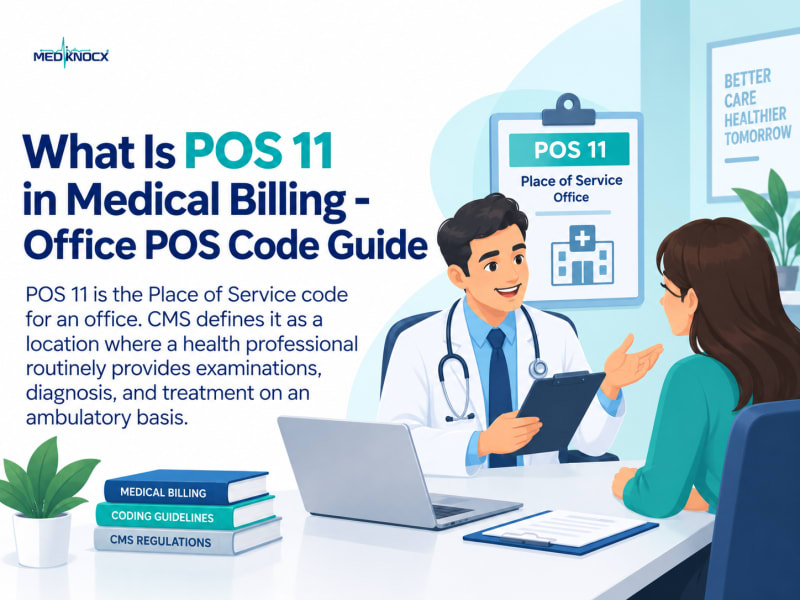
Learn what POS 11 means in medical billing, when to use the office POS code, how it affects claims, and common...

Learn what POS 12 means in medical billing, when to use it, home visit CPT codes, POS 10 vs 12, documentation ...