Healthcare

CPT Code 90837: Psychotherapy Billing and Documentation Guide
Learn how to bill CPT code 90837, including 60-minute psychotherapy time requirements, documentation, teleheal...

Sep 19, 2026
1 min read

Jordan Taylor
September 18, 2026
Table of Contents
15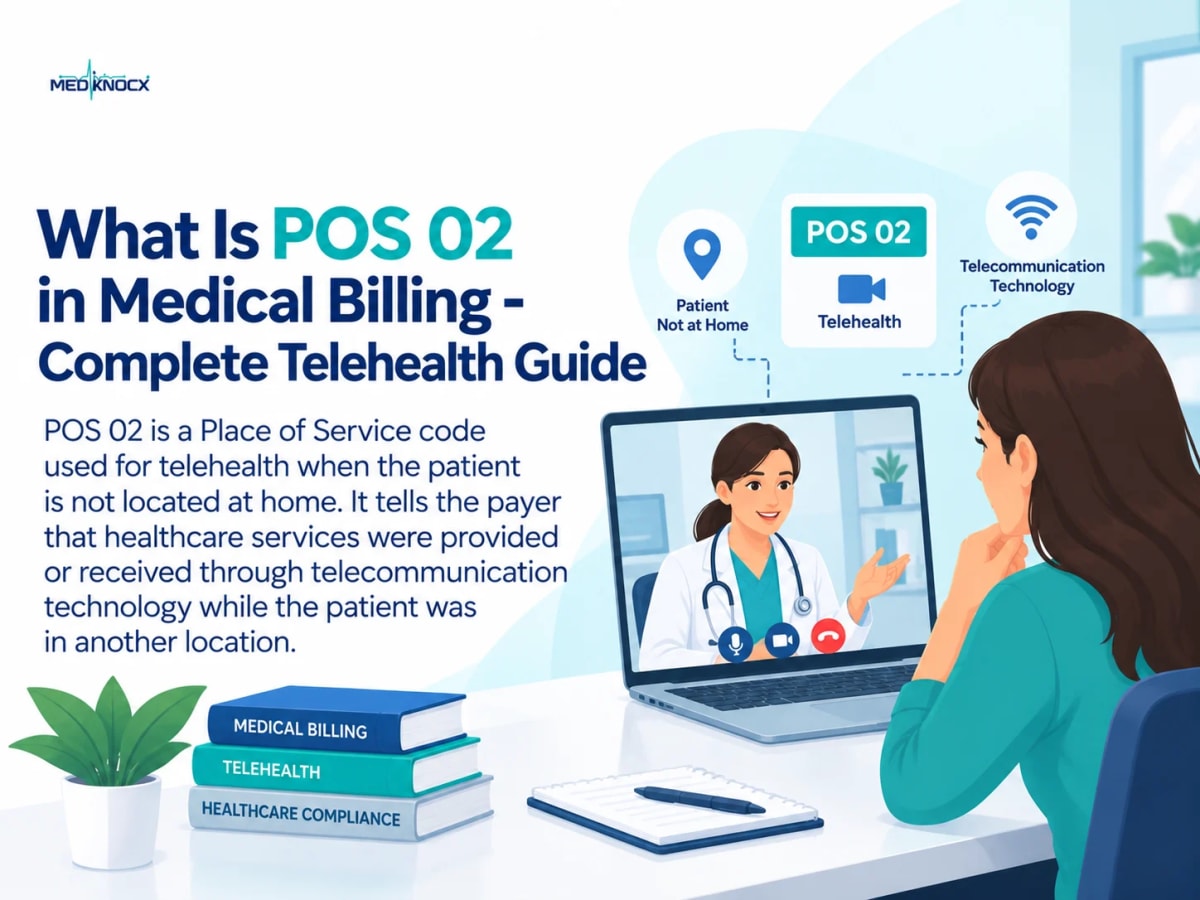
POS 02 is a Place of Service code used when a healthcare service is provided through telehealth and the patient is not located at home. The code tells the payer that the encounter was delivered through telecommunication technology from a location other than the patient's home.
In medical billing, the correct Place of Service code helps describe the setting of the healthcare encounter. For practices that provide virtual care, selecting the right POS code is an important part of preparing accurate claims.
If your practice handles a high volume of telehealth encounters, this step should be part of your regular medical billing services workflow.
POS 02 means Telehealth Provided Other than in Patient's Home.
CMS includes POS 02 in its official Place of Service code set. The code identifies telehealth services when the patient is not located in their home during the encounter.
You can review the current definition and code information in the CMS Place of Service code set.
POS 02 became effective on January 1, 2017. CMS later updated its description to distinguish telehealth services provided outside the patient's home from services provided in the home.
The basic idea is simple. If a patient receives a qualifying telehealth service while they are somewhere other than home, POS 02 may apply.
However, the billing team should always verify the payer's current requirements before submitting the claim.
POS 02 is used for qualifying telehealth encounters when the patient is not at home.
The billing team should first confirm that the service was provided through an applicable telehealth method. It should then verify the patient's location and review the payer's requirements.
For example, a patient may connect with a healthcare provider through a virtual platform while they are at another healthcare location. If the service and payer requirements are satisfied, POS 02 may be appropriate.
The provider's location alone does not determine the POS code. The patient's location is an important part of the POS 02 and POS 10 distinction.
POS 02 and POS 10 are both used for telehealth services. The main difference is where the patient is located during the encounter.
POS 02 applies when the patient is receiving telehealth from a location other than home. POS 10 applies when the patient is receiving telehealth while located at home.
This makes the distinction easy to remember:
Patient at home = POS 10
Patient somewhere other than home = POS 02
The payer's current billing policy should still be checked before the claim is submitted.
Place of Service codes give payers information about where a professional healthcare service was provided or received.
For telehealth claims, this information becomes especially important because virtual encounters can take place while the patient is in different locations.
Using the wrong POS code can create a mismatch between the claim and the documented encounter. Depending on the payer, this may lead to additional claim review or other processing issues.
Accurate POS reporting should therefore be part of the claim review process.
It also works alongside other parts of the revenue cycle, including coding, claim submission, payment processing, and follow-up.
POS 02 is only one part of a complete telehealth claim. The billing team should review the entire encounter before submitting it.
A practical workflow includes the following steps.
First, verify that the service was provided through an applicable telehealth method.
Determine where the patient was physically located during the encounter.
This is one of the most important steps when deciding between POS 02 and POS 10.
If the patient was not at home and the applicable requirements are satisfied, POS 02 may be appropriate.
Make sure the CPT or HCPCS code accurately represents the service provided.
Review the current payer rules to determine whether a modifier is required for the specific service.
Make sure the medical record supports the service reported on the claim.
Medicare, Medicaid, and commercial payers may have different requirements. The billing team should verify the rules that apply to the claim.
After the claim passes the billing review, submit it electronically and monitor its status through the normal claim follow-up process.
This workflow helps connect POS 02 with the rest of the billing process rather than treating it as an isolated code.
POS 02 identifies the Place of Service. A modifier provides additional information about a service when required.
These are two different parts of a claim.
A billing team should not assume that POS 02 automatically determines the modifier. Requirements can vary based on the payer, service, and type of telehealth encounter.
Some older telehealth resources discuss modifier GT, while other billing situations may involve different modifiers. Because telehealth rules have changed over time, current payer guidance should always be checked before submission.
The safest approach is to verify the modifier requirement for the exact service and payer rather than applying one rule to every telehealth claim.
Accurate documentation helps support the information reported on a telehealth claim.
The medical record should clearly support the service that was provided. Depending on the payer and encounter, the billing team may need to verify:
Patient location
Date of service
Provider information
Type of telehealth encounter
Service provided
Medical necessity
Procedure code
Applicable modifier
Required telehealth documentation
The exact requirements can vary between payers.
A consistent documentation review can also make it easier for billing staff to identify missing information before claim submission.
Medicare telehealth billing involves more than choosing the correct POS code.
Providers should verify whether the service qualifies for Medicare telehealth coverage and whether the current billing requirements are satisfied.
Medicare Fee-for-Service guidance can include requirements related to the service, patient location, technology, modifiers, and documentation.
Because these rules can change, billing teams should use current Medicare guidance when creating or updating their telehealth billing workflows.
This is particularly important for practices that provide virtual care regularly.
Small mistakes can create problems when telehealth claims are prepared. The following errors are worth checking during claim review.
If the patient receives telehealth services while at home, POS 10 is the specific Place of Service code for that situation.
A provider may be sitting in an office while treating a patient through telehealth. The patient's location remains important when distinguishing POS 02 from POS 10.
Different payers can have different telehealth billing rules. A billing workflow should include a payer-specific review before claim submission.
Telehealth billing requirements have changed over time. An older article or billing guide may not reflect current requirements.
The documentation should support the service, patient location, and other information reported on the claim.
POS 02 identifies the place of service. It does not describe the medical procedure itself.
The CPT or HCPCS code describes the service, while the POS code provides information about the service setting.
Patient location should be confirmed before the claim is finalized. This is especially important for practices that provide both home-based and non-home telehealth services.
A correct POS code does not guarantee reimbursement. Eligibility, coverage, service requirements, payer policy, coding, documentation, and other claim details can affect payment.
A simple pre-submission review can help your billing team catch POS errors before claims reach the payer.
Is this a telehealth encounter?
Confirm that the service meets the applicable telehealth requirements.
Where was the patient located?
Verify the patient's physical location during the encounter.
Was the patient at home?
If yes, review POS 10 instead of POS 02.
Does the service qualify for telehealth?
Check the current payer requirements.
Is the correct CPT or HCPCS code reported?
Make sure the procedure code matches the service.
Is a modifier required?
Verify the current payer-specific rule.
Does the documentation support the claim?
Review the medical record before submission.
Are there payer-specific requirements?
Check the applicable Medicare, Medicaid, or commercial insurance policy.
A consistent checklist can make telehealth claim review more reliable.
POS 02 provides the payer with information about the setting of the telehealth encounter.
When the reported POS matches the documented patient location, the claim provides information that is consistent with the encounter.
When the reported POS does not match the encounter or payer requirements, the claim may require additional review or experience processing issues.
POS 02 itself does not guarantee payment. Reimbursement depends on the payer, service, patient eligibility, coverage, coding, documentation, and other claim requirements.
For this reason, POS verification should be part of a broader revenue cycle management process.
POS 02 is one code within the larger Place of Service system used for professional claims.
Some commonly discussed codes include:
POS 02: Telehealth provided other than in patient's home
POS 10: Telehealth provided in patient's home
POS 11: Office
POS 12: Home
POS 21: Inpatient hospital
POS 22: On-campus outpatient hospital
Each code describes a different service setting.
This is why billing teams should select the POS based on the actual encounter rather than choosing a code simply because the provider normally works in a particular location.
Practices that provide regular telehealth services can build POS verification into their standard billing workflow.
The process can begin during registration or encounter review. Staff can confirm the patient's location and document the information needed for billing.
Before submission, the coding or billing team can review the POS, procedure code, modifiers, payer requirements, and documentation.
After submission, the team can monitor claims and investigate any issues that may affect reimbursement.
This approach connects telehealth coding with the wider billing process and makes POS verification a routine step.
POS 02 in medical billing identifies telehealth services when the patient receives care from a location other than their home. POS 10 is used when the patient receives telehealth while at home.
The key step is to verify the patient's location before selecting the Place of Service code. The billing team should then review the service code, modifiers, documentation, and payer requirements before submitting the claim.
For practices that provide regular virtual care, making POS verification part of the standard billing workflow can help keep telehealth claims accurate and consistent.
POS 02 means Telehealth Provided Other than in Patient's Home. It identifies telehealth services when the patient is not located at home.
Yes. POS 02 is a Place of Service code used to identify qualifying telehealth services provided when the patient is somewhere other than their home.
POS 02 is used for telehealth when the patient is not at home. POS 10 is used when the patient receives telehealth while located in their home.
No. POS 10 is the Place of Service code specifically designated for telehealth provided when the patient is at home.
Not necessarily. Modifier requirements depend on the payer, service, and applicable telehealth billing rules.
Yes. POS 02 is included in the Medicare Place of Service code set for professional claims. However, providers should verify the current Medicare requirements for the specific telehealth service.
Commercial payer requirements can vary. Providers should check the specific payer's current telehealth and reimbursement policies before submitting a claim.
The team should verify the patient's location, telehealth status, service code, modifier requirements, documentation, and payer rules.
A mismatch between the reported POS and the actual encounter can create claim processing issues. The impact depends on the payer and the details of the claim.
Explore more medical billing guides, coding updates, and revenue cycle tips.
Learn how to bill CPT code 90837, including 60-minute psychotherapy time requirements, documentation, teleheal...
Learn what POS 11 means in medical billing, when to use the office POS code, how it affects claims, and common...
Learn what POS 12 means in medical billing, when to use it, home visit CPT codes, POS 10 vs 12, documentation ...