Healthcare
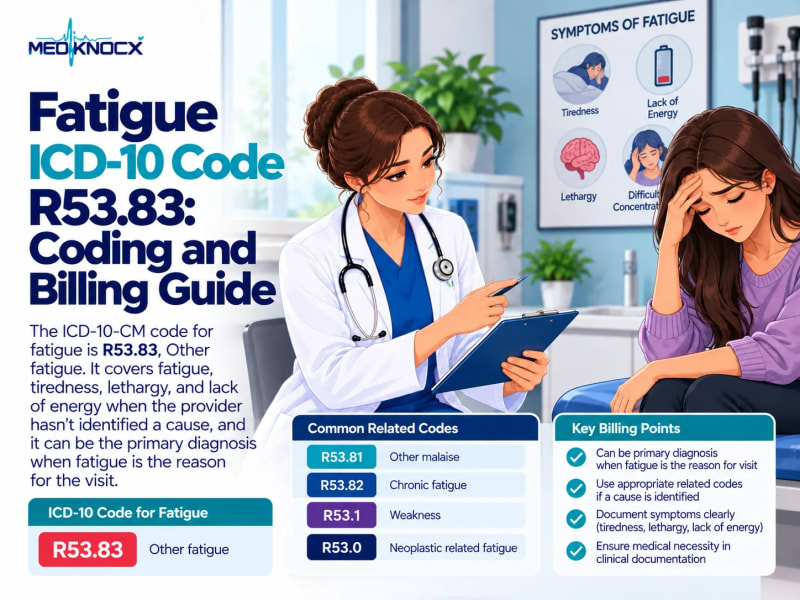
Fatigue ICD-10 Code R53.83: Coding and Billing Guide
R53.83 is the ICD-10 code for fatigue, tiredness, lethargy, and lack of energy. Learn R53.81 malaise, R53.82 c...

Oct 3, 2026
1 min read

Jordan Taylor
April 2, 2026
Table of Contents
6
Claim denials are one of the biggest challenges in medical billing today. Each denied claim not only delays payment but also increases administrative workload and negatively impacts your practice’s revenue. Efficient revenue cycle management is essential to prevent denials and keep cash flow healthy.
In this article, we’ll explore common causes of denied claims, strategies to prevent them, and how Mediknocx can help your practice recover lost revenue.
Understanding why claims are denied is the first step toward reducing rejections in medical billing. The most frequent reasons include:
Incomplete patient records, missing referral forms, or inadequate supporting documents are common causes of claim denials. Ensuring all required documentation is submitted with every claim is critical to prevent rejections.
Errors in CPT, ICD-10, or HCPCS codes are a leading cause of denials. Even minor mistakes can delay reimbursement and disrupt revenue cycle management. Regular coding audits and staff training can drastically reduce these errors.
Claims may be denied if a patient’s insurance has expired, the service isn’t covered, or prior authorizations weren’t obtained. Verifying eligibility and coverage before submitting claims can prevent these costly mistakes.
Proactive strategies can minimize denials and improve your revenue cycle management:
Ensure all procedures and diagnoses are coded correctly. Implement regular audits and staff training to reduce errors.
Confirm patient demographics, insurance details, and coverage limits before submitting claims. Proper verification prevents eligibility-related denials.
Track denied claims promptly, identify the cause, and resubmit corrected claims. A structured follow-up process helps recover lost revenue quickly.
Pro Tip: Create a checklist for your team to verify documentation, coding, and insurance information before submitting any claim.
Mediknocx offers solutions to reduce claim denials and optimize your revenue cycle management:
By leveraging Mediknocx’s expertise, practices can focus more on patient care while ensuring revenue stays on track.
After partnering with Mediknocx, one medical practice reduced claim denials by 35% within three months, improving cash flow and overall revenue. This demonstrates how effective revenue cycle management can transform billing operations.
Denied claims shouldn’t drain your practice’s revenue. With proper coding, patient verification, and follow-up processes, you can reduce denials and recover lost income.
Take Action Today: Book a free billing audit with Mediknocx and start optimizing your medical billing and revenue cycle management. Don’t let denied claims slow down your practice’s growth.
Claim denials in medical billing occur when an insurance company refuses to pay for services provided. This can happen due to errors, missing information, or policy-related issues, and it directly impacts your practice’s revenue.
The most common causes of claim denials include: Missing or incomplete documentation Incorrect medical coding (CPT, ICD-10, HCPCS) Patient insurance eligibility issues Lack of prior authorization
To reduce claim denials, practices should: Ensure accurate coding and regular audits Verify patient insurance and demographic information Submit complete documentation Implement a strong follow-up and resubmission process
Effective revenue cycle management ensures that every step—from patient registration to final payment—is handled correctly. This reduces errors, improves claim acceptance rates, and minimizes revenue loss due to denials.
Denied claims can often be recovered by: Identifying the denial reason Correcting errors promptly Resubmitting claims with proper documentation Following up consistently with payers
A clean claim rate refers to the percentage of claims that are accepted and processed without errors or rejections. A high clean claim rate (like 99%) indicates efficient medical billing and strong revenue cycle management practices.
Explore more medical billing guides, coding updates, and revenue cycle tips.
R53.83 is the ICD-10 code for fatigue, tiredness, lethargy, and lack of energy. Learn R53.81 malaise, R53.82 c...

ICD-10 codes for cough by duration: R05.1 acute, R05.2 subacute, R05.3 chronic, R05.9 unspecified. Plus Exclud...

M25.512 is the ICD-10 code for left shoulder pain. See M25.511, M25.519, bilateral coding, scapula and clavicl...