Healthcare
Fatigue ICD-10 Code R53.83: Coding and Billing Guide
R53.83 is the ICD-10 code for fatigue, tiredness, lethargy, and lack of energy. Learn R53.81 malaise, R53.82 c...

Oct 3, 2026
1 min read

Jordan Taylor
August 24, 2026
Table of Contents
10CPT code 90791 is billed for a psychiatric diagnostic evaluation, the intake assessment a mental health provider completes before starting treatment. It covers no medical services: no prescribing, no medication management, no physical exam. Two mistakes drive most of the denials tied to this code: confusing it with CPT 90792, and submitting it without documentation that supports a full diagnostic workup. Both are avoidable once the intake process is built around the payer's actual requirements.
CPT 90791 describes an integrated psychiatric diagnostic evaluation performed at intake or at the start of a new episode of care. It includes a psychiatric history, a mental status examination, an initial diagnosis, and a treatment plan, the groundwork a clinician needs before therapy or management begins.
It does not include medical services. If the same visit involves a medication review, prescribing, or a physical component of the exam, the correct code is CPT 90792, not 90791. This single distinction is the root of most 90791/90792 coding disputes, and it's why payers scrutinize the two codes closely during audits.
Any licensed behavioral health provider can perform the evaluation described by 90791, which is what separates it from 90792 in the first place. See the comparison below.
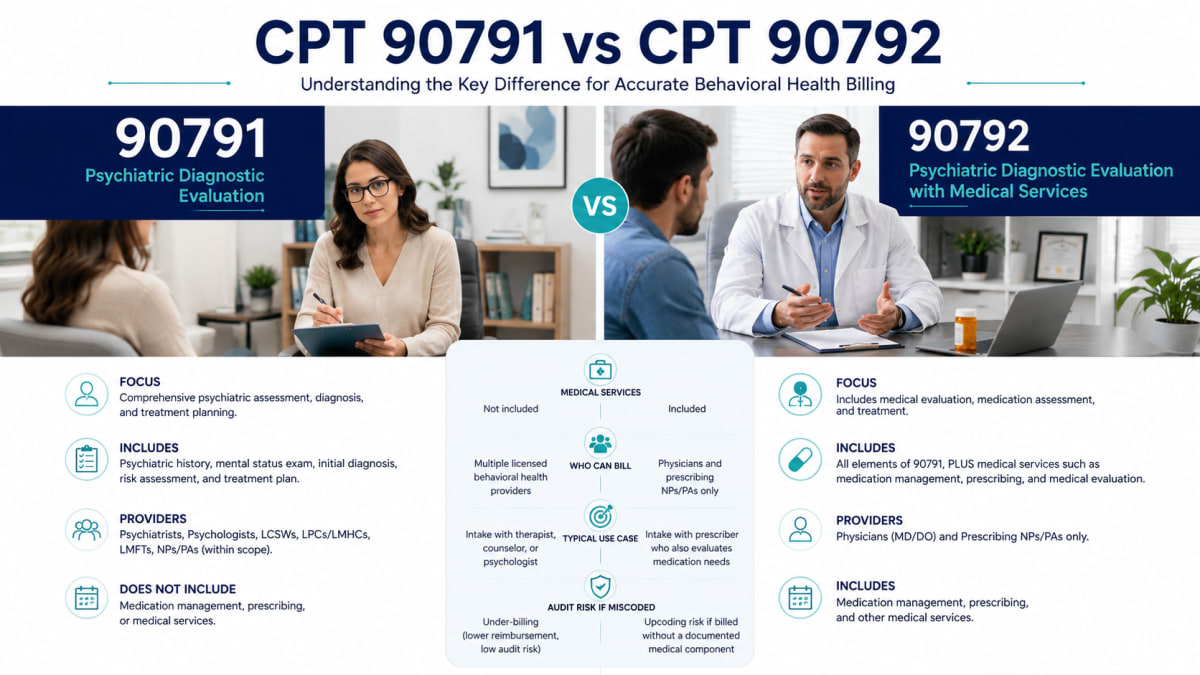
Billing 90792 when no medical evaluation actually occurred is treated as upcoding, not a coding preference — it's one of the first things a payer audit checks on a behavioral health claim.
CPT 90791 isn't restricted to psychiatrists. Eligible billers typically include:
Psychiatrists (MD/DO)
Clinical psychologists (PhD/PsyD)
Licensed Clinical Social Workers (LCSWs)
Licensed Professional Counselors and Licensed Mental Health Counselors (LPCs/LMHCs)
Licensed Marriage and Family Therapists (LMFTs)
Nurse practitioners and physician assistants, within their state scope of practice
Reimbursement for the same code isn't always identical across provider types. Several payers, including Medicare, pay non-physician licensed behavioral health providers a reduced percentage of the physician fee schedule for 90791. Confirm the exact rate for each license type directly against the payer's current fee schedule rather than assuming parity.
Medical necessity for 90791 has to be visible in the note, not just implied by the visit type. CMS guidance on psychiatric diagnostic evaluations describes the assessment as an integrated evaluation that can include medical and psychiatric history, a mental status examination, diagnostic formulation, and treatment planning. Providers can review the CMS Psychiatric Diagnostic Evaluation coverage guidance for additional documentation and medical-necessity considerations.
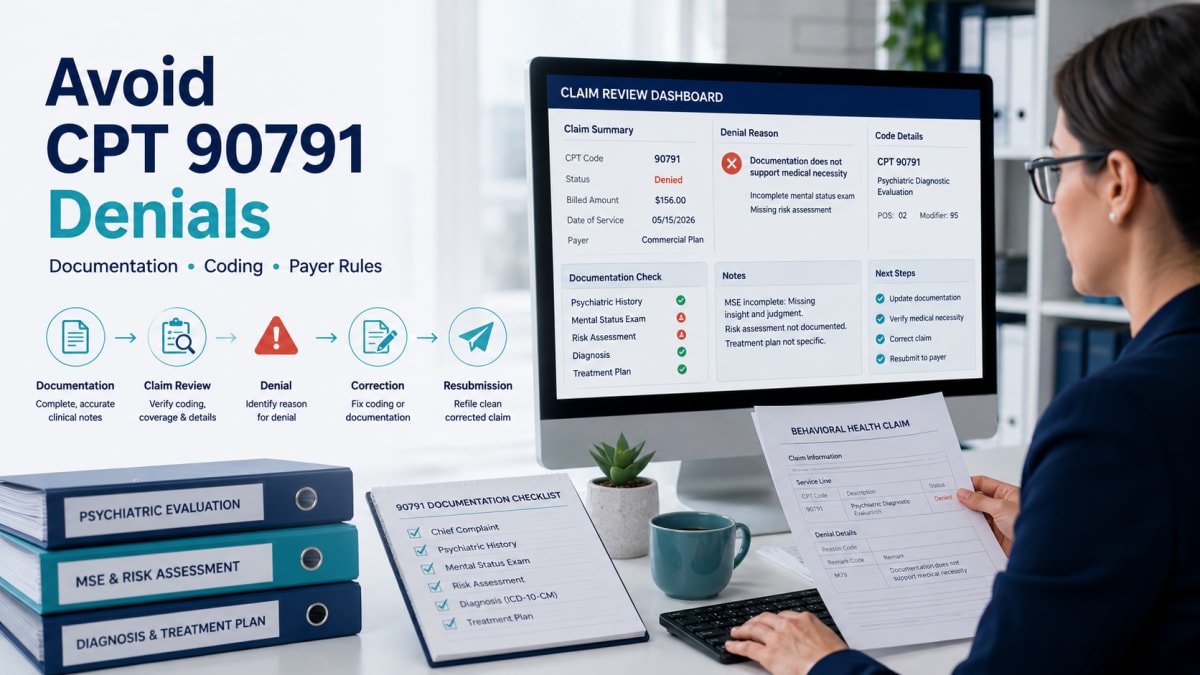
A defensible intake note includes:
Chief complaint, in the patient's own words where possible
History of present illness, including prior treatment attempts
Psychiatric history: prior diagnoses, hospitalizations, medications
A complete mental status exam: appearance, behavior, mood, affect, thought process, cognition, insight, and judgment
A risk assessment covering suicidal or homicidal ideation and self-harm
A diagnosis coded to its full ICD-10-CM specificity, not a default unspecified code
A treatment plan naming modality, frequency, and goals
The most common documentation gap isn't a missing element entirely — it's an incomplete mental status exam or a treatment plan that never got written into the note.
How Often Can You Bill CPT 90791?
CPT doesn't assign 90791 a fixed time range the way it does for psychotherapy codes like 90834 or 90837. In practice, a thorough diagnostic interview usually runs 45 to 90 minutes, but the code itself isn't billed by the minute. Documentation needs to justify a complete workup regardless of exact duration.
Most payers treat 90791 as billable once per patient, per provider, per episode of care. Re-billing it for an existing patient generally requires either a new, clinically distinct episode or a documented gap since the last evaluation. The exact window varies by payer and can run anywhere from six months to a year or more. Run an eligibility and history check before scheduling a repeat 90791, rather than assuming the prior claim aged out.
CPT 90791 is telehealth-eligible under Medicare and most commercial plans. What changes by payer is the modifier and place of service combination:
Modifier 95 for synchronous audio-video sessions, the modifier most commercial payers expect
Modifier GT still required by some commercial and Medicare Advantage plans
POS 02 for telehealth delivered anywhere other than the patient's home
POS 10 for telehealth delivered to the patient's home
Audio-only coverage exists under specific Medicare provisions, but these rules are extended through legislation on a recurring basis. Verify current-year coverage before relying on it
Getting the modifier and POS combination wrong is one of the fastest ways to turn a clean telehealth intake into a denied claim.
Upcoding to 90792 when no prescriber medical evaluation actually took place during the visit.
Billing 90791 and 90792 for the same encounter: payers treat this as a duplicate, not two separate services.
Repeating 90791 for an established patient without documentation showing a new, distinct episode of care.
Submitting an incomplete mental status exam: missing one or two MSE domains is enough to trigger a documentation-based denial.
Coding to an unspecified diagnosis (like F32.9) when the note supports a more specific code (like F32.1).
Missing or wrong telehealth modifier on a video or audio-only intake session.
Confirm licensure against the payer's list of eligible 90791 billers before the intake is even scheduled, not after the claim is denied.
Standardize the intake note template so every mental status exam domain and risk assessment item is a required field, not an optional one.
Run an eligibility and claims-history check ahead of the appointment to catch frequency-limit issues before the visit happens.
Apply the correct telehealth modifier and POS code at the time of the visit, not as a post-submission correction.
Reserve 90792 strictly for encounters where a prescriber actually performed medical evaluation or management. If that didn't happen, it's 90791.
Audit a sample of intake notes quarterly against each major payer's current 90791 policy, since frequency and documentation rules shift periodically.
Pull the specific denial reason from the ERA/EOB rather than resubmitting blind.
Compare the intake note against the payer's documentation checklist to confirm what's actually missing.
For frequency denials, verify the episode-of-care timing and file an appeal with clinical justification if the repeat evaluation was warranted.
For modifier or place-of-service mismatches, correct the claim and resubmit it as a corrected claim, not a duplicate.
Log the denial reason. A pattern of repeat 90791 denials usually points to one fixable gap in the intake workflow, not six unrelated problems.
Getting 90791 right protects the revenue tied to every new intake — and it's exactly the kind of recurring, rule-heavy billing work that Mediknocx's mental health billing and behavioral health billing teams handle daily. If denials on this code are already showing up in your reports, our denial management services can trace the pattern back to its source, and a billing audit will confirm whether the issue is documentation, coding, or payer policy. For more on fixing recurring denials across your practice, see how to reduce claim denials in medical billing.
Talk to a Mediknocx billing specialist about your intake and denial workflow. Request a Demo
Yes. Medicare and most commercial payers cover 90791 by telehealth, provided the correct modifier (95 or GT, depending on the payer) and place-of-service code are applied.
No. Payers treat this as duplicate billing for the same service. Choose 90792 only if a prescriber performed an actual medical evaluation during that visit; otherwise, bill 90791.
Most payers allow it once per patient, per provider, per episode of care. A repeat evaluation generally needs a new, clinically distinct episode or a documented gap since the last one — verify the exact window with each payer.
Usually not for routine outpatient intakes, but this varies by plan. Confirm authorization requirements as part of the standard eligibility check before the appointment.
90791 is a one-time diagnostic evaluation used at intake; 90837 and similar codes bill ongoing psychotherapy sessions and are time-based. They serve different points in the care timeline and aren't interchangeable.
Explore more medical billing guides, coding updates, and revenue cycle tips.
R53.83 is the ICD-10 code for fatigue, tiredness, lethargy, and lack of energy. Learn R53.81 malaise, R53.82 c...

ICD-10 codes for cough by duration: R05.1 acute, R05.2 subacute, R05.3 chronic, R05.9 unspecified. Plus Exclud...

M25.512 is the ICD-10 code for left shoulder pain. See M25.511, M25.519, bilateral coding, scapula and clavicl...