Healthcare

Abdominal Pain ICD-10 Codes: Complete R10 Coding Guide
Every abdominal pain ICD-10 code in the R10 family, from R10.9 and R10.84 to the new flank, suprapubic and mul...

Sep 26, 2026
1 min read

Jordan Taylor
August 13, 2026
Table of Contents
12
A denial in medical billing occurs when an insurance payer processes a submitted claim but refuses payment for the service as billed. The payer generally provides a reason explaining why the claim was not paid.
Common causes include eligibility problems, coding errors, missing documentation, medical necessity concerns, authorization issues, timely filing problems, and non-covered services.
A denial can delay reimbursement, increase accounts receivable work, and create additional administrative costs for a medical practice. Understanding why claims are denied helps healthcare providers resolve unpaid claims and prevent the same problems from happening again.
A medical billing denial means an insurance payer has reviewed a submitted claim and decided not to pay the service as billed.
The payer may deny an entire claim or only a specific service line. The denial information usually identifies the reason for nonpayment and helps the billing team determine what action should be taken.
A claim may be denied because:
The patient's insurance coverage was inactive.
Required authorization was missing.
The service did not meet the payer's medical necessity requirements.
The claim contained incorrect CPT, ICD-10-CM, or HCPCS codes.
Required documentation was missing.
The claim was submitted after the filing deadline.
The payer considered the claim a duplicate.
The service was excluded from the patient's insurance plan.
The appropriate response depends on the denial reason. Some claims can be corrected and resubmitted. Others may require additional documentation or an appeal. Some claims may not be recoverable under the payer's coverage rules.
This is why denial management involves more than resubmitting unpaid claims. The practice must identify the underlying cause and choose the correct resolution strategy.
Claim rejection and claim denial are different stages of the claims process.
A claim rejection generally occurs before payer adjudication. The claim may contain missing, invalid, or incorrectly formatted information that prevents normal processing.
A claim denial generally occurs after the payer has processed the claim and determined that payment will not be made as submitted.
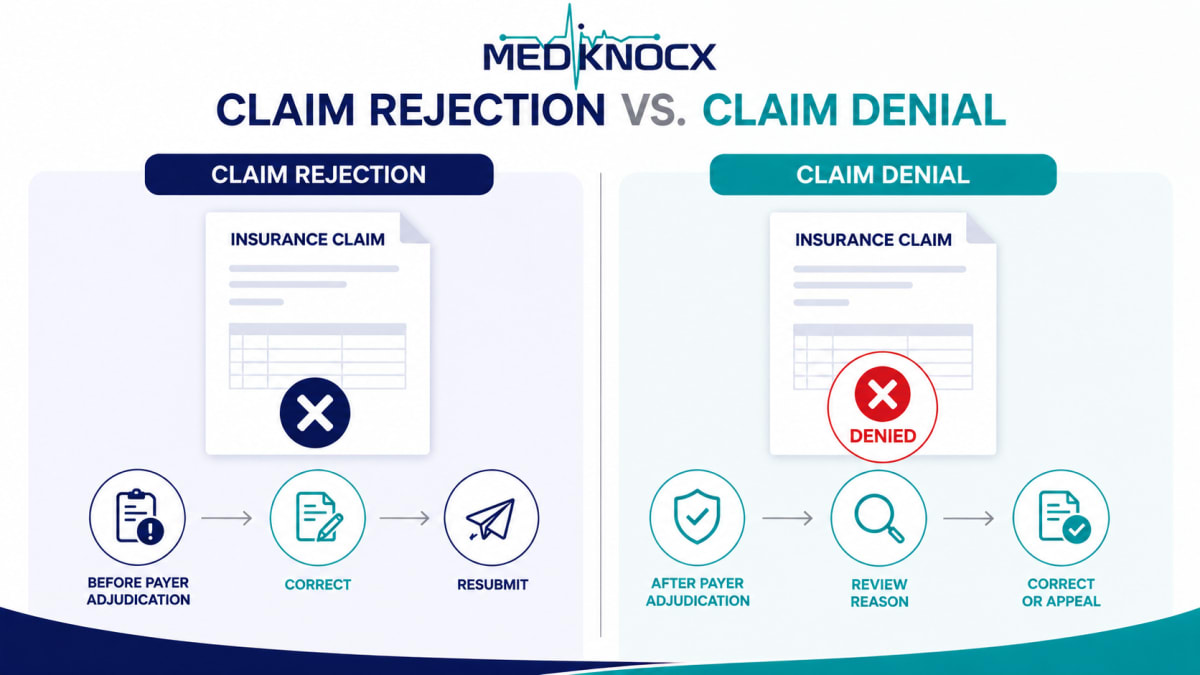
The distinction matters because the resolution process can be different.
A rejected claim often needs a technical or data correction before it can move through the payer's system. A denied claim requires the billing team to understand why the payer refused payment and whether the claim can be corrected or appealed.
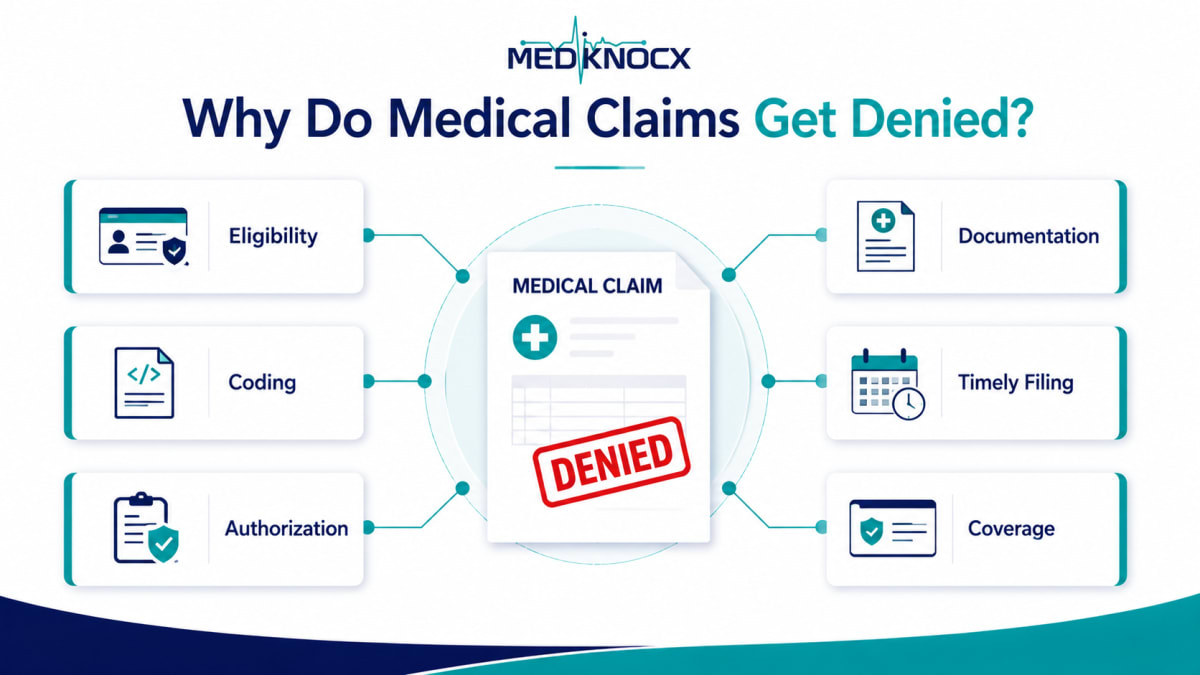
Medical claims can be denied for many reasons. Most fall into recurring billing, coverage, coding, documentation, and payer-related problems.
A claim may be denied when the patient's insurance coverage was inactive or did not apply to the service provided.
Incorrect insurance information can also cause problems. Errors involving the member ID, payer, patient demographics, or coverage details may prevent proper claim processing.
Eligibility verification before services are provided can help identify these issues earlier in the revenue cycle.
Coding Errors
Incorrect medical coding is another common cause of claim denials.
Problems may involve:
CPT codes
ICD-10-CM codes
HCPCS codes
Modifiers
Diagnosis and procedure relationships
Coding specificity
Documentation support
A code may be valid by itself but still result in a denial if it does not match the documentation or payer requirements.
Accurate coding requires more than selecting a code from a code set. The codes reported must accurately represent the services performed and be supported by the medical record.
Practices that need specialized support can explore Medical Coding Services to address coding accuracy and recurring coding-related claim problems.
Healthcare providers should also follow the applicable ICD-10-CM guidelines when reporting diagnoses. The CDC provides the official ICD-10-CM files and fiscal-year releases used for diagnosis coding.
A payer may deny a service when it determines that the submitted information does not support medical necessity under its coverage policy.
These cases often require a review of the diagnosis, procedure, medical documentation, and applicable payer criteria.
Depending on the circumstances, additional records may support reconsideration or an appeal.
Some services require prior authorization before they are provided.
If required authorization was not obtained, expired, or did not cover the service billed, the payer may deny the claim.
Authorization requirements should therefore be checked before treatment whenever applicable.
Payers may request documentation supporting the service billed.
Missing or incomplete records can prevent payment even when the service was performed correctly.
The billing team may need to obtain the relevant records, review payer instructions, and submit the required information through the appropriate process.
Insurance payers establish deadlines for claim submission.
When a claim is submitted after the applicable filing period, the payer may deny it unless an exception applies.
Timely filing problems can be particularly difficult because recovery options may be limited after the deadline.
Submitting the same claim more than once can trigger a duplicate claim denial.
This may happen when a practice resubmits a claim without checking its current status or when multiple staff members work on the same account.
Accurate claim tracking helps reduce unnecessary duplicate submissions.
A payer may deny a service because it is excluded from the patient's plan or does not meet the plan's coverage requirements.
These cases require careful review because correcting the claim may not result in payment when the service is genuinely excluded.
What Happens After a Claim Is Denied?
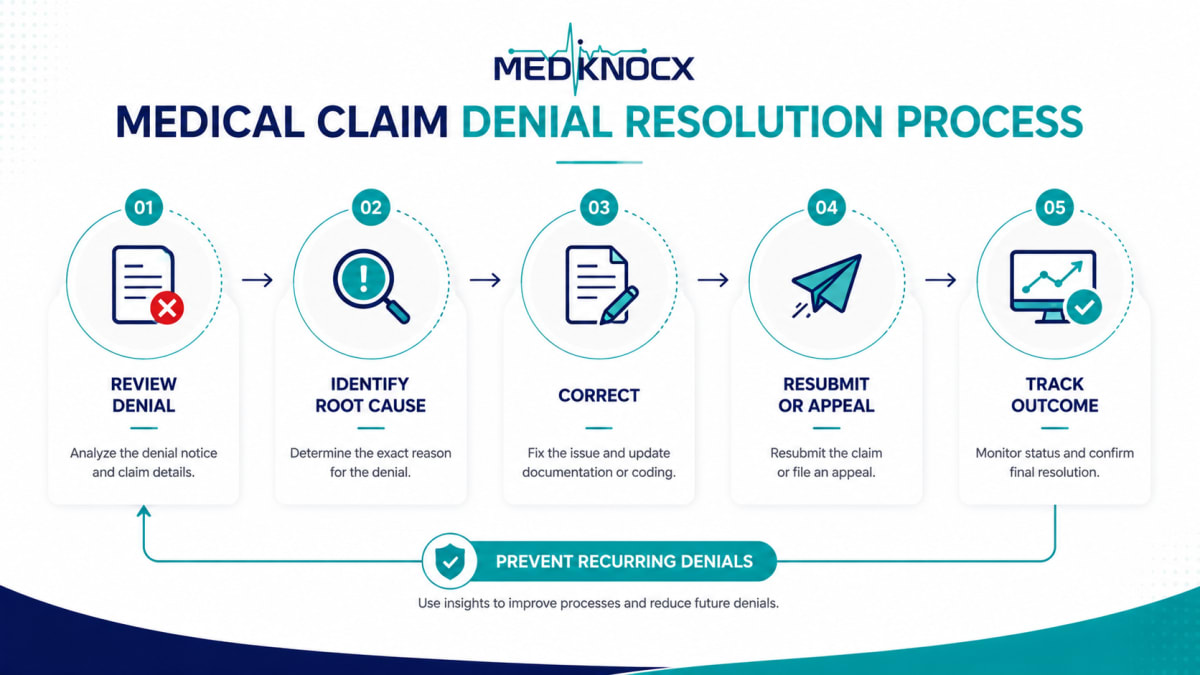
A denied claim should enter a structured resolution process.
Start with the payer's denial information.
Review the claim, remittance details, adjustment information, documentation, and relevant payer messages.
Determine why the claim was denied.
Was the problem caused by:
Eligibility?
Coding?
Authorization?
Documentation?
Timely filing?
Coverage?
Payer processing?
Finding the root cause is more valuable than simply correcting one claim.
The appropriate next step depends on the denial.
A corrected claim may be appropriate for certain billing or data errors. An appeal may be appropriate when the practice disagrees with the payer's decision and has supporting documentation.
Follow the payer's instructions carefully.
For Original Medicare claims, CMS describes a five-level appeals process beginning with redetermination by the Medicare Administrative Contractor and progressing through reconsideration and later appeal levels when applicable.
A denial should not be considered resolved until the claim has been reprocessed or the available recovery process has been completed.
Track the claim's status and document the final outcome.
One denial may be an isolated error.
Repeated denials for the same reason point to a workflow problem.
For example, recurring authorization denials may indicate a front-end process issue. Repeated coding denials may suggest a documentation or coding problem.
This is where denial management becomes a process-improvement function instead of simple claim follow-up.
These involve inactive coverage, incorrect insurance information, or coverage that does not apply to the service.
These occur when required authorization was missing, incorrect, or insufficient for the billed service.
These may involve incorrect codes, modifiers, diagnosis relationships, or coding that does not support the service reported.
These occur when the payer determines that the submitted information does not support the medical necessity of the service under its policy.
These involve missing or insufficient records needed to support the claim.
These occur when a claim does not meet the payer's filing deadline.
These occur when the payer determines that a claim duplicates an existing submission.
These occur when a service is excluded or does not meet the payer's coverage requirements.
Understanding the denial category helps the billing team choose the appropriate resolution path.
Payers use standardized adjustment and remark codes to communicate why claim payments were adjusted, reduced, or denied.
Two important categories are Claim Adjustment Reason Codes (CARCs) and Remittance Advice Remark Codes (RARCs).
CMS explains that electronic remittance advice reports claim adjudication and payment information, with adjustment reasons communicated through standard codes. CARCs provide an overall explanation for financial adjustments, while RARCs can provide additional information.
For example, practices dealing with a specific adjustment scenario can review our detailed CO-197 denial code guide.
The code itself should not determine the resolution strategy. Billing teams should also review the claim, payer policy, documentation, and remittance information before deciding whether to correct, resubmit, or appeal.
Denials affect more than a single unpaid claim.
A denied claim can delay payment and increase the time required to recover revenue.
Unresolved denials can remain in A/R and increase outstanding balances.
Staff must review the denial, determine the cause, communicate with the payer, correct the issue, and track the result.
Recurring denials create unnecessary work for billing and administrative teams.
When significant revenue remains unresolved, the practice may experience less predictable cash flow.
Not every denied claim is ultimately recovered. When valid reimbursement is not collected, the financial impact can extend beyond the cost of processing the claim.
For smaller practices with limited internal resources, Medical Billing Services for Small Practices can provide additional support with claims, follow-up, and revenue cycle activities.
Denial prevention starts before the claim is submitted.
Confirm coverage and patient information before services are billed.
Identify services requiring authorization and complete the process before treatment when applicable.
Use current coding guidance and make sure codes match the documentation.
Make sure the medical record supports the services and codes reported.
Review claims for missing information, coding issues, payer-specific requirements, and known submission problems.
Track denial reasons by payer, provider, service, and category.
This can reveal recurring problems that might otherwise be treated as isolated claim issues.
Suppose one payer repeatedly denies the same procedure for the same reason.
The solution may not be another appeal. The practice may need to change how the procedure is authorized, documented, coded, or submitted.
For a broader prevention strategy, see How to Reduce Claim Denials in Medical Billing.
Denial management is the structured process of identifying, analyzing, correcting, appealing, tracking, and preventing claim denials.
A practical denial management workflow looks like this:
Identify → Analyze → Correct → Resubmit or Appeal → Track → Prevent
The goal is not simply to recover one unpaid claim.
A strong process also asks:
Why did this denial happen, and what can the practice change to prevent it from happening again?
That makes denial management an important part of revenue cycle management.
Front-end processes such as eligibility verification and authorization can affect downstream denials. Coding, documentation, and claim submission processes also influence whether claims are paid correctly.
Some practices can manage denials internally. Others need dedicated resources because the volume or complexity becomes difficult to handle consistently.
Professional denial management may be worth considering when:
Denials are increasing
A/R is aging
Appeals are being missed
The same denial reasons keep appearing
Staff cannot follow up consistently
Denial reporting is limited
Providers spend too much time on billing problems
The practice lacks specialized denial expertise
The right service should focus on both revenue recovery and prevention.
A structured team can review denied claims, identify recurring patterns, coordinate corrections and appeals, track outcomes, and report findings to the practice.
For practices that need dedicated support, Denial Management Services can become part of a broader revenue cycle strategy rather than a reactive claims task.
When a third-party organization performs billing or claims-related functions involving protected health information, healthcare providers should understand applicable HIPAA business associate responsibilities. HHS identifies billing and claims processing among functions that can involve a business associate relationship. (HIPAA business associate requirements)
Effective denial management creates feedback between the front end and back end of the revenue cycle.
A repeated eligibility denial can reveal a registration or insurance verification problem.
A recurring coding denial can identify a documentation or coding issue.
A pattern of authorization denials can show that front-end staff need a clearer workflow.
This makes denial data useful beyond claim recovery.
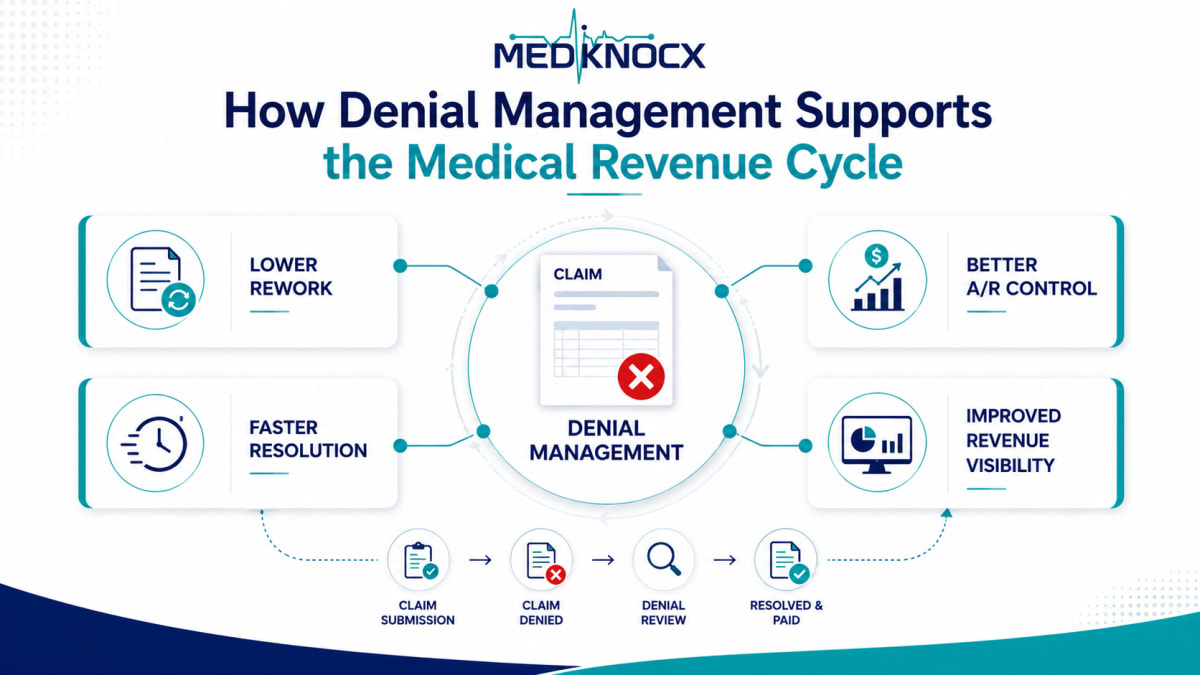
Practices can use recurring denial patterns to improve:
Eligibility verification
Authorization workflows
Documentation
Medical coding
Claims submission
Payer-specific processes
A/R follow-up
For broader financial and operational support, explore Healthcare Revenue Cycle Management Services.
The goal is to reduce recurring problems while improving the consistency of the overall billing process.
A denial in medical billing is more than an unpaid claim. It can signal a problem with eligibility, authorization, coding, documentation, coverage, timely filing, or another part of the revenue cycle.
The best response is not to correct the claim and move on.
Practices should identify the root cause, resolve the claim through the appropriate process, and analyze recurring patterns that may be causing additional denials.
When denial data becomes part of the revenue cycle workflow, healthcare providers can use it to reduce rework, improve billing accuracy, and strengthen reimbursement performance.
Mediknocx helps healthcare providers address denial-related billing challenges through structured revenue cycle support, claim follow-up, denial resolution, and reporting.
Need help reducing unresolved medical billing denials? Explore Mediknocx's Denial Management Services and discuss your practice's revenue cycle needs with our team.
A denial occurs when an insurance payer processes a submitted claim but refuses payment for the service as billed. The payer generally provides a reason that helps the provider determine whether to correct the claim, submit additional information, or appeal the decision.
A rejection generally occurs before payer adjudication because the claim cannot be processed as submitted. A denial occurs after the payer processes the claim and decides not to pay it as billed.
Common reasons include eligibility problems, coding errors, missing documentation, medical necessity concerns, authorization issues, timely filing problems, duplicate claims, and non-covered services.
Some denied claims can be corrected and resubmitted. The appropriate action depends on the payer's denial reason and its correction rules.
Many denied claims can be appealed when the payer's rules allow it. The practice should follow the applicable appeal process and provide documentation that addresses the reason for the denial.
CARC stands for Claim Adjustment Reason Code. RARC stands for Remittance Advice Remark Code. These standardized codes help explain claim payment adjustments and related information. CMS provides additional information about these codes in its Electronic Remittance Advice guidance.
Start with accurate patient information, eligibility verification, authorization checks, correct coding, complete documentation, clean claim submission, and regular denial trend analysis.
The team should review the denial, identify the root cause, determine whether correction or appeal is appropriate, submit the required action, track the outcome, and record the reason for future prevention.
Explore more medical billing guides, coding updates, and revenue cycle tips.
Every abdominal pain ICD-10 code in the R10 family, from R10.9 and R10.84 to the new flank, suprapubic and mul...

R19.7 is the ICD-10 code for diarrhea, unspecified. Learn when to use K52.9, A09, K58.0, K59.1, C. diff and tr...

Learn what POS 19 means in medical billing, when to use it, POS 19 vs POS 11 and 22, Medicare billing, reimbur...