Healthcare

Diarrhea ICD-10 Code (R19.7): Coding and Billing Guide
R19.7 is the ICD-10 code for diarrhea, unspecified. Learn when to use K52.9, A09, K58.0, K59.1, C. diff and tr...

Sep 25, 2026
1 min read

Jordan Taylor
September 26, 2026
Table of Contents
10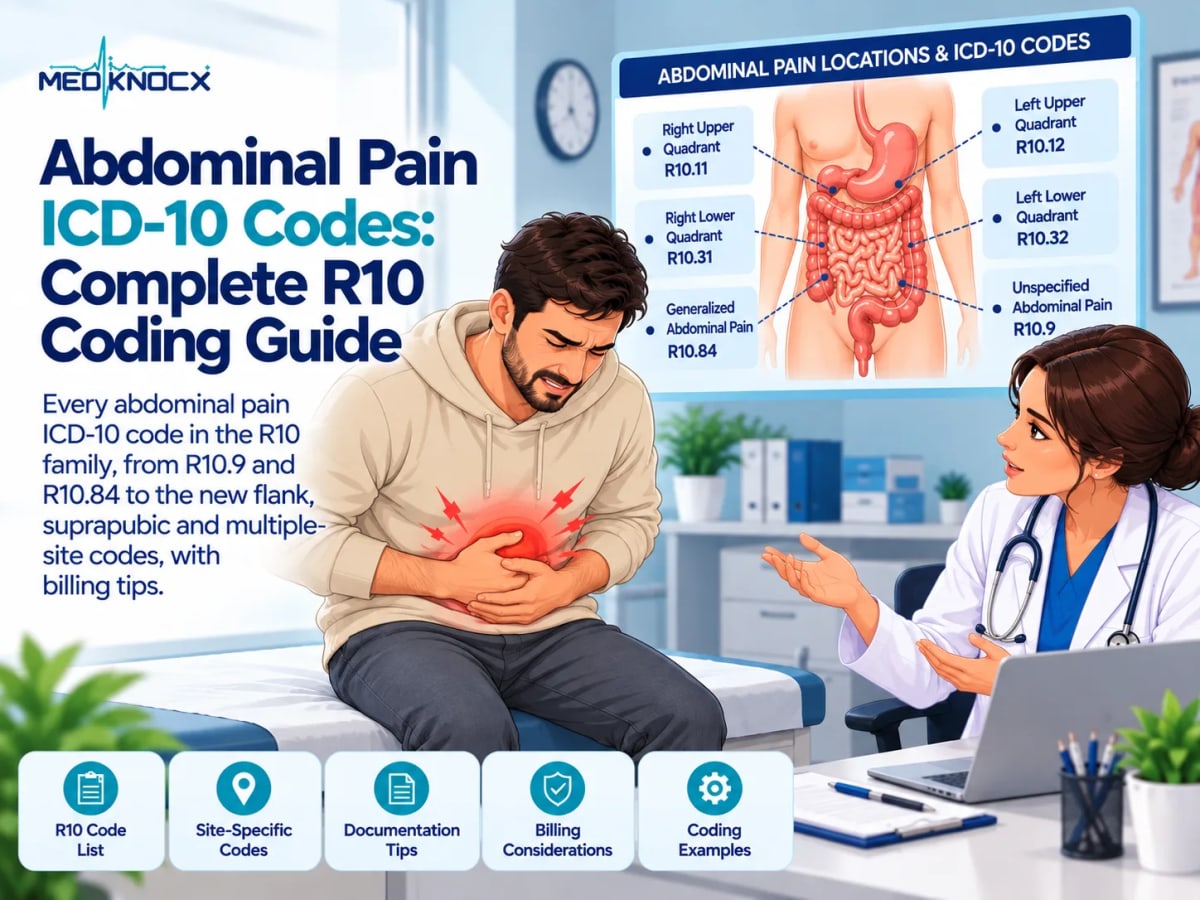
The ICD-10-CM code for unspecified abdominal pain is R10.9, but it's rarely the best choice. Category R10 has more than 40 billable codes that pin abdominal and pelvic pain to a quadrant, a side, or a pattern: right lower quadrant pain is R10.31, epigastric pain is R10.13, generalized abdominal pain is R10.84, and right flank pain is now R10.A1.
The FY2026 code set changed this category more than any update since ICD-10 began. R10.2 now needs a fifth character, flank pain has its own codes, and there are new codes for suprapubic pain, multiple-site pain, and flank tenderness. Claims built on older templates still carrying R10.2 are rejecting as invalid. This guide walks through the full R10 family, how to choose between the codes, and what gets abdominal pain claims denied.
R10 sits in Chapter 18, symptoms and signs, under R10 to R19, symptoms involving the digestive system and abdomen.
The header codes R10, R10.1, R10.2, R10.3, R10.8, R10.81, R10.82, R10.8A, and R10.A aren't billable on their own.
Four changes took effect for dates of service on or after October 1, 2025.
R10.2 now needs a fifth character. Pelvic and perineal pain used to be a single billable code. It's now a header, and a claim with R10.2 alone is invalid. The replacements are R10.20 through R10.23 for side, plus R10.24 for suprapubic pain, which previously had no clean home. This is the change most likely to be causing rejections right now, because it lives in old EHR favorites lists and charge templates.
Flank pain has its own subcategory, R10.A. Before this, flank pain got pushed to R10.9 or a nearby quadrant code that didn't really fit. Now it's R10.A1 for the right side, R10.A2 for the left, R10.A3 for both, and R10.A0 when the side isn't documented. The codes cover lateral abdomen and lateral flank pain. Costovertebral angle tenderness is still R39.85, which can be reported alongside when both are documented.
R10.85, abdominal pain of multiple sites. For pain documented in two or more distinct areas that doesn't fit generalized pain. It isn't meant to be stacked with the individual location codes describing the same pain; it replaces them.
Flank and suprapubic tenderness, R10.8A. Exam-finding codes to match the new pain codes: R10.8A1 right flank tenderness, R10.8A2 left, R10.8A3 suprapubic tenderness, and R10.8A9 flank tenderness, unspecified.
Worth doing now: search your EHR's diagnosis favorites and superbills for R10.2 and replace it, and add the flank codes so providers stop defaulting to R10.9 for flank complaints.
Location decides most abdominal pain codes. If the note says where it hurts, there's almost always a code for it.
R10.9 vs R10.84 vs R10.85 vs R10.0. These four get mixed up the most:
R10.84 isn't a fallback for "not sure where." That's R10.9. And R10.0 isn't just "recent onset" pain; it carries an emergency implication that the note needs to support. R10.0 already includes the generalized pain that comes with an acute abdomen, so R10.84 isn't added to it.
Quadrants and regions. Upper right is R10.11 (gallbladder and liver territory), upper left R10.12, epigastric R10.13, lower right R10.31 (the appendicitis workup), lower left R10.32, and around the navel R10.33. There's no generic "right-sided" or "left-sided" abdominal pain code, so a note saying "right-sided pain" needs the upper or lower detail to land on a specific code; if it isn't there, R10.10 or R10.30 fits only when upper or lower is at least known.
Pain, tenderness, and rebound are different findings. Pain is what the patient reports. Tenderness (R10.81-) is what the provider finds on palpation. Rebound tenderness (R10.82-) is pain on release of pressure, often a sign of peritoneal irritation. They can be reported together when both are documented, such as a patient reporting generalized pain (R10.84) with focal right lower quadrant rebound on exam (R10.823).
Terms patients and providers use. Stomach pain, belly pain, abdominal cramping, abd pain, and tummy ache all index to abdominal pain. Code them by the location documented, and R10.9 only if there isn't one. Colic, intermittent cramping pain that comes and goes, is R10.83, used most often in infants.
R10 codes are symptom codes. They're correct when no definitive diagnosis has been made, and they come off the claim once one is. Abdominal pain from confirmed appendicitis is coded as appendicitis (K35.-), from cholecystitis as K81.-, from diverticulitis as K57.-, from pancreatitis as K85.-. The pain is part of the disease and isn't coded separately. The exception is pain the provider documents as unrelated to the confirmed diagnosis.
A few Excludes notes shape the category:
• Renal colic (N23) is excluded from R10. When the provider documents renal colic, code N23, not flank or abdominal pain.
• R52, pain unspecified, excludes abdominal pain, so R52 is never added to an R10 code.
• Back pain (M54.-), flatulence and gas (R14.-), and CVA tenderness (R39.85) are Excludes2, meaning they can be reported with R10 when separately documented.
Chronic or intractable abdominal pain. There's no "chronic" R10 code. Use the location code, and when the documentation supports a chronic pain diagnosis, add G89.29, other chronic pain. If the visit is specifically for pain management, G89.29 is listed first and the R10 code follows. G89.4 applies only when the provider documents chronic pain syndrome.
Severe abdominal pain. Severity isn't a code element. Severe pain with an acute surgical picture is R10.0; otherwise use the location code and put the pain score and exam in the note.
Postoperative abdominal pain. Routine, expected pain after surgery isn't coded. Pain the provider documents as beyond what's expected uses G89.18 (acute post-procedural) or G89.28 (chronic post-procedural), with the R10 code for location.
Pregnancy. Pregnancy-related abdominal pain is coded in Chapter 15, commonly O26.89- (other specified pregnancy-related conditions) with the trimester character, plus the R10 location code and a Z3A code for weeks. Bleeding with pain early in pregnancy may point to O20.0, threatened abortion, when that's what the provider documents. Pain the provider documents as unrelated to the pregnancy is coded with the regular R10 code and Z33.1, pregnant state, incidental.
Associated symptoms. Without a unifying diagnosis, each documented symptom gets its own code: R11.0 nausea, R11.2 nausea with vomiting, R19.7 diarrhea, R14.0 bloating or abdominal distension, R50.9 fever. Our diarrhea ICD-10 guide covers when R19.7 stays on the claim and when a gastroenteritis code replaces it. For suprapubic or flank pain with urinary symptoms, a confirmed urinary tract infection replaces the pain codes; see our UTI ICD-10 guide.
The R10 code on the claim is what justifies everything billed with it, and imaging is where the location detail pays off most.
Many commercial plans send outpatient CT and MRI through a prior authorization program, and the diagnosis on the request is the first thing reviewed. "Abdominal pain, unspecified" with no location, exam findings, or failed initial workup is a weak request. Right lower quadrant pain with rebound, fever, and an elevated white count is a strong one. The same logic applies after the fact on audits.
Inpatient. When abdominal pain is the principal diagnosis, the case groups to MS-DRG 391 or 392, esophagitis, gastroenteritis and miscellaneous digestive disorders with or without MCC. Most admissions for abdominal pain end with a definitive diagnosis, and that diagnosis, not the R10 code, should be principal at discharge.
• Location: quadrant, region, flank, suprapubic, or "diffuse"
• Side: right, left, or bilateral, especially for pelvic and flank pain
• Onset and duration: sudden or gradual, hours, days, or months
• Character and severity: sharp, dull, cramping, burning; a pain score
• Associated symptoms: nausea, vomiting, fever, bowel or urinary changes, bleeding, pregnancy status
• Exam: tenderness and where, rebound, guarding, rigidity
• Assessment: a diagnosis, or a clear statement that the cause is still being worked up
The most common gap isn't a missing finding. It's an exam that says "RLQ tenderness with rebound" and an assessment line that just says "abdominal pain," which a coder then turns into R10.9. The detail was there; it didn't reach the diagnosis. When the exam supports a location, the code should too.
Nearly all of these are fixed before submission by a consistent medical coding review that matches the diagnosis to the exam. When the same imaging or R10.2 denials keep returning, trace them through denial management to find the template or workflow causing them.
• CMS, ICD-10-CM official code files and guidelines, FY2026 code set effective October 1, 2025, with the April 1, 2026 update
• CMS, MS-DRG classifications and software, version 43
R10.9 for unspecified abdominal pain, but a location code is better whenever the note gives one, such as R10.31 for right lower quadrant pain or R10.13 for epigastric pain.
R10.9 means the location isn't documented. R10.84 means the pain covers the whole abdomen.
R10.13. Epigastric tenderness on exam is R10.816.
R10.30 when right or left isn't specified, R10.31 for the right lower quadrant, R10.32 for the left, and R10.33 for periumbilical pain.
R10.A1 for the right side, R10.A2 for the left, R10.A3 for bilateral, and R10.A0 when the side isn't documented.
No. Since October 1, 2025, it needs a fifth character: R10.20 to R10.23 by side, or R10.24 for suprapubic pain.
There's no chronic-specific R10 code. Use the location code, plus G89.29 when the provider documents chronic pain.
For pregnancy-related pain, O26.89- with the trimester, plus the R10 location code. For pain unrelated to the pregnancy, the R10 code with Z33.1.
Not usually. Once the provider confirms the diagnosis, the pain is part of it and the R10 code comes off.
Both are coded as abdominal pain by location, R10.9 if no location is documented. Episodic colicky cramping is R10.83.
Explore more medical billing guides, coding updates, and revenue cycle tips.
R19.7 is the ICD-10 code for diarrhea, unspecified. Learn when to use K52.9, A09, K58.0, K59.1, C. diff and tr...
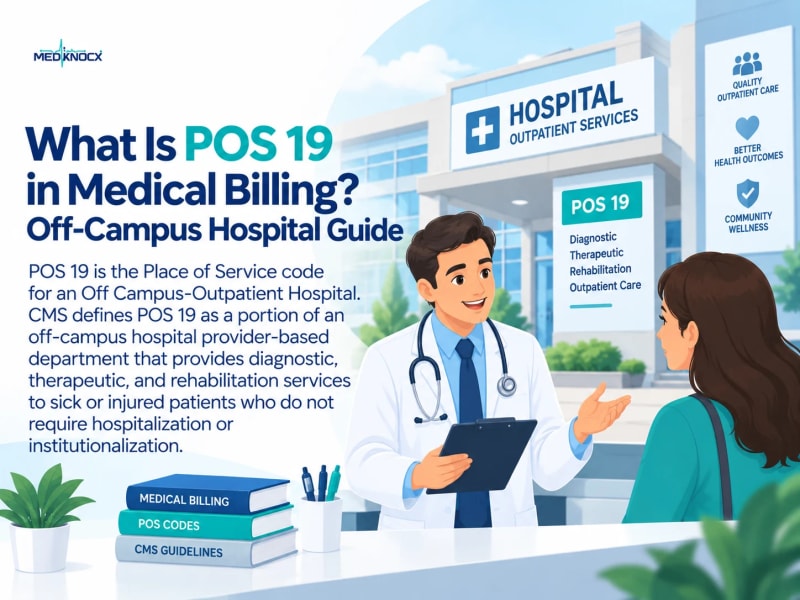
Learn what POS 19 means in medical billing, when to use it, POS 19 vs POS 11 and 22, Medicare billing, reimbur...
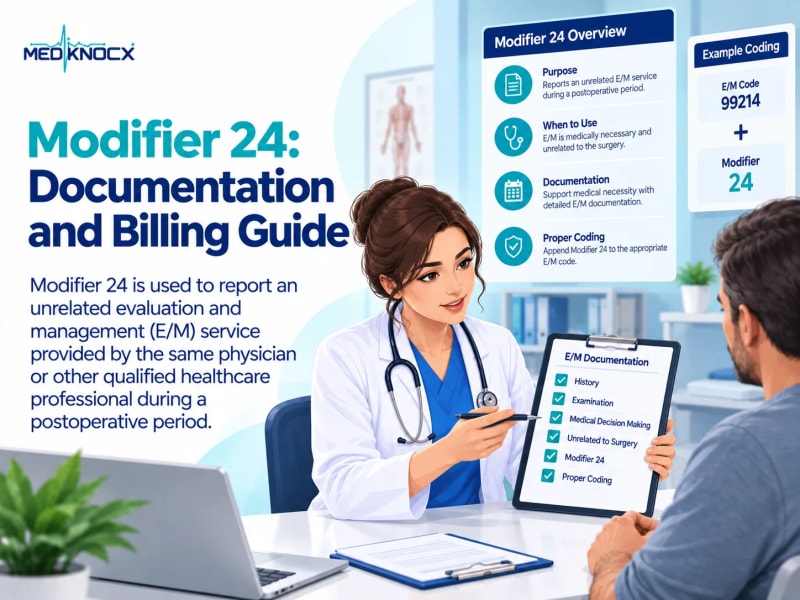
Modifier 24 reports an unrelated E/M service by the same physician or qualified healthcare professional during...