Healthcare
What Is POS 19 in Medical Billing? Off-Campus Hospital Guide
Learn what POS 19 means in medical billing, when to use it, POS 19 vs POS 11 and 22, Medicare billing, reimbur...

Sep 25, 2026
1 min read

Jordan Taylor
September 25, 2026
Table of Contents
11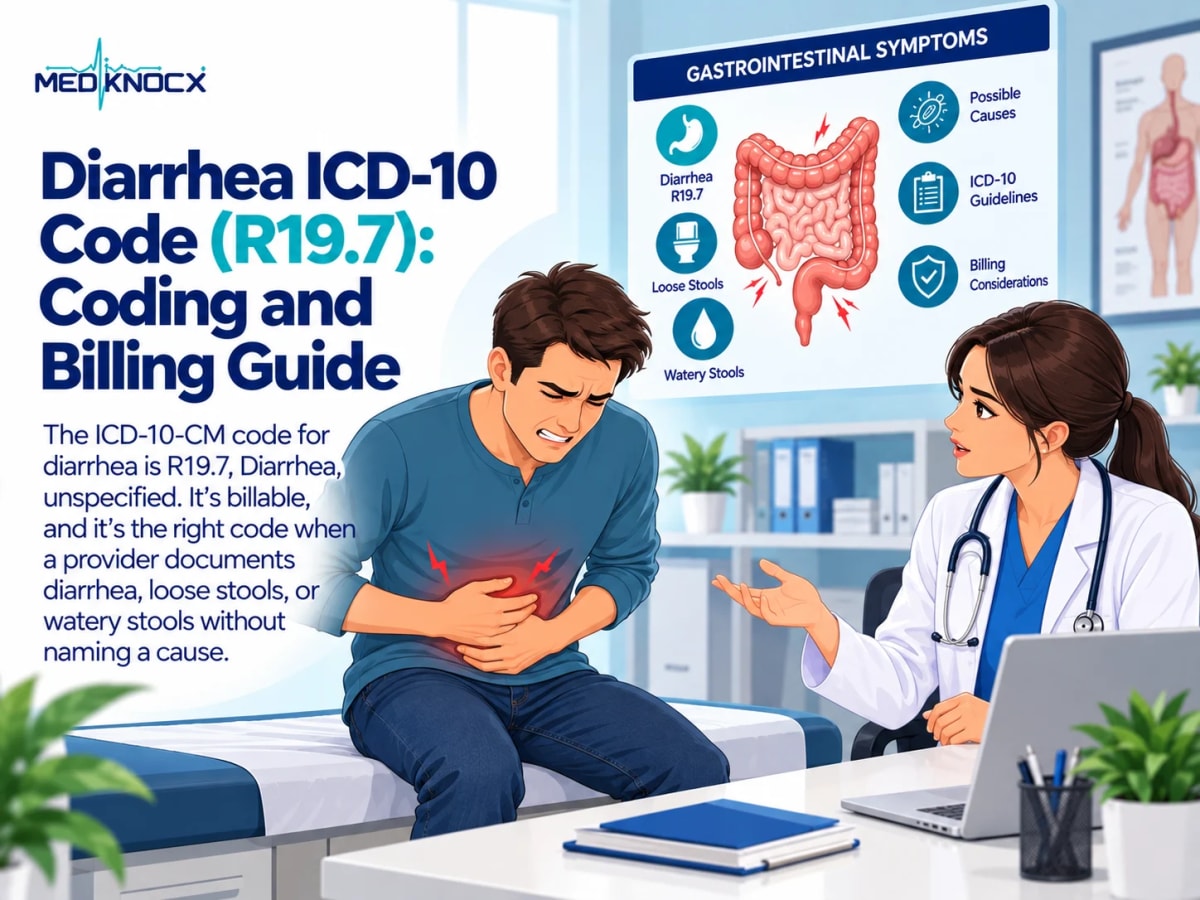
The ICD-10-CM code for diarrhea is R19.7, Diarrhea, unspecified. It's billable, and it's the right code when a provider documents diarrhea, loose stools, or watery stools without naming a cause. Acute, chronic, persistent, and intermittent diarrhea all use R19.7 when no underlying diagnosis is documented, since ICD-10-CM has no separate code for duration.
Most of the coding work happens once the provider names a cause. Gastroenteritis moves the claim to K52.9, an infection to A09 or a pathogen-specific code, irritable bowel syndrome to K58.0, a drug reaction to K52.1 with a T code, and C. difficile to A04.71 or A04.72. When a diagnosis like that is on the claim, R19.7 usually comes off, because diarrhea is part of the diagnosis. This guide covers each of those decisions.
R19.7 sits in Chapter 18 of ICD-10-CM, symptoms, signs and abnormal findings. Its inclusion term is diarrhea NOS, which is why "loose stools," "loose bowel movements," "watery stools," and plain "diarrhea" all land here when nothing more is documented.
As a symptom code, it follows the Chapter 18 rule: it's reported when no more definitive diagnosis is established, and it isn't reported alongside a diagnosis that routinely includes diarrhea. Once a provider documents gastroenteritis, C. diff, or IBS-D, the diarrhea is part of that diagnosis and R19.7 comes off.
R19.7 also carries an Excludes1 note, so these conditions are coded instead of it, never with it:
• Functional diarrhea, K59.1
• Neonatal diarrhea, P78.3
• Psychogenic diarrhea, F45.8
K52.9, noninfective gastroenteritis and colitis, unspecified. This is where "gastroenteritis," "acute gastroenteritis," "enteritis," and "colitis" land when the note doesn't call them infectious. It surprises people that plain gastroenteritis defaults to the noninfective code, but that's how the Index works. K52.9 has its own Excludes1 note, which includes diarrhea NOS (R19.7), so the two aren't billed together. It is also not a "chronic diarrhea" code; chronic diarrhea with no named cause stays on R19.7.
A09, infectious gastroenteritis and colitis, unspecified. When the provider documents infectious diarrhea, infectious gastroenteritis, or diarrhea of presumed infectious origin, A09 applies. It has no subcodes in ICD-10-CM. Codes like A09.0 and A09.9 appear online, but they belong to the WHO version of ICD-10 and will reject on a US claim.
Viral gastroenteritis. A08.4 when the provider documents a viral cause without naming the virus. Once a test identifies it, use the specific code: A08.11 for norovirus, A08.0 for rotavirus.
Confirmed bacterial pathogens. A positive stool culture or GI panel, documented by the provider, moves the claim to the organism code:
C. difficile. A04.7 isn't billable. Use A04.71 for a recurrent episode or A04.72 when it isn't documented as recurrent. When C. diff follows antibiotic use, the C. diff code replaces any "antibiotic-associated diarrhea" coding.
Traveler's diarrhea. There's no dedicated code. Before a pathogen is identified, traveler's diarrhea is coded as infectious diarrhea, A09; once a culture or panel names the organism (often enterotoxigenic E. coli), use that code instead. The note should connect symptom onset to the trip, which supports both the code and any GI panel ordered.
Chronic diarrhea has no code of its own. Chronic, persistent, or intermittent diarrhea without a named cause is R19.7, and the duration goes in the note, where it supports the workup. Some guides steer chronic diarrhea to K52.9, but K52.9 needs a documented gastroenteritis or colitis and excludes diarrhea NOS.
K58.0, irritable bowel syndrome with diarrhea. When the provider documents IBS-D or IBS with diarrhea, K58.0 applies and R19.7 isn't added. Don't downgrade it to K58.9 (IBS without diarrhea) when the record says diarrhea predominant; K58.1 is IBS with constipation and K58.2 is mixed.
K59.1, functional diarrhea. Used when the provider documents functional diarrhea. Clinically, it's a diagnosis of exclusion reached after a workup, and the note usually reflects that, but coders assign it from the provider's diagnosis rather than by checking which tests were done. The practical difference from K58.0 is pain: IBS-D involves recurrent abdominal pain tied to bowel movements, functional diarrhea doesn't. K59.1 excludes R19.7, so the two never appear together.
When the provider links diarrhea to a medication, K52.1, toxic gastroenteritis and colitis, is the manifestation code, and it needs a T code for the drug. For a correctly prescribed, properly taken drug, that's an adverse effect: K52.1 first, then the T code with a 5 in the fifth or sixth character.
• Chemotherapy-induced diarrhea: K52.1 + T45.1X5A (adverse effect of antineoplastic drugs)
• Antibiotic-associated diarrhea without C. diff: K52.1 + the antibiotic's adverse effect code, such as T36.0X5A for penicillins or T36.95XA for an unspecified systemic antibiotic
• Metformin, magnesium, and other drugs: K52.1 + the matching T code
If the drug was taken wrongly or in overdose, it's a poisoning instead, and the T code with a poisoning character goes first. If C. diff is confirmed, A04.71 or A04.72 replaces K52.1.
Bile acid (bile salt) diarrhea. When the provider documents bile acid malabsorption as the cause, it's generally reported with K90.89, other intestinal malabsorption. Diarrhea documented only as "post-cholecystectomy" without that diagnosis is coded from what's written, usually R19.7 with the relevant history.
Vomiting and diarrhea. Without a unifying diagnosis, code both: R19.7 plus R11.2 (nausea with vomiting) or R11.10 (vomiting, unspecified). Once the provider documents gastroenteritis, whether K52.9, A09, or A08.4, both symptoms are part of it and neither is added.
Diarrhea with abdominal pain. R19.7 plus the R10 code for the documented location, such as R10.32 for left lower quadrant pain, until a diagnosis explains both. If that diagnosis is IBS-D, K58.0 replaces the pair.
Dehydration and electrolytes. These aren't integral to diarrhea, so they're coded when documented and treated: E86.0 for dehydration, E86.1 for hypovolemia, E87.6 for low potassium. Heavy GI losses are a common cause of hypokalemia, and our hypokalemia ICD-10 guide covers how E87.6 is sequenced when both are present.
Related stool findings:
Bloody diarrhea. Code the cause the provider names, such as infectious colitis, C. diff, or ulcerative colitis. Without one, report R19.7 with the code for the bleeding the provider describes.
Pregnancy. When the provider documents diarrhea or its cause as complicating the pregnancy, a Chapter 15 code leads: O99.61- (digestive system diseases complicating pregnancy) for noninfective causes such as K52.9 or K58.0, or O98.8- for infectious causes such as A09, with the trimester character and the specific code after it. If the provider documents it as incidental to the pregnancy, Z33.1 is reported with the regular code instead.
Newborns. Noninfective diarrhea in the newborn record is P78.3, which R19.7 excludes. Infectious diarrhea in a newborn uses the infection code.
Family history. A family history of a digestive disease that matters to the workup, such as celiac disease or inflammatory bowel disease, is Z83.79, family history of other diseases of the digestive system. A family history of colon cancer is Z80.0 instead.
Most diarrhea claims carry lab work, and the diagnosis on the line has to explain why the test was ordered. R19.7 supports an initial workup; A09 or a travel history supports a broader infectious panel.
The large multiplex GI panels draw the most denials. Many Medicare contractors and commercial plans cover 87507 only for specific situations, such as immunocompromised patients, severe or bloody diarrhea, or suspected outbreaks, so check the MAC's policy and document why a panel was needed rather than a standard culture.
Inpatient. When diarrhea or gastroenteritis is the principal diagnosis, the case groups to MS-DRG 391 or 392, esophagitis, gastroenteritis and miscellaneous digestive disorders with or without MCC. A confirmed C. diff principal diagnosis groups differently, to the major gastrointestinal disorders family (MS-DRG 371 to 373), which is one more reason to code the confirmed organism rather than R19.7.
For any diarrhea code to hold up, the record should include:
• Onset and duration, and frequency per day
• Stool character: watery, bloody, mucus, greasy
• Associated symptoms: fever, vomiting, abdominal pain, urgency
• Relevant exposures: travel, recent antibiotics, new medications, sick contacts, chemotherapy
• Hydration status and any treatment for it
• The provider's impression in words: diarrhea, gastroenteritis, infectious diarrhea, IBS-D, or a confirmed organism
• Test results once available, and an updated diagnosis if they change the picture
When a culture comes back positive after the visit, the claim should reflect the confirmed diagnosis only if the provider documents it. A result sitting in the lab tab isn't a diagnosis until the provider addresses it.
These are almost all selection errors that a pre-submission medical coding review catches. When the same denial shows up again and again, particularly on GI panels, trace it through denial management to see whether the problem starts at ordering, documentation, or coding.
• CMS, ICD-10-CM official code files and guidelines, current fiscal year code set and April update
• CMS, MS-DRG classifications and software
R19.7, Diarrhea, unspecified, when no cause is documented. It also covers loose stools and watery stools.
There isn't a separate one. Chronic or persistent diarrhea without a documented cause is R19.7; with a cause, code the cause.
K52.9 when the provider doesn't call it infectious, A09 when they do, and A08.4 for viral gastroenteritis.
A09 until a pathogen is identified, then the organism's code, such as A04.1 for enterotoxigenic E. coli.
A04.72 when not documented as recurrent, A04.71 for a recurrent episode. A04.7 alone isn't billable.
K58.0.
Functional diarrhea. It can't be billed with R19.7.
K52.1 with T45.1X5A for the adverse effect of the antineoplastic drug.
R11.2 or R11.10 with R19.7 when there's no diagnosis; the gastroenteritis code alone when there is.
The reason for the test: usually R19.7, A09, or the suspected infection the provider documents, with travel or antibiotic history in the note when relevant.
Explore more medical billing guides, coding updates, and revenue cycle tips.
Learn what POS 19 means in medical billing, when to use it, POS 19 vs POS 11 and 22, Medicare billing, reimbur...
Modifier 24 reports an unrelated E/M service by the same physician or qualified healthcare professional during...
E87.6 is the ICD-10 code for hypokalemia (low potassium). Covers hyperkalemia E87.5, drug-induced and pregnanc...