Healthcare
Fatigue ICD-10 Code R53.83: Coding and Billing Guide
R53.83 is the ICD-10 code for fatigue, tiredness, lethargy, and lack of energy. Learn R53.81 malaise, R53.82 c...

Oct 3, 2026
1 min read

Jordan Taylor
August 22, 2026
Table of Contents
16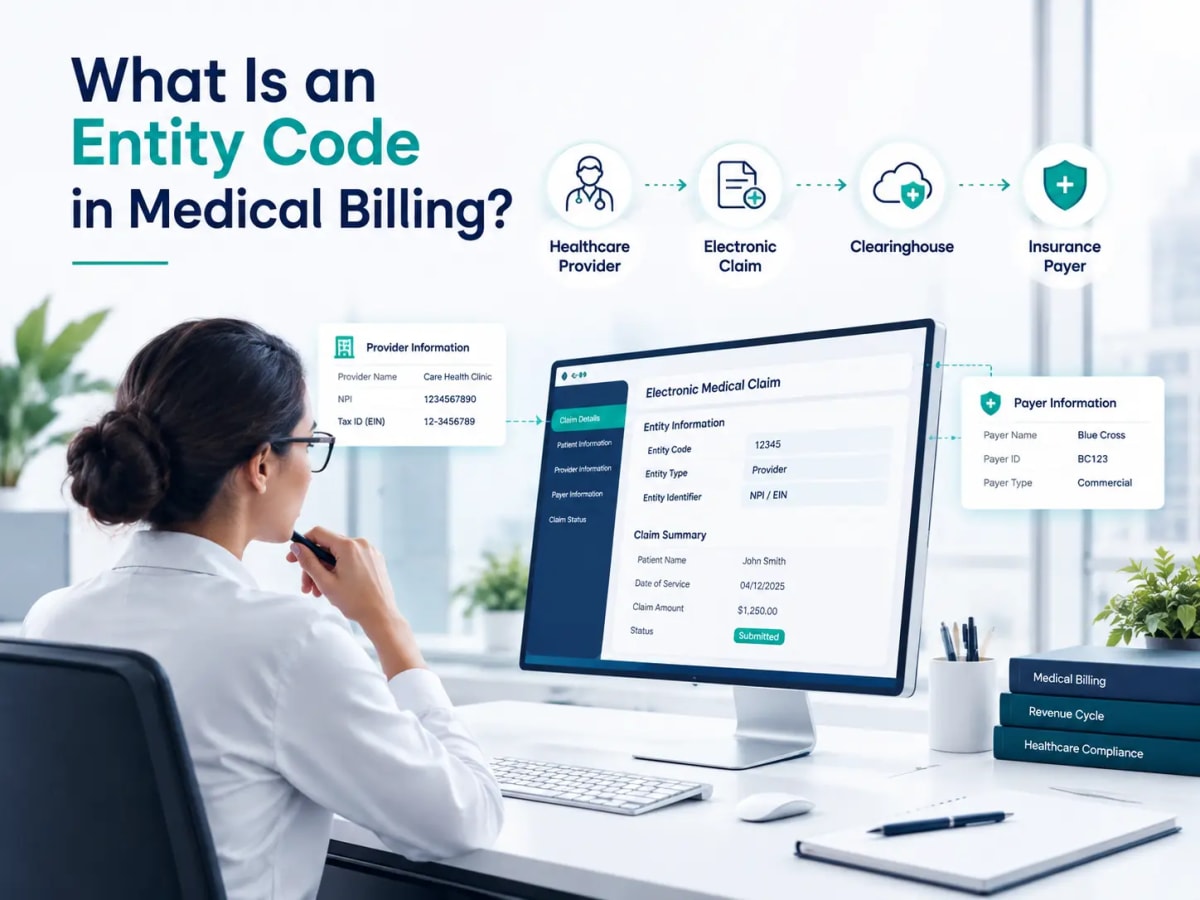
Medical billing involves far more than submitting a procedure code and waiting for an insurance payment. A single electronic healthcare transaction can contain information about the patient, subscriber, payer, billing provider, rendering provider, and other parties involved in the claim. Each party has a specific role, and electronic transactions need a consistent way to identify those roles.
This is where the term entity code in medical billing comes into the picture.
In simple terms, an entity code helps identify the entity or role being referenced in an electronic healthcare transaction. The term can be confusing because it is sometimes mixed up with other identifiers used in medical billing, especially the NPI and EIN. These identifiers are related to healthcare billing, but they serve different purposes.
An NPI identifies a healthcare provider, while an EIN is a federal tax identification number assigned by the IRS. An Entity Identifier Code is used within an X12 transaction to identify or reference an entity.
The distinction becomes especially important when a billing team encounters a message such as “This code requires use of an entity code.” That wording does not simply mean that someone needs to enter an EIN or NPI. The correct interpretation depends on the transaction and the specific claim-status code involved.
An entity code is a code used within an electronic healthcare transaction to identify or reference a particular entity.
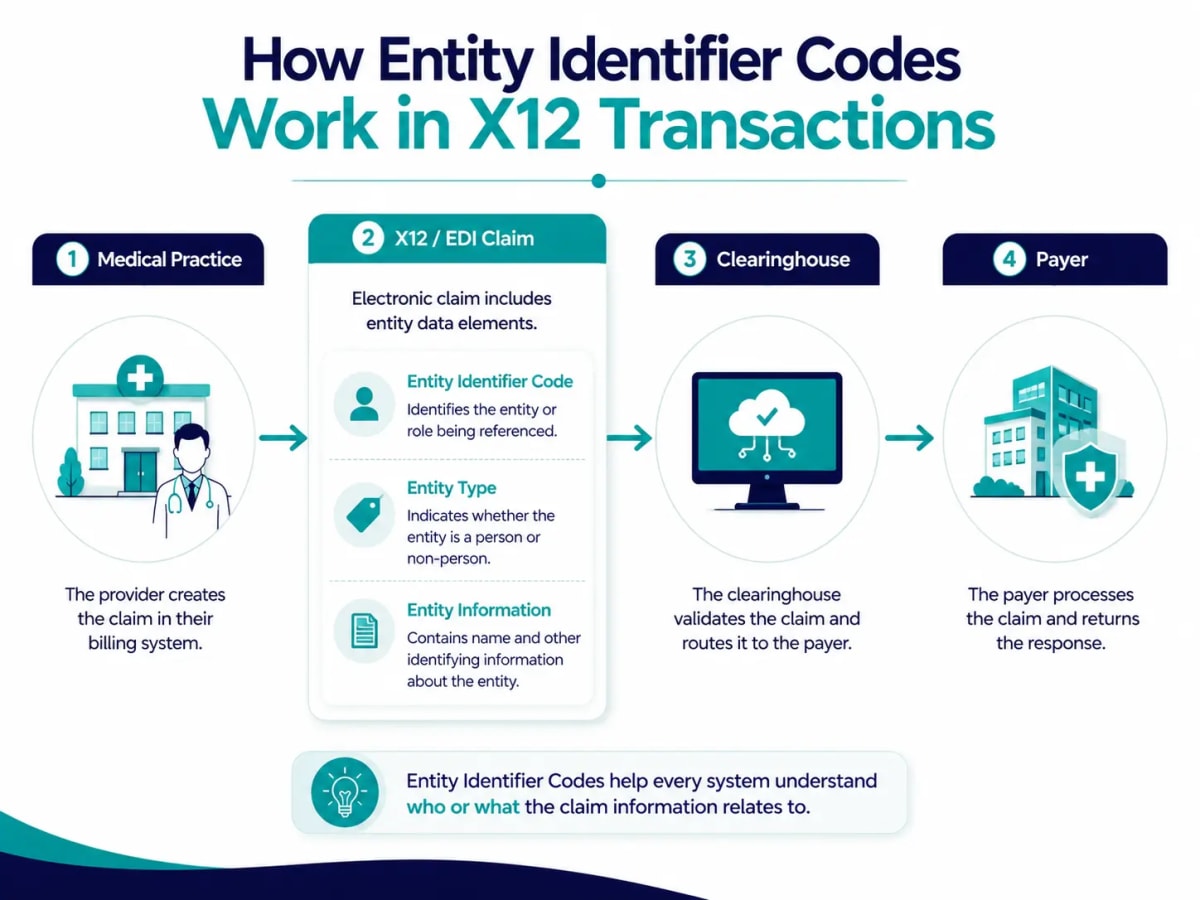
Think about a medical claim moving from a provider's billing system to a clearinghouse and then to an insurance payer. The receiving systems need to understand who each piece of information relates to. Is it the billing provider? The rendering provider? The patient? The subscriber? The payer?
The entity code helps establish that context.
X12 uses the term Entity Identifier Code for a data element that identifies an organizational entity, physical location, property, or individual. The exact values and their permitted use depend on the transaction and implementation guide.
This is why there is not one universal entity code meaning that applies to every medical claim. The meaning depends on where the code is being used and which entity the transaction is describing.
For a billing professional, the easiest way to think about it is:
Entity = the person, organization, or party involved
Entity Identifier Code = the code that identifies or references that entity or role within the transaction
That distinction becomes useful when investigating claim errors because an entity code is not automatically the same thing as the identifier attached to that entity.
The word "entity" sounds technical, but the concept is fairly simple.
An entity is a person, organization, or other party represented in a healthcare transaction. A single claim may involve several entities at the same time.
For example, imagine a patient visits a physician who works for a medical group. The physician performs the service, but the medical group submits the claim. The patient's spouse is the subscriber on the insurance policy, and the insurance company processes the claim.
That one claim can involve a rendering provider, billing organization, patient, subscriber, and payer.
Each party has a different role. Electronic transactions therefore need structured information that tells the receiving system which party is being referenced.
This is why entity codes in medical billing are part of a larger electronic data structure rather than a standalone identifier like an NPI.
When someone searches for entity code on claim, they are often looking for a specific field or number that identifies a provider, payer, patient, or another party.
The answer depends on the transaction.
X12 healthcare transactions use the Entity Identifier Code as part of their structured data. For example, the NM1 segment can contain information that identifies the entity being represented. The particular entity identifier code used depends on the loop, transaction, and implementation guide.
This means you should not assume that an entity code always identifies the billing provider or always represents the payer. Its meaning comes from its context.
The same concept can be seen in claim-status transactions. X12 maintains claim-status codes that specifically require an Entity Code when the status relates to a particular entity. For example, status code 16 means that a claim or encounter has been forwarded to an entity, while code 26 means that the entity was not found. Both have a usage rule requiring an Entity Code.
That context is important when troubleshooting an electronic claim. Instead of asking only, "What is the entity code?" it is usually better to ask:
Which entity is the transaction referring to, and what information does the transaction require about that entity?
The term Entity Identifier Code is closely connected with the ANSI X12 standards used for electronic healthcare transactions.
One place billing professionals may encounter the concept is the NM1 segment. Depending on the transaction, the segment can contain information that identifies the entity, describes the entity type, and provides the entity's name or identifier.
This creates an important separation between the role of an entity and the identifier associated with that entity.
For example, a transaction may need to indicate that the information relates to a particular provider role. Another field can then carry the provider's actual identifier.
That is why changing an NPI does not necessarily mean you have changed the entity code. They are different pieces of information within the transaction.
The distinction is particularly useful when working with clearinghouse responses. If a claim fails validation, a billing specialist should review the transaction structure and the payer or clearinghouse message rather than changing identifiers at random.
The applicable X12 implementation guide remains the best source for determining which entity codes and related fields are valid in a specific transaction.
The National Provider Identifier (NPI) is a unique 10-digit identifier for healthcare providers. CMS explains the NPI standard CMS states that covered healthcare providers, health plans, and clearinghouses use NPIs in HIPAA standard transactions
An Employer Identification Number (EIN) is different. The RS defines an EIN as a federal tax ID for businesses and other qualifying entities.
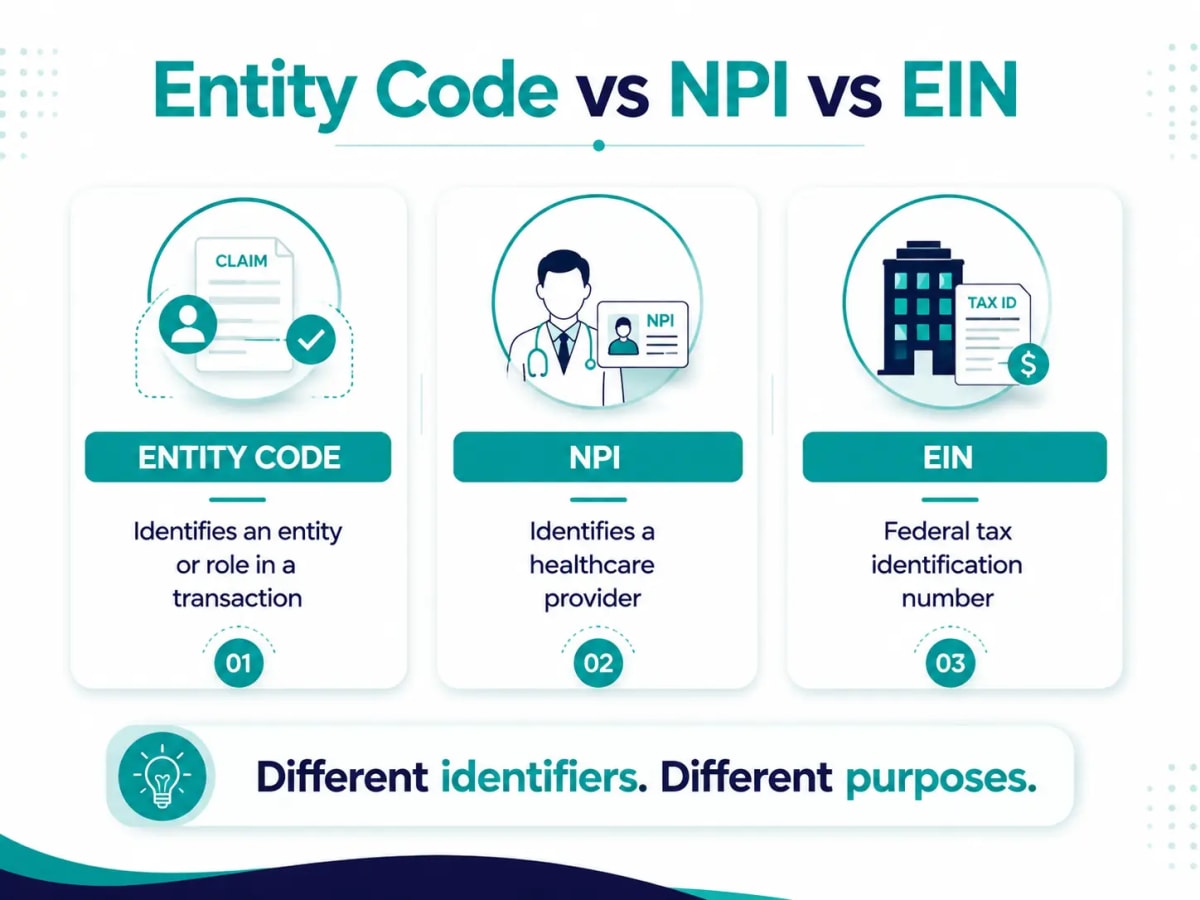
The entity identifier serves another purpose within the transaction.
So, if someone asks whether an NPI or EIN is an entity code for medical billing, the safest answer is no. They are identifiers that may be associated with entities, but they are not interchangeable with the Entity Identifier Code used in an X12 transaction.
A billing entity is the person or organization responsible for billing or submitting healthcare services in a particular arrangement.
For example, a physician may provide the service while a medical group submits the claim. In that situation, the group can be the billing organization while the physician is the rendering provider.
This distinction matters because the billing entity and the rendering provider are not necessarily the same party.
The same claim can therefore contain information representing different entities and different roles.
A billing entity is the actual organization or person involved in the billing relationship.
An entity code is a transaction-level code used to identify or reference an entity or role.
A simple way to remember the difference is:
Billing entity = who the party is
Entity Identifier Code = how the transaction identifies or references the party's role
That difference helps explain why searching for billing entity meaning and searching for entity code meaning can lead to two different answers.
An EIN in medical billing is the Employer Identification Number associated with a business or organization when an EIN is applicable.
The IRS describes an EIN as a unique nine-digit federal tax identification number assigned to businesses and other qualifying entities. It can be used for purposes such as employment taxes, federal tax filings, banking, and other business activities.
Healthcare organizations may have an EIN while also using an NPI for healthcare transactions. CMS specifically distinguishes employers' EINs from providers' NPIs within its explanation of HIPAA unique identifiers.
So when someone searches what is EIN number in medical billing, they may actually be trying to understand the tax identifier associated with a medical practice or healthcare organization.
That does not make the EIN an entity code.
EIN stands for Employer Identification Number.
It is issued by the Internal Revenue Service and is used to identify businesses and other qualifying entities for federal tax purposes.
An EIN is generally a nine-digit number. It should not be confused with the 10-digit NPI used to identify healthcare providers.
No.
An EIN identifies an employer or qualifying organization for federal tax purposes. An Entity Identifier Code serves a different function inside an X12 transaction.
CMS lists EIN and NPI as separate unique identifiers with different purposes, which reinforces why they should not be treated as interchangeable.
A medical claim is essentially a collection of related information. For that information to move correctly between systems, each party and each data element needs to be interpreted in the right context.
Suppose a claim contains information about a medical group and an individual physician. If the transaction does not clearly represent the roles of those parties, the receiving system may not interpret the data as intended.
Entity identification becomes even more important when a claim moves through multiple systems, such as a practice management system, clearinghouse, and payer.
Accurate entity information supports the broader claim-processing workflow by helping systems understand which party is associated with the reported information.
However, an entity-code issue does not automatically mean that a claim has been denied. It may appear in a claim-status response, an electronic transaction error, or another processing context. The specific status code and transaction determine what the message actually means.
This is one of the most confusing phrases people encounter when researching entity code in medical billing.
If a claim-status code says:
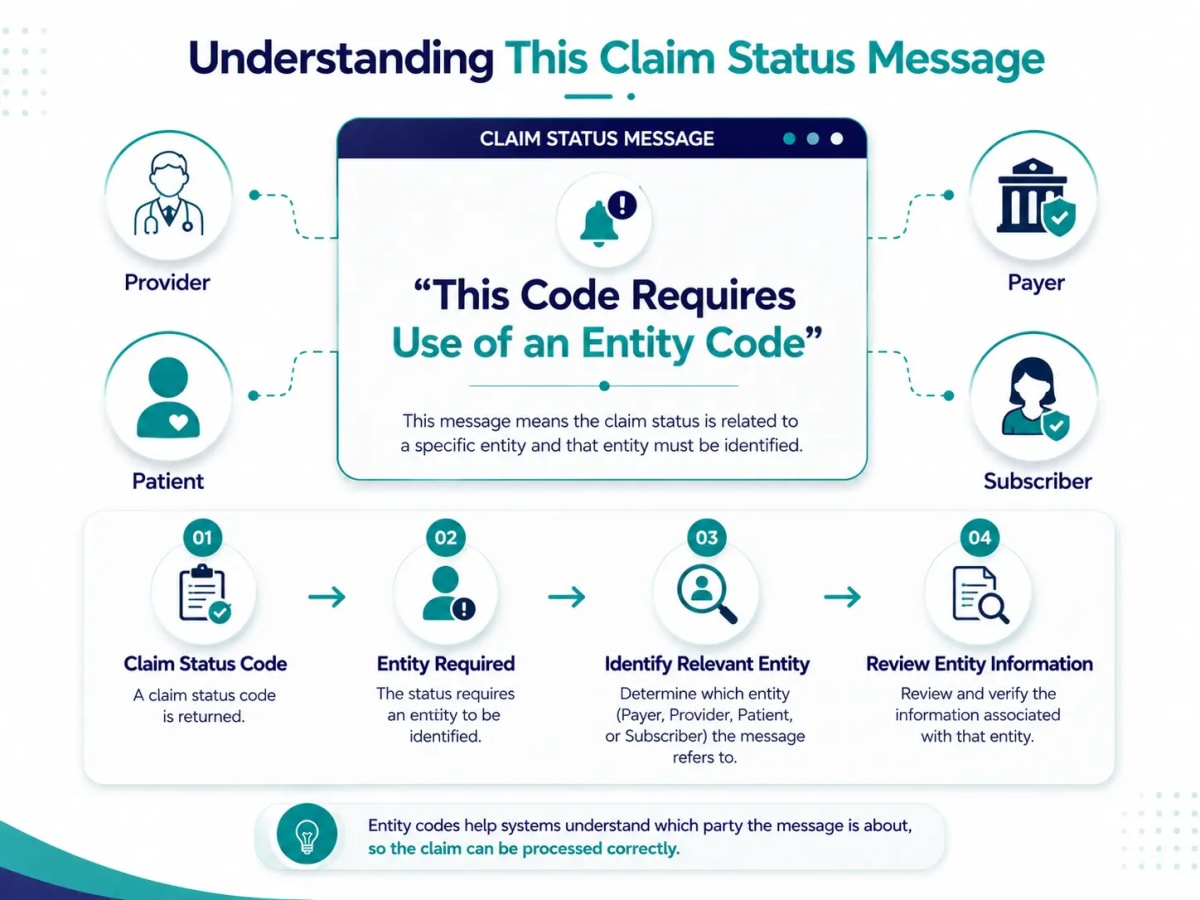
“Usage: This code requires use of an Entity Code.”
it means the status code is defined in a way that requires an entity to be identified along with the status information.
X12 confirms that when a Claim Status Reason Code includes this usage rule, implementers must transmit the code with an Entity Code.
In other words, the message is not simply asking for an EIN.
It is telling the transaction that the status applies to a particular entity and that the entity needs to be identified.
For example, X12 lists status code 16 as:
Claim/encounter has been forwarded to entity.
It also lists code 26 as:
Entity not found.
Both codes require use of an Entity Code.
The same principle appears in other statuses. Code 88 relates to an entity not being eligible for benefits for the submitted dates of service, while code 96 indicates no agreement with the entity. Both include the requirement for an Entity Code.
This is why the exact status code matters. The phrase alone does not tell you which entity is wrong.
X12 maintains a large claim-status code list, and many codes include the Entity Code usage requirement. Some useful examples include:
X12 also includes codes for specific information about an entity. For example, code 128 relates to an entity's tax ID, code 145 relates to an entity's specialty or taxonomy code, and code 149 relates to an entity's employer ID. These codes also have the Entity Code usage requirement.
This illustrates an important point: entity code does not mean EIN. X12 can separately identify an entity's tax ID or employer ID while still requiring an Entity Code to indicate which entity the information belongs to.4
An entity code error usually means there is a problem identifying or processing an entity associated with a transaction.
The underlying issue can vary considerably.
Sometimes the problem may involve provider information. In another case, the payer may be unable to locate the referenced entity. A transaction could also require information about a specific entity, such as a tax ID, provider ID, taxonomy code, address, or another identifier.
That is why there is no single fix for every entity-code error.
The first step is to determine which entity the message refers to and then understand what information the payer or clearinghouse is requesting.
One common cause is incorrect provider information. For example, the billing provider or rendering provider may not be represented consistently with the payer's records.
Another possibility is an NPI mismatch. Since the NPI is the standard unique identifier for healthcare providers in HIPAA transactions, incorrect or inconsistent NPI information can affect claim processing.
Payer enrollment can also matter. If the organization or provider information in the claim does not align with the payer's enrollment records, the transaction may require correction or additional information.
Taxonomy information is another area worth checking when the payer or transaction specifically references it. CMS describes taxonomy codes as 10-character codes used to designate a provider's classification and specialization, and taxonomy information is part of the NPI enrollment process.
Other causes can include:
Incorrect billing or rendering provider relationships
Missing entity information
Incorrect payer information
Incorrect subscriber or patient relationships
Payer-specific EDI requirements
Incorrect source data in the billing system
The exact cause should always be determined from the complete rejection or status response rather than from the words "entity code" alone.
When a billing team receives an entity-related error, the best approach is to trace it back to the transaction instead of changing random claim fields.
Start by reading the complete rejection or claim-status message. Look for the status code, additional status information, and any reference to a particular entity.
Next, identify the entity involved. Is the message referring to the billing provider, rendering provider, payer, subscriber, patient, or another party?
Once the entity is identified, review the information associated with it. Depending on the message, this may include the provider's NPI, name, address, taxonomy information, payer enrollment details, tax identification information, or another identifier.
It is also important to compare the claim information with the payer's records. A claim can contain technically valid information but still fail if the payer's enrollment or provider records do not match the submitted data.
After correcting the source information, validate the transaction and resubmit it according to the payer or clearinghouse requirements.
If the message remains unclear, the complete rejection information should be provided to the clearinghouse or payer. The exact transaction context often determines the appropriate correction.
An entity-code issue and a claim denial are not necessarily the same thing.
A claim rejection generally prevents a transaction or claim from moving through the expected processing workflow because information is missing, invalid, or cannot be processed.
A claim denial, on the other hand, generally refers to a payer decision not to pay a claim or service as submitted after the claim has been evaluated under the applicable processing rules.
The distinction matters because the corrective process is different.
For example, X12 status code 20 means accepted for processing, while status code 21 indicates missing or invalid information and requires another status code to identify the missing or invalid information. Status code 26 specifically indicates that an entity was not found and requires an Entity Code.
So if your clearinghouse report contains an entity-related message, do not immediately classify it as a denial. First determine what transaction generated the message and what the status code actually says.
Consider a physician who works for a multi-provider medical group.
The physician performs the service, but the medical group may submit the claim. The patient receives the service, while a spouse may be the subscriber responsible for the insurance policy. The insurance company then processes the claim.
There are several different parties involved in one transaction, and each has a different relationship to the claim.
Now consider a different situation where a claim-status response says that an entity was not found. The billing team cannot solve that problem simply by changing the patient's information. They need to determine which entity the status refers to and then verify the relevant data.
Another example is an entity-specific request for information. X12 includes claim-status codes that refer to an entity's tax ID, provider ID, taxonomy code, address, or other information. The status code tells the transaction what information is being requested, while the Entity Code identifies the entity to which that information relates.
These examples show why entity code for medical billing is better understood as part of a structured transaction rather than as one fixed identifier.
The best way to prevent recurring entity-related problems is to keep provider, payer, and organizational information accurate across the systems involved in claim submission.
Healthcare organizations should regularly review provider names, NPIs, taxonomy information, payer enrollment data, billing relationships, and other information used to build electronic claims.
It is also useful to monitor clearinghouse responses instead of treating each rejection as an isolated event. If the same entity-related issue appears repeatedly, the underlying problem may be in the practice management system, provider setup, payer enrollment, or claim configuration.
Keeping source data synchronized is particularly important for organizations with multiple providers or locations. A change made in one system but not reflected elsewhere can create inconsistencies that surface during claim processing.
A structured medical billing audit can also help identify recurring data and workflow problems that are contributing to claim errors, reimbursement delays, or unnecessary rework.
The easiest way to understand an entity code in medical billing is to separate the entity from the identifiers used to describe it.
A medical practice, physician, patient, subscriber, or payer can be an entity involved in a healthcare transaction. The Entity Identifier Code helps the transaction identify or reference the relevant entity or role.
An NPI serves a different purpose. It is the standard 10-digit identifier used to identify healthcare providers in HIPAA standard transactions. An EIN is also different. It is a nine-digit federal tax identification number issued by the IRS to businesses and other qualifying entities.
When a claim-status message says “This code requires use of an entity code,” it does not automatically mean that an EIN or NPI is missing. X12 uses this wording for claim-status codes where an entity must be identified, and the appropriate interpretation depends on the specific status and transaction.
If your billing team needs help reviewing claims, identifying billing errors, or improving reimbursement accuracy, Mediknocx provides professional medical billing services designed to support accurate claims processing, billing compliance, and stronger revenue cycle performance
Explore more medical billing guides, coding updates, and revenue cycle tips.
R53.83 is the ICD-10 code for fatigue, tiredness, lethargy, and lack of energy. Learn R53.81 malaise, R53.82 c...
ICD-10 codes for cough by duration: R05.1 acute, R05.2 subacute, R05.3 chronic, R05.9 unspecified. Plus Exclud...
M25.512 is the ICD-10 code for left shoulder pain. See M25.511, M25.519, bilateral coding, scapula and clavicl...