Healthcare
Abdominal Pain ICD-10 Codes: Complete R10 Coding Guide
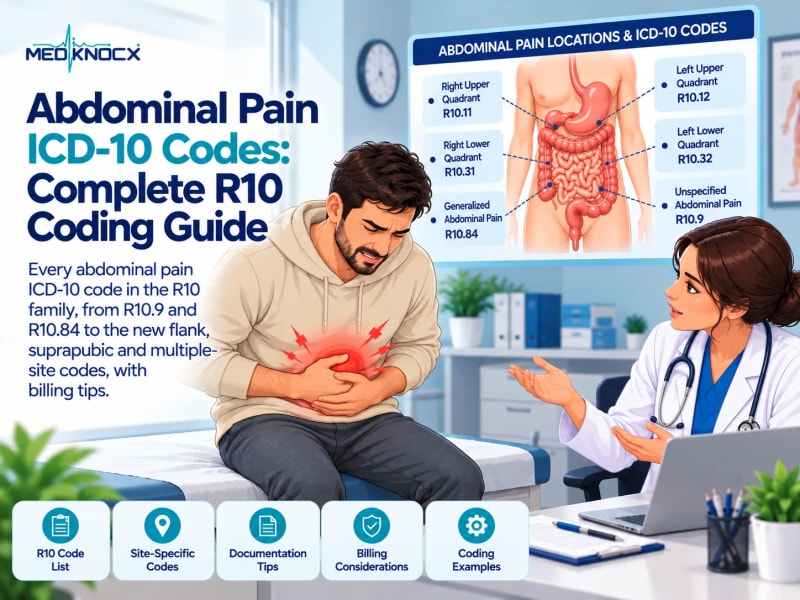
Every abdominal pain ICD-10 code in the R10 family, from R10.9 and R10.84 to the new flank, suprapubic and mul...

Sep 26, 2026
1 min read

Jordan Taylor
September 28, 2026
Table of Contents
9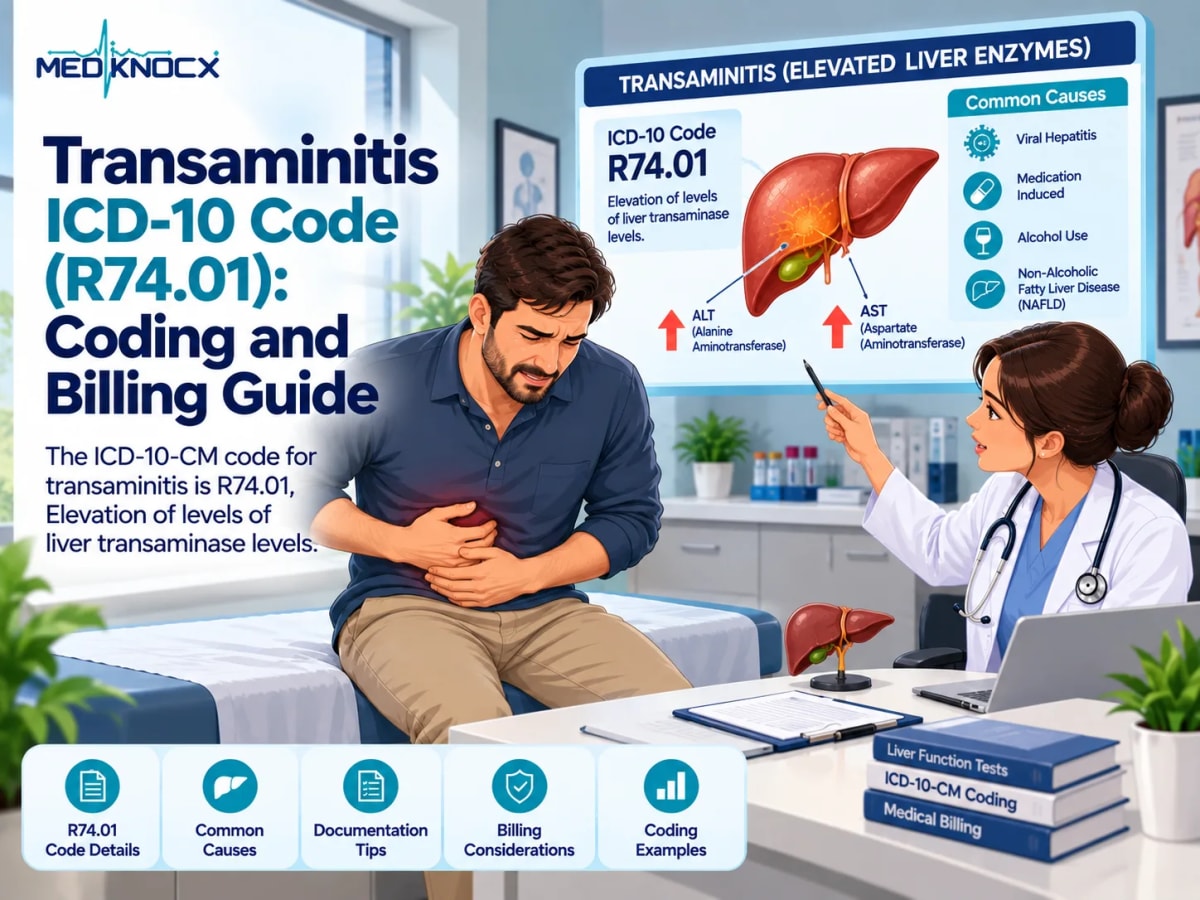
The ICD-10-CM code for transaminitis is R74.01, Elevation of levels of liver transaminase levels. It covers elevated ALT, elevated AST, or both, when the provider hasn't identified what's causing them. It's billable, and it has been the correct code since October 1, 2020, when the old R74.0 was split into separate transaminase and LDH codes.
R74.01 is a findings code, which means its job usually ends once the workup does. Fatty liver, viral hepatitis, alcoholic liver disease, and drug-induced liver injury each have their own codes, and when the provider documents one of them, it replaces R74.01. The harder calls sit in between: a raised alkaline phosphatase instead of ALT, a note that only says "abnormal LFTs," a statin that might be responsible, or a patient who's pregnant. This guide covers each of those.
R74.01 sits in Chapter 18, abnormal findings on examination of blood without diagnosis. It has no severity or duration variants, so mild, marked, acute, chronic, and persistent transaminitis all use it.
The three that get confused most:
• R74.01 vs R74.8. ALT and AST go to R74.01. Alkaline phosphatase alone goes to R74.8. When both are elevated and both are addressed, both codes can be reported.
• R74.01 vs R94.5. R94.5 is for a note that just says "abnormal liver function tests" or "abnormal LFTs" without naming the enzyme. It's less specific, and a quick look at the lab usually lets the provider name ALT or AST and move the claim to R74.01.
• R74.01 vs R74.0. Some older templates and favorites lists still carry R74.0. It's been a non-billable header since October 1, 2020, and claims with it reject.
R74.01 fits when the provider documents elevated transaminases and no definitive cause has been established. That's the typical outpatient picture: ALT of 96 on a routine CMP, the provider notes "transaminitis, etiology unclear," and orders a hepatitis panel and a right upper quadrant ultrasound. R74.01 is first-listed, and it supports the tests ordered.
Three documentation rules decide whether it holds up.
The provider has to address it. A flagged ALT in the lab table doesn't support R74.01 by itself. Abnormal findings are coded when the provider indicates they're clinically significant, through a diagnosis, a plan, a repeat test, or a medication change. A note that never mentions the value doesn't support the code, no matter how high it is.
Suspected causes aren't coded in outpatient settings. "Likely fatty liver" or "probable hepatitis C" isn't coded as fatty liver or hepatitis C on a clinic claim. R74.01 stays until the diagnosis is confirmed. Inpatient facility coding is different: an uncertain diagnosis documented at discharge as probable or likely can be coded as if confirmed.
The note should show the reasoning. The enzyme and its value, the pattern (for instance, "ALT greater than AST"), the differential being worked through, and the next step. That last part is what supports repeat hepatic panels and imaging, and it's what's usually missing when these claims get questioned.
A note that does all of this can be two lines: "Transaminitis, ALT 96, AST 71, pattern suggests hepatocellular cause. Differential includes MASLD, viral hepatitis, and medication effect; ordering hepatitis panel and RUQ ultrasound, recheck LFTs in 6 weeks."
Once the provider documents the cause, that diagnosis is coded, and R74.01 generally comes off because raised transaminases are part of the condition. It stays as an additional code only when the provider addresses the enzymes as a separate concern, for instance values out of proportion to the known condition.
A result review visit follows the same idea. When the patient comes back to go over an ultrasound that the radiologist reads as hepatic steatosis and the provider agrees, that visit is coded K76.0, not R74.01.
A note on alcoholic liver disease. Some guides say K70 codes need documented current drinking. They don't. K70 is coded when the provider documents that the liver disease is alcohol-related, including in a patient who has since stopped drinking. The patient's alcohol use is captured separately with an F10 code, such as F10.21 for alcohol dependence in remission, when the provider documents it. What K70 does need is the provider linking the liver disease to alcohol; a history of drinking plus elevated enzymes, with no stated link, stays on R74.01.
Medication-related enzyme elevations code one of two ways, depending on what the provider documents.
Elevated enzymes attributed to a drug, without a liver disease diagnosis. A patient on atorvastatin with an ALT at twice normal, and a note that says "transaminitis likely due to statin, dose reduced." That's an adverse effect: R74.01 first, then the drug's adverse effect code, here T46.6X5A (antihyperlipidemic drugs). The ICD-10-CM rule for adverse effects is the nature of the effect first, then the T code with a 5 in the fifth or sixth character.
Documented drug-induced liver injury or toxic hepatitis. When the provider documents DILI, drug-induced hepatitis, or toxic liver disease, category K71 replaces R74.01. K71 isn't one code; it's split by the pattern of injury:
The T code is still required. Common ones: T46.6X5A for statins, T36.0X5A for penicillins such as amoxicillin-clavulanate, T37.1X5A for antituberculosis drugs such as isoniazid, T45.1X5A for methotrexate and other antineoplastics, and T39.1X5A for acetaminophen at a therapeutic dose. The seventh character follows the encounter: A for active treatment, D for follow-up visits.
Adverse effect or poisoning. If the drug was taken as prescribed, it's an adverse effect and the liver code goes first. If it was an overdose or taken wrongly, such as an acetaminophen overdose, it's a poisoning: the T code with the poisoning character (T39.1X1A for accidental, T39.1X2A for intentional self-harm) is sequenced first, followed by the liver injury code.
In a pregnant patient, the obstetric code leads. Elevated liver enzymes in pregnancy are coded with O26.61-, liver and biliary tract disorders in pregnancy, followed by R74.01 to identify the specific finding and a Z3A code for weeks of gestation. The sixth character sets the trimester:
So a patient at 31 weeks with newly elevated ALT and AST that the provider is working up is O26.613, R74.01, Z3A.31. You'll see O99.89 suggested for this scenario on some billing blogs, but O26.6 is the category ICD-10-CM provides for liver disorders in pregnancy, and O99.6 (digestive diseases complicating pregnancy) actually excludes it.
The same category is used for other pregnancy liver conditions such as intrahepatic cholestasis of pregnancy, with the specific condition documented alongside it. HELLP syndrome is different: it has its own codes in the O14.2- category and is coded there rather than as transaminitis.
The most common lab mistake is overlap. A CMP and a hepatic function panel on the same draw repeat most of the same tests, so billing 80053 and 80076 together draws bundling edits. If the provider needs direct bilirubin on top of a CMP, bill 82248 rather than a second panel. The same applies to billing 84460 or 84450 alongside a panel that already includes them.
For repeat panels, the note needs to say why the recheck matters: trending after a medication change, monitoring a known elevation, or completing a workup. "Repeat labs" alone is what gets these lines denied.
Inpatient. R74.01 rarely stays principal through a full admission, because most workups end in a diagnosis. When the confirmed principal is toxic liver disease or fatty liver, the case typically groups to MS-DRG 441 to 443, disorders of liver except malignancy, cirrhosis, or alcoholic hepatitis; alcoholic hepatitis and cirrhosis group to MS-DRG 432 to 434.
Right upper quadrant pain often travels with abnormal LFTs, and when it's documented without a diagnosis, it's coded separately as R10.11; our abdominal pain ICD-10 guide covers the full R10 family. Most of the rows above are caught before submission by a medical coding review that checks the diagnosis against the note, and recurring lab denials are worth tracing through denial management to find whether the gap starts at ordering, documentation, or coding.
• CMS, ICD-10-CM official code files and guidelines, FY2026 code set effective October 1, 2025, with the April 1, 2026 update
• CMS, MS-DRG classifications and software, version 43
R74.01, elevation of levels of liver transaminase levels. It applies to elevated ALT, AST, or both when no cause is confirmed.
R74.01 when the elevated enzymes are ALT or AST. Elevated alkaline phosphatase alone is R74.8.
R94.5, abnormal results of liver function studies, when the note doesn't say which value is abnormal. If it names ALT or AST, R74.01 is more specific.
No. Since October 1, 2020, R74.0 is a header; use R74.01 for transaminases or R74.02 for LDH.
No. R74.01 covers every severity and duration; the detail belongs in the note.
R74.01 with T46.6X5A when the provider attributes the elevated enzymes to the statin. If the provider documents drug-induced hepatitis, a K71 code replaces R74.01, still with T46.6X5A.
O26.61- with the trimester character, then R74.01, then the Z3A code for weeks of gestation.
Most often 80076 (hepatic function panel) or 80053 (CMP), 84460 and 84450 for single enzymes, 80074 for a hepatitis panel, and 76705 for a right upper quadrant ultrasound.
No. K70 requires the provider to link the liver disease to alcohol. Current or past alcohol use is captured separately with an F10 code.
Explore more medical billing guides, coding updates, and revenue cycle tips.
Every abdominal pain ICD-10 code in the R10 family, from R10.9 and R10.84 to the new flank, suprapubic and mul...
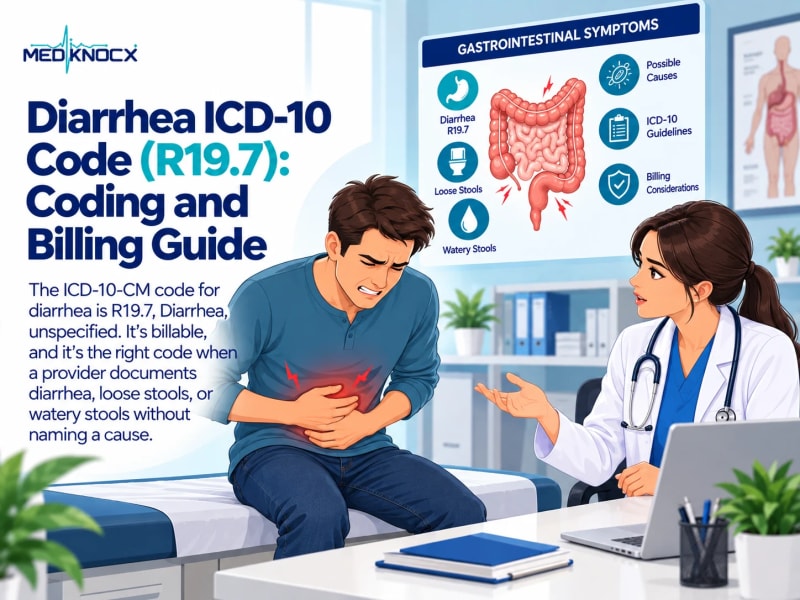
R19.7 is the ICD-10 code for diarrhea, unspecified. Learn when to use K52.9, A09, K58.0, K59.1, C. diff and tr...
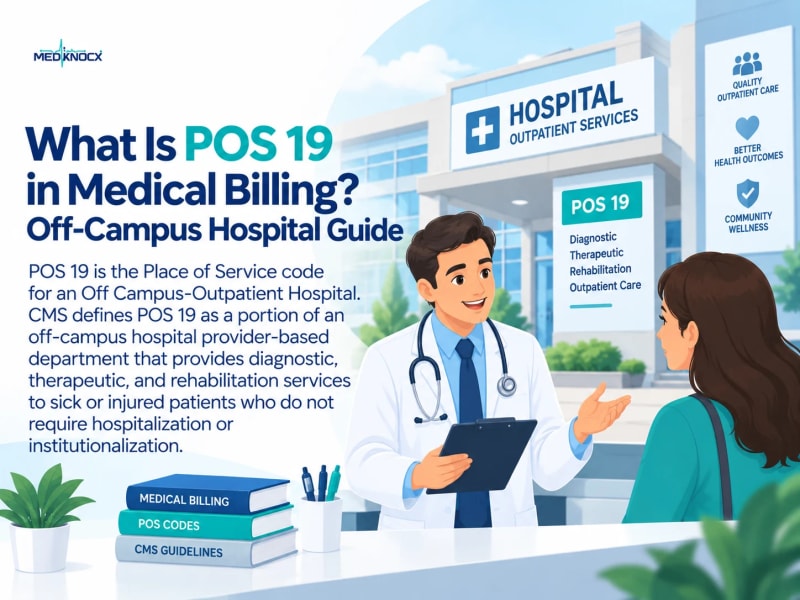
Learn what POS 19 means in medical billing, when to use it, POS 19 vs POS 11 and 22, Medicare billing, reimbur...