Healthcare

Hypokalemia ICD-10 Code (E87.6): Coding & Billing Guide
E87.6 is the ICD-10 code for hypokalemia (low potassium). Covers hyperkalemia E87.5, drug-induced and pregnanc...

Sep 24, 2026
1 min read

Jordan Taylor
September 24, 2026
Table of Contents
25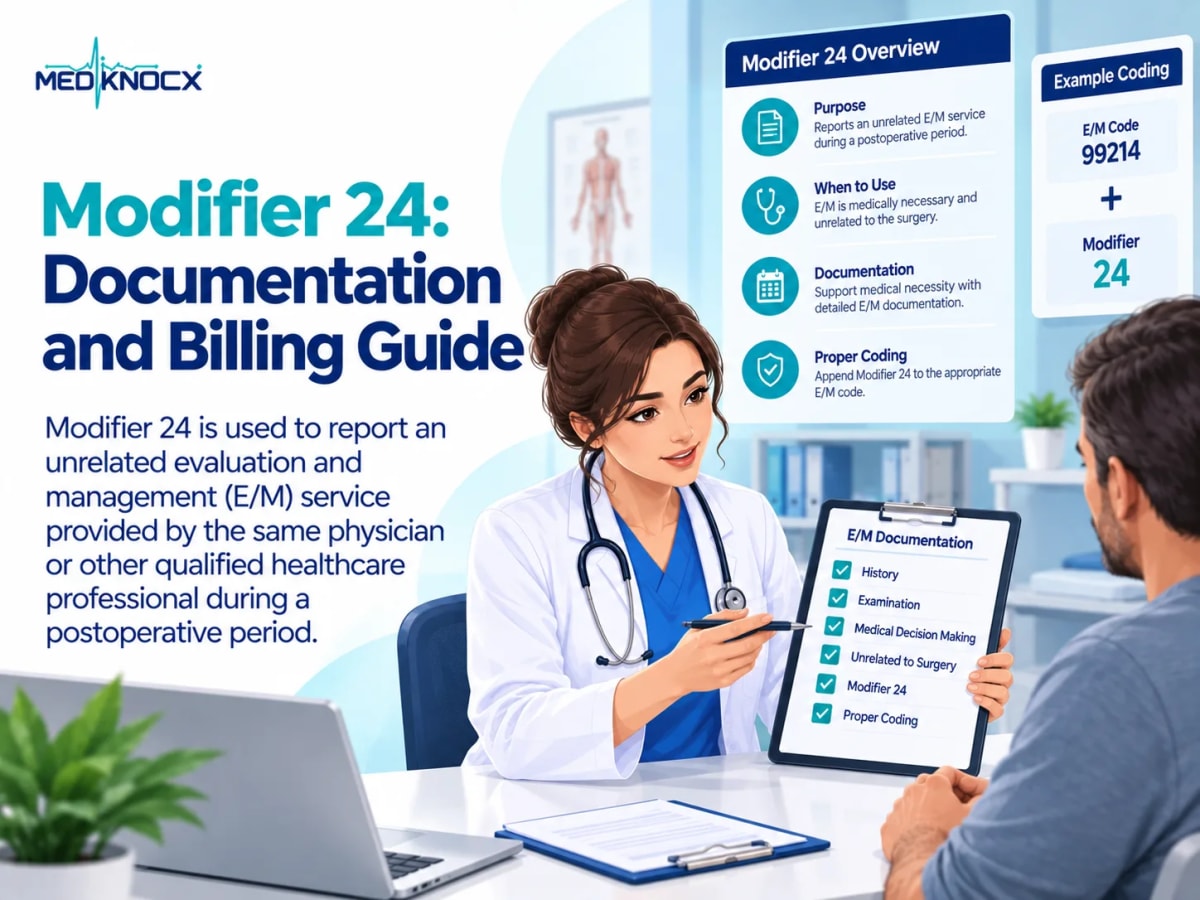
Modifier 24 is used to report an unrelated evaluation and management (E/M) service provided by the same physician or other qualified healthcare professional during a postoperative period.
It helps distinguish a separately reportable E/M service from postoperative care included in the global surgical package.
Understanding Modifier 24 is important for accurate medical coding, claim submission, reimbursement, and denial prevention. Incorrect use can result in claim denials, payment delays, and compliance concerns.
This guide explains when to use Modifier 24, when not to use it, global-period rules, documentation requirements, provider relationships, payer considerations, practical examples, denial prevention, and related modifiers.
Modifier 24 is a CPT modifier appended to an appropriate E/M code when the same physician or qualified healthcare professional provides an unrelated E/M service during a postoperative period.
The key concept is unrelated.
The new E/M service must address a condition that is separate from the condition or surgical service that created the global period.
For example, a physician performs knee surgery. During the postoperative period, the same physician evaluates the patient for a newly documented respiratory condition.
If the respiratory evaluation is medically necessary, separately reportable, and supported by documentation, Modifier 24 may be appropriate.
Modifier 24 does not automatically make an E/M service payable. The underlying service must still satisfy applicable coding, medical necessity, documentation, and payer requirements.
Modifier 24 should be considered when an unrelated E/M service occurs during an applicable postoperative global period.
Common situations include:
A patient develops an unrelated medical condition after surgery.
The physician evaluates a condition involving a different body system.
An unrelated chronic condition requires management.
A new diagnosis requires a separately reportable E/M evaluation.
The encounter is not routine postoperative management.
The E/M service is medically necessary and separately identifiable.
The medical record should establish the clinical reason for the encounter.
A different diagnosis can help demonstrate that the service is unrelated, but diagnosis selection alone should never be used simply to bypass a global-period edit.
The global surgical package includes certain preoperative, intraoperative, and postoperative services associated with a procedure.
Medicare uses global surgery indicators including:
A 10-day global period generally applies to certain minor procedures, while a 90-day global period applies to major surgical procedures.
However, the existence of a global period does not automatically mean Modifier 24 should be used.
The central question is:
Is the E/M service unrelated to the original procedure and separately reportable under the applicable rules?
If the service is routine postoperative care or related to the original surgery, Modifier 24 is generally not appropriate.
Modifier 24 commonly applies when the unrelated E/M service is provided by the same physician or qualified healthcare professional during the postoperative period.
Provider relationships can become more complicated when multiple clinicians work within the same group practice.
Before billing, verify:
Who performed the original procedure?
Who performed the unrelated E/M service?
Are both providers in the same group?
Do they share the same specialty?
Do they have the same or overlapping subspecialty?
How does the payer treat providers within the group?
Do not assume that a different provider automatically makes the E/M service separately payable.
Always verify the applicable payer policy.
A new diagnosis can create a situation where Modifier 24 may be appropriate.
A patient undergoes surgery for an adnexal mass.
During the postoperative period, final pathology identifies ovarian cancer. The physician performs a medically necessary E/M service to discuss the new diagnosis and treatment planning.
This encounter is different from a routine postoperative wound check.
However, the pathology result alone does not automatically justify Modifier 24.
The provider must perform and document a separately reportable E/M service, and the encounter must satisfy applicable payer and coding requirements.
Modifier 24 should not be added simply because an E/M code appears during a global period.
Do not automatically use it for:
Routine wound checks
Routine postoperative examinations
Normal healing assessments
Routine postoperative recovery management
Follow-up related to the original procedure
Aftercare related to the procedure
Services included in the global surgical package
Related postoperative complications
The medical record must demonstrate that the service was genuinely unrelated to the original procedure.
Postoperative complications require careful coding analysis.
A complication related to the original procedure is not automatically an unrelated E/M service.
The coder should determine whether the encounter involves:
Generally included in the global package.
Requires appropriate complication coding and application of the relevant global-surgery rules.
May support Modifier 24 when the E/M service is separately reportable and all applicable requirements are satisfied.
For example, treatment of a surgical-site infection requires analysis of its relationship to the original procedure. It should not automatically be classified as an unrelated condition.
Strong documentation is essential for Modifier 24 billing.
The medical record should support:
The E/M service was performed.
The service was medically necessary.
The condition evaluated was unrelated to the original procedure.
The assessment supports the reported diagnosis.
The documentation supports the reported E/M level.
The encounter was not routine postoperative care.
The medical decision-making or other applicable E/M elements support the reported service.
A useful documentation chain is:
Chief concern → Assessment → Diagnosis → Medical decision-making → Treatment plan
These elements should tell a consistent clinical story. Practices can also use medical coding services to improve coding consistency and reduce avoidable claim errors.
A practical documentation structure can include:
Reason for visit:
Patient presents for evaluation of the unrelated condition.
Relevant history:
Document symptoms, duration, relevant history, and clinical changes.
Assessment:
Document the condition evaluated and clinical findings.
Medical decision-making:
Document evaluation, risk, data reviewed, and treatment decisions as applicable.
Plan:
Document treatment, medication changes, testing, referral, or follow-up.
Relationship to surgery:
Clearly document why the current E/M service is unrelated to the procedure that created the global period when clinically appropriate.
The exact format should follow the provider's EHR and applicable payer requirements.
A patient undergoes knee surgery.
During the postoperative period, the same physician evaluates the patient for a newly documented respiratory condition.
The respiratory condition is unrelated to the knee surgery.
If the E/M service is medically necessary, separately reportable, and supported by documentation, Modifier 24 may be appropriate.
A patient undergoes surgery for a hand condition.
During the global period, the patient presents with symptoms of a gastrointestinal problem.
The physician performs an E/M evaluation and develops a treatment plan.
Because the condition is unrelated to the hand procedure, Modifier 24 may be considered when all applicable requirements are satisfied.
A patient undergoes surgery for an adnexal mass.
Final pathology identifies ovarian cancer.
The physician performs an E/M service to discuss the new diagnosis and treatment options.
If the documentation supports a separately reportable E/M service and applicable payer rules are met, Modifier 24 may be appropriate.
A patient is recovering from surgery but returns for management of an unrelated chronic condition.
The physician reviews the condition, makes treatment decisions, and documents medical necessity.
If the service is unrelated to the surgery and separately reportable, Modifier 24 may be considered.
A patient returns after surgery for a routine wound assessment.
The physician examines the surgical site and confirms normal healing.
The encounter is directly related to the original procedure.
Modifier 24 should not be appended simply to obtain separate reimbursement.
Modifier 24 can arise across many specialties because the key issue is the relationship between the E/M service and the original procedure.
After knee surgery, the physician evaluates an unrelated respiratory or gastrointestinal condition.
After a cardiac procedure, the physician evaluates a separate medical condition that is unrelated to the procedure.
After an eye procedure, the physician evaluates an unrelated systemic condition.
After a skin procedure, the physician evaluates an unrelated chronic medical condition.
During a postoperative global period, the provider evaluates a condition unrelated to the procedure that created the global period.
The specialty itself does not determine whether Modifier 24 applies.
The clinical relationship between the E/M service and the original procedure does.
Medical necessity remains essential even when Modifier 24 is appropriate.
The modifier identifies the relationship between the E/M service and the postoperative period. It does not replace the requirement for a medically necessary and appropriately documented service.
A strong claim should demonstrate:
Medical necessity + appropriate E/M code + unrelated condition + supporting documentation + correct modifier. Regular medical billing audit services can help identify documentation gaps and coding inconsistencies.
Understanding related modifiers helps prevent incorrect modifier selection.
This is one of the most important distinctions.
Modifier 24: unrelated E/M service
Modifier 79: unrelated procedure or service
They should not be treated as interchangeable. For additional E/M context, see our 99214 billing guidelines.
Modifier 24 concerns an unrelated E/M service during a postoperative period.
Modifier 25 concerns a significant, separately identifiable E/M service performed on the same day as another procedure or service.
Modifier 57 relates to the decision for major surgery.
Modifier 58 relates to a staged, related, or planned procedure during the postoperative period.
Modifier 78 relates to an unplanned return to the operating or procedure room for a related procedure.
One common billing mistake is assuming that Medicare rules automatically apply to every payer.
CMS provides specific global-surgery guidance for Modifier 24 and requires documentation supporting the unrelated E/M service.
Medicaid programs may use NCCI methodology and global-surgery modifiers, but state Medicaid requirements can vary.
Commercial insurers may have their own:
Global-period policies
Provider-group rules
Specialty definitions
Documentation requirements
Claim edits
Modifier-processing rules
Appeal procedures
The safest workflow is:
Identify payer → review current policy → verify global period → verify provider relationship → validate documentation → submit claim
Before submitting a Modifier 24 claim, verify:
Current payer policy
Global-period rules
Original procedure
Provider relationship
Same-group requirements
Specialty or subspecialty requirements
Documentation requirements
NCCI edits
Medical necessity
Claim-specific edits
Always use the policy applicable to the payer and date of service.
Routine surgical follow-up is generally included in the global package.
A related complication requires appropriate coding analysis.
The diagnosis must accurately represent the condition evaluated.
Group and specialty relationships may affect reimbursement.
Verify the global indicator for the original procedure.
The record should explain why the E/M service was unrelated.
Commercial and government payer requirements can differ.
The modifier should be based on the actual clinical circumstances.
A denied claim should be corrected based on the actual coding or documentation issue rather than automatically resubmitting it with Modifier 24. A structured denial management services workflow can help identify recurring denial patterns and address them before they affect future claims.
Use this pre-bill workflow:
Confirm whether the original procedure has a postoperative global period.
Determine which procedure created the global period.
Identify exactly what condition was evaluated.
Review the assessment and diagnosis.
Confirm that the E/M service is medically necessary and separately reportable.
Review group, specialty, and payer requirements.
Confirm the claim meets applicable coding rules.
Make sure the medical record supports the E/M service and its unrelated nature.
Ask these questions in order:
Was the patient evaluated during a postoperative global period?
If no, Modifier 24 may not be relevant.
Was the E/M service related to the original procedure or routine postoperative care?
If yes, Modifier 24 generally should not be used.
Was the E/M service for a genuinely unrelated condition?
If no, review other applicable coding rules.
Was the service medically necessary and separately reportable?
If yes, continue the review.
Does the documentation support the unrelated nature of the service?
If yes, verify payer-specific requirements before claim submission. Practices that need broader claim and payment-cycle support can also review medical billing services.
A denied Modifier 24 claim should first be classified by the actual denial reason.
Common categories include:
Global-period edit
Insufficient documentation
Incorrect modifier
Provider relationship
Medical necessity
Coding error
Payer-specific processing rule
For Medicare, the first level of appeal is generally redetermination by the Medicare Administrative Contractor (MAC). CMS generally provides 120 days from receipt of the initial determination to request a redetermination. (cms.gov)
If the decision remains unfavorable, the second level is reconsideration by a Qualified Independent Contractor (QIC). CMS generally provides 180 days from receipt of the redetermination decision to request reconsideration. (cms.gov)
An appeal should connect:
Denial reason → coding rationale → clinical documentation → global-period status → unrelated condition → applicable payer rule
For commercial and Medicaid claims, follow the applicable payer or state appeal process rather than automatically using the Medicare process.
The fundamental purpose of Modifier 24 remains the same in 2026: it identifies an unrelated E/M service during a postoperative period when applicable requirements are satisfied.
The important operational issue for 2026 is to use current payer policies and current CMS guidance rather than relying on outdated modifier cheat sheets.
CMS continues to distinguish Modifier 24 from other global-surgery modifiers and emphasizes documentation supporting the unrelated E/M service.
For RCM teams, the 2026 workflow should emphasize:
Global-period validation + provider relationship + clinical documentation + NCCI review + payer-specific edits + denial analytics
The modifier itself does not replace the underlying coding and documentation requirements.
A structured RCM process can follow:
Patient encounter
↓
Identify original procedure
↓
Verify global period
↓
Review new E/M service
↓
Determine related vs unrelated
↓
Validate medical necessity
↓
Verify provider/group relationship
↓
Review diagnosis
↓
Validate E/M level
↓
Check NCCI and payer policy
↓
Apply Modifier 24 when supported
↓
Submit claim
↓
Review ERA
↓
Analyze denial root cause
↓
Update pre-bill edits
This approach treats Modifier 24 as a claim-validation issue, not simply a modifier-selection task. It should also be integrated into broader revenue cycle management workflows.
Before submitting a claim, review:
Correct rendering provider
Enrollment verified
License verified
Scope of practice
Credentialing
NPI
Taxonomy
Group relationship
Diagnosis documented
Medical necessity established
Clinical assessment documented
Treatment plan documented
E/M service supported
Original procedure identified
Global indicator verified
Postoperative period confirmed
Relationship to original surgery reviewed
Correct E/M code
Correct diagnosis
Modifier 24 supported
Related modifiers considered
NCCI edits reviewed
Current payer policy checked
Specialty requirements reviewed
Provider relationship requirements checked
Authorization requirements reviewed when applicable
Unrelated condition clearly supported
Medical necessity supported
E/M level supported
Documentation matches claim
A recurring medical billing audit can help verify that Modifier 24 is being applied consistently and that documentation supports the reported service.
Modifier 24 is used to identify an unrelated E/M service provided during a postoperative period when the applicable coding and payer requirements are met.
Yes. An unrelated E/M service may be separately reportable during a 90-day global period when the applicable requirements are satisfied. The existence of the 90-day period alone does not justify Modifier 24.
A new diagnosis may support Modifier 24 when the E/M service is genuinely unrelated to the original procedure, medically necessary, separately reportable, and properly documented.
Not automatically. A complication related to the original procedure requires appropriate coding analysis and should not simply be classified as an unrelated E/M service.
The documentation should establish the E/M service, medical necessity, diagnosis, assessment, treatment plan, and why the encounter was unrelated to the original procedure.
Modifier 24 identifies an unrelated E/M service during a postoperative period. Modifier 79 identifies an unrelated procedure or service during the postoperative period.
No. The modifier identifies the nature of the E/M service. Payment still depends on medical necessity, documentation, coding rules, payer policy, and claim adjudication.
Modifier 24 is not simply a way to bypass a postoperative global edit. It identifies an unrelated E/M service provided during a postoperative period when the service is separately reportable and the applicable coding, documentation, and payer requirements are satisfied.
A strong Modifier 24 claim connects:
Original procedure + global period + unrelated condition + medical necessity + E/M documentation + provider relationship + correct modifier + payer requirements
The most important distinction is between routine postoperative care and a genuinely unrelated E/M service.
Explore more medical billing guides, coding updates, and revenue cycle tips.
E87.6 is the ICD-10 code for hypokalemia (low potassium). Covers hyperkalemia E87.5, drug-induced and pregnanc...

D72.829 is the ICD-10 code for leukocytosis. Learn when to use it, the specific D72.82 codes, leukopenia codes...

CPT 93971 versus 93970, medical necessity under LCD L35451, ICD-10 pairing, modifiers, and the denial patterns...