Healthcare
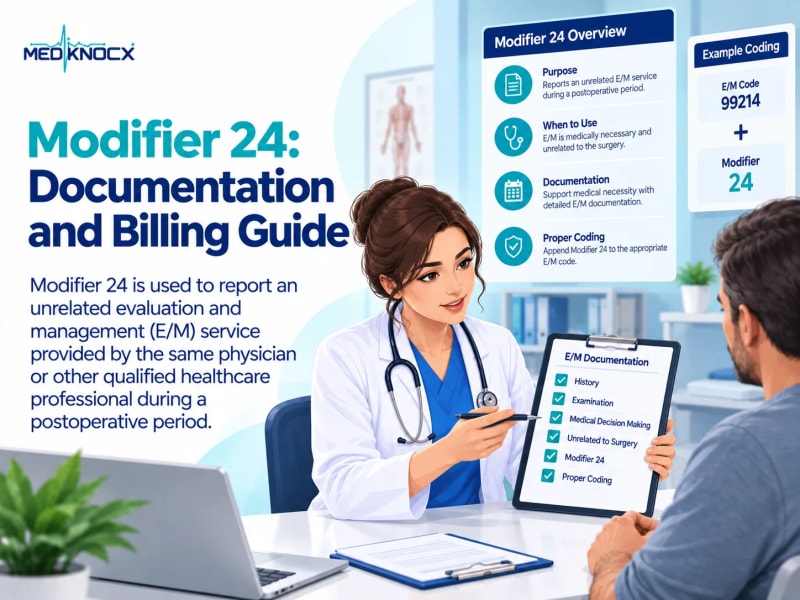
Modifier 24: Documentation and Billing Guide
Modifier 24 reports an unrelated E/M service by the same physician or qualified healthcare professional during...

Sep 24, 2026
1 min read

Jordan Taylor
September 24, 2026
Table of Contents
10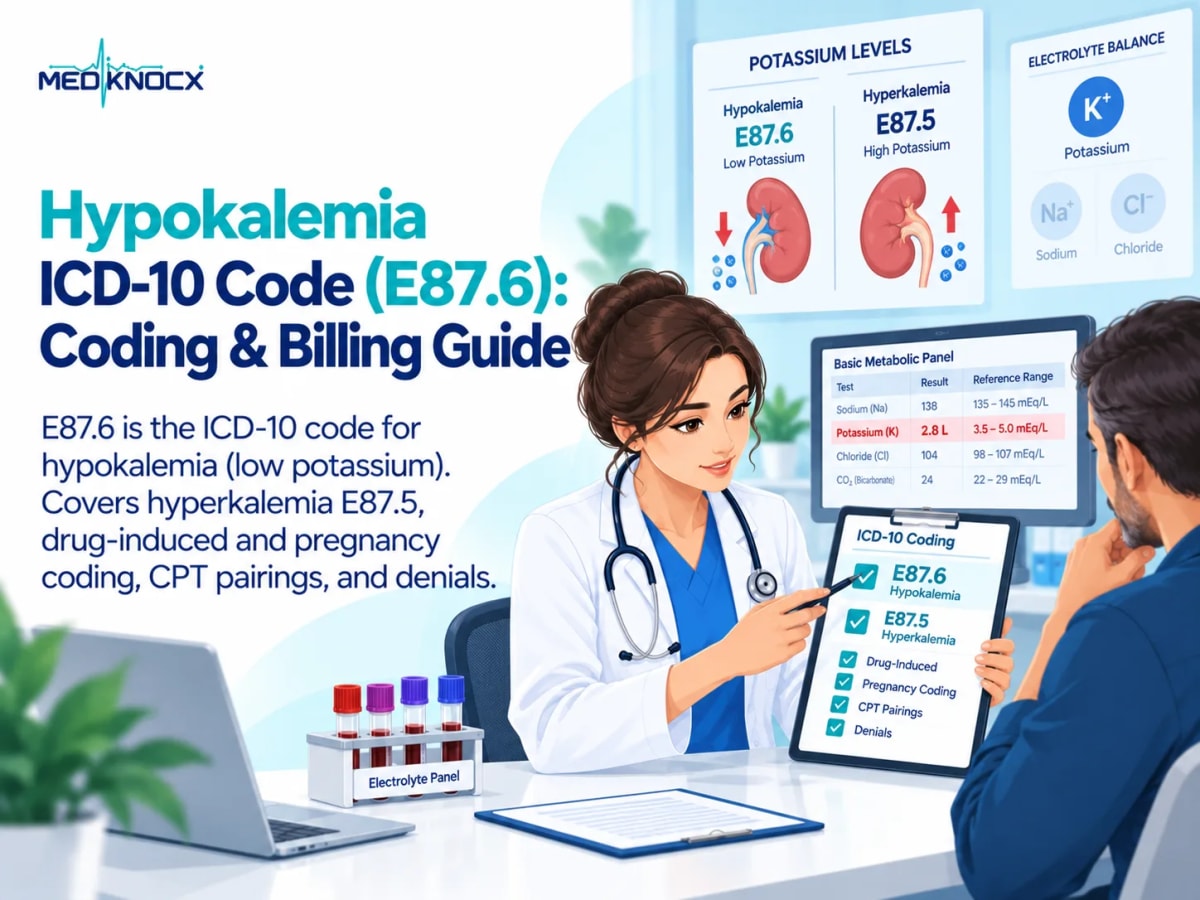
The ICD-10-CM code for hypokalemia is E87.6, Hypokalemia. It's billable under the FY2026 code set, effective October 1, 2025, and it covers low potassium, potassium deficiency, and hypopotassemia in every adult and pediatric patient past the newborn period. There's one code for every severity, so mild, moderate, severe, acute, and chronic hypokalemia all land on E87.6.
The code itself is the easy part. What decides whether an E87.6 claim holds up is everything around it: whether the provider actually addressed the low potassium in the note, whether a drug caused it, whether the patient is pregnant, and what else gets billed with it. High potassium is a different code, E87.5, Hyperkalemia, and it's covered here too.
Hypokalemia is a serum potassium below the lab's reference range, which is usually 3.5 to 5.0 mEq/L in adults. Clinicians commonly describe it in three bands:
• Mild: 3.0 to 3.4 mEq/L, often without symptoms
• Moderate: 2.5 to 2.9 mEq/L, with weakness, cramps, or ECG changes more likely
• Severe: below 2.5 mEq/L, where arrhythmias and muscle paralysis become real risks and IV replacement is typical
The common causes are losses through the kidneys (loop and thiazide diuretics are the big one, along with hyperaldosteronism and some renal tubular disorders), losses through the gut (vomiting, diarrhea, laxative use), a shift of potassium into cells (insulin, beta agonists, alkalosis), and, less often, poor intake. Low magnesium makes it worse and harder to correct.
Providers don't always write "hypokalemia." The same condition shows up in notes as low potassium, low K, hypokalemic, potassium deficiency, or hypopotassemia, and the British spellings hypokalaemia and hypopotassaemia. All of them index to E87.6.
E87.6 has no subcodes. There is no E87.60 or E87.61, and any source listing one is wrong. It sits alongside the other fluid and electrolyte codes, several of which show up on the same claims:
Hyperkalemia is E87.5, and it's the most damaging mix-up in this family: the codes sit next to each other, describe opposite problems, and a transposed digit puts the wrong condition on the claim. Elevated potassium, high potassium, and hyperpotassemia all code to E87.5, again with no severity subcodes.
Related codes outside E87 that come up with low potassium:
One correction worth making, because it circulates on billing blogs: E83.40 and E83.49 are magnesium codes, not potassium codes. E83.4 is disorders of magnesium metabolism. There's no "disorder of potassium metabolism" code to fall back on; low potassium is E87.6.
Excludes1 notes under category E87 mean these conditions are coded to their own codes, not E87.6:
A potassium of 3.2 on the BMP doesn't, by itself, support E87.6. ICD-10-CM guidelines say abnormal lab findings are reported only when the provider indicates they're clinically significant. The coder can't read the lab and assign the code; the provider has to address it, and it's one of the most common reasons E87.6 claims get questioned.
What the provider addresses it with can be simple. Any of these in the assessment or plan does the job: "hypokalemia, start KCl 20 mEq daily," "low K, recheck BMP in one week," or "potassium 2.9, hold HCTZ." What doesn't work is a lab table showing a flagged value and a plan that never mentions it. When that happens and the value looks significant, query the provider.
For E87.6 to hold up on review, the note should show:
• The word hypokalemia (or low potassium) in the assessment, not only in the labs
• The potassium value that supports it
• Symptoms and ECG findings if present
• The treatment: oral or IV potassium, a medication change, or monitoring
• The cause when known, especially a drug
• A follow-up plan for rechecks
Severity doesn't change the code, but it changes everything around it. Mild and severe hypokalemia are both E87.6. Severity, symptoms, and treatment are what support the E/M level, the medical necessity of repeat labs and telemetry, and, for inpatients, whether the stay is justified.
Setting matters for uncertain diagnoses. In outpatient and professional coding, "possible hypokalemia" or "rule out hypokalemia" isn't coded; code the documented findings instead. In inpatient facility coding, a diagnosis documented as probable or suspected at discharge can be coded as if confirmed.
Diuretic-induced hypokalemia. When a correctly prescribed, properly taken drug causes hypokalemia, it's an adverse effect. The guideline sequence is the nature of the effect first, then the T code with a fifth or sixth character of 5:
• E87.6 + T50.1X5A for loop diuretics such as furosemide or bumetanide
• E87.6 + T50.2X5A for thiazides and other diuretics, such as hydrochlorothiazide or chlorthalidone
Then the condition the drug treats, such as I10 or I50.x. The seventh character follows the encounter: A for active treatment, D for subsequent visits, S for sequela. Don't use the poisoning characters (1 to 4) unless the drug was taken wrongly or in overdose; that's a different story on the claim entirely.
Insulin or other drug shifts. Hypokalemia the provider attributes to insulin codes as E87.6 + T38.3X5A. Beta agonists and corticosteroids follow the same pattern with their own T codes.
GI losses. Code E87.6 with the cause the provider names: gastroenteritis, R11.2 for nausea with vomiting, R19.7 for diarrhea, or the underlying condition if one is diagnosed. Sequencing follows the reason for the visit. If the patient came in for vomiting and the low potassium was found and treated, the GI problem goes first.
With hypomagnesemia. Low magnesium keeps potassium from correcting, so the two travel together. When both are documented and treated, code E87.6 and E83.42.
Pregnancy. Chapter 15 codes take sequencing priority. Hypokalemia complicating pregnancy is coded with O99.28-, endocrine, nutritional and metabolic diseases complicating pregnancy, with the sixth character for trimester (O99.281, O99.282, O99.283, or O99.280 if unspecified; O99.284 for childbirth, O99.285 for the puerperium), followed by E87.6 and a Z3A code for weeks of gestation. The exception is hyperemesis gravidarum: when the low potassium comes with hyperemesis before 20 weeks, O21.1 covers the metabolic disturbance and E87.6 isn't added, per the Excludes1 note.
Hypokalemic periodic paralysis. This is a neuromuscular channel disorder with episodes of low potassium, and it's coded G72.3, not E87.6.
Newborns. Hypokalemia in the newborn record uses P74.32. E87.6 is for patients past the perinatal period.
The most common lab error is billing 84132 on top of a panel. Potassium is already inside 80048, 80051, and 80053, so a separate 84132 for the same specimen is unbundling and gets denied under NCCI edits. For J3480, units are counted per 2 mEq, so 20 mEq is 10 units; a units error on this line is easy to make and easy to catch.
When hypokalemia is the reason for admission (typically a severe level needing IV replacement and telemetry), E87.6 is the principal diagnosis and the case groups to MS-DRG 640 or 641, miscellaneous disorders of nutrition, metabolism, fluids and electrolytes, with or without MCC. When it's found and treated during a stay for heart failure, CKD, or sepsis, it's secondary and the principal condition drives the DRG.
Moving from 641 to 640 takes a secondary diagnosis that is actually on the MCC list in the grouper version for the discharge date: V43.0 for discharges October 1, 2025 through March 31, 2026, V43.1 after that. Some billing guides suggest an unspecified arrhythmia (I49.9) gets you there. It doesn't; I49.9 doesn't carry MCC status. Specific, documented complications do the work, and CDI queries should aim for accuracy, not a target DRG.
Nearly every row here is a coding or documentation problem rather than a payer dispute, so it gets fixed upstream through medical coding review before claims go out. When the same denial keeps returning, trace it through denial management to find where the workflow breaks. For patients on long-term diuretics with regular potassium monitoring alongside heart failure or CKD, that recurring work often fits under chronic care management billing rather than a string of standalone visits.
E87.6, Hypokalemia. It's billable under the FY2026 code set and covers every severity.
The same code, E87.6. Low potassium, potassium deficiency, and hypopotassemia all index to it.
E87.5, Hyperkalemia. It also covers elevated potassium and hyperpotassemia.
No. E87.6 has no subcodes, so severity and acuity are documented in the note, not the code.
Not on its own. The provider has to address the low potassium in the note, through a diagnosis, a treatment, or a monitoring plan.
E87.6 first, then the adverse effect code: T50.1X5A for loop diuretics, T50.2X5A for thiazides and other diuretics, then the condition being treated.
O99.28 with the trimester character, then E87.6 and a Z3A code. With hyperemesis gravidarum, O21.1 replaces both.
G72.3, periodic paralysis. It isn't coded as E87.6.
Hypo-osmolality and hyponatremia, meaning low sodium. It's a different electrolyte from potassium.
E86.1. Dehydration is E86.0, and volume depletion, unspecified, is E86.9.
84132 for serum potassium alone. When a BMP, CMP, or electrolyte panel is run, the panel code includes potassium and 84132 isn't billed separately.
P74.32, hypokalemia of newborn.
• CMS, ICD-10-CM official code files and guidelines, FY2026 code set effective October 1, 2025, with the April 1, 2026 update
• CMS, MS-DRG classifications and software, versions 43.0 and 43.1
Explore more medical billing guides, coding updates, and revenue cycle tips.
Modifier 24 reports an unrelated E/M service by the same physician or qualified healthcare professional during...
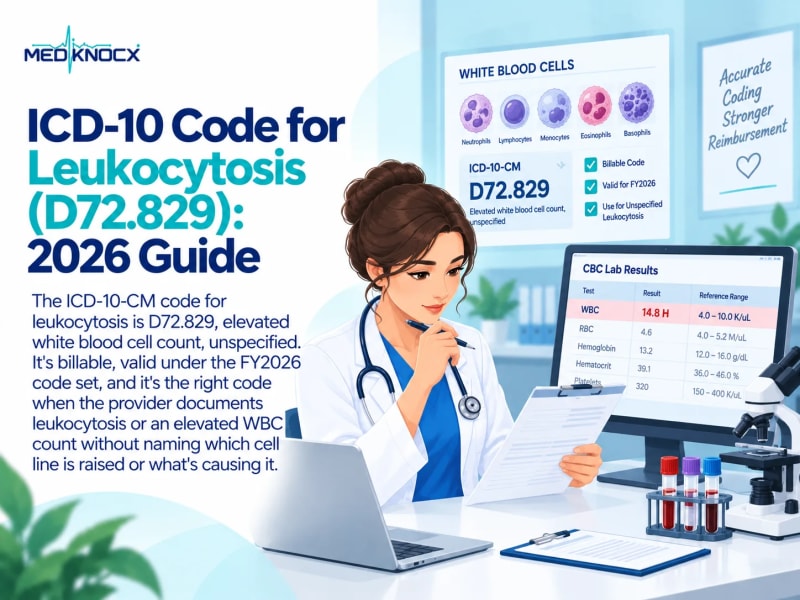
D72.829 is the ICD-10 code for leukocytosis. Learn when to use it, the specific D72.82 codes, leukopenia codes...
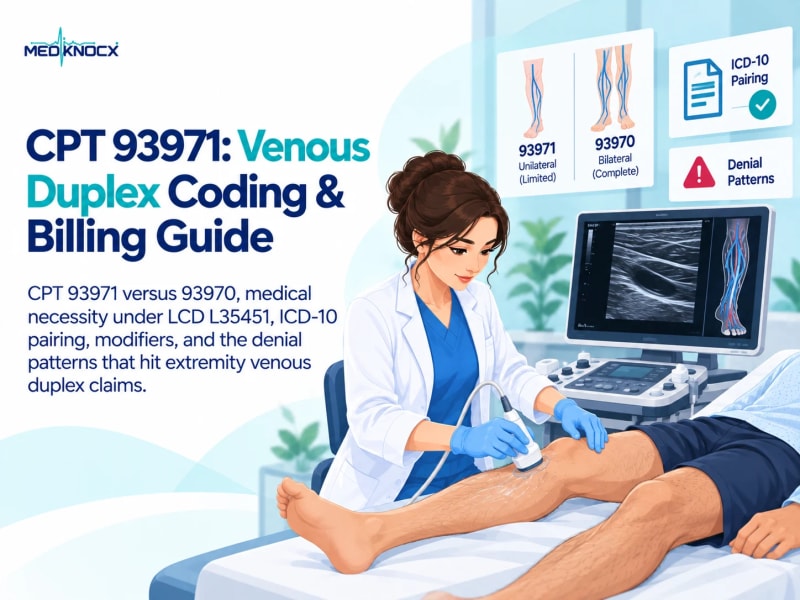
CPT 93971 versus 93970, medical necessity under LCD L35451, ICD-10 pairing, modifiers, and the denial patterns...