Healthcare
What Is POS 20 in Medical Billing? Complete Urgent Care Guide
Learn what POS 20 means in medical billing, when to use it, POS 20 vs POS 11 and 23, CPT codes, Medicare billi...

Sep 29, 2026
1 min read

Jordan Taylor
September 30, 2026
Table of Contents
13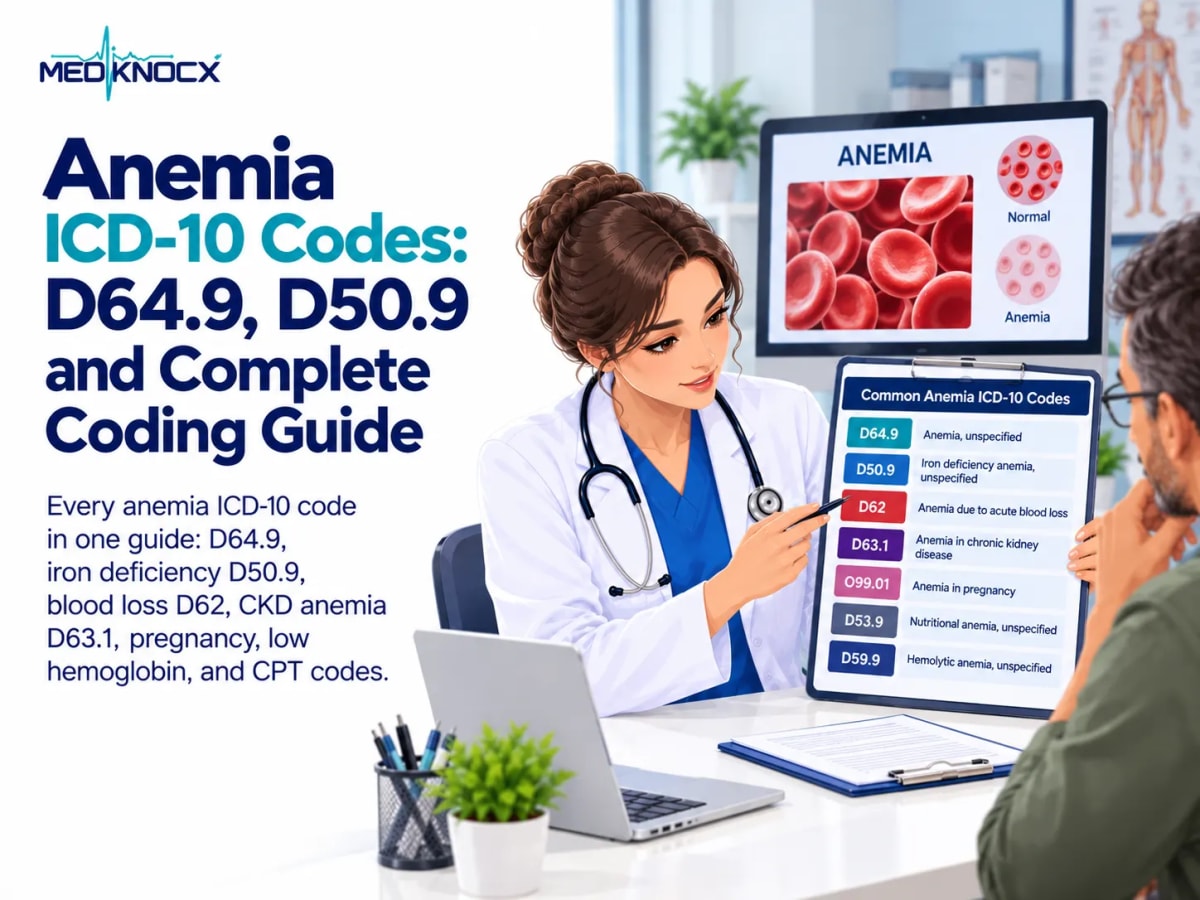
The ICD-10-CM code for anemia, unspecified, is D64.9. The code for iron deficiency anemia, unspecified, is D50.9. Those two cover a large share of anemia claims, but they're also the two most often used when a better code was available. Anemia codes span D50 through D64, and the right one depends on the type the provider documents, what's causing it, and whether an underlying condition has to be coded first.
This guide covers each anemia family in turn: unspecified and descriptive terms like normocytic or symptomatic anemia, iron deficiency, acute and chronic blood loss, anemia in chronic kidney disease and cancer, B12 and folate deficiency, hemolytic and aplastic anemia, pregnancy and postpartum anemia, and the low hemoglobin findings that aren't anemia codes at all. It ends with the lab and treatment codes billed alongside them and the errors that cause denials.
D64.9 sits in Chapter 3 under D64, other anemias. The Alphabetic Index sends anemia described as essential, general, primary, profound, or hemoglobin deficiency here, which makes it the code for "anemia" or "anemia NOS" when the provider hasn't identified a type or cause. It's billable, and as a principal inpatient diagnosis it groups to MS-DRG 811 or 812, red blood cell disorders with or without MCC.
Many terms providers use describe the anemia without changing the code:
• Normocytic, or normocytic normochromic, anemia: D64.9 when no cause is named
• Symptomatic anemia: D64.9; the symptoms support severity but don't change the code
• Mild, moderate, or severe anemia: D64.9; ICD-10-CM has no severity codes for anemia
• Chronic anemia: generally D64.9 when no type or cause is documented
• Anemia requiring transfusion: the anemia code for the documented type; the transfusion is reported as a procedure
A few descriptors do change it. Microcytic or microcytic hypochromic anemia indexes to D50.9, iron deficiency anemia, unspecified. Macrocytic anemia without a stated cause indexes to D53.9, and megaloblastic anemia NOS to D53.1. Once a B12 or folate deficiency is identified, those codes take over.
Two traps sit close to D64.9. "Anemia of chronic disease" isn't D64.9; it's D63.8 with the underlying disease coded first. And "simple chronic anemia" indexes to D53.9. Multifactorial anemia doesn't have a code of its own; code each type the provider documents, such as D50.9 and D63.1 together, and query if the contributing types aren't named.
D64.9 also matters in cardiology. A type 2 myocardial infarction caused by anemia is coded with the anemia first, then I21.A1, as the code-first note under I21.A1 instructs.
Iron deficiency anemia, often written IDA or Fe deficiency anemia, is coded from category D50. The fourth character reflects the cause.
D50.9 is appropriate when the cause is still being worked up, and chronic, severe, or recurrent iron deficiency anemia all use it until a cause is named. Once the provider documents a cause, move to the specific code and code the cause as well, for instance D50.0 with N92.0 for excessive menstrual bleeding.
Iron deficiency without anemia is a different code. Low ferritin, low iron saturation, or low serum iron with a normal hemoglobin is E61.1, iron deficiency, in the nutritional deficiency chapter. It's the right code when the provider treats depleted iron stores before anemia develops. Billing D50.9 when the hemoglobin is normal is one of the more common errors in this category, and E61.1 and D50 aren't reported together for the same deficiency; once anemia develops, the D50 code replaces E61.1.
A history of iron deficiency anemia that has resolved is Z86.2, personal history of diseases of the blood.
Blood loss anemia codes by timing, and it's one of the most audited anemia diagnoses because D62 affects inpatient severity.
Acute blood loss anemia (ABLA), D62. Acute posthemorrhagic anemia, from trauma, surgery, a GI bleed, or delivery. The provider has to document it as anemia; a lower postoperative hemoglobin alone isn't ABLA. Clinical support usually includes a significant drop from baseline, symptoms, and treatment or monitoring: a transfusion, iron, serial hemoglobins, or a change in care.
Chronic blood loss anemia, D50.0. Iron deficiency anemia from slow, ongoing loss.
Acute on chronic blood loss anemia: both codes. When the provider documents acute on chronic blood loss anemia, D62 and D50.0 are both reported, since each describes a different part of the picture.
Postoperative anemia. The Index splits it by cause: due to acute blood loss, D62; due to chronic blood loss, D50.0; otherwise D64.9. Expected surgical blood loss isn't coded at all. A postoperative anemia is reported as a surgical complication only when the provider explicitly documents it as one.
GI bleed with anemia. Code the bleed (K92.2 for GI hemorrhage, unspecified, or the specific source such as a bleeding ulcer) and the anemia by timing, D62 or D50.0. Sequencing follows the reason for the admission or visit; when the bleed is what's being treated, it's usually first.
Postpartum acute blood loss anemia follows its own rule, covered in the pregnancy section below.
These are manifestation codes. The underlying condition carries a code-first instruction, and the sequencing is where most errors happen.
Anemia in chronic kidney disease, D63.1. Code the CKD stage first, then D63.1: for example N18.4 then D63.1 for stage 4. For anemia in ESRD, that's N18.6, D63.1, and Z99.2 for dialysis dependence when applicable. D63.1 needs the provider to link the anemia to the kidney disease, which the Index treats as linked when documented as "anemia in" or "anemia due to" CKD.
Anemia in neoplastic disease, D63.0. Anemia caused by the cancer itself. The malignancy is coded first, then D63.0, even when the visit is for managing the anemia.
Anemia due to chemotherapy, D64.81. Here the order flips. When the encounter is for anemia caused by chemotherapy, the guidelines put D64.81 first, then T45.1X5A for the adverse effect of antineoplastic drugs, then the cancer. Anemia due to both the cancer and its treatment can carry both D63.0 and D64.81.
Anemia of chronic disease (AOCD), D63.8. Anemia the provider attributes to a chronic inflammatory or systemic condition, such as rheumatoid arthritis or chronic infection. Code that condition first, then D63.8. If the note says "anemia of chronic disease" without naming the disease, query the provider rather than billing D63.8 alone.
Anemia, neutropenia, and thrombocytopenia together. When the provider documents pancytopenia, it's coded as pancytopenia, not three separate conditions: D61.810 when it's due to antineoplastic chemotherapy, D61.811 for other drugs, and D61.818 for other pancytopenia. If the three are listed separately and never called pancytopenia, a query settles it.
For patients whose anemia is monitored and managed alongside CKD, heart failure, or diabetes over months, that recurring work often fits under chronic care management billing rather than a series of separate visits.
Vitamin B12 deficiency anemia, D51. Pernicious anemia, the autoimmune form caused by missing intrinsic factor, is D51.0. Dietary B12 deficiency anemia is D51.3, and B12 deficiency anemia with no cause documented is D51.9. B12 deficiency without anemia is a different code, E53.8.
Folate deficiency anemia, D52. Dietary folate deficiency anemia is D52.0, drug-induced is D52.1 (with the drug's T code), and unspecified folate deficiency anemia is D52.9.
Hemolytic anemia, D55 to D59. Hemolytic anemia with no type named indexes to D58.9. Acquired hemolytic anemia, unspecified, is D59.9. Autoimmune hemolytic anemia has its own subcodes: D59.10 unspecified, D59.11 warm, D59.12 cold, D59.13 mixed, and D59.19 other. Sickle cell disorders (D57) and thalassemias (D56) are in this block too and are always coded by their specific type.
Aplastic anemia, D60 and D61. Aplastic anemia, unspecified, is D61.9. Drug-induced aplastic anemia is D61.1, and constitutional forms including Fanconi anemia are D61.09.
Sideroblastic and other specified anemias. Sideroblastic anemia is coded D64.0 to D64.3 by type. A named anemia that has no dedicated code goes to D64.89, other specified anemias.
Anemia in pregnancy. Obstetric codes lead. Anemia complicating pregnancy is O99.01-, with the sixth character for the trimester, followed by the D code for the type and a Z3A code for weeks of gestation.
So iron deficiency anemia at 30 weeks is O99.013, D50.9, Z3A.30. Iron deficiency without anemia in pregnancy is coded differently, with O99.28- (nutritional and metabolic diseases complicating pregnancy) and E61.1.
Postpartum anemia. Anemia after delivery is O90.81, anemia of the puerperium, with an additional code for the type. For postpartum acute blood loss anemia, that's O90.81 with D62, the combination Coding Clinic has addressed directly. Expected blood loss at delivery isn't coded unless the provider documents anemia.
Newborns. Anemia of prematurity is P61.2, and other congenital and perinatal anemias are in the P61 category. Adult anemia codes aren't used on the newborn record for perinatal conditions.
Low hemoglobin isn't automatically anemia. When the provider documents a low, decreased, or dropping hemoglobin or hematocrit without diagnosing anemia, the Index sends it to R71.0, precipitous drop in hematocrit, whose inclusion terms cover a drop in hemoglobin as well. Other red cell abnormalities without a diagnosis, such as abnormal red cell morphology, are R71.8.
Category R71 carries an Excludes1 note for all anemias, D50 to D64, so R71.0 and an anemia code never appear together. When the provider documents anemia, the anemia code replaces R71.0. And a low value in the lab report that the provider never addresses isn't coded as either.
A screening CBC or ferritin in a patient with no symptoms or findings is Z13.0. If the test is ordered because of fatigue, pallor, or a known condition, code that reason instead; it's a diagnostic test, not a screen.
Old ICD-9 codes. Before ICD-10 took effect on October 1, 2015, anemia, unspecified was 285.9 and iron deficiency anemia, unspecified was 280.9. They're only relevant for historical records; D64.9 and D50.9 replaced them.
There's no CPT code "for anemia." CPT describes the tests and treatments; the ICD-10 code explains why they were done.
A CBC often turns up more than one finding, such as a low hemoglobin alongside a high white count; our leukocytosis ICD-10 guide covers how that side of the result is coded. IV iron and ESA claims draw the most scrutiny: most payers want the anemia type, recent hemoglobin and iron studies, and often a trial of oral iron documented before approving IV therapy, and many require prior authorization.
• The word anemia in the assessment, not just a low hemoglobin in the labs
• The type: iron deficiency, blood loss, B12, anemia of CKD, and so on
• The cause or link: "due to CKD," "secondary to menorrhagia," "from chemotherapy"
• Timing for blood loss anemia: acute, chronic, or acute on chronic
• Supporting values: hemoglobin, MCV, ferritin, iron studies, trend from baseline
• Treatment and plan: oral or IV iron, B12, ESA, transfusion, or monitoring
The difference between D64.9 and a specific code is almost always one phrase the provider already knows but didn't write. "Anemia, likely iron deficiency, ferritin 8, start ferrous sulfate" supports D50.9. "Anemia" with the same labs and plan only supports D64.9.
Most of these are caught before submission by a medical coding review that checks sequencing and specificity against the note. When IV iron and ESA claims keep coming back, trace them through denial management to see whether the gap is in authorization, documentation, or coding.
• CMS, ICD-10-CM official code files and guidelines, FY2026 code set effective October 1, 2025, with the April 1, 2026 update
• CMS, MS-DRG classifications and software, version 43
D64.9, anemia, unspecified, when the provider doesn't document a type or cause.
D50.9 when the cause isn't documented, D50.0 when it's due to chronic blood loss, and D50.8 for other stated causes such as poor dietary intake.
D62, acute posthemorrhagic anemia. Acute on chronic blood loss anemia is D62 plus D50.0.
D63.1, with the CKD stage coded first, such as N18.4 then D63.1. For ESRD, N18.6, D63.1, and Z99.2 if on dialysis.
D63.8, with the underlying chronic disease coded first.
D64.9 when no cause is named. Neither term changes the code.
D50.9, since microcytic anemia indexes to iron deficiency anemia, unspecified.
R71.0 when the provider documents a low or dropping hemoglobin without diagnosing anemia. If anemia is diagnosed, use the anemia code.
E61.1, iron deficiency.
O99.01- with the trimester, followed by the specific anemia code and a Z3A code.
O90.81, anemia of the puerperium, with the type of anemia, such as D62 for acute blood loss.
D64.81, followed by T45.1X5A and the cancer code.
Z86.2, personal history of diseases of the blood and blood-forming organs.
D51.0.
Explore more medical billing guides, coding updates, and revenue cycle tips.
Learn what POS 20 means in medical billing, when to use it, POS 20 vs POS 11 and 23, CPT codes, Medicare billi...
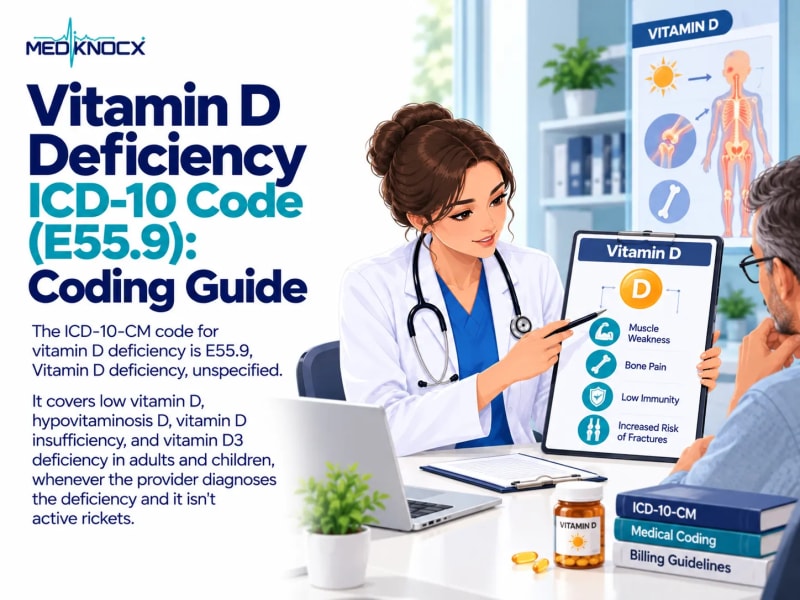
E55.9 is the ICD-10 code for vitamin D deficiency. Covers screening (Z13.21), history, pregnancy, CPT 82306 vs...
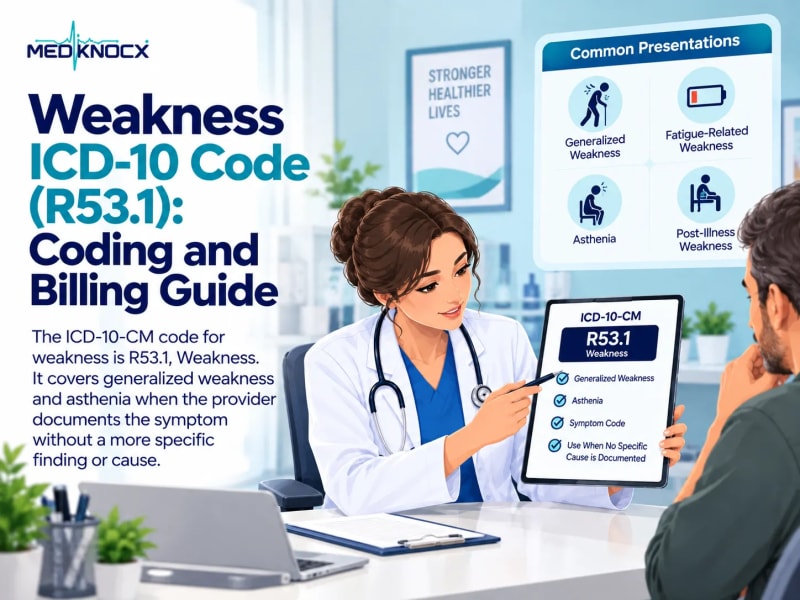
R53.1 is the ICD-10 code for weakness. Learn when to use M62.81, R54, R53.81, or R53.83 instead, and why R53.1...