Healthcare

ICD-10 Code for Cough: R05.9, R05.1, R05.3 Coding Guide
ICD-10 codes for cough by duration: R05.1 acute, R05.2 subacute, R05.3 chronic, R05.9 unspecified. Plus Exclud...

Oct 2, 2026
1 min read

Jordan Taylor
August 18, 2026
Table of Contents
13
An echocardiogram CPT code identifies the specific cardiac ultrasound service performed, documented, and billed to a payer. Choosing the right CPT code for echocardiogram services matters because the code must match the type and extent of the study, the documentation, medical necessity, and the payer's reimbursement rules. Incorrect coding can lead to claim edits, denials, underpayments, or compliance concerns.
This guide explains the major echo CPT codes used in 2026, including complete and limited transthoracic studies, transesophageal echocardiography, stress echocardiography, Doppler services, modifiers, reimbursement considerations, diagnosis pairing, and common denial risks. For practices that need broader support, Mediknocx also provides cardiology medical billing services.
An echo CPT code is a Current Procedural Terminology code used to report an echocardiographic procedure to a health plan. There is not one universal code for every echocardiogram because the service can differ by technique, scope, patient population, and whether additional components such as Doppler, stress testing, or 3D imaging are performed.
The primary echocardiography families include:
Transthoracic echocardiography (TTE): Imaging performed through the chest wall.
Transesophageal echocardiography (TEE): Imaging performed with an ultrasound probe positioned in the esophagus.
Stress echocardiography: Echocardiographic imaging performed during cardiovascular stress.
Doppler services: Spectral and color flow Doppler components that may be separately reportable with qualifying echo codes.
Congenital echocardiography: Studies designed for congenital cardiac anomalies.
3D echocardiography: Additional three-dimensional imaging and postprocessing services.
The first coding decision should always come from the provider's documentation, not from the diagnosis alone. Accurate code selection is also supported by professional medical coding services.
The following table is a practical reference for commonly encountered echocardiography CPT codes. Code descriptions are summarized rather than reproduced verbatim from CPT to respect CPT copyright.
The key distinction is that 93306 already incorporates spectral and color flow Doppler into a complete TTE. CMS guidance states that when Doppler is combined with a complete echocardiogram, 93306 should be used rather than separately reporting the Doppler components.
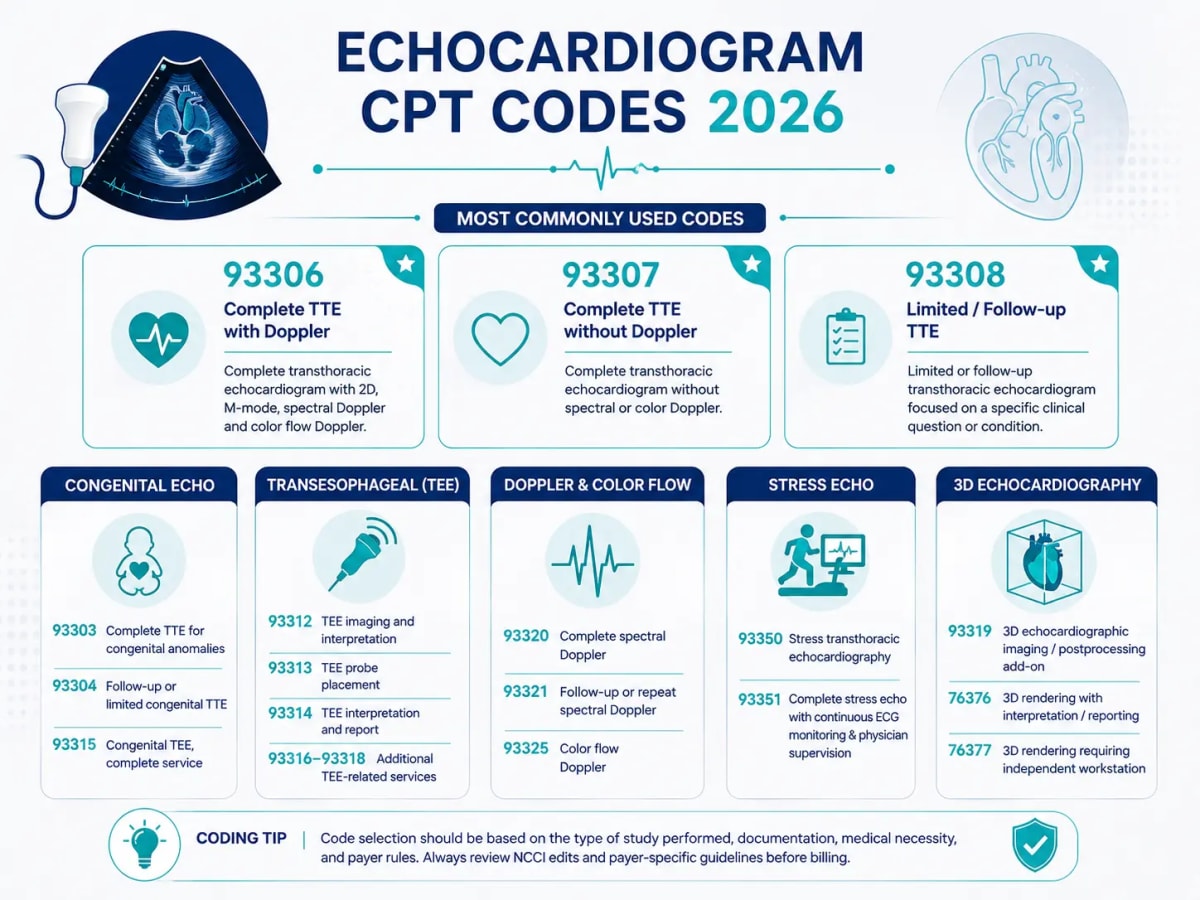
The most frequently used transthoracic echocardiogram CPT code for a complete study with Doppler is 93306. Code 93307 represents a complete TTE without spectral or color Doppler, while 93308 is used for limited or follow-up examinations. AAPC describes 93307 as a 2D TTE service and 93308 as a focused limited or follow-up study.
For congenital cardiac anomalies, 93303 and 93304 are important options. Do not assume that congenital codes are limited to pediatric patients. Code selection is driven by the congenital nature and scope of the examination.
TEE services use a different family of codes because the imaging approach and provider work differ from standard chest-wall echocardiography. Code 93312 represents the core TEE imaging service, while 93313 addresses probe placement. Code 93314 represents the interpretation and report component in applicable circumstances.
Codes 93320, 93321, and 93325 are used for qualifying Doppler services. Code 93320 describes complete spectral Doppler, while 93321 is associated with follow-up spectral Doppler. Code 93325 represents color flow Doppler.
Their use depends on the underlying echocardiography code and payer coding rules. They should never be automatically added simply because Doppler technology was mentioned in the report.
Stress echocardiography is commonly reported with 93350 or 93351, depending on the services performed and documented. The stress portion can involve treadmill exercise, bicycle exercise, or pharmacologically induced stress. Importantly, 93351 is not simply a "pharmacologic stress" code. It represents a more complete stress echo service that includes continuous electrocardiographic monitoring and physician supervision.
3D echocardiographic services may be reported with appropriate add-on or rendering codes when the documentation and CPT instructions support them. Code 93319 is an echocardiography-specific 3D add-on used in defined circumstances, while 76376 and 76377 describe 3D rendering services.
Codes 93303 and 93304 cover congenital transthoracic echocardiography. The patient's age alone does not determine whether a congenital code is appropriate. The clinical indication and nature of the cardiac abnormality must support the code selected.
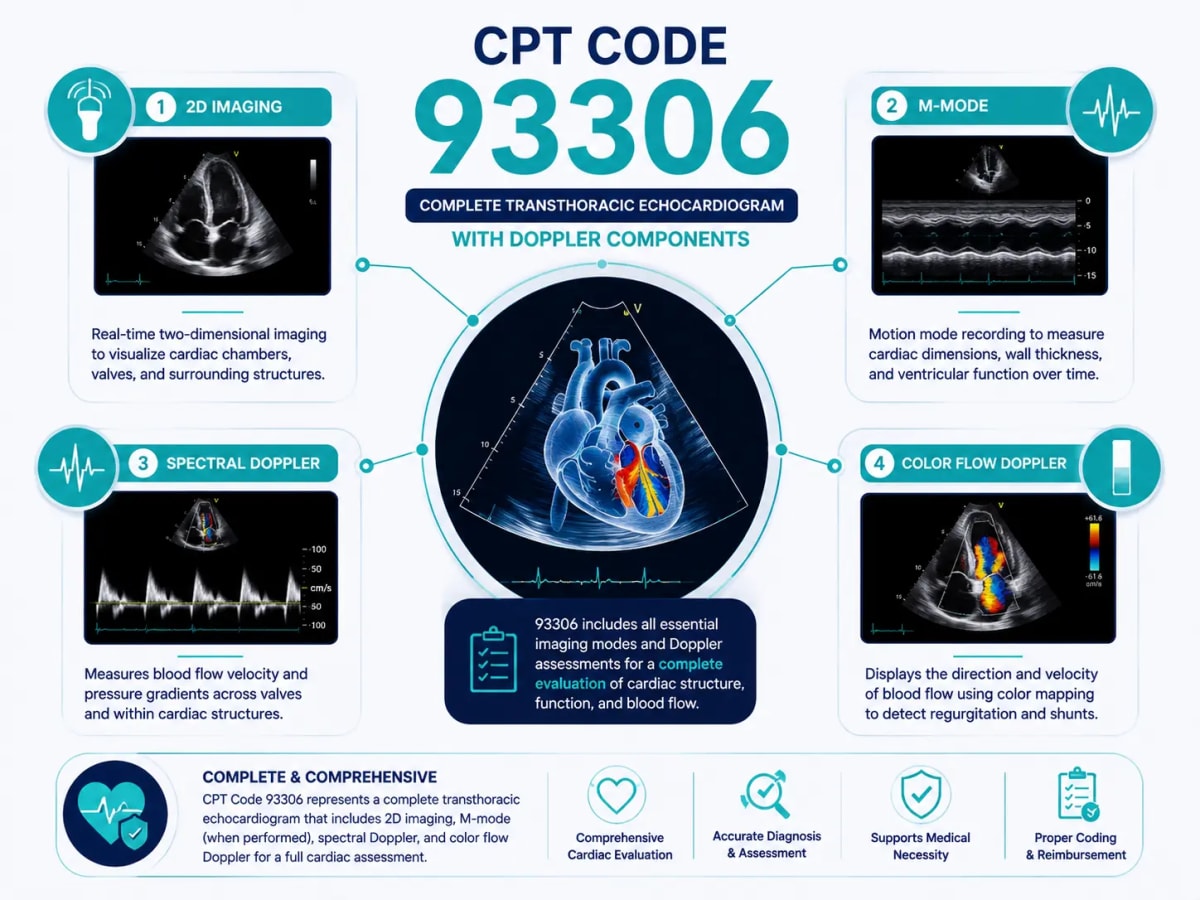
CPT code 93306 is generally used for a complete transthoracic echocardiogram with 2D imaging, M-mode when performed, spectral Doppler, and color flow Doppler. The official descriptor identifies it as a complete TTE that includes these Doppler components.
For coding purposes, think of 93306 as the complete TTE package rather than a basic echo plus separate Doppler charges.
The major documented elements include:
Real-time 2D echocardiographic image documentation.
M-mode recording when performed.
Spectral Doppler echocardiography.
Color flow Doppler echocardiography.
One important nuance is that "complete" does not mean every possible imaging technique was performed. The medical record needs to support the scope of the examination and the required components of the code.
Common documentation problems include:
A report that does not clearly support spectral Doppler.
Color flow Doppler mentioned without meaningful interpretation or documentation.
A limited focused examination reported as a complete study.
Provider documentation that does not clearly distinguish the examination's scope.
Billing separate Doppler codes when 93306 already includes them.
CMS's transthoracic echocardiography coverage guidance specifically notes that Doppler should be medically necessary and supported by the examination report and clinical record.
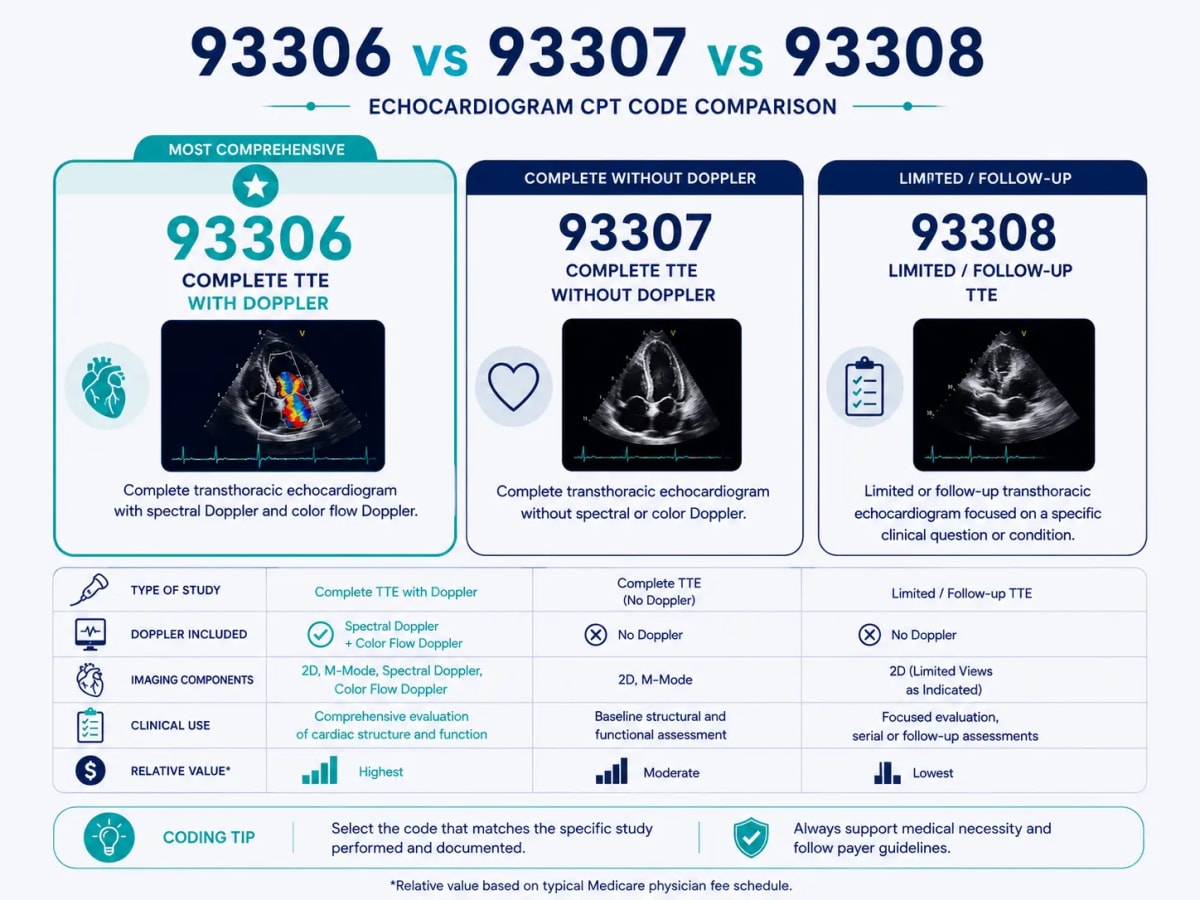
Understanding the difference between these three codes prevents one of the most common echocardiography coding errors.
When to Use 93307 (No Doppler)
CPT code 93307 is used for a complete transthoracic echocardiogram without spectral or color Doppler. AAPC describes the code as a complete 2D TTE service.
It should not be used merely because a coder failed to locate Doppler documentation. The report should actually support an examination that does not include the Doppler components captured by 93306.
CPT code 93308 represents a limited or follow-up TTE focused on a particular clinical concern. It is not simply a cheaper version of a complete echo.
Examples can include targeted assessment of a known issue, such as reassessing a previously identified pericardial effusion when a complete examination is not clinically necessary.
AAPC characterizes 93308 as a limited examination that does not attempt to evaluate or document all structures included in a complete echo.
A transesophageal echocardiogram CPT code should reflect the actual TEE service performed and the portion of the service being reported.
The central code is 93312, which represents TEE imaging. AAPC describes it as an examination using transducers or probes positioned to obtain detailed cardiac images through the esophageal approach.
The TEE family also separates certain components. 93313 addresses probe insertion, while 93314 may represent the interpretation and report component when the coding circumstances call for separate reporting.
This distinction matters in settings where different clinicians or entities perform different components.
Coders should review:
Who performed the TEE.
Who inserted the probe.
Who acquired the images.
Who interpreted the study.
Whether the applicable code is global or component-based.
Whether any Doppler or 3D services meet separate reporting requirements.
Do not select a TEE code simply because the physician wrote "TEE" in the note. The operative and imaging documentation should support the actual service.
The stress echocardiogram CPT code depends on the scope of the stress echo service and whether the cardiovascular stress testing components are separately reported.
93350 represents transthoracic stress echocardiography performed at rest and during cardiovascular stress. The stress can involve treadmill, bicycle exercise, or pharmacologic induction.
93351 is the more comprehensive option when the stress echo is combined with the complete cardiovascular stress test and continuous ECG monitoring with physician supervision. CPT guidance indicates that 93351 should not be reported together with 93350 or the 93015–93018 stress-testing codes for the same service.
This is an important correction to a common misconception: 93351 is not specifically the pharmacologic stress echo code. Both 93350 and 93351 can apply to exercise or pharmacologic stress, depending on what was performed.
When 93350 is used without the complete stress-testing component, the appropriate cardiovascular stress test code may also be needed to capture that portion of the service.
Do not automatically report 93306 with a stress echo for the same session. Review payer edits, documentation, and whether a distinct resting study was separately performed and medically necessary.
Doppler & Color Flow Add-On Codes: Bundling Rules
One of the most important rules for an echocardiogram CPT code with Doppler is understanding what is already bundled into the primary code.
When a complete TTE includes Doppler, 93306 is the appropriate comprehensive code. The CMS Medicare coverage database states that 93306 should be used when Doppler is combined with a complete echocardiogram. Practices should also review the current CMS NCCI Policy Manual when evaluating Medicare bundling rules.
Therefore, do not routinely report:
93306 + 93320
93306 + 93321
93306 + 93325
as though Doppler were an additional service.
Those combinations can create bundling or unbundling problems. Doppler add-on codes have legitimate uses with other qualifying echocardiography services, but the code selection must follow the underlying primary procedure and applicable NCCI and payer rules.
The safest workflow is to identify the primary echocardiographic service first, then determine whether any Doppler service remains separately reportable.
An important 93306 modifier issue is whether the practice performed the complete service or only one component.
For diagnostic services that have a professional and technical component, Medicare allows appropriate use of modifier 26 for the professional component and TC for the technical component when the applicable code has a PC/TC indicator permitting the split. CMS explains that modifier 26 represents the professional portion, while TC represents the technical portion.
For example:
A cardiology group reads and interprets the echo but does not own or provide the imaging equipment. The interpreting physician may report the professional component with 93306-26, while the qualifying facility or diagnostic entity reports the technical component as 93306-TC when permitted.
If the same entity performs both technical and professional components, the service may generally be reported globally without splitting the components, subject to the applicable fee schedule and payer rules.
Other modifiers may arise in specific Medicare circumstances, but GZ, GY, and KX should not be treated as routine echocardiography modifiers. Their use depends on the specific coverage, liability, and claim circumstances. Always verify current Medicare instructions before applying an unusual modifier.
There is no single universal 93306 reimbursement amount for every practice.
Medicare payment can vary based on locality, facility versus non-facility setting, geographic practice cost indices, applicable fee schedule provisions, and whether the claim represents the professional, technical, or global service. CMS maintains updated 2026 Physician Fee Schedule files, including the July 2026 national payment amount file.
For 2026, CMS established separate conversion factors for qualifying APM participants and nonqualifying participants. The final conversion factor is $33.57 for qualifying APM participants and $33.40 for nonqualifying participants.
As a practical reference, a 2026 cardiac ultrasound coding and payment chart lists a national non-facility amount of approximately $137.95 for 93306, with professional and technical components shown separately. That figure is a reference point, not a universal payment guarantee.
Always verify the current Medicare MAC fee schedule or payer-specific contract before quoting a reimbursement amount to a client or using it in a financial forecast.
Private payer reimbursement may differ substantially from Medicare.
An echocardiogram ICD-10 code is not selected simply because an echo was performed. The diagnosis must support the medical necessity of the service under the applicable payer policy.
Common clinical scenarios that can support echocardiography may include suspected or known valve disease, cardiomyopathy, certain heart murmurs, heart failure-related findings, congenital abnormalities, or follow-up of a previously documented cardiac condition.
However, there is no universal diagnosis list that guarantees payment.
CMS's TTE LCD explains that Doppler should contribute significant information to the patient's condition or treatment plan and provides examples such as valve problems, shunts, suspected congenital heart disease, myocardial infarction complications, and cardiomyopathy.
Before submitting a claim, verify:
The diagnosis is supported by the patient's record.
The indication meets the applicable payer policy.
The procedure performed matches the CPT code.
The documentation supports the billed components.
Any payer-specific medical-necessity policy has been reviewed.
Coverage policies can differ by MAC and commercial payer, so this article should be used as a coding education resource rather than legal or payer-specific advice.
Effective echocardiogram billing depends on matching the clinical documentation to the exact service billed.
A provider documents an echo but does not clearly support the Doppler components required for a complete study with Doppler.
Prevention: Make sure the report clearly documents the relevant Doppler work and findings.
A coder selects 93306, but the record does not support the complete service.
Prevention: Use the complete code only when the required examination scope and components are documented.
The claim is split between the physician and technical entity incorrectly, or the modifier does not match the component performed.
Prevention: Verify the code's PC/TC indicator and the actual division of responsibility.
The diagnosis does not reasonably support the examination under the applicable policy.
Prevention: Compare the order, clinical documentation, diagnosis, and payer coverage policy before claim submission. CMS has specifically reviewed TTE claims for medical necessity, coding, and documentation compliance.
The biller adds 93320 or 93325 to 93306 without a separately reportable service.
Prevention: Remember that Doppler is already incorporated into a complete 93306 study.
A focused follow-up study is reported as a complete examination.
Prevention: Determine whether the provider evaluated the full scope of a complete study or only a specific clinical question.
A structured Medical Coding review can help identify code selection and documentation problems before they become recurring denial patterns. For practices experiencing repeated payment issues, a Medical Billing Audit can also identify broader coding, documentation, and reimbursement leakage.
Use this echocardiogram CPT code cheat sheet as a quick reference. Always confirm the current CPT book, payer policy, NCCI edits, and documentation before final claim submission.
How Mediknocx Helps Cardiology Practices Bill Echo Correctly
Accurate echo coding requires more than selecting a CPT number from a code list. Practices need documentation that supports the service, correct diagnosis-to-procedure pairing, appropriate modifier use, payer-specific edits, and ongoing denial analysis.
Mediknocx provides medical coding, revenue cycle management, denial management, and billing audit services designed to identify coding errors, documentation gaps, claim issues, and reimbursement opportunities. Its medical coding team reviews records to improve coding accuracy, while its billing audit services evaluate claims and workflows for potential revenue leakage.
You can explore Mediknocx Medical Coding Services, Revenue Cycle Management, Medical Billing Audit Services, and Denial Management to strengthen your cardiology billing workflow. Mediknocx also lists cardiology medical billing among its specialty services.
The biggest billing risks are usually not the code numbers themselves. They are incomplete documentation, incorrect medical-necessity pairing, modifier errors, confusion between complete and limited studies, and unbundling of Doppler services.
For 2026 claims, always confirm the current CPT guidance, Medicare MAC policy, NCCI edits, and payer-specific reimbursement rules before submitting or appealing an echocardiography claim.
Note: CPT is maintained by the American Medical Association. This guide summarizes coding concepts for educational purposes and does not replace the current CPT code set, payer policy, MAC guidance, or professional coding advice.
There is no single code for every echocardiogram. 93306 is commonly used for a complete transthoracic echocardiogram with spectral and color flow Doppler. Limited studies, congenital studies, TEE, and stress echocardiography use different codes.
93306 may be covered by Medicare when the service is medically necessary and meets the applicable Medicare coverage requirements. Coverage is not determined by the CPT code alone. The diagnosis, documentation, clinical indication, and applicable MAC policy all matter.
There is not one national payment amount that applies to every claim. Medicare payment varies by locality and site of service. CMS maintains current 2026 fee schedule files for calculating applicable payment amounts.
Generally, 93325 should not be separately reported with 93306 simply because color flow Doppler was performed, because Doppler is already included in the complete 93306 service.
Both are complete transthoracic echocardiography codes, but 93306 includes spectral and color flow Doppler, while 93307 does not.
93306 represents a complete TTE with Doppler. 93308 is a limited or follow-up TTE focused on a specific clinical issue rather than a complete examination.
There is not one universal combined "echo with EKG" CPT code. For certain stress echo services, 93351 includes continuous ECG monitoring and physician supervision as part of the complete stress echo service. Other stress echo arrangements may use 93350 with the appropriate cardiovascular stress testing code.
TTE uses the 93303–93308 family depending on the type and scope of the study. TEE uses the 93312–93318 family, with separate codes available for certain components such as probe placement and interpretation.
Explore more medical billing guides, coding updates, and revenue cycle tips.
ICD-10 codes for cough by duration: R05.1 acute, R05.2 subacute, R05.3 chronic, R05.9 unspecified. Plus Exclud...

M25.512 is the ICD-10 code for left shoulder pain. See M25.511, M25.519, bilateral coding, scapula and clavicl...

Back pain ICD-10 codes by region: M54.50 low back pain, M54.6 mid back, M54.9, sciatica, radiculopathy, disc c...