Healthcare
CPT 93971: Venous Duplex Coding - 2026 Billing Guide
CPT 93971 versus 93970, medical necessity under LCD L35451, ICD-10 pairing, modifiers, and the denial patterns...

Sep 23, 2026
1 min read

Jordan Taylor
September 23, 2026
Table of Contents
12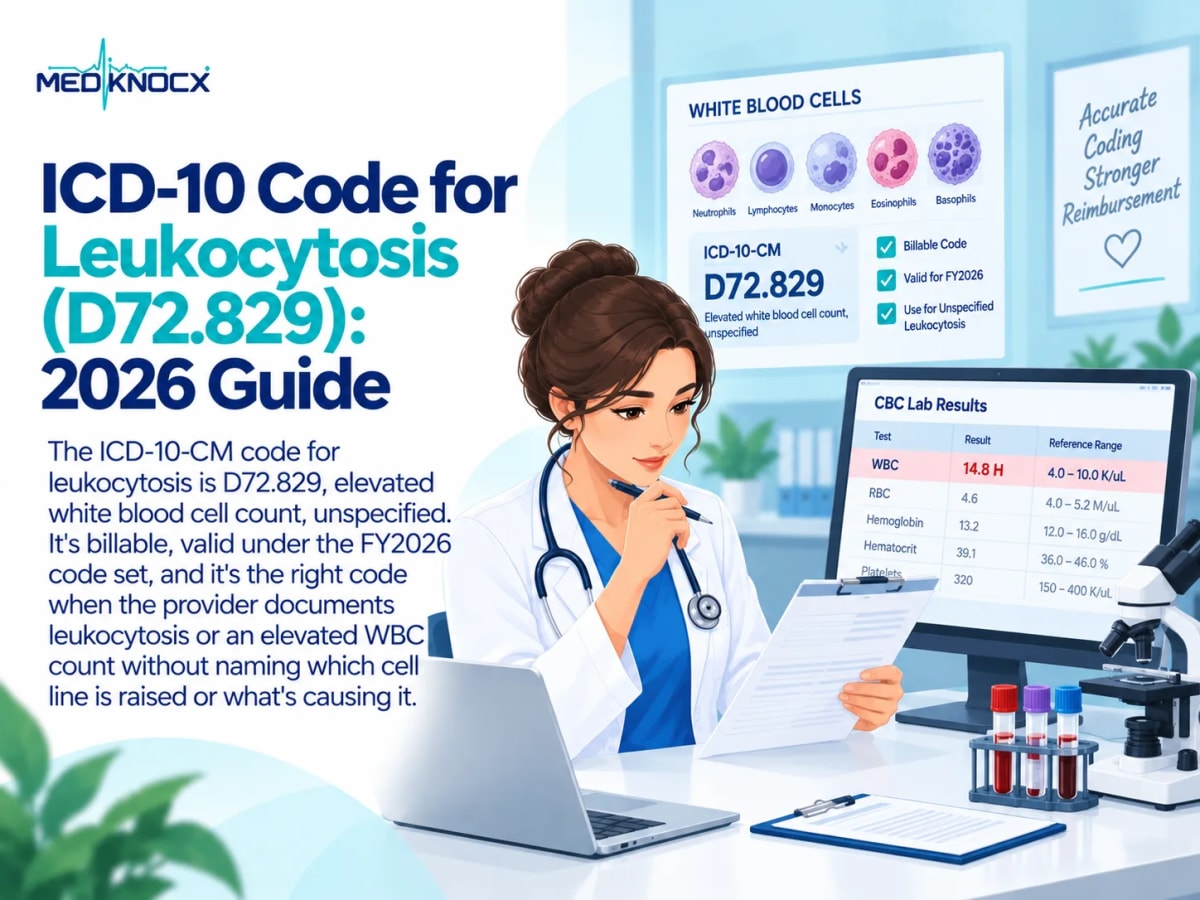
The ICD-10-CM code for leukocytosis is D72.829, elevated white blood cell count, unspecified. It's billable, valid under the FY2026 code set, and it's the right code when the provider documents leukocytosis or an elevated WBC count without naming which cell line is raised or what's causing it.
That last part is where most of the coding decisions actually happen. If the note says lymphocytosis, bandemia, or leukemoid reaction, a more specific D72.82 code applies. If the elevated count is explained by a confirmed diagnosis like pneumonia or sepsis, leukocytosis often isn't coded at all. And if the count is low instead of high, the answer moves to a different code family entirely. This guide walks through all of it.
Leukocytosis is a white blood cell count above the lab's reference range, which for most adult labs sits somewhere around 4,500 to 11,000 cells per microliter. A count above roughly 11,000 is usually flagged as high. Above 50,000 with no leukemia involved, clinicians start talking about a leukemoid reaction. Above 100,000, typically in leukemia, the term is hyperleukocytosis.
The cause matters more than the number for coding. Most leukocytosis is reactive: the body responding to an infection, inflammation, tissue injury, physical stress, smoking, or medications like corticosteroids. Less often it comes from the bone marrow itself, as in leukemia or a myeloproliferative disorder.
It also matters which white cell line is raised, because ICD-10-CM codes several of them separately:
• Neutrophils (neutrophilia), the most common pattern with bacterial infection and steroids
• Lymphocytes (lymphocytosis), often viral
• Monocytes (monocytosis)
• Eosinophils (eosinophilia), often allergic or parasitic
• Basophils (basophilia)
• Immature neutrophils, or bands (bandemia)
A CBC with differential tells the provider which line is up. Whether the note reflects that is what decides the code.
D72.829, elevated white blood cell count, unspecified, sits in Chapter 3 of ICD-10-CM (diseases of the blood and blood-forming organs and certain disorders involving the immune mechanism), under category D72, other disorders of white blood cells. Its inclusion terms are "elevated leukocytes, unspecified" and "leukocytosis, unspecified," which is why a search for the dx code for leukocytosis, a high WBC, or an elevated white count all lands on the same code.
It's billable and accepted by Medicare, Medicaid, and commercial payers. Its parent, D72.82, isn't billable on its own. Neither is D72.8. Occasionally a claim goes out with the header code by mistake and rejects for an invalid diagnosis, which is an easy fix but an avoidable one.
D72.829 is the right code when:
• The provider documents "leukocytosis" or "elevated WBC" with no specific cell line named
• The workup for the cause is still pending
• The elevated count is the reason for the visit or a separate clinical concern the provider is actively following
It's the wrong code when the note specifies the cell type (use the matching D72.82 code), when eosinophilia is documented (D72.1 series), or when the elevated count is simply part of a confirmed condition that's already coded.
When the note names the elevated cell line, the specific code replaces D72.829.
A few points trip up coders on this family.
Neutrophilia has no dedicated code. Neutrophilic leukocytosis, elevated neutrophils, and granulocytosis are reported with D72.828, since the provider has specified the type but no individual code exists for it. Some online code lists assign neutrophilia to D70.1 or D72.822; both are wrong. D70.1 is agranulocytosis from chemotherapy, and D72.822 is plasmacytosis.
Eosinophilia is excluded from D72.82. It has its own category: D72.10 for unspecified eosinophilia, D72.11 codes for hypereosinophilic syndrome, D72.12 for DRESS syndrome, D72.18 for eosinophilia in diseases classified elsewhere, and D72.19 for other eosinophilia.
Bandemia gives way to a confirmed infection. D72.825 is for bandemia without a diagnosed specific infection. Once the provider confirms the infection, code the infection instead.
Leukemoid reaction excludes leukemia. If leukemia is diagnosed, the C91 to C95 codes apply and the D72.82 codes don't.
Most leukocytosis guides skip this rule, and it's the one that matters most for clean claims. ICD-10-CM guidelines say signs and findings that are routinely associated with a confirmed disease process aren't coded in addition to that disease. An elevated WBC is an expected finding in a lot of conditions.
Confirmed infection. A patient with community-acquired pneumonia and a WBC of 16,000 is coded for the pneumonia. The leukocytosis is part of that picture. Adding D72.829 isn't required and, on some payers, draws a question about why a lab finding was coded alongside the condition that explains it.
Sepsis. An elevated WBC is one of the clinical criteria for sepsis and SIRS. When sepsis is diagnosed, the sepsis code carries it.
Leukemia and hyperleukocytosis. Category D72 excludes leukemia. When a very high count is due to documented leukemia, code the leukemia from C91 to C95. "Hyperleukocytosis" has no separate code; if leukemia hasn't been diagnosed and the provider calls it a leukemoid reaction, use D72.823, otherwise D72.829.
When it is coded alongside a condition. If the provider documents that the leukocytosis is out of proportion to the known condition, is being worked up on its own, or persists after the condition resolved, it's a separate clinical concern and can be reported. The deciding factor is what the provider documents, not the lab value alone.
Primary diagnosis. Leukocytosis goes first when it's the reason for the encounter: a patient referred to hematology for an unexplained high WBC, or a follow-up visit specifically to recheck an elevated count. The note should say something like "leukocytosis, etiology under evaluation."
Secondary diagnosis. It follows another code when the provider treats it as a separate concern during a visit for something else, and documents it as such.
A few scenarios that come up often:
Mild leukocytosis on routine labs. A WBC of 11,800 on an annual physical, no symptoms, provider notes "mild leukocytosis, repeat CBC in 4 weeks." That's D72.829 as a secondary code after the preventive visit code. There's no separate "mild" code; severity lives in the documentation, not the code.
Chronic or persistent leukocytosis. A count that stays elevated over months with no explanation is still D72.829 unless the provider identifies the cell line or a cause. Terms like "chronic" or "persistent" don't change the code, but they do support the medical necessity of repeat CBCs and a hematology referral.
Reactive leukocytosis. When the provider calls it reactive and names what it's reacting to, code that condition. When it's called reactive with no cause named, D72.829 applies.
Steroid-induced leukocytosis. A patient on prednisone with neutrophilic leukocytosis the provider attributes to the steroid: D72.828 for the neutrophilia, plus T38.0X5A for the adverse effect of glucocorticoids, initial encounter. The adverse effect code tells the payer why the count is up.
Leukocytosis in pregnancy. A mild rise in WBC is normal in pregnancy and labor and usually isn't coded. When the provider documents it as a clinical concern, the obstetric code leads: O99.11 with the trimester character, for other diseases of the blood complicating pregnancy, followed by D72.829 to specify the condition.
Low white counts sit right next door in the code book, and the two get confused often enough to cover here.
D72.819 is the leukopenia code when the note says leukopenia or low WBC without more detail. If the low count is specifically neutrophils, it moves to the D70 neutropenia category, and D72 excludes neutropenia, so the two aren't reported together. For chemotherapy-related neutropenia, D70.1 is paired with the adverse effect code for the drug and, when present, a fever code.
Leukocytes in urine. White cells in the urine aren't leukocytosis. That finding is pyuria, R82.81, and it belongs to urinary coding, not blood counts. When pyuria comes with a confirmed urinary tract infection, the infection code applies instead; our ICD-10 code for UTI guide covers how N39.0, R82.81, and the site-specific codes fit together.
Thrombocytosis. A high platelet count, not a high white count. It's coded from D75.83: D75.839 for thrombocytosis, unspecified, and D75.838 for other specified thrombocytosis. Essential thrombocythemia is a separate neoplasm code, D47.3.
Abnormal WBC, not otherwise described. When the note documents a white cell abnormality without saying whether it's high or low, D72.9, disorder of white blood cells, unspecified, applies. It's rarely the best answer, since the CBC usually shows which direction the count moved, and a quick query typically gets a more specific code.
D72.829 most often supports lab work, so the diagnosis to procedure link has to make sense.
Don't bill 85025 and 85027 together, or 85025 with 85004, for the same draw; the differential is already inside 85025. For a hematology workup that goes further, flow cytometry and bone marrow procedures follow, and those draw closer medical necessity review.
Medicare covers blood counts under National Coverage Determination 190.15, which lists the diagnoses that support a CBC and limits how often a routine repeat is covered without a change in the patient's condition. A documented elevated count that the provider is actively following is what supports those repeat CBCs; a note that just says "labs" doesn't.
A lab result alone doesn't support a diagnosis code. Coders can't assign D72.829 from a flagged CBC value unless the provider addresses it in the note. For a leukocytosis claim to hold up, the record should include:
• The WBC value and ideally the reference range, so the elevation is visible
• The provider's interpretation, in words: leukocytosis, elevated WBC, or the specific cell type
• The differential, if run, and whether the provider names the raised cell line
• The suspected or confirmed cause, or a clear statement that the cause is unknown
• The plan: repeat CBC, smear review, hematology referral, or monitoring
• Relevant history: steroid use, smoking, recent infection, pregnancy, or a known hematologic condition
When the lab shows a pattern the note doesn't mention, such as a clear neutrophilia on the differential with a note that just says "leukocytosis," a short query to the provider is often worth it. It moves the claim from D72.829 to D72.828 and gives the record a clearer clinical story.
Most of these are code selection problems that show up at the diagnosis to procedure link, which is where consistent medical coding review catches them before submission. When the same lab denials keep coming back across patients, it usually points to a workflow gap, such as CBCs ordered under a generic diagnosis, and tracing it through denial management fixes the pattern rather than one claim at a time.
• CMS, ICD-10-CM official code files and guidelines, FY2026 code set effective October 1, 2025, with the April 1, 2026 update
• CMS National Coverage Determination 190.15, Blood Counts
D72.829, elevated white blood cell count, unspecified. It's used when leukocytosis or a high WBC is documented without the specific cell type.
Yes. D72.829 is a billable code under the FY2026 ICD-10-CM code set. Its parent codes, D72.82 and D72.8, are not.
The same code, D72.829, when the note doesn't name the cell line. "Elevated leukocytes" and "leukocytosis, unspecified" are both inclusion terms for it.
D72.828 is for a specified type of elevated white count that has no code of its own, such as neutrophilia. D72.829 is for an elevated count where the type isn't specified.
D72.828, other elevated white blood cell count. Neutrophilia doesn't have a dedicated code, and it isn't D70.1 or D72.822.
D72.819, decreased white blood cell count, unspecified. Low neutrophils specifically code to the D70 neutropenia category, and low lymphocytes to D72.810.
No separate codes. All of them use D72.829 unless the cell type or cause is documented. The descriptors belong in the note, where they support repeat testing.
Usually not. An elevated WBC is expected with those conditions, so the confirmed diagnosis covers it. Code it separately only when the provider documents it as its own concern.
R82.81, pyuria. That's a urine finding, not leukocytosis, and a confirmed UTI takes its own infection code instead.
If the provider documents it as a clinical concern, O99.11 with the trimester character goes first, followed by D72.829. A normal mild rise during pregnancy usually isn't coded.
Explore more medical billing guides, coding updates, and revenue cycle tips.
CPT 93971 versus 93970, medical necessity under LCD L35451, ICD-10 pairing, modifiers, and the denial patterns...
Learn what POS 13 means in medical billing, when to use it, CPT codes, POS 12 vs POS 13, common billing errors...
The correct ICD-10 codes for weight loss management, from E66 obesity codes to Z71.3 counseling and Medicare's...