Healthcare

What Is POS 22 in Medical Billing - On-Campus Guide
POS 22 marks on-campus hospital outpatient services. See how it differs from POS 19 and POS 11, how split bill...

Aug 26, 2026
1 min read

Jordan Taylor
July 28, 2026
Table of Contents
1
CPT Code 99214 is one of the most frequently reported Evaluation and Management (E/M) codes for established patient office visits. It is commonly used by family physicians, internists, cardiologists, endocrinologists, psychiatrists, and many other healthcare providers who manage patients with chronic conditions or medically complex follow-up visits.
Although this code is used every day across medical practices, it is also one of the most misunderstood. Selecting CPT 99214 requires more than documenting a long office visit or listing several diagnoses. Providers must demonstrate medical necessity, support the level of medical decision making (MDM) or document the required total physician time, and accurately report the encounter according to current E/M coding guidelines.
Accurate coding plays a vital role in medical billing services because it directly impacts claim acceptance, reimbursement, and compliance. Incorrect code selection can lead to claim denials, payment delays, payer audits, or downcoding, all of which negatively affect a practice's revenue cycle management. Understanding the requirements for CPT Code 99214 helps healthcare providers improve coding accuracy, reduce billing errors, and maintain a healthier financial workflow.
In this guide, you'll learn what CPT Code 99214 is, when it should be used, the documentation requirements, time guidelines, billing considerations, common coding mistakes, and answers to frequently asked questions.

CPT Code 99214 represents an office or other outpatient Evaluation and Management (E/M) visit for an established patient. It is used when the patient's condition requires a moderate level of medical decision making or when the total time spent on the date of the encounter falls within the required time range.
Unlike previous E/M coding guidelines, the current rules allow providers to select the appropriate office visit code based on either:
Medical Decision Making (MDM)
Total time spent on the date of the encounte
Providers do not need to satisfy both requirements. Meeting either the MDM criteria or the required total time is sufficient when supported by appropriate documentation.
Because CPT 99214 reflects a moderate level of complexity, it is commonly reported in primary care, internal medicine, cardiology, endocrinology, pulmonology, and other specialties that manage chronic diseases or complex follow-up visits.
Who Is Considered an Established Patient?
An established patient is someone who has previously received professional services from the same physician or another physician of the same specialty within the same group practice during the past three years.
If the patient does not meet this definition, a new patient E/M code rather than CPT Code 99214 may be appropriate.
Correctly identifying whether the patient is new or established is an important first step before selecting any E/M code.
Choosing the correct E/M code affects much more than reimbursement. Accurate coding supports compliance, reflects the complexity of the care provided, and creates a reliable medical record for future treatment. Many healthcare providers also rely on professional medical coding services to improve coding accuracy, reduce documentation errors, and maintain compliance with current E/M guidelines.
Using CPT Code 99214 appropriately can help healthcare organizations:
Improve reimbursement accuracy
Reduce claim denials
Support documentation during payer audits
Demonstrate medical necessity
Strengthen revenue cycle performance
Maintain coding compliance
On the other hand, selecting this code without adequate documentation may result in claim denials, payment delays, downcoding, or audit findings.
CPT Code 99214 should be reported when an established patient's visit requires a moderate level of evaluation and management. These encounters often involve multiple chronic conditions, medication management, review of diagnostic testing, or an increased risk associated with treatment decisions.
The decision to report CPT Code 99214 should always be based on the complexity of the service provided rather than the number of diagnoses listed in the patient's chart.
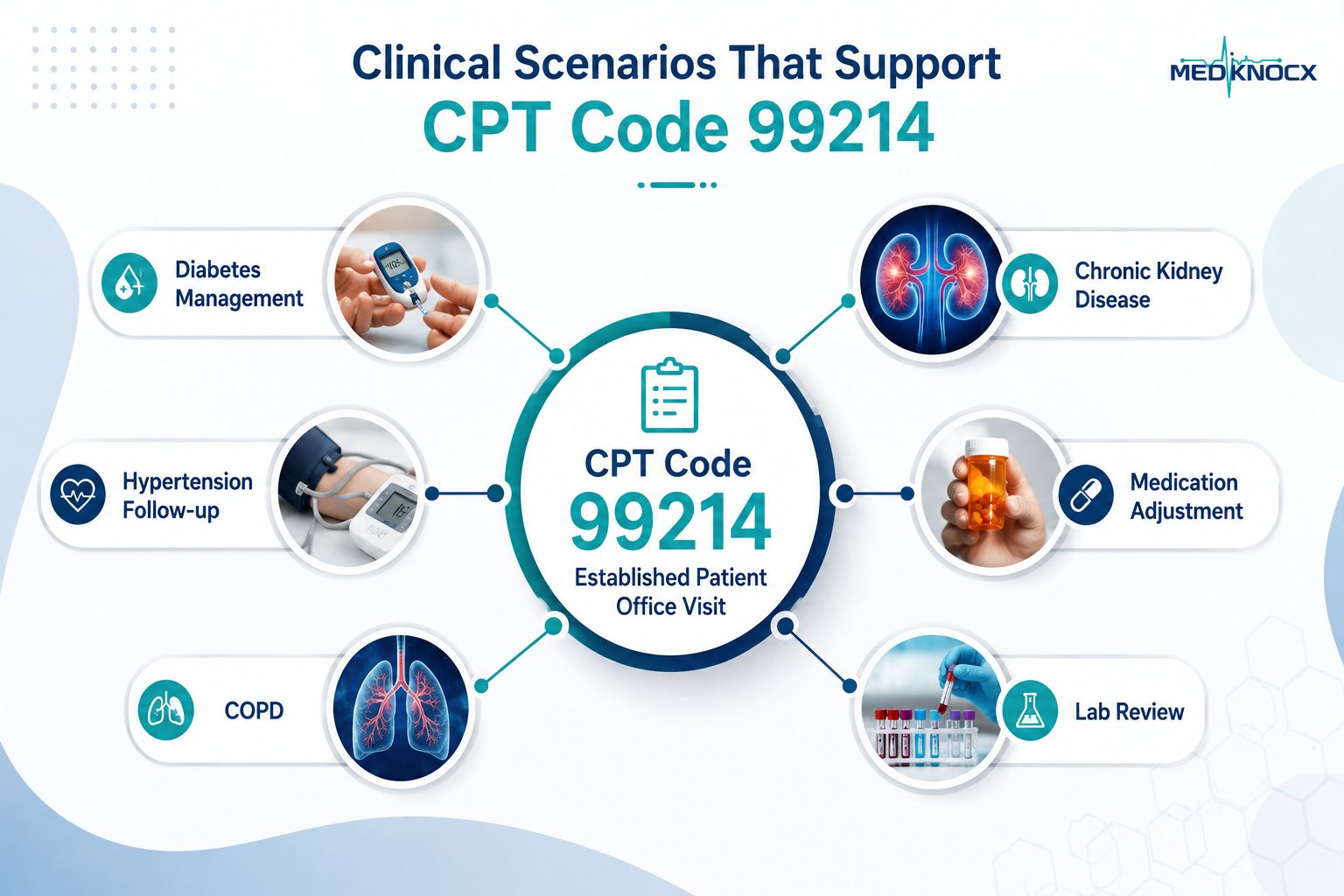
Common situations where CPT Code 99214 may be appropriate include:
Managing diabetes with medication adjustments
Treating hypertension that requires ongoing monitoring
Evaluating patients with multiple chronic illnesses
Reviewing laboratory results before modifying a treatment plan
Assessing worsening respiratory conditions such as COPD or asthma
Monitoring chronic kidney disease or cardiovascular disease
Coordinating care with specialists for complex medical conditions
Each encounter must demonstrate that the provider performed work consistent with moderate complexity and that the documentation clearly supports the services delivered.
 Medical Necessity Always Comes First
Medical necessity is the foundation of accurate E/M coding. Even if the documentation includes enough detail or the visit lasts more than 30 minutes, CPT Code 99214 should not be reported unless the patient's condition genuinely requires a moderate level of evaluation and management.
For example, spending additional time discussing routine lifestyle advice with a stable patient does not automatically justify reporting a higher-level E/M service. The documentation should clearly explain why the services provided were medically necessary based on the patient's clinical condition.
Providers should avoid selecting a code solely because of visit length or reimbursement expectations. Instead, every coding decision should accurately reflect the patient's needs and the complexity of the medical care provided.
Accurate documentation is essential when reporting CPT Code 99214. The medical record should clearly demonstrate why the selected code reflects the level of care provided. Good documentation not only supports reimbursement but also protects the provider during payer reviews and compliance audits.
The documentation should tell the complete story of the patient encounter. Anyone reviewing the record should understand the patient's condition, the provider's clinical thinking, the services performed, and the treatment plan without requiring additional clarification.
A well-documented 99214 encounter typically includes:
The patient's chief complaint or reason for the visit
A relevant history of the present illness
Assessment of chronic or acute medical conditions
Physical examination findings when clinically appropriate
Review of laboratory or imaging results
Medication review and any adjustments made
Clinical assessment and medical decision making
Treatment plan and follow-up recommendations
The documentation should always support the medical coding necessity of the visit rather than simply increasing the amount of information recorded.
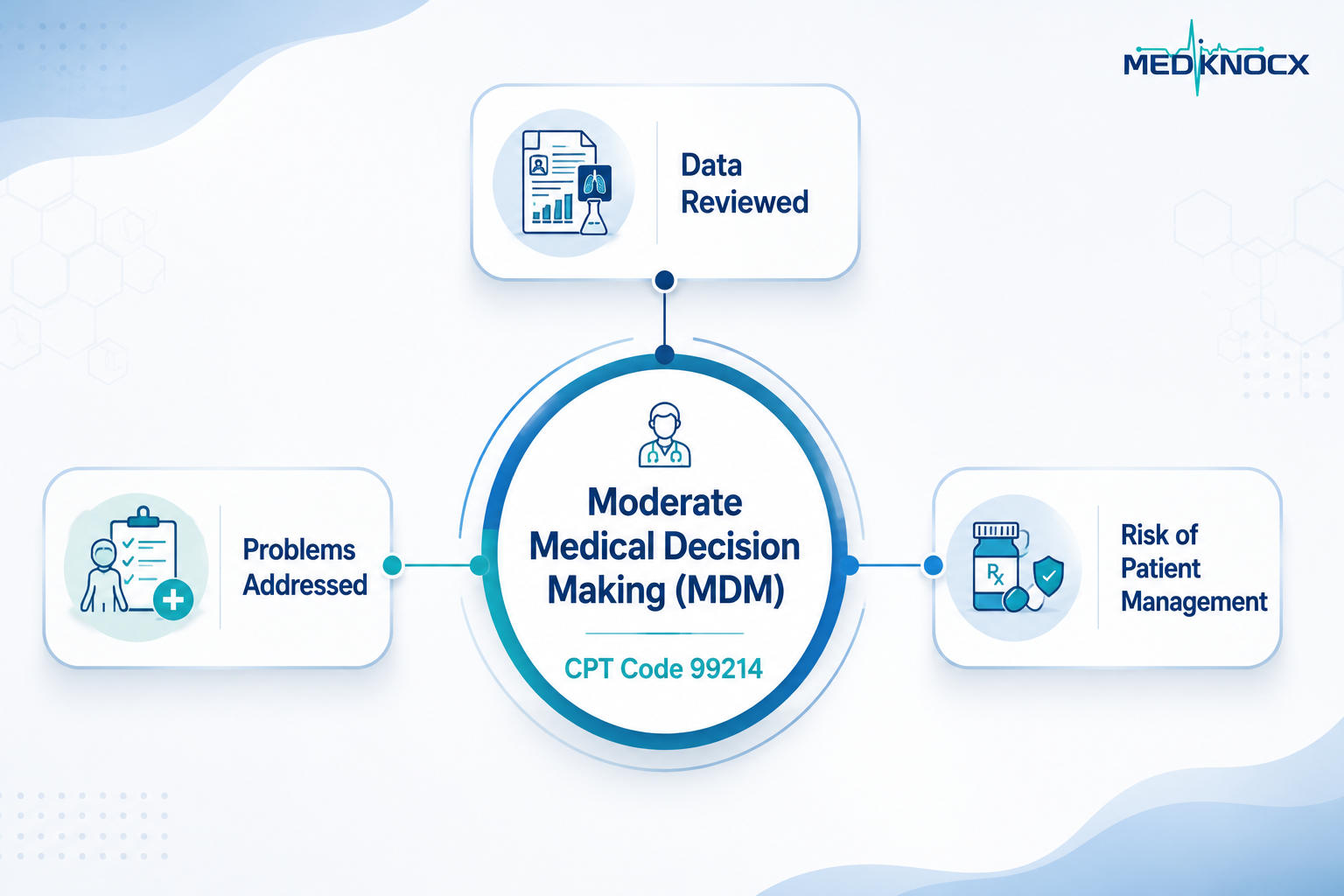
Medical Decision Making is one of the two methods used to select CPT Code 99214. Under the current E/M guidelines, providers may report this code when the encounter involves medical billing specialists.
MDM is evaluated using three elements:
Problems addressed during the encounter
Amount or complexity of data reviewed and analyzed
Risk of complications, morbidity, or mortality related to patient management
At least two of these three elements must meet the requirements for moderate complexity.
The first MDM element considers the complexity of the patient's medical problems.
Examples that commonly support moderate complexity include:
Two or more stable chronic illnesses
One chronic illness with progression or side effects
One acute illness with systemic symptoms
One undiagnosed new problem with an uncertain prognosis
For example, a patient with diabetes and hypertension requiring medication adjustments may qualify for moderate complexity depending on the overall clinical evaluation.
Providers often review additional information before making treatment decisions. The complexity of this work contributes to medical decision making.
Examples include:
Reviewing laboratory reports
Evaluating imaging studies
Reviewing external physician notes
Ordering diagnostic tests
Discussing patient management with another healthcare professional
Independently interpreting test results when appropriate
The documentation should clearly identify the data reviewed and explain how it influenced clinical decisions.
Risk is another important component of moderate medical decision making.
Examples include:
Prescription drug management
Decisions regarding minor procedures with identified patient risk factors
Monitoring medication side effects
Managing chronic diseases that require ongoing treatment adjustments
Evaluating conditions that may worsen without appropriate intervention
Prescription medication management alone may contribute to moderate-risk decision making when supported by the overall clinical documentation.
Instead of selecting the code based on Medical Decision Making, providers may choose CPT Code 99214 based on the total time spent on the date of the encounter.
The required time range is 30 to 39 minutes.
Total time includes both face-to-face and certain non-face-to-face activities performed on the same calendar date, such as:
Reviewing medical records before the visit
Evaluating diagnostic results
Performing the patient examination
Counseling the patient or family
Ordering medications or diagnostic tests
Documenting the encounter
Coordinating care with other healthcare professionals
Travel time, separately billable procedures, and work performed on different dates should not be included in the total time calculation.
When coding based on time, providers should document the total minutes spent and briefly describe the activities performed during that time.
A 68-year-old patient with diabetes, hypertension, and stage 3 chronic kidney disease presents for a follow-up visit. Blood pressure remains uncontrolled despite current medication. Recent laboratory results show declining kidney function. The physician reviews laboratory reports, adjusts antihypertensive medications, discusses lifestyle modifications, orders repeat laboratory testing, and schedules follow-up monitoring.
This encounter may support CPT Code 99214 because the provider managed multiple chronic conditions, reviewed diagnostic data, adjusted prescription medications, and documented moderate medical decision making.
The final code selection should always reflect the complete documentation and medical necessity of the services provided rather than a single factor such as visit duration or the number of diagnoses listed.
Even experienced providers and billing professionals can make mistakes when reporting CPT Code 99214. These errors often lead to claim denials, delayed reimbursement, downcoding, or increased audit risk. Understanding the most common pitfalls can help improve coding accuracy and reduce unnecessary revenue loss.
One of the most common mistakes is assuming that a longer office visit automatically qualifies for CPT Code 99214.
Although total time can be used to select the code, providers must document that 30 to 39 minutes were personally spent on qualifying activities performed on the date of the encounter. Simply scheduling a longer appointment or spending additional time on non-qualifying tasks does not justify reporting a higher-level E/M service.
Many patients with diabetes, hypertension, asthma, or other chronic conditions are seen regularly. However, not every follow-up visit meets the requirements for CPT Code 99214.
A routine visit for stable chronic conditions with no significant changes in treatment or medical decision making may support a lower-level E/M code instead. The complexity of the encounter, rather than the diagnosis itself, determines the appropriate code.
A claim may be denied even when the provider performed work consistent with CPT Code 99214 if the documentation does not clearly support the level of service.
Common documentation issues include:
Missing assessment and treatment plan
No explanation for medication changes
Incomplete review of diagnostic results
Failure to document medical necessity
Lack of evidence supporting moderate medical decision making
Missing total time when coding based on time
Complete and accurate documentation remains the strongest defense during payer reviews and audits.
Upcoding occurs when a higher-level E/M code is reported without documentation supporting the complexity of the visit.
Examples include:
Reporting CPT Code 99214 for a straightforward follow-up visit
Choosing a higher code based solely on reimbursement
Reporting moderate medical decision making when the documentation reflects low complexity
Upcoding increases the risk of payer audits, claim recoupments, financial penalties, and compliance concerns.
While upcoding receives significant attention, downcoding can also create problems.
Some providers consistently report lower-level E/M codes because they are uncertain about documentation requirements or want to avoid audit scrutiny. This practice may result in lost revenue and fail to reflect the true complexity of patient care.
Accurate coding should always reflect the services actually provided.
Claim denials occur for many reasons, but most are preventable with proper denial management and coding practices.
Common reasons include:
Documentation does not support moderate medical decision making
Medical necessity is not clearly established
Total time is missing or falls outside the required range
Incorrect patient status (new versus established)
Missing or incorrect diagnosis codes
Billing errors or incomplete claim information
Payer-specific documentation requirements are not met
Healthcare organizations that regularly review denied claims can identify recurring issues and improve coding accuracy through education and internal audits.
Consistent coding accuracy requires collaboration between providers, coders, and billing professionals. Following established best practices helps reduce claim denials, maintain compliance with current coding guidelines, and support more efficient revenue cycle management across healthcare organizations.
Consider the following recommendations:
Document the patient's clinical condition clearly.
Explain why the services provided were medically necessary.
Record all relevant diagnostic data reviewed during the encounter.
Document prescription medication management when applicable.
Include the total time when selecting the code based on time.
Ensure the assessment and treatment plan support the reported level of service.
Stay informed about annual CPT and payer guideline updates.
Perform periodic internal documentation and coding audits.
Accurate coding is not about selecting the highest-paying code. It is about ensuring the reported service accurately reflects the complexity of the care delivered and is fully supported by the medical record.
Before submitting a claim, verify that the medical record includes the following:
Clear reason for the patient's visit
Relevant history and clinical findings
Appropriate assessment of all addressed conditions
Review of laboratory or imaging results when applicable
Medication review and documented changes
Evidence supporting moderate medical decision making or documented total time of 30 to 39 minutes
Treatment plan with follow-up instructions
Documentation demonstrating medical necessity
Using a standardized documentation checklist can improve coding consistency, reduce claim denials, and strengthen compliance across the organization.
Conclusion
CPT Code 99214 plays an important role in outpatient Evaluation and Management coding by accurately representing moderately complex established patient visits. Correct code selection requires more than identifying multiple diagnoses or documenting a longer appointment. Providers must ensure that the patient's condition, medical necessity, clinical decision making, and supporting documentation all justify the reported level of service.
Understanding current E/M guidelines, documenting patient encounters thoroughly, and applying coding standards consistently can reduce claim denials, improve reimbursement accuracy, and strengthen compliance with payer requirements. Regular provider education, internal coding reviews, and documentation audits also help healthcare organizations maintain high coding quality and reduce financial risk.
As coding regulations continue to evolve, staying informed about CPT updates and payer policies remains essential for delivering accurate, compliant, and efficient medical billing services.
Accurate coding is the foundation of a healthy revenue cycle. If your practice is experiencing claim denials, coding inconsistencies, delayed reimbursements, or documentation challenges, partnering with an experienced medical billing company can make a significant difference.
Mediknocx provides comprehensive medical billing service and revenue cycle management services tailored to the unique needs of healthcare providers. Our experienced billing and coding specialists work to improve coding accuracy, reduce revenue leakage, optimize claim submission, resolve denials, and maintain compliance with current CPT, ICD-10, and payer guidelines.
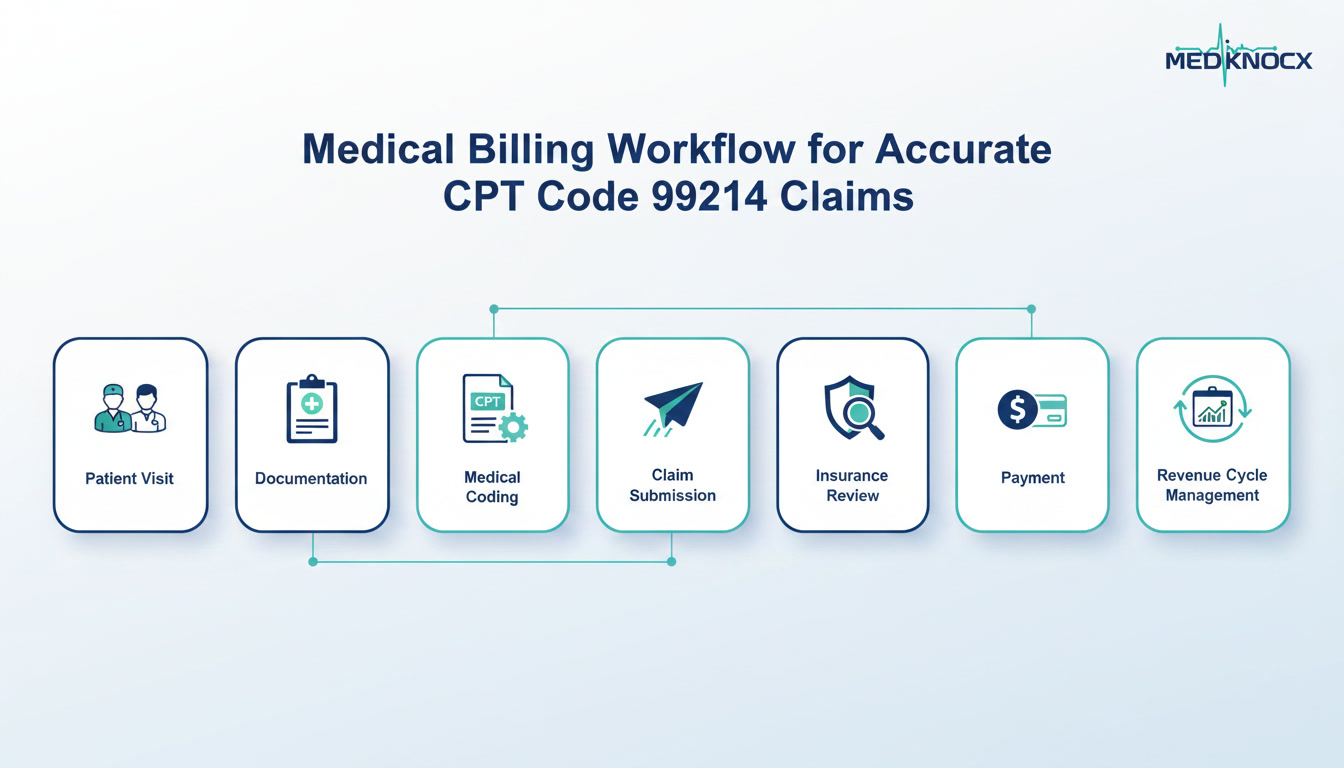
From patient registration and insurance verification to payment posting and accounts receivable management, we support every stage of the revenue cycle with accuracy, transparency, and efficiency.
Whether you operate a private practice, multi-specialty clinic, or healthcare organization, Mediknocx is committed to helping you increase collections, reduce administrative workload, and maximize reimbursement.
Contact Mediknocx today to learn how our medical billing, medical coding, and revenue cycle management solutions can help your practice achieve stronger financial performance while you focus on delivering outstanding patient care
CPT Code 99214 is an Evaluation and Management (E/M) code used for office or outpatient visits involving an established patient. It is reported when the visit meets the requirements for moderate medical decision making or when the provider spends a total of 30 to 39 minutes on qualifying activities performed on the date of the encounter.
When selecting the code based on time, the provider must spend 30 to 39 minutes on the date of the encounter. This includes both face-to-face and certain non-face-to-face activities, such as reviewing records, documenting the visit, ordering tests, and coordinating patient care.
Yes. Under the current E/M guidelines, providers may select CPT Code 99214 based on either moderate medical decision making or total time. When time is used, the medical record should clearly document the total minutes spent and describe the work performed during that time.
No. Having multiple chronic conditions does not automatically justify reporting CPT Code 99214. The provider must evaluate the complexity of the encounter, the medical decision making involved, and the medical necessity of the services provided. Documentation should always support the reported level of service.
The medical record should include the reason for the visit, assessment of the patient's conditions, relevant examination findings when appropriate, review of diagnostic data, medication management, treatment plan, follow-up recommendations, and documentation supporting either moderate medical decision making or the required total time.
The primary difference is the complexity of the encounter. CPT Code 99213 generally reflects low medical decision making, while CPT Code 99214 requires moderate medical decision making or 30 to 39 minutes of total provider time. Providers should select the code that accurately reflects the documented services and medical necessity.
Claims are commonly denied because of insufficient documentation, lack of medical necessity, incorrect patient status, inaccurate diagnosis coding, missing total time when time-based coding is used, or documentation that does not support moderate medical decision making.
Explore more medical billing guides, coding updates, and revenue cycle tips.
POS 22 marks on-campus hospital outpatient services. See how it differs from POS 19 and POS 11, how split bill...

POS 10 marks telehealth delivered to a patient's home. See how it differs from POS 02, which modifiers to use,...

CPT code 90791 covers the psychiatric diagnostic evaluation. See who can bill it, documentation rules, frequen...
Acupuncture Medical Billing Service
Allergy and Immunology Medical Billing Services
Anesthesia Medical Billing Services
Behavioral Health Billing Services
Psychiatry Medical Billing Services
Cardiology Medical Billing Services
Cardiovascular Medical Billing Services
Chiropractic Medical Billing Services
Dermatology Medical Billing Services
View All Specialities