Healthcare

What Is POS 13 in Medical Billing? Assisted Living Guide
Learn what POS 13 means in medical billing, when to use it, CPT codes, POS 12 vs POS 13, common billing errors...

Sep 22, 2026
1 min read

Jordan Taylor
September 23, 2026
Table of Contents
12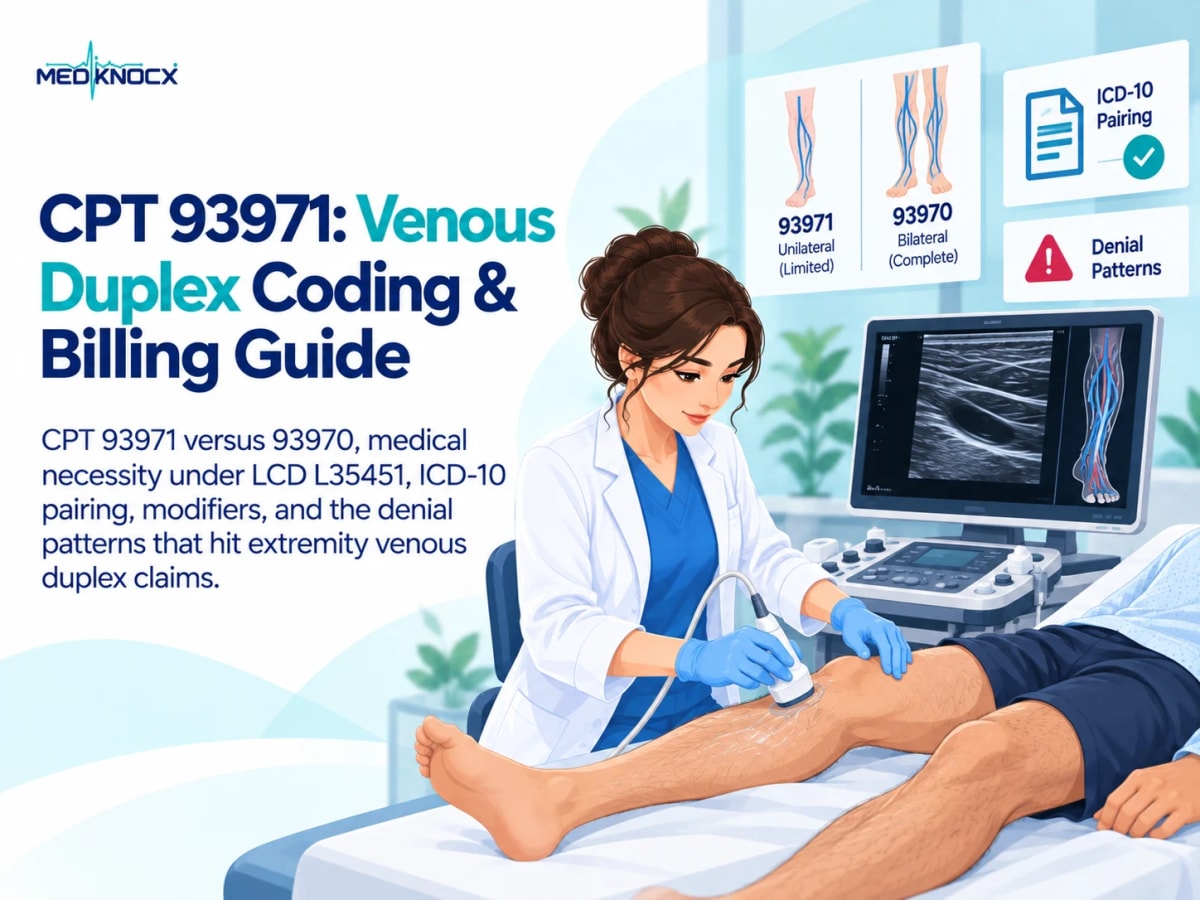
CPT 93971 covers a duplex ultrasound of arm or leg veins, either a complete study of one side or a limited study that can cover one side or both. Most of the coding risk on this code doesn't come from the definition itself. It comes from confusing it with its bilateral companion code, CPT 93970, which covers something narrower than its name suggests.
CPT 93971 reports a duplex ultrasound of upper or lower extremity veins, combining B-mode imaging of the vein's anatomy with Doppler assessment of blood flow, including the vein's response to compression and other maneuvers. It sits in the non-invasive extremity venous study family, maintained by the AMA as part of the national CPT code set.
The code covers two scenarios: a complete study of one arm or leg, or a limited study, which can cover one side or both. A limited study means the exam didn't complete every component of the full protocol for that side, whatever the reason. What it does not cover is a complete study of both sides at once. That's a separate code, covered next, and mixing the two up is where most of the coding risk on this study actually lives.
A duplex exam itself typically involves grayscale imaging to show the vein's anatomy, spectral or pulsed Doppler to evaluate flow, color flow imaging to show direction, and compression testing to check whether a vein segment collapses normally. Not every exam needs every technique. Documentation should describe what was actually performed rather than listing a standard protocol by default.
CPT 93970 reports a complete bilateral extremity venous duplex study, meaning both corresponding extremities got the full required protocol. CPT 93971 reports everything else in this study family: a complete unilateral study, a limited unilateral study, or a limited bilateral study. The word "bilateral" appearing in an order doesn't settle which code applies. What the report documents does.
Modifier 50 doesn't belong on either code. CMS Medicare billing article A52993 states this directly for 93971: a limited bilateral study is reported as 93971, and modifier 50 is not appropriate for it. The Medicare fee schedule backs this up structurally, listing 93971 with a bilateral indicator of 0, meaning the 150 percent bilateral payment adjustment doesn't apply, because the code's own descriptor already accounts for both unilateral and limited bilateral scenarios. If a complete bilateral exam was actually performed and the report supports it, that's 93970, reported once, not 93971 with a modifier attached.
Suspected deep vein thrombosis is probably the most common reason. Unilateral swelling, pain, tenderness, warmth, or erythema are the typical clinical triggers, and the study either confirms thrombus or rules it out. A follow-up study is also used to investigate DVT as a possible source when a pulmonary embolism has already been confirmed.
Chronic venous insufficiency and reflux show up as heaviness, edema, itching, skin changes, or, in more advanced cases, ulceration. The study evaluates valve function and reflux patterns. Asymptomatic or cosmetic varicose veins with no functional complaint documented don't carry the same medical necessity weight as symptomatic disease.
Post-ablation assessment checks for complications after a venous ablation procedure, including thrombus extending into the deep system. Timing isn't fixed by a single national rule; it depends on the payer, the MAC, and the specific clinical concern being evaluated.
Preoperative vein mapping identifies a suitable vein for use as a bypass graft before surgery. This is a different service from initial hemodialysis-access vessel mapping, which uses its own separate CPT codes.
Upper-extremity studies follow the same code, not a separate one. Arm-vein concerns like suspected thrombosis, swelling, or catheter-related symptoms are billed under 93971 the same way leg studies are, once the documented scope and laterality are established.
Medicare coverage for extremity venous duplex studies runs through Local Coverage Determination L35451, and coverage isn't automatic just because the study was performed. The LCD lists specific indication categories it considers reasonable and necessary: new-onset DVT signs or symptoms, investigating DVT as the source of a confirmed pulmonary embolism, symptomatic chronic venous insufficiency, post-thrombotic syndrome, post-ablation evaluation where policy supports it, and preoperative mapping for a harvest vein.
The LCD is also explicit about what it doesn't consider reasonable and necessary: routine screening with no clinical concern documented, asymptomatic varicose veins, and imaging that won't actually change how the patient is managed. None of these situations automatically kills a claim by itself, but each one raises the odds of a denial without stronger supporting documentation.
One detail worth remembering: an LCD is local policy, tied to a specific Medicare Administrative Contractor's jurisdiction, not a nationwide rule. The right first step for verifying coverage is identifying which MAC covers the billing provider's location, then checking that MAC's current LCD and its associated billing article rather than assuming the same rule applies everywhere.
No single diagnosis code guarantees coverage. The code has to represent what the record actually documents as the reason for the exam.
A confirmed pulmonary embolism can also justify the study under select I26 codes when the goal is finding the venous source. Across all of these, coders should select the highest specificity the documentation actually supports, matching acuity and laterality to what's in the chart, using the code set in effect for the date of service.
CMS Article A52993 sets out the record-keeping expectations for this study clearly: images stored in a retrievable format, a signed final report with findings and an impression, a comparison statement when prior relevant imaging was reviewed, and a note of any urgent provider communication.
Beyond that baseline, a few things make the difference between a claim that holds up and one that doesn't:
• The order and indication. Name the ordering provider and the specific reason for the test. "Leg pain" alone is a weak indication. "Suspected DVT, unilateral swelling and tenderness for three days" is not.
• Scope and laterality, stated together. Something like "complete unilateral right lower-extremity venous duplex" or "limited bilateral study restricted to the proximal deep system" tells the coder everything needed in one line.
• Technique actually performed. List which of B-mode imaging, compression testing, color flow, and spectral Doppler were used, and note anything that couldn't be completed and why.
• Findings specific enough to support the diagnosis code. Compressibility, flow characteristics, thrombus location, or reflux, whichever applies to the clinical question being answered.
Getting this right the first time is fundamentally a medical coding accuracy question, since a coder working from an incomplete report has no way to choose correctly between 93970 and 93971 no matter how careful they are.
This study can be billed globally, when one entity provides both the equipment and the interpretation, or split between the technical and professional pieces. Modifier 26 covers the professional interpretation and written report. Modifier TC covers the technical component, the equipment and its operation, where separately payable. Which applies depends on who actually performed each part, not just who owns the equipment.
The modifier 50 point is worth repeating because it's the single most common mistake on this code: 93971 already includes limited bilateral scenarios in its own descriptor, so adding modifier 50 for bilateral involvement is redundant at best and a red flag to the payer at worst. Modifier 25 and 59 both require genuine, documented separateness. Neither should go on a claim by default just because two services happened to land on the same date.
CMS's National Correct Coding Initiative runs Procedure-to-Procedure edits to catch improper code combinations and Medically Unlikely Edits to catch improper unit counts, both updated quarterly. Whether this code can be billed twice, or alongside another vascular study, depends on the anatomy involved, the current edits, and the payer's own policy, not a fixed rule.
Two genuinely separate studies, such as a limited right upper-extremity exam and a separate limited left lower-extremity exam, each with its own indication and documentation, is a reasonable example of two billable units. What doesn't work is billing 93970 and 93971 together for overlapping work in the same extremity group. A complete bilateral lower-extremity study already represents the complete service on its own; there's no scenario where the limited code adds anything to it for the same anatomy.
Arterial and venous studies performed the same day answer different clinical questions, but same-day reporting can still run into MAC-specific restrictions, and each study needs its own supporting medical necessity. CMS Article A52993 specifically states that certain duplex and physiologic studies can't be billed on the same date under that MAC's guidance, which is a local rule rather than something to assume applies everywhere.
On repeat studies, there's no single national once-a-year frequency limit for this code. A repeat needs to tie to a documented clinical change, a treatment decision, or a policy-supported follow-up interval, not a routine calendar assumption.
There's no single national dollar amount for this code. Payment depends on the work RVU, the practice expense RVU, the malpractice RVU, the Geographic Practice Cost Index for the specific locality, the applicable conversion factor, and whether the service was billed globally, professionally, or technically.
Starting January 1, 2026, CMS finalized two separate conversion factors for the first time: $33.57 for clinicians who qualify as participants in an Advanced Alternative Payment Model, and $33.40 for everyone else, both up roughly 3 to 4 percent from 2025. CMS also finalized a 2.5 percent efficiency adjustment to work RVUs for most non-time-based codes in 2026, which offsets part of that conversion factor increase depending on the specific code.
Facility and non-facility settings are priced differently, and professional-only payment differs from a global reading, so "the facility rate is lower" isn't a safe generalization without specifying which component is being compared. The reliable way to check an actual number is the current CMS Physician Fee Schedule lookup tool for the correct year, locality, and component, not a number copied from an older PDF or a competitor's published figure.
Five patterns account for most denials on this code, and each one calls for different appeal evidence.
Before appealing anything, identify which category the denial actually falls into. A coverage denial needs clinical evidence. A coding denial needs the report. A modifier denial needs the edit logic. Sending the wrong kind of evidence is its own common reason appeals fail on the first attempt.
A short, factual reconsideration request tends to work better than a long form letter: state what service was actually performed, point to the order and signed report that support the documented indication and scope, and request reconsideration under the applicable coverage and coding policy. Original Medicare's appeals process has five formal levels, starting with redetermination by the responsible Medicare contractor, and NCCI-related edits get appealed through that same MAC, not through the NCCI contractor directly.
When the same denial pattern keeps showing up across multiple claims, that's usually a workflow issue rather than a one-off mistake, and it's worth tracing through denial management to find out whether the failure starts in documentation, authorization, coding, or claim submission.
• CMS Medicare Billing and Coding Article A52993, Peripheral Venous Ultrasound, linked to LCD L35451
• CMS Medicare Coverage Database, for locating current LCDs and articles by MAC jurisdiction
• CMS Physician Fee Schedule Look-Up Tool
• CY 2026 Medicare Physician Fee Schedule Final Rule, published October 31, 2025, effective January 1, 2026
A duplex ultrasound of extremity veins, either a complete unilateral study of one arm or leg, or a limited study covering one or both sides.
93970 is the complete bilateral study, both sides, full protocol. 93971 covers everything short of that: complete unilateral, limited unilateral, or limited bilateral.
No. CMS Article A52993 states this directly, and the code's own bilateral indicator confirms it. A limited bilateral study is already 93971 without the modifier.
When it's reasonable and necessary under LCD L35451, ordered by the treating provider, and supported by documentation. Coverage isn't automatic just because the study was performed.
Commonly the I82 and I80 series for thrombosis, I83 and I87 for venous insufficiency, and R22, R60, or M79.6 symptom codes when they connect to a documented venous concern. Z01.810 and Z09 apply to preoperative and post-ablation scenarios specifically.
Not as a universal rule based on current CMS guidance, though some payers still require it. Documentation should identify the side regardless.
Only if two genuinely separate studies were performed on distinct anatomy, each with its own documentation, and the payer's edits allow it. There's no blanket yes.
A mismatch between the documented study scope and the code billed, most often 93971 billed with modifier 50 when the descriptor already covers that scenario, or a diagnosis that doesn't match what the LCD requires.
Explore more medical billing guides, coding updates, and revenue cycle tips.
Learn what POS 13 means in medical billing, when to use it, CPT codes, POS 12 vs POS 13, common billing errors...

The correct ICD-10 codes for weight loss management, from E66 obesity codes to Z71.3 counseling and Medicare's...

Learn how physician assistant billing works, including Medicare billing, NPI requirements, incident-to billing...