Healthcare

CPT 93971: Venous Duplex Coding - 2026 Billing Guide
CPT 93971 versus 93970, medical necessity under LCD L35451, ICD-10 pairing, modifiers, and the denial patterns...

Sep 23, 2026
1 min read

Jordan Taylor
February 25, 2026
Table of Contents
19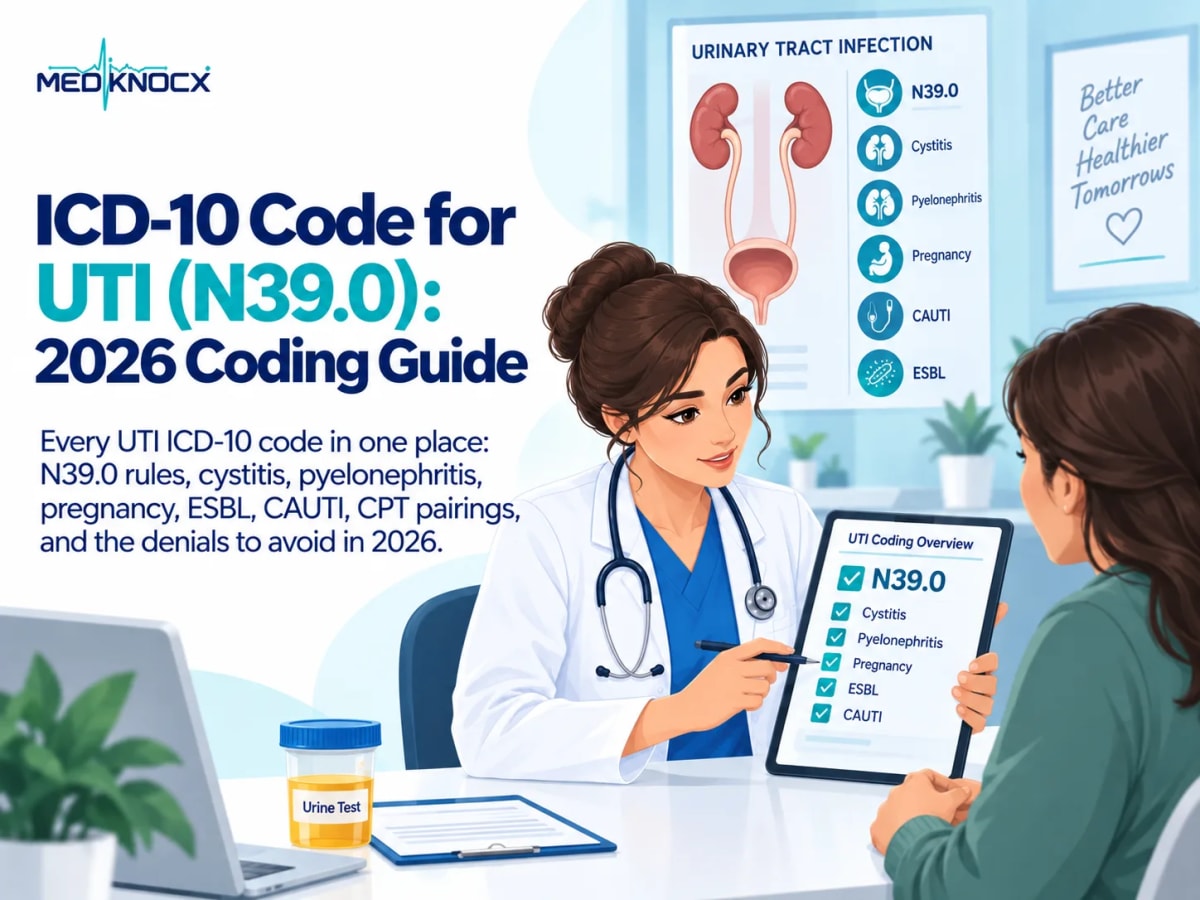
The ICD-10-CM code for a urinary tract infection with no documented site is N39.0, urinary tract infection, site not specified. It's billable and valid under the FY2026 code set, effective October 1, 2025. The moment the chart names a site, though, N39.0 stops being the right answer: acute cystitis codes to N30.00 or N30.01, acute pyelonephritis to N10, and urethritis to the N34 series.
That single rule accounts for a large share of avoidable UTI denials. N39.0 gets used out of habit on charts that clearly say "cystitis," payer edits catch the mismatch, and the claim comes back. This guide covers every piece of UTI coding a billing team runs into: site-specific codes, organism and resistance codes, pregnancy, catheter-associated infections, sepsis sequencing, CPT pairings, documentation, and the denial patterns worth fixing at the source.
UTIs are among the most frequently billed diagnoses in primary care, urgent care, and urology, which is exactly why small coding habits on them add up fast. The details the provider documents about the infection decide which code belongs on the claim, so it helps to know what coders are actually looking for in the note.
Organism. E. coli causes roughly 80 percent of community-acquired UTIs. Klebsiella pneumoniae, Proteus mirabilis, Enterococcus, Staphylococcus saprophyticus, and Pseudomonas aeruginosa account for most of the rest. When a culture names the organism, it gets its own secondary code.
Risk factors. Catheter use, urinary obstruction or retention, recent urologic procedures, pregnancy, and immunocompromise all change how the infection is classified. A catheter-associated infection, for example, doesn't start with a urinary code at all. It starts with a complication code, covered further down.
Type and site. This is the variable that picks the code family:
• Bladder infection (cystitis): N30 series
• Kidney infection (pyelonephritis): N10, N11, or N12
• Urethral infection (urethritis): N34 series
• Site not documented: N39.0
When the note gives a site, the coder uses it. When it doesn't, N39.0 is correct. Problems start when a site is documented and N39.0 goes out anyway.
N39.0 is urinary tract infection, site not specified. It sits in Chapter 14 of ICD-10-CM (diseases of the genitourinary system), it's billable, and it's accepted by Medicare, Medicaid, and commercial payers. "Site not specified" describes what the documentation says. It isn't a default for when the coder is in a hurry.
N39.0 fits when:
• The provider documents "UTI" with no bladder, kidney, or urethral involvement named
• A culture confirms infection but the site-specific workup is still pending
• A telehealth visit supports a UTI diagnosis but the provider couldn't examine for localizing signs
• A catheter-associated infection needs its secondary infection code and no site is documented
N39.0 doesn't fit when:
• The note says cystitis, bladder infection, pyelonephritis, kidney infection, or urethritis
• The patient is pregnant (O23 series instead)
• The patient is a newborn (P39.3 instead)
• The infection is fungal (B37.4 series instead)
• There's a positive culture but no symptoms (that's bacteriuria, R82.71, not a UTI)
A useful internal check: pull a month of UTI claims and see what share carry N39.0. If it's most of them, that usually points to documentation that isn't capturing site, not to a patient population whose infections are genuinely unlocalized. Site-specific codes also give stronger medical necessity support for the E/M level and lab work billed alongside them, so specificity protects more than just the diagnosis line.
Excludes1 is the strictest exclusion in ICD-10-CM. It means the two conditions aren't coded together for the same encounter; one replaces the other. The current tabular list carries this note under N39.0:
Claim scrubbers at Medicare contractors and most commercial clearinghouses run these pairings automatically, so an N39.0 plus N30.00 claim typically fails before a person ever reviews it. Appealing that edit rarely works because the code pair itself is invalid. The fix is a corrected claim with the right code, not a letter.
The core UTI codes didn't change structure in the FY2026 update. N39.0, the N30 series, N10 through N12, the N34 series, and the O23 series all carry forward. What changed is the environment around them.
Two code-set releases, not one. The FY2026 ICD-10-CM code set took effect for dates of service on or after October 1, 2025, and CMS released a mid-year update effective April 1, 2026. A billing system that didn't load the April file will reject or mis-code claims for services after that date. Put both refreshes on the billing calendar every year.
The IDSA reclassification. In July 2025, the Infectious Diseases Society of America published its first guideline on complicated UTI, and it redrew the line between complicated and uncomplicated infections:
• Uncomplicated UTI is now an infection confined to the bladder, in women or men. Male sex alone no longer makes a UTI complicated, and neither do diabetes, BPH, or immunocompromise by themselves.
• Complicated UTI is an infection extending beyond the bladder: fever, chills, flank pain or CVA tenderness, kidney involvement, obstruction, bacteremia from a urinary source, or an indwelling catheter, stent, or nephrostomy tube.
There's no "complicated UTI" code, so this doesn't add anything to the code book. It changes what providers write. An afebrile man with bladder symptoms and no catheter can now be documented as uncomplicated acute cystitis and coded to N30.00, rather than defaulting to a vaguer diagnosis. For coders, the practical point is simple: if the note doesn't state the site and the classification, don't infer them. Query.
One table for the codes that come up on UTI claims, grouped by what they do on the claim.
The right code on any given claim depends on documented site, acuity, organism, resistance, and patient population together. No single code covers all of them.
The N30 series turns on two facts in the note: acuity and hematuria. Both need to be documented, and "no hematuria" counts as documentation.
N30.00, acute cystitis without hematuria. The workhorse code. The assessment says acute cystitis, the urinalysis supports infection, and there's no blood in the urine. After the IDSA reclassification, this is where most uncomplicated bladder infections in both women and men should land.
N30.01, acute cystitis with hematuria. Same picture, with hematuria confirmed on dipstick, microscopy, or exam. The hematuria is already inside this code, so adding R31.9 on top is redundant and trips edits on some commercial plans.
N30.90 and N30.91, cystitis, unspecified. Used when the note says "cystitis" without acute or chronic. It's valid, but it's weaker than N30.00. A one-word addendum from the provider ("acute") usually settles it.
N30.10 and N30.11, interstitial cystitis. This is a chronic inflammatory bladder condition, not a bacterial infection, and it shouldn't be used for a recurrent bacterial UTI. These claims draw more medical necessity review, so cystoscopy findings, prior treatment history, and the diagnostic basis belong in the record.
N30.20 and N30.21, other chronic cystitis. Persistent bladder infection or inflammation that isn't interstitial cystitis.
A quick example: a 34-year-old woman with dysuria and frequency, positive leukocyte esterase and nitrites, no fever, no flank pain, no blood on dipstick, documented as "acute uncomplicated cystitis." That's N30.00, not N39.0, and if the culture later returns E. coli, B96.20 goes on as the secondary code.
Kidney infections carry more clinical weight than bladder infections, and payers look harder at the services billed with them: CT imaging, blood cultures, IV antibiotics, longer courses. The diagnosis code needs to carry that weight too.
N10, acute pyelonephritis. Fever, flank pain or CVA tenderness, a positive urinalysis, and often a patient sick enough for IV therapy. This is one of the more commonly under-coded UTI diagnoses: the note describes classic pyelonephritis, orders blood cultures and ceftriaxone, and the claim still goes out as N39.0. That weakens the support for everything else on the claim.
N11.0, nonobstructive reflux-associated chronic pyelonephritis. Requires documented vesicoureteral reflux.
N11.9, chronic tubulo-interstitial nephritis, unspecified. Chronic kidney involvement where the type isn't documented further.
N12, tubulo-interstitial nephritis, not specified as acute or chronic. The right choice when kidney involvement is clear but the provider hasn't stated acuity. Worth a query, since N10 is usually the more accurate answer for a febrile presentation.
N13.6, pyonephrosis. Kidney infection with obstruction and pus. It has its own code and excludes N39.0.
Under the IDSA framework, any of these is by definition a complicated UTI, which is useful context when a payer questions the level of care. The documentation for imaging and IV antibiotics should connect directly back to the pyelonephritis diagnosis.
The first question on any urethritis claim is whether the cause is sexually transmitted. Gonococcal and chlamydial urethritis code to their infectious disease categories, not the N34 series, and the N34 codes are for everything else.
N34.0, urethral abscess. A documented abscess of the urethra.
N34.1, nonspecific urethritis. Urethritis without an identified STI pathogen. This is the usual code when an STI workup comes back negative.
N34.2, other urethritis. Specified urethritis that doesn't fit the categories above.
N34.3, urethral syndrome, unspecified. Urethritis-like symptoms with no confirmed infection on testing.
One billing wrinkle worth knowing: some commercial plans route STI-related services through different benefit structures or carve-outs. If N34.1 claims keep denying with one particular payer while the coding looks right, check how that plan adjudicates urethritis before assuming it's a coding problem.
N39.0 carries a "use additional code" instruction for B95 to B97 when the organism is known. These are the most commonly skipped secondary codes on UTI claims, and leaving them off costs more than accuracy points. A payer reviewing a targeted antibiotic, or a prior authorization for a second-line drug, wants to see what organism justified it.
Common organism codes:
• B96.20, unspecified E. coli. Use B96.29 when the culture specifies another non-Shiga-toxin strain.
• B96.1, Klebsiella pneumoniae. Frequent in hospital-acquired and catheter-associated infections.
• B96.4, Proteus. Associated with catheters and struvite stones.
• B96.5, Pseudomonas aeruginosa. Often needs anti-pseudomonal coverage.
• B95.2, Enterococcus. It has its own code, so it doesn't belong under B96.89.
• B95.7, other staphylococcus, which is where Staph saprophyticus goes.
• B96.89, other specified bacterial agents without a dedicated code.
The infection code is always sequenced first; the organism code follows.
ESBL infections need three codes. There's no single ESBL code. The combination is the infection, the organism, and the resistance: for example, N30.00 + B96.20 + Z16.12 for ESBL-producing E. coli cystitis. That third code is what supports carbapenems or other ESBL-active agents. Without it, authorization for those drugs often stalls.
Other resistance codes from the Z16 series follow the same logic: Z16.24 for resistance to multiple antibiotics, Z16.29 for resistance to another single specified antibiotic. They go on only when the sensitivity report actually documents the resistance.
These four scenarios get mixed up often, and each one codes differently.
Recurrent UTI is defined clinically as two or more infections in six months or three or more in a year, each one resolving before the next. There's no single "recurrent UTI" code. Code the current episode on its own merits, site-specific when documented and N39.0 when not, and add Z87.440 (personal history of urinary tract infections) to capture the pattern. Roughly 20 to 30 percent of women with one UTI will have a symptomatic recurrence within six months, so this comes up constantly in primary care.
Chronic UTI is a different thing: an infection that never fully clears. Three resolved infections in a year is recurrent. One infection persisting through multiple antibiotic courses is chronic. Chronic codes include N30.20 or N30.21 for chronic cystitis, N11.0 for reflux-associated chronic pyelonephritis, and N11.9 for chronic kidney involvement that isn't further specified.
History only. When there's no active infection at the visit, Z87.440 can stand alone. The common case is a visit to start or renew prophylactic antibiotics. The history code explains why a low-dose, long-term prescription makes sense; without it, a utilization review can read it as an underdosed treatment course.
Suspected or possible UTI. Outpatient coding guidelines don't allow coding an uncertain diagnosis as confirmed. When the note says "possible UTI" or "rule out UTI," code the symptoms: R30.0 for dysuria, R35.0 for frequency, R39.15 for urgency, R31.9 for hematuria. Once the culture and the provider's assessment confirm infection, the confirmed diagnosis goes on subsequent claims.
For a pregnant patient, the UTI codes from Chapter 14 step aside. ICD-10-CM guidelines give Chapter 15 obstetric codes sequencing priority, and infections of the genitourinary tract in pregnancy have their own category, O23. Billing N39.0 or N30.00 for a pregnant patient's UTI is a coding error, and payers edit it out.
So acute cystitis in a woman at 22 weeks is O23.12, and a UTI with no site at 10 weeks is O23.41. A Z3A code for weeks of gestation goes on alongside it, and the organism code still applies when the culture identifies one.
The unspecified trimester codes are valid, but they invite questions. If the chart gives the gestational age, the trimester is known and should be coded. It's also worth confirming the rendering provider is credentialed for obstetric services with the patient's plan, since some contracts route O-codes through a different benefit structure.
Symptom codes do two jobs. When infection isn't confirmed, they're the diagnosis. When it is confirmed, they generally drop off, because the infection code already explains them.
• R30.0, dysuria. Primary when the patient presents with burning on urination and no infection is confirmed yet.
• R31.0 and R31.9, gross hematuria and hematuria unspecified. Primary when hematuria is being evaluated on its own. Not alongside N30.01 or N30.11, which already include it.
• R35.0, frequency, and R39.15, urgency. Primary for an unconfirmed presentation, or secondary only when the provider treats them as a separate concern.
• R82.81, pyuria. White cells in the urine. A finding, and excluded from use with N39.0.
The distinction that matters most for audits is bacteriuria. R82.71 is bacteriuria, bacteria found in the urine. R82.79 covers other abnormal findings on microbiological examination of urine. Neither is a UTI. A UTI is a clinical diagnosis that needs symptoms and a provider's assessment in addition to a lab result.
A positive culture in a patient with no urinary symptoms is asymptomatic bacteriuria, and in most non-pregnant adults it isn't treated. Coding N39.0 from the culture alone, with nothing in the note about dysuria, frequency, fever, or other symptoms, puts a diagnosis on the claim that the record doesn't support, which is exactly what a medical necessity review looks for.
Catheter-associated UTI. When the provider documents that the infection is due to an indwelling urethral catheter, the complication code leads: T83.511A, infection and inflammatory reaction due to indwelling urethral catheter, initial encounter. The infection code (N39.0 or site-specific) follows, then the organism. The seventh character matters. "A" is for active treatment, "D" for subsequent encounters during healing, "S" for sequela. A follow-up visit for a resolving CAUTI shouldn't carry A every time. The provider has to link the infection to the catheter; a patient who happens to have a catheter and a UTI isn't automatically a CAUTI.
Urosepsis. This term has no code in ICD-10-CM. The official guidelines treat it as nonspecific, so when a provider writes "urosepsis," the coder queries: does the patient have sepsis, a UTI, or both? If sepsis from a urinary source is confirmed, sepsis is sequenced first. With a known organism, that means the organism-specific sepsis code, such as A41.51 for E. coli sepsis. With no organism identified, A41.9. The UTI code follows as secondary. Severe sepsis adds R65.20, or R65.21 with septic shock. Putting the UTI first is a sequencing error that auditors check for on inpatient charts.
Complicated versus uncomplicated. There's no dedicated code for either, but the classification decides which codes apply. Under the 2025 IDSA definitions, an afebrile bladder-only infection is uncomplicated and usually lands on N30.00 or N30.01. A complicated infection brings in N10, T83.511A, or a code for the obstruction or other complicating factor. Asking providers to write "complicated" or "uncomplicated" in the assessment, along with the reason, gives the coder a defensible basis and gives utilization review the answer before it asks.
The ICD-10 code says why the patient was seen; the CPT code says what was done. When the two don't make clinical sense together, the claim fails edits before a person reads it.
Two details trip up a lot of claims. Billing 81001 without documented microscopy is upcoding; if the analyzer doesn't report microscopy, it's 81003. And in-office waived tests generally need the QW modifier and a CLIA certificate on file.
Modifier 25 goes on the E/M code when the provider performs a significant, separately identifiable evaluation on the same day as a procedure or other service, so the visit isn't bundled into the lab work. It isn't automatic: the note needs its own history, exam, and medical decision making that stand apart from simply ordering a test. Some payers also want modifier 59 or an X modifier on a lab code billed alongside another procedure it could look bundled with. This kind of diagnosis-to-CPT linkage is really a medical coding accuracy question, and it's where most UTI billing errors actually start.
Medicare rates for these codes change every year and vary by locality and setting, so check the current CMS Physician Fee Schedule lookup for your MAC locality rather than relying on a published average.
Coders can only code what the note says. Most N39.0 overuse is a documentation problem that shows up in coding. Each UTI encounter should capture:
A few template changes do more than any amount of coder training:
• A UTI smart phrase that prompts for site, acuity, classification, and hematuria every time.
• A complicated or uncomplicated field that uses the IDSA wording, so providers pick one instead of leaving the coder to guess.
• Culture results linked to the encounter, so the organism and sensitivities are sitting in front of the coder instead of in a separate lab tab.
• An addendum workflow for when the culture comes back after the claim is built, so the organism code gets added rather than forgotten.
These are small builds in most EHRs. They save far more time than reworking denied claims one by one.
Most UTI denials aren't policy disputes. They're the same handful of errors, repeated.
1. N39.0 when the note names a site. "Acute cystitis" in the assessment, N39.0 on the claim. It should be N30.00 or N30.01.
2. N39.0 and N30 on the same claim. A direct Excludes1 conflict that scrubbers catch automatically.
3. No organism code despite a positive culture. The result is in the chart; the B95 to B96 code isn't on the claim.
4. Chapter 14 codes for a pregnant patient. Should be O23 with the trimester.
5. UTI coded from a culture alone. No symptoms documented means bacteriuria, R82.71.
6. Redundant symptom codes. R31.9 next to N30.01, or R30.0 next to a confirmed infection.
7. Modifier 25 missing or unsupported on a same-day E/M and lab.
What the common denial codes usually mean on UTI claims:
CO-197 in particular tends to hit complicated UTIs, and we've covered it in detail in our guide to denial code CO-197. When the same denial keeps returning across claims, it's usually a workflow gap rather than a one-off error, and it's worth tracing back through denial management to find where it starts: documentation, coding, authorization, or submission.
Medicare. Coverage for urine cultures and related lab work follows national and local coverage policy, and the diagnosis has to support the test. Urine culture coverage under NCD 190.12, for instance, ties to an abnormal urinalysis or clinical signs of infection. A practice that bills a steady stream of N39.0 claims with no organism codes at all also stands out on data review, because it suggests cultures either aren't being ordered or aren't making it onto claims.
Medicaid. Rules vary by state, and managed care plans within a state can differ from its fee-for-service program. Prior authorization for repeat cultures, imaging in recurrent UTI workups, or certain antibiotic classes is common but not uniform. Check the specific MCO's policy, not just the state's general guidance.
Commercial payers. UnitedHealthcare, BCBS plans, Aetna, and Cigna all run automated CPT to ICD-10 linkage edits, and most expect organism documentation before authorizing targeted or broad-spectrum antibiotics. Sending B96.20 or the right organism code with the claim answers that question before it's asked.
Credentialing gaps. One of the more frustrating ways to lose UTI revenue has nothing to do with coding. A new provider starts seeing patients before their payer enrollment is complete, documents everything correctly, and every claim under that NPI denies anyway. UTI visits are high volume, so the loss builds fast, and timely filing deadlines keep running while enrollment is pending. Starting insurance credentialing well before a provider's first patient day is the only reliable fix.
• CMS, ICD-10-CM official code files and guidelines, FY2026 code set effective October 1, 2025, with the April 1, 2026 update
• Zwahlen D, Ball J, Jackson Q. Recurrent UTI in Women: Diagnosis and Management. American Family Physician. 2026;113(6):568-577.
• CMS National Coverage Determination 190.12, Urine Culture, Bacterial
The ICD-10-CM code for Urinary Tract Infection (UTI) is N39.0. This code remains unchanged in the 2025 update cycle and continues to be used in 2026 for accurate medical classification and billing purposes under ICD-10-CM.
No, N39.0 has not changed. Although the latest update introduced 252 new codes, 13 revisions, and 36 deletions, the ICD-10 code for UTI remains the same. However, documentation and reporting guidelines may impact how it is applied.
The most recent ICD-10-CM update became effective on October 1, 2024, and remains active through September 30, 2025. These guidelines continue to influence coding practices in 2026.
ICD-10-CM code N39.0 represents Urinary Tract Infection, site not specified. If documentation identifies a more specific infection site (such as kidney or bladder), a more specific code may be required.
To accurately assign ICD-10 code N39.0, documentation should clearly specify: Acute, chronic, or recurrent infection Presence of underlying conditions (e.g., diabetes) Associated complications Clinical confirmation of diagnosis Treatment plan and supporting lab findings Incomplete documentation can result in claim denials or audit risks.
If a patient has diabetes and develops a UTI, coders must determine whether the infection is considered a complication of diabetes. Additional codes may be required to accurately reflect the relationship between the conditions.
An E/M code such as 99213 or 99214, plus the lab work performed: urinalysis (81000 to 81003), urine culture (87086, 87088), and susceptibility testing (87186) when done. Modifier 25 goes on the E/M when a separately identifiable visit is documented.
No. Bacteriuria is R82.71, a lab finding. A UTI needs clinical symptoms and a provider's diagnosis. A positive culture alone doesn't support N39.0.
Explore more medical billing guides, coding updates, and revenue cycle tips.
CPT 93971 versus 93970, medical necessity under LCD L35451, ICD-10 pairing, modifiers, and the denial patterns...
Learn what POS 13 means in medical billing, when to use it, CPT codes, POS 12 vs POS 13, common billing errors...

The correct ICD-10 codes for weight loss management, from E66 obesity codes to Z71.3 counseling and Medicare's...