Healthcare

Physician Assistant Billing - Medicare & RCM Guide
Learn how physician assistant billing works, including Medicare billing, NPI requirements, incident-to billing...

Sep 21, 2026
1 min read

Jordan Taylor
September 22, 2026
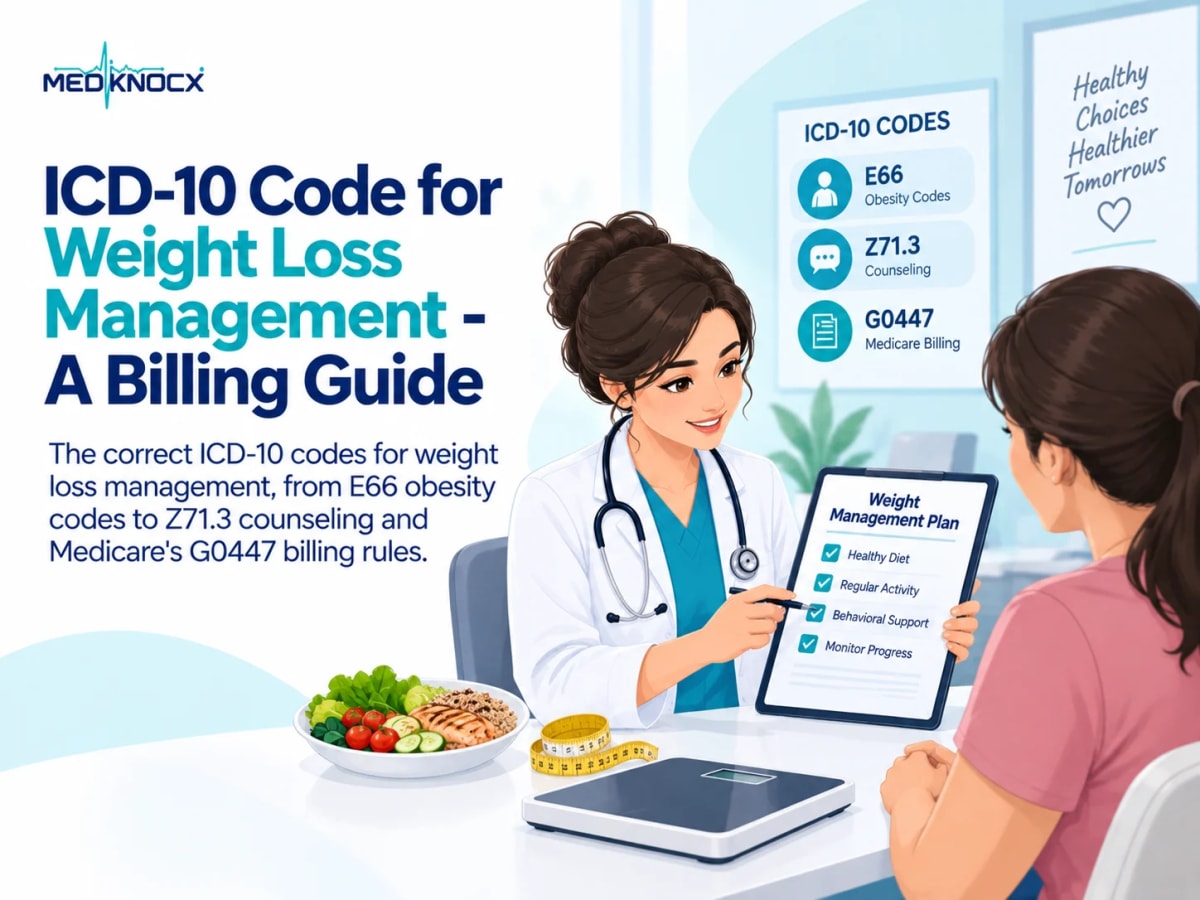
There is no single ICD-10 code for weight loss management. Most encounters draw from three code families: E66 for obesity itself, Z68 for the BMI value that supports it, and Z71.3 for the counseling visit. Which one leads the claim depends on why the patient is being seen, not just their weight, and picking the wrong one is a common source of denials.
Obesity sits in category E66, under Chapter 4 of the ICD-10-CM manual (endocrine, nutritional, and metabolic diseases). It is not one code. It is a family of related codes, and payers expect the most specific one the documentation supports, not the easiest one to find.
The FY2026 edition of this code set took effect October 1, 2025, and E66.9 stays the default only when nothing more specific is documented. A note reading simply "obese" without a BMI or class supports E66.9. A chart with a calculated BMI and a stated cause supports one of the more specific codes, and coding to that level tends to hold up better on audit.
A BMI code from the Z68 series is never billed on its own. It is a secondary code, attached to a primary diagnosis such as E66.01, to document how the obesity severity was measured.
Z71.3, dietary counseling and surveillance, covers the counseling encounter itself rather than the condition being managed. It is billable on its own claim line, but ICD-10-CM guidance still requires a code for the underlying reason the counseling is happening, whether that's obesity, diabetes, or another condition driving the dietary plan. A claim carrying Z71.3 with no linked diagnosis is incomplete documentation, and payers read it that way too.
CPT 99401-99403 cover preventive counseling billed by time (roughly 15, 30, and 45-60 minutes), and any of the three can be used for a standard weight-management counseling visit outside Medicare's specific benefit.
Medicare runs its own pathway. HCPCS G0447 covers a 15-minute, face-to-face Intensive Behavioral Therapy (IBT) session for obesity, under National Coverage Determination 210.12. It only applies when the patient's BMI is 30 kg/m2 or higher, documented with a Z68.30-Z68.39 or Z68.41-Z68.45 code, and delivered by a primary care provider in a primary care setting.
The visit schedule is specific and worth documenting up front: weekly in month one, every other week through month six, then monthly through month twelve, but only if the patient has lost at least 3 kg (6.6 lb) by the six-month reassessment. Medicare allows up to 22 of these visits in a 12-month period. Billing past that frequency, or without the qualifying BMI code attached, is one of the more preventable reasons these claims come back denied.
Four patterns account for most of the denials our denial management team sees on these claims.
1. Defaulting to E66.9 when the chart actually supports a class-specific code. Payers increasingly flag unspecified codes for review when a BMI is already on file.
2. Billing G0447 without the matching Z68 code. Medicare's claims edits check for this pairing automatically, and a mismatch is an easy denial to avoid.
3. Exceeding the 22-visit annual limit, or continuing monthly visits past month six without documenting the required 3 kg weight loss reassessment.
4. Billing Z71.3 as a standalone diagnosis, with no linked condition explaining why the counseling was medically necessary.
Each of these is a documentation gap rather than a coding error, which is why practices that route weight-management visits through consistent medical coding review tend to see fewer of these claims bounce back in the first place.
This is where a lot of coders trip up. Everything above assumes the visit is about managing obesity or overweight status on purpose. If a patient is losing weight unintentionally, the code changes entirely: R63.4 (abnormal weight loss) applies instead, and it typically points toward a workup for the underlying cause rather than a counseling program.
Mixing the two up on a chart, coding R63.4 for a patient who is actively trying to lose weight, or coding E66 for a patient with unexplained wasting, is a documentation error that can delay both the correct treatment path and the claim. Practices managing patients through longer weight-management programs, where progress is tracked over several visits, often fold that tracking into chronic care management billing rather than one-off counseling codes, which keeps the coding consistent across the whole course of care.
• CMS, ICD-10-CM official code files, FY2026 edition, effective October 1, 2025
• CMS National Coverage Determination 210.12, Intensive Behavioral Therapy for Obesity (G0447)
E66.9 (obesity, unspecified) is the default when documentation doesn't support a more specific code, but E66.01 (morbid obesity due to excess calories) is the most common specific diagnosis in general practice.
Not always, but it's required for Medicare's G0447 counseling benefit, and it strengthens the claim for commercial payers by supporting the severity documented in the diagnosis code.
Z71.3 can stand for the counseling encounter, but coding guidance calls for an additional code identifying the condition the counseling addresses, so it shouldn't be the only code on the claim.
Up to 22 face-to-face IBT visits under G0447 in a 12-month period, following the weekly, biweekly, then monthly schedule tied to the six-month weight loss reassessment.
No. Obesity and overweight status use the E66 family. Unintentional weight loss uses R63.4, a different clinical picture that usually triggers a diagnostic workup rather than a counseling program.
Explore more medical billing guides, coding updates, and revenue cycle tips.
Learn how physician assistant billing works, including Medicare billing, NPI requirements, incident-to billing...

Learn how to bill CPT code 90837, including 60-minute psychotherapy time requirements, documentation, teleheal...
Learn what POS 02 means in medical billing, when to use it for telehealth, how it differs from POS 10, and com...