Healthcare
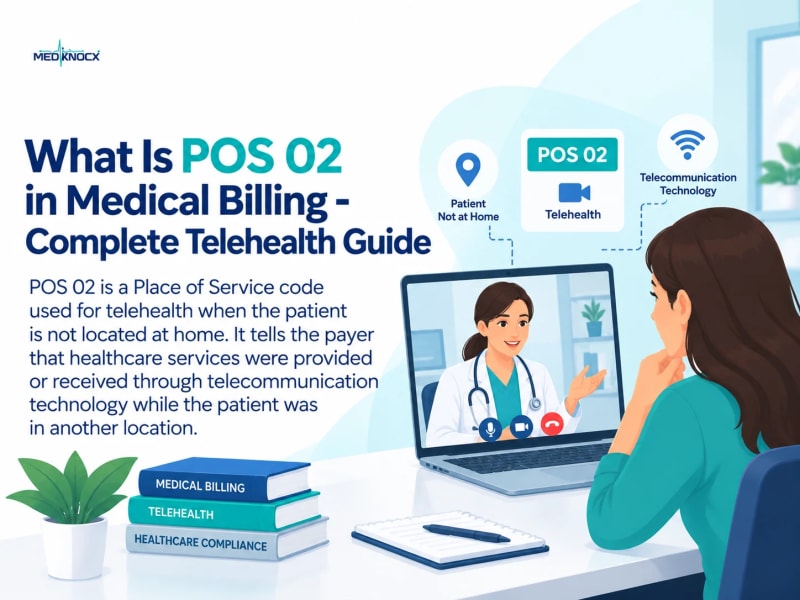
What Is POS 02 in Medical Billing - Complete Telehealth Guide
Learn what POS 02 means in medical billing, when to use it for telehealth, how it differs from POS 10, and com...

Sep 18, 2026
1 min read

Jordan Taylor
September 19, 2026
Table of Contents
3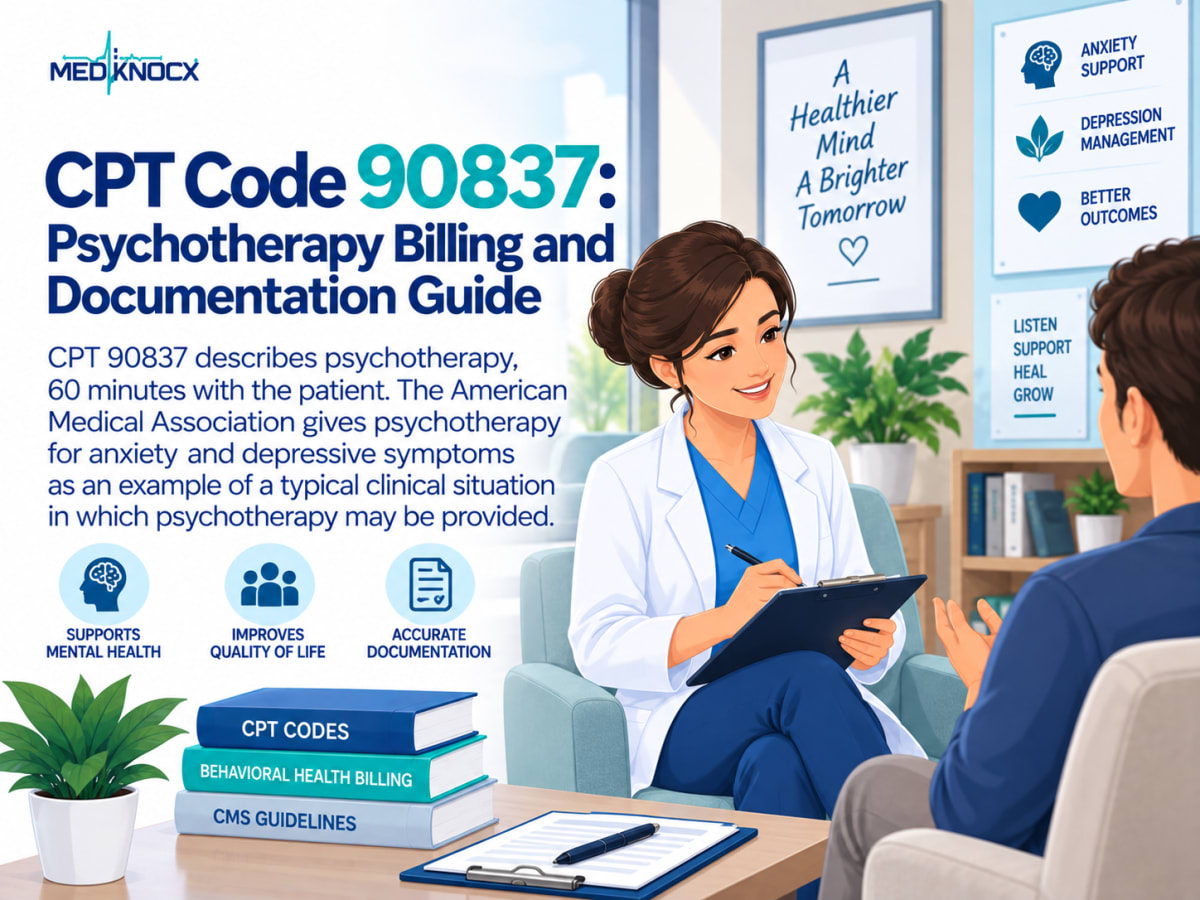
CPT 90837 is used for individual psychotherapy at the 60-minute level. For Medicare, CMS uses time ranges when selecting psychotherapy codes, with 53 minutes or more supporting 90837.
Accurate 90837 billing requires more than a 60-minute appointment. The clinical record should support the actual psychotherapy time, medical necessity, treatment provided, provider eligibility, diagnosis, and payer requirements.
This guide explains 90837 billing, documentation, modifiers, place of service, telehealth, related psychotherapy codes, and common denial risks.
CPT 90837 represents individual psychotherapy, 60 minutes.
For Medicare, CMS identifies these psychotherapy time ranges:
CMS instructs providers to report the psychotherapy code that corresponds to the actual documented time.
The important point is that a session scheduled for 60 minutes does not automatically justify 90837.
The American Medical Association's CPT 90837 guide provides the official code description and a clinical example of psychotherapy for anxiety and depressive symptoms. AMA CPT Code 90837 Guide.
Time is one of the most important elements of 90837 billing.
For Medicare, 53 minutes or more falls within the 90837 range.
A therapist provides psychotherapy from:
2:05 PM to 3:00 PM
Actual psychotherapy time:
55 minutes
This falls within the Medicare 90837 range.
Now consider:
Scheduled appointment: 60 minutes
Actual psychotherapy: 49 minutes
Under Medicare's published ranges, 49 minutes falls within 90834, not 90837.
The billing team should therefore validate the documented service time instead of relying only on the appointment schedule.
The record should support the psychotherapy service actually furnished to the patient.
A practical workflow is:
Document the psychotherapy start time when required.
Document the end time when required.
Calculate the actual psychotherapy duration.
Document the therapeutic interventions.
Connect the intervention to the patient's condition.
Select the CPT code supported by the service.
When psychotherapy is performed with an E/M service, psychotherapy time should be distinguished from the E/M portion. CMS identifies separate psychotherapy add-on codes for psychotherapy performed with E/M.
The key principle is simple:
Do not use scheduled time as a substitute for documented psychotherapy time.
The code should follow the documented service rather than reimbursement expectations.
Provider eligibility is an important part of claim accuracy.
For Medicare, psychotherapy services must be performed by practitioners who are authorized by Medicare and permitted under applicable state law to provide the service. CMS guidance recognizes provider categories such as clinical psychologists, clinical social workers, nurse practitioners, clinical nurse specialists, marriage and family therapists, and mental health counselors, subject to applicable Medicare rules and scope-of-practice requirements.
For example, CMS coverage guidance lists 90837 among the psychotherapy services that can be furnished by qualifying clinical psychologists and clinical social workers, while MFTs and MHCs became eligible for Medicare mental health services beginning January 1, 2024, subject to the applicable requirements.
Before billing, verify:
Provider Medicare enrollment status
State license
Scope of practice
Payer credentialing
Rendering provider information
NPI
Taxonomy
Contract participation
Applicable supervision or incident-to rules
Commercial payer rules can differ from Medicare, so provider eligibility should be checked against the specific payer contract.
A strong psychotherapy note should demonstrate:
Diagnosis or clinical condition
Relevant symptoms
Functional impact
Treatment goals
Psychotherapy interventions
Patient response
Progress or barriers
Medical necessity
Session duration
Follow-up or treatment plan when applicable
Weak documentation might say:
"Patient discussed anxiety. Therapy provided."
A stronger record identifies what was addressed, what intervention was used, how the patient responded, and how the service relates to the treatment plan.
The goal is not to create unnecessarily long notes.
The goal is to create clinically meaningful and auditable documentation.
Time alone does not establish medical necessity.
CMS coverage guidance states that psychotherapy must be medically reasonable and necessary for the patient's psychiatric illness or emotional or behavioral condition. The type, frequency, and duration of treatment should be appropriate for the condition.
For example, a patient with depression may have:
Persistent symptoms
Impaired daily functioning
Difficulty maintaining employment
Reduced social functioning
The therapist may provide structured psychotherapy addressing cognitive patterns, behavioral activation, coping strategies, and treatment goals.
The documentation should connect those interventions to the patient's condition.
Modifiers should not be added automatically.
Before submitting a claim, verify:
Whether the payer requires a modifier
Whether the service was provided through telehealth
Whether the modifier applies to the specific CPT
Whether the payer recognizes the modifier
Whether documentation supports the billing circumstances
Whether the modifier conflicts with other claim information
A modifier should describe a legitimate billing circumstance. It should not be used simply to overcome an edit or increase reimbursement.
90785 is an interactive complexity add-on CPT code, not a modifier.
CMS permits 90785 with certain psychotherapy services, including 90832, 90834, 90837, 90833, 90836, 90838, and 90853, when the circumstances meet the applicable requirements.
Examples of interactive complexity can include:
Significant communication difficulties
Caregiver behavior interfering with treatment
Required participation of a third party
Certain language barriers
Communication circumstances that complicate delivery of care
90785 should not be added simply because a patient was difficult or the session was complicated.
CMS also states that 90785 should not be reported with crisis codes 90839 or 90840.
When psychotherapy is performed with an E/M service, CMS identifies psychotherapy add-on codes:
90833 with E/M
90836 with E/M
90838 with E/M
CMS does not treat E/M codes alone as including psychotherapy. The psychotherapy and E/M services must be appropriately supported and separately identifiable.
Therefore, do not simply combine an E/M code with 90837 because the appointment lasted an hour.
90837 should not replace family psychotherapy codes.
90846 represents family psychotherapy without the patient present.
90847 represents family psychotherapy with the patient present.
CMS identifies both as family psychotherapy services for the treatment of mental disorders. They should not be used simply for taking a family history or providing E/M counseling.
The treatment format should therefore be established before selecting the CPT code.
90853 represents group psychotherapy other than multiple-family group psychotherapy.
It is different from individual psychotherapy billed with 90837.
The record should support:
Group psychotherapy was actually provided
Therapeutic purpose
Patient participation
Clinical condition
Intervention or treatment focus
Medical necessity
CMS also recognizes that 90785 may be reported with 90853 when medically indicated.
90849 represents multiple-family group psychotherapy.
It should be distinguished from:
90837: Individual psychotherapy
90846: Family psychotherapy without patient
90847: Family psychotherapy with patient
90853: Group psychotherapy
The treatment format and clinical purpose should determine the code selection.
Crisis psychotherapy uses different codes.
90839: Psychotherapy for crisis, first 60 minutes
90840: Each additional 30 minutes with 90839
CMS identifies these as crisis psychotherapy services.
The distinction is clinical, not simply based on session duration.
A 60-minute routine psychotherapy session is not automatically crisis psychotherapy.
Likewise, a patient having serious symptoms does not automatically make a routine psychotherapy session a crisis service.
CMS states that crisis codes should not be reported with psychotherapy codes 90832 through 90838.
Place of service should accurately identify where the service was provided.
CMS's professional POS code set includes:
CMS says POS codes on professional claims identify the location where services were rendered and advises providers to check individual payer policies.
When psychotherapy is provided in a standard physician or behavioral health office, POS 11 may describe the service location when applicable.
For Medicare professional telehealth claims:
POS 02 = patient is receiving telehealth somewhere other than their home
POS 10 = patient is receiving telehealth in their home
CMS's 2026 telehealth FAQ confirms these POS options.
Do not select POS based only on the CPT code.
The billing team should consider:
Where was the patient? + Where was the service delivered? + Was it telehealth? + What does the payer require?
Commercial payer rules may differ from Medicare, so the payer's current billing policy should be checked before submission.
CMS currently recognizes 90837 among behavioral health services included in its telehealth-related code lists.
For telehealth claims, verify:
Patient location
Provider location
POS
Required modifier
Payer telehealth policy
Licensure requirements
Documentation requirements
CMS also states that telehealth practitioners must be authorized under applicable state law to furnish the service.
Do not apply one universal telehealth modifier or POS combination to every payer.
There is no single universal reimbursement rate for 90837.
Payment can vary according to:
Medicare locality
Commercial payer
Medicaid program
Provider contract
Place of service
Telehealth rules
Allowed amount
Deductible and coinsurance
Payer fee schedule
For RCM analysis, the actual payer allowed amount is more useful than a generic online reimbursement estimate.
Under Medicare's published psychotherapy ranges, 50 minutes falls within 90834.
A 60-minute calendar appointment does not automatically establish 60 minutes of psychotherapy.
The note does not demonstrate the intervention, response, medical necessity, or time.
90785 is an add-on CPT code.
Psychotherapy and E/M services must be appropriately distinguished.
Crisis psychotherapy has 90839 and 90840.
Family psychotherapy uses 90846 or 90847 when applicable.
Group psychotherapy uses 90853 when applicable.
Telehealth POS should reflect the patient's location and applicable payer rules.
A correctly selected CPT can still create a claim problem when the rendering provider is not eligible or properly credentialed for the service.
Before submitting a claim, review:
Correct rendering provider
Active enrollment
State license
Scope of practice
Credentialing
NPI and taxonomy
Diagnosis documented
Medical necessity established
Treatment plan supported
Intervention documented
Patient response documented
Actual psychotherapy time documented
CPT matches documented duration
Correct CPT
Correct diagnosis
Modifier verified
E/M separately supported when applicable
Related psychotherapy code ruled out
Actual service location verified
Telehealth status verified
POS verified
Payer-specific requirements checked
Patient eligibility checked
Authorization checked
NPI verified
Payer information correct
A strong RCM workflow should validate the claim before submission:
Eligibility → Provider validation → Documentation → Time validation → CPT validation → Diagnosis → Modifier/POS → Payer edits → Claim submission → ERA → Denial analysis
Track denial root causes, not just denial volume.
This creates a feedback loop between clinicians, coders, and billing teams.
A patient receives individual psychotherapy for a documented behavioral health condition.
The therapist records:
55 minutes of psychotherapy
Relevant symptoms
Treatment goals
Psychotherapy interventions
Patient response
Medical necessity
Under Medicare's published time range, the documented 55-minute psychotherapy service falls within 90837.
Now consider another session:
Scheduled: 60 minutes
Actual psychotherapy: 49 minutes
Under Medicare's time range, the service falls within 90834.
This illustrates why actual documented psychotherapy time matters more than the calendar appointment length.
CPT 90837 is used for individual psychotherapy at the 60-minute level, but accurate billing depends on more than the scheduled appointment length. For Medicare, 53 minutes or more supports 90837 when the documented service meets the applicable requirements.
Providers and billing teams should verify the actual psychotherapy time, medical necessity, clinical documentation, provider eligibility, CPT code, modifier, and place of service before submitting a claim. Telehealth services also require careful review of the patient's location and payer-specific requirements.
For related behavioral health billing, see our guide to CPT Code 90791 and psychiatric diagnostic evaluation. Practices can also review our medical billing services for small practices to learn more about claim processing and denial prevention.
A strong 90837 billing workflow connects clinical documentation → time validation → coding → claim review → payer submission → denial analysis. This helps behavioral health practices reduce avoidable denials and maintain accurate reimbursement.
90837 represents psychotherapy at the 60-minute level. Medicare's published time guidance uses 53 minutes or more for 90837.
For Medicare, 53 minutes or more supports 90837 under CMS psychotherapy time guidance. Other payers may have different requirements.
Eligible Medicare practitioners can include qualifying clinical psychologists, clinical social workers, nurse practitioners, clinical nurse specialists, marriage and family therapists, and mental health counselors, subject to Medicare rules, state scope of practice, and enrollment requirements.
For Medicare, 90834 covers 38–52 minutes and 90837 covers 53 minutes or more.
POS depends on where the service occurs. POS 11 represents office services. For Medicare telehealth, POS 02 applies when the patient is not at home, while POS 10 applies when the patient is at home.
Yes, when the service is eligible and all applicable Medicare, state, and payer requirements are met. CMS includes 90837 among behavioral health codes in its telehealth materials.
No. 90785 is an interactive complexity add-on CPT code. It may be reported with 90837 when the clinical circumstances satisfy the requirements.
Psychotherapy with E/M is reported using the appropriate E/M code plus the applicable psychotherapy add-on code, such as 90838 at the 60-minute psychotherapy level.
Common causes include unsupported time, medical necessity issues, provider eligibility, incorrect POS, modifier problems, authorization issues, diagnosis mismatches, and payer-specific billing edits.
Explore more medical billing guides, coding updates, and revenue cycle tips.
Learn what POS 02 means in medical billing, when to use it for telehealth, how it differs from POS 10, and com...
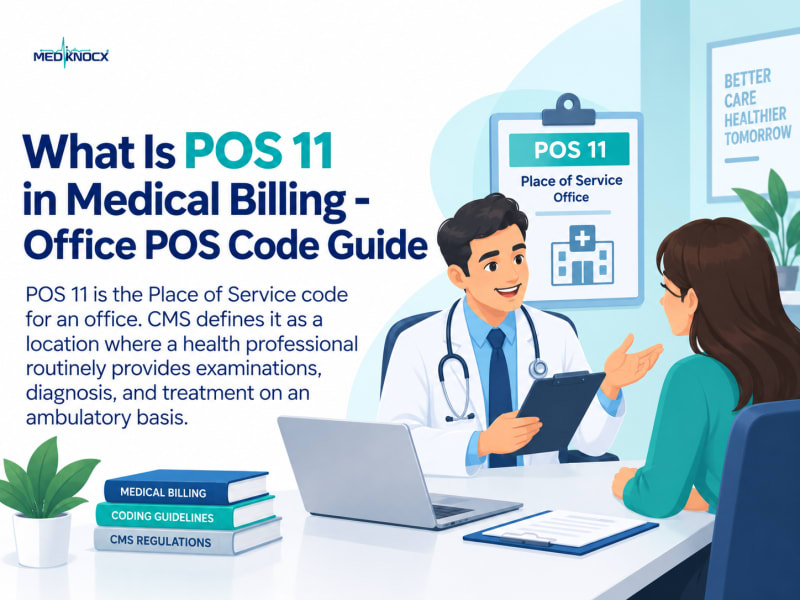
Learn what POS 11 means in medical billing, when to use the office POS code, how it affects claims, and common...

Learn what POS 12 means in medical billing, when to use it, home visit CPT codes, POS 10 vs 12, documentation ...