Healthcare

CPT Code 90837: Psychotherapy Billing and Documentation Guide
Learn how to bill CPT code 90837, including 60-minute psychotherapy time requirements, documentation, teleheal...

Sep 19, 2026
1 min read

Jordan Taylor
September 21, 2026
Table of Contents
24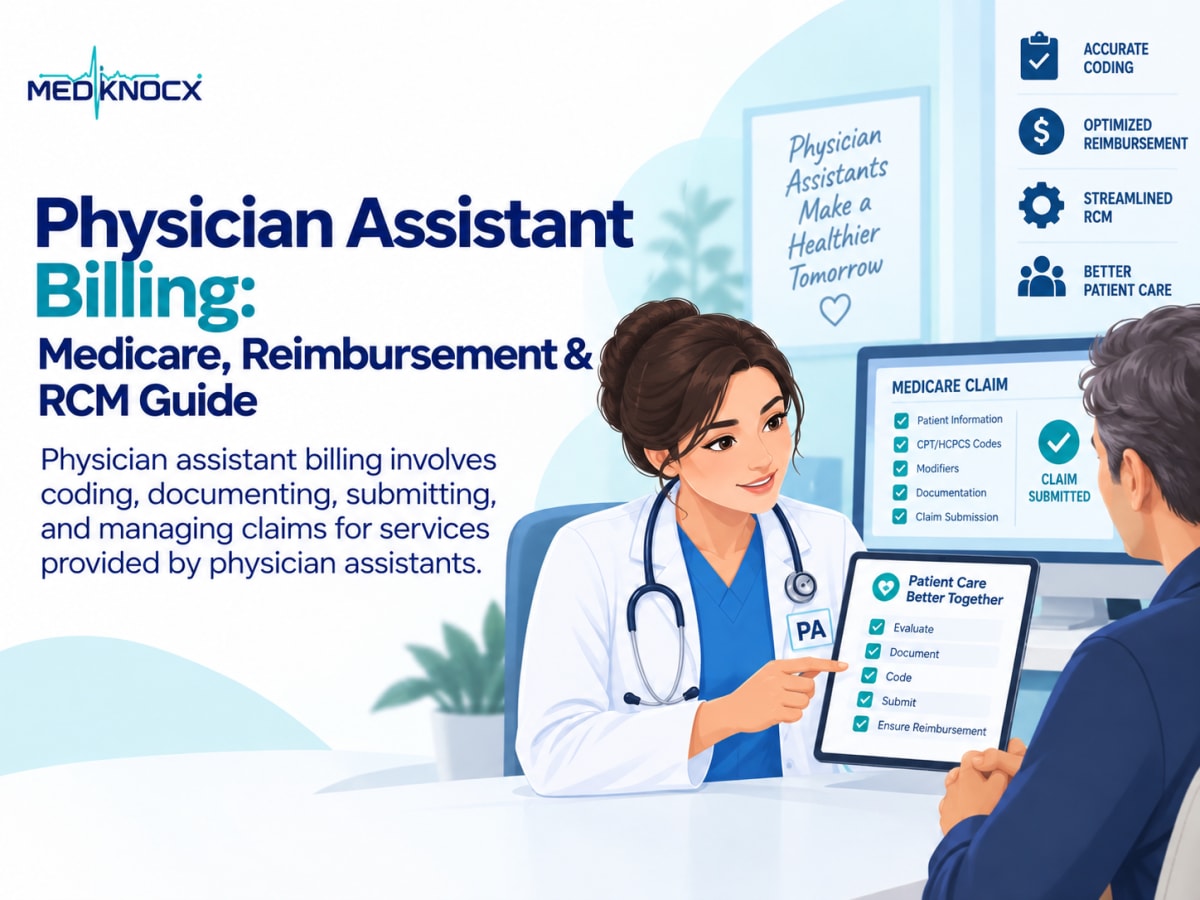
As healthcare organizations continue to rely on advanced practice providers (APPs), physician assistants (PAs) play an important role in delivering care across primary care, urgent care, surgery, and specialty settings. As PA services continue to expand, accurate billing and reimbursement have become important parts of an effective healthcare revenue cycle.
Physician assistants are nationally certified and state-licensed medical professionals who provide diagnostic, therapeutic, and preventive care. Their scope of practice can vary by state law, payer requirements, and the healthcare setting where services are provided. PAs may evaluate patients, diagnose conditions, order tests, prescribe medications where permitted, and manage treatment plans.
From a billing perspective, physician assistant billing involves documenting services, selecting appropriate CPT and HCPCS codes, reporting applicable modifiers and diagnosis codes, submitting claims, and managing reimbursement. How a PA service is billed can depend on factors such as Medicare rules, the place of service, the PA's enrollment status, payer requirements, and whether the service qualifies for direct billing or incident-to billing.
In this guide, we explain physician assistant billing, including Medicare billing, PA reimbursement, incident-to billing, documentation requirements, CPT codes, telehealth, chronic care management, and revenue cycle management.
A typical physician assistant billing workflow looks like this:
Patient Visit → Documentation → CPT/HCPCS → ICD-10-CM → NPI → POS → Modifier → Claim Submission → Adjudication → Payment or Denial
Each step affects claim accuracy.
For example, the PA may document an established patient visit. The coding team reviews the documentation and selects the appropriate CPT code. The claim then includes the diagnosis, rendering provider information, place of service, and any applicable modifiers.
The claim is submitted to the payer for adjudication.
If the payer approves the claim, the practice receives payment based on the applicable fee schedule or contract. If the claim is denied, the billing team reviews the denial and determines the appropriate correction or appeal.
Yes. Eligible physician assistants can bill Medicare for covered services using their own NPI. For current Medicare eligibility, billing, and payment rules, see the CMS Physician Assistant billing guidelines.
CMS allows PAs to:
Use their NPI to bill their services
Allow an employer or contractor to use their NPI for reassigned services
Provide services subject to Medicare's medical necessity requirements
Bill applicable services within their scope of practice
The PA must meet applicable Medicare enrollment and eligibility requirements.
CMS also requires providers who bill Medicare directly to enroll in the program and obtain an NPI.
Before billing Medicare, a PA should have:
NPI
Medicare enrollment
Appropriate state license
Eligible provider status
Correct practice information
Correct taxonomy
Payer enrollment
Applicable reassignment information
A practice should verify enrollment before submitting claims.
A correctly coded claim can still create a billing problem if the rendering provider is not properly enrolled.
Medicare payment depends on the service, setting, and applicable payment rules.
CMS states that, for services provided outside hospital and skilled nursing facility settings, Medicare pays PA services at 80% of the lesser of the actual charge or 85% of the amount a physician receives under the Medicare Physician Fee Schedule.
This means it is not accurate to simply say that every PA service receives an "85% reimbursement rate."
Payment can vary based on:
Service
Place of service
Medicare fee schedule
Actual charge
Facility status
Payer rules
Contract terms
Hospital and SNF services can follow different payment rules. CMS states that it pays PAs directly under the Physician Fee Schedule for applicable hospital services.
Medicare provides different billing pathways for services performed by physician assistants.
Two important concepts are direct billing and incident-to billing.
The PA bills for services they personally provide using the applicable billing information and their NPI.
This is generally appropriate when the service does not qualify for incident-to billing or when the PA is the appropriate billing practitioner.
Incident-to billing allows certain services provided by a PA or other non-physician practitioner to be billed under the supervising physician's NPI when specific Medicare requirements are met.
CMS requires incident-to services to be part of the patient's normal treatment, follow an initial service and plan of care established by the physician or another qualifying practitioner, and meet applicable supervision and setting requirements.
The distinction matters because incorrect incident-to billing can result in claim denials or compliance concerns.
Incident-to billing is a Medicare billing method that allows qualifying services provided by a PA to be reported under a supervising physician or other eligible practitioner's NPI.
The rules are specific.
CMS states that incident-to services must:
Be an integral part of the patient's normal treatment
Follow an initial service provided by the physician or qualifying practitioner
Remain part of an active treatment plan
Be commonly provided in the physician's office or clinic
Meet applicable supervision requirements
Comply with state law
The supervising practitioner who meets the applicable requirements is responsible for the billing.
A physician evaluates a patient with hypertension and establishes a treatment plan.
The patient later returns for follow-up care provided by a PA.
If the service meets all applicable incident-to requirements, the practice may be able to bill the service under the supervising physician's NPI.
However, if the PA evaluates a new problem that is not part of the existing treatment plan, the service may not qualify for incident-to billing.
The PA may need to bill under their own NPI instead.
Incident-to billing is not a universal billing option for every PA service.
For example, a new patient or a new medical problem may not meet the requirements for incident-to billing.
AAFP explains that a new problem for an established patient may require the PA to bill under the PA's own NPI rather than using incident-to billing.
Incident-to billing also has setting restrictions.
CMS's incident-to guidance identifies office and clinic settings and specific supervision requirements.
Practices should therefore verify:
Patient status
Existing treatment plan
Nature of the condition
Supervising practitioner
Service location
Supervision
State law
Payer rules
The correct billing method depends on the actual service and whether all applicable requirements are satisfied.
A successful PA billing process begins before the claim reaches the payer.
The PA should have:
Valid professional credentials
State authorization to practice
NPI
Medicare enrollment when applicable
Payer credentialing
Correct taxonomy
Appropriate practice information
The medical record should support:
Reason for the encounter
Relevant symptoms
Assessment
Medical necessity
Services performed
Treatment plan
Patient response when applicable
Follow-up plan
The claim may require:
CPT or HCPCS code
ICD-10-CM diagnosis
NPI
Place of service
Modifiers
Units
Date of service
Payer information
CMS applies reasonable and necessary standards to services billed by PAs. The record should identify the signs, symptoms, or complaints supporting medical necessity.
There is no single CPT code set exclusively for physician assistants.
PAs report CPT and HCPCS codes that describe the services they provide within their scope of practice.
Common service categories can include:
Evaluation and management
Preventive services
Procedures
Care management
Chronic care management
Telehealth services
Surgical assistance
Other covered professional services
The CPT code should match the actual service and documentation.
A PA should not select a code simply because it produces a higher reimbursement amount.
The documentation should support the service reported on the claim.
Documentation is one of the most important parts of the billing process.
A strong record connects the patient's condition to the service provided.
Depending on the service, documentation may include:
Patient complaint
Relevant history
Clinical findings
Assessment
Diagnosis
Medical necessity
Treatment provided
Procedures performed
Treatment response
Plan
Follow-up
Provider identity
Date of service
For incident-to services, documentation must also support the requirements of the incident-to arrangement.
Poor documentation can create problems even when the CPT and diagnosis codes are technically correct.
Medical necessity explains why the service was appropriate for the patient's condition.
CMS requires PA services to meet applicable reasonable and necessary standards.
For example, a patient may visit a PA for management of diabetes and hypertension.
The record should show the relevant clinical condition, evaluation, treatment decisions, and medical reasoning supporting the service.
A note that only states:
"Follow-up completed."
may not provide enough information to support the full service reported.
The documentation should describe the actual care provided.
Physician assistants can also play a role in chronic care management.
This creates an important connection between PA billing and CCM billing.
Chronic Care Management can involve:
Care plan development
Care coordination
Medication management
Communication with patients
Coordination with other providers
Follow-up activities
Clinical staff services
Monthly billing requirements
CMS's incident-to guidance specifically addresses general supervision for clinical staff providing services and supplies incident to Chronic Care Management.
For practices using PAs in ongoing care management, billing workflows should clearly distinguish the PA's professional services from services provided by clinical staff.
Practices can also review Chronic Care Management and Principal Care Management Billing Services for support with care-management billing workflows.
Advanced Primary Care Management, or APCM, is another relevant area for physician assistant billing.
CMS states that beginning January 1, 2025, eligible non-physician practitioners, including physician assistants, can bill APCM services when the applicable requirements are met.
APCM is designed around ongoing primary care rather than individual time-based care management services.
To bill APCM, the eligible practitioner must meet requirements such as:
Responsibility for the patient's primary care
Serving as the focal point for the patient's healthcare
Patient consent
Applicable service requirements
CMS allows APCM billing once per patient per calendar month.
This makes APCM an important topic for practices using PAs in primary care and care coordination.
PA billing rules can change depending on where the service occurs.
Office-based services may use the applicable office POS code.
Incident-to billing can also apply in certain office settings when all Medicare requirements are satisfied.
Hospital services follow different rules from office-based incident-to services.
CMS states that it pays PAs directly under the Physician Fee Schedule for applicable hospital services.
SNF billing requires careful attention to the facility's status, patient coverage, and applicable Medicare rules.
Split/shared E/M billing can apply in institutional settings when both the physician and PA contribute to the service and the requirements are satisfied.
For telehealth services, the billing team should verify:
Patient location
Provider location
Place of service
Modifier
Payer requirements
Licensure
Documentation
Do not apply the same telehealth billing configuration to every payer.
Place of Service codes tell the payer where the professional service occurred.
Common POS codes can include:
The billing team should select the POS based on the actual service setting and payer requirements.
This becomes particularly important when deciding between office, telehealth, hospital, and nursing facility billing.
Modifiers describe specific circumstances surrounding a service.
There is no single modifier that applies to every PA claim.
Depending on the service, billing teams may need to review:
Modifier 25
Modifier 59
Modifier 95
Modifier AS
Other payer-specific modifiers
The AS modifier is particularly relevant to certain assistant-at-surgery services performed by PAs.
CMS should be checked for current Medicare requirements before using a modifier.
A modifier should never be added simply to bypass a payer edit.
PAs may assist surgeons during eligible procedures.
Medicare has specific payment rules for assistant-at-surgery services.
CMS states that it pays PAs directly for eligible assistant-at-surgery services at 85% of 16% of the amount a physician receives under the Physician Fee Schedule.
The claim should include the applicable procedure information and modifier requirements.
The billing team should also verify whether Medicare allows an assistant at surgery for the specific procedure.
Split/shared billing is different from incident-to billing.
It generally applies to E/M services provided jointly by a physician and another eligible practitioner in an institutional setting.
AAFP identifies settings such as:
Inpatient hospitals
Hospital outpatient departments
Emergency departments
Skilled nursing facilities
as settings where split/shared E/M services can apply under Medicare requirements.
For these services, the practitioner who performs the substantive portion of the encounter determines who bills the service under current Medicare rules.
When total time is used, more than half of the total time is used to determine the substantive portion.
This is different from office-based incident-to billing.
The claim may contain the wrong rendering provider NPI.
A PA may provide the service but lack the required payer enrollment.
The practice may bill incident-to even though the service involves a new problem or does not meet the applicable requirements.
The POS may not match where the service was provided.
A required modifier may be missing or incorrectly reported.
The record may not support medical necessity or the reported service.
The selected CPT may not match the actual service.
The practice may assume that every PA service receives the same payment percentage.
The payer may have outdated provider information.
The POS, modifier, patient location, or payer requirements may be incorrect.
A denied PA claim should be analyzed beyond the individual claim.
Look for patterns.
The goal should be to identify the root cause rather than repeatedly correct the same type of denial.
A strong PA revenue cycle should connect clinical operations with billing controls.
Check patient coverage before services are provided.
Keep NPI, credentialing, payer enrollment, and practice information current.
Make sure the record supports the service and medical necessity.
Confirm CPT, HCPCS, ICD-10-CM, modifiers, and POS.
Run claims through pre-submission edits.
Send complete and accurate claims to the correct payer.
Review payment and denial information.
Track unpaid and underpaid claims.
Identify recurring problems and improve the workflow.
This approach turns PA billing into a complete revenue cycle process rather than a simple claim submission task.
Physician assistant practices may need support across several parts of the revenue cycle.
A medical billing partner can help with:
Eligibility verification
Medical coding
Provider credentialing
Payer enrollment
Claim submission
Claim scrubbing
Payment posting
Denial management
A/R follow-up
Medicare billing
Commercial payer billing
CCM billing
PCM billing
APCM billing
Reporting
The exact services required depend on the practice, specialty, payer mix, and billing volume.
A practical PA billing workflow can be summarized as:
Provider Enrollment
↓
Patient Eligibility
↓
Clinical Documentation
↓
CPT/HCPCS Coding
↓
ICD-10-CM Coding
↓
NPI Validation
↓
POS and Modifier Review
↓
Claim Scrubbing
↓
Payer Submission
↓
Adjudication
↓
ERA/EOB Review
↓
Payment Posting
↓
Denial Management
↓
A/R Follow-Up
This workflow helps connect clinical documentation with reimbursement.
Final Takeaway
Physician assistant billing involves much more than submitting a CPT code. Accurate billing depends on provider enrollment, NPI reporting, medical necessity, documentation, coding, place of service, modifiers, payer rules, and the correct Medicare billing pathway.
For Medicare, eligible PAs can bill using their own NPI. Certain services may also qualify for incident-to billing when the required treatment plan, supervision, setting, and other requirements are met.
PA billing also connects with newer care-management models. Eligible physician assistants can bill APCM services under applicable Medicare requirements, while PA involvement in CCM requires careful attention to the applicable care-management billing rules.
For practices managing ongoing patient care, our Chronic Care Management and Principal Care Management Billing Services can provide a relevant next step for reviewing care-management billing workflows.
A strong PA revenue cycle connects provider enrollment → documentation → coding → claim submission → adjudication → payment → denial management. Reviewing this process regularly can help practices identify recurring billing problems and improve claim accuracy.
Yes. Eligible PAs can use their own NPI to bill Medicare for covered services. They must meet applicable enrollment, licensing, scope-of-practice, and billing requirements.
Yes. CMS allows physician assistants to use their NPI to bill their services. Employers and contractors can also use the PA's NPI for reassigned services.
Incident-to billing allows qualifying PA services to be billed under a supervising physician or other eligible practitioner's NPI when Medicare's requirements are satisfied. These requirements include an established treatment plan, applicable supervision, and appropriate service setting.
Generally, incident-to billing does not apply when the service involves a new patient or a new problem that is not part of an established treatment plan. The PA may need to bill under their own NPI.
With direct billing, the PA bills for their own eligible service using the applicable provider information. With incident-to billing, a qualifying service can be billed under the supervising practitioner's NPI when the Medicare requirements are met.
For applicable services outside hospital and SNF settings, CMS states that Medicare pays 80% of the lesser of the actual charge or 85% of the physician PFS amount. Payment rules can differ by setting and service.
Yes. CMS states that eligible PAs can bill Advanced Primary Care Management services beginning January 1, 2025, when the applicable requirements are met.
Documentation should support the patient's condition, medical necessity, service provided, diagnosis, treatment, provider identity, and other requirements applicable to the service and payer.
PAs may provide eligible telehealth services when the service, provider, patient, state, and payer requirements are satisfied. The billing team should verify the current POS, modifier, licensure, and payer rules before submission.
Explore more medical billing guides, coding updates, and revenue cycle tips.
Learn how to bill CPT code 90837, including 60-minute psychotherapy time requirements, documentation, teleheal...
Learn what POS 02 means in medical billing, when to use it for telehealth, how it differs from POS 10, and com...
Learn what POS 11 means in medical billing, when to use the office POS code, how it affects claims, and common...