Healthcare

What Is POS 22 in Medical Billing - On-Campus Guide
POS 22 marks on-campus hospital outpatient services. See how it differs from POS 19 and POS 11, how split bill...

Aug 26, 2026
1 min read

Jordan Taylor
July 31, 2026
Table of Contents
1 Managing medical billing in-house can become expensive as your practice grows. Beyond staff salaries, healthcare providers must also account for software subscriptions, ongoing training, compliance requirements, claim follow-ups, and administrative overhead. These costs can reduce efficiency and impact overall profitability if not managed effectively.
This is why many healthcare organizations choose medical billing outsourcing services instead of expanding their internal billing departments. A reliable billing partner can streamline revenue cycle management, reduce claim denials, improve reimbursement timelines, and help practices focus more on patient care.
However, one question comes up before making the switch:
How much does medical billing outsourcing cost?
The answer depends on several factors, including your specialty, claim volume, practice size, billing complexity, and the pricing model offered by the billing company. While there is no universal price, understanding how medical billing companies structure their fees can help you make an informed decision and avoid unexpected expenses.
This guide explains the most common medical billing outsourcing pricing models, the factors that influence costs, the difference between flat-fee and percentage-based billing, and how to evaluate return on investment before choosing a billing partner.
By the end of this article, you will have a clear understanding of what affects medical billing outsourcing costs and how to select a solution that supports both your operational goals and long-term financial performance.
Medical billing outsourcing costs vary based on your practice's size, specialty, claim volume, and the level of support you need. Instead of offering one fixed price, most medical billing companies use flexible pricing models that align with a practice's billing workload and revenue cycle requirements.
The most common pricing structure is percentage-based billing, where the billing company charges a percentage of the revenue successfully collected. Depending on the services included and the complexity of the specialty, this typically ranges between 3% and 9% of monthly collections. Practices with higher claim volumes and cleaner billing processes often qualify for more competitive rates, while specialties with complex coding or frequent denials may fall toward the higher end of the range.
Some providers prefer a flat monthly fee, which offers predictable billing expenses regardless of monthly collections. This model is often suitable for practices with stable claim volumes and well-established workflows.
Other billing companies may charge per claim, making this option attractive for smaller practices or providers with lower patient volumes. Some organizations also offer hybrid pricing, combining a fixed monthly fee with performance-based charges for selected revenue cycle services.
The right pricing model depends on more than cost alone. Practices should evaluate what services are included, how claims are managed, reporting capabilities, denial management support, coding expertise, and the company's experience within their specialty.
While pricing is an important consideration, healthcare providers should focus on overall value rather than the lowest quote. A slightly higher fee may deliver stronger financial results if it leads to cleaner claims, fewer denials, faster reimbursements, and improved revenue cycle performance.
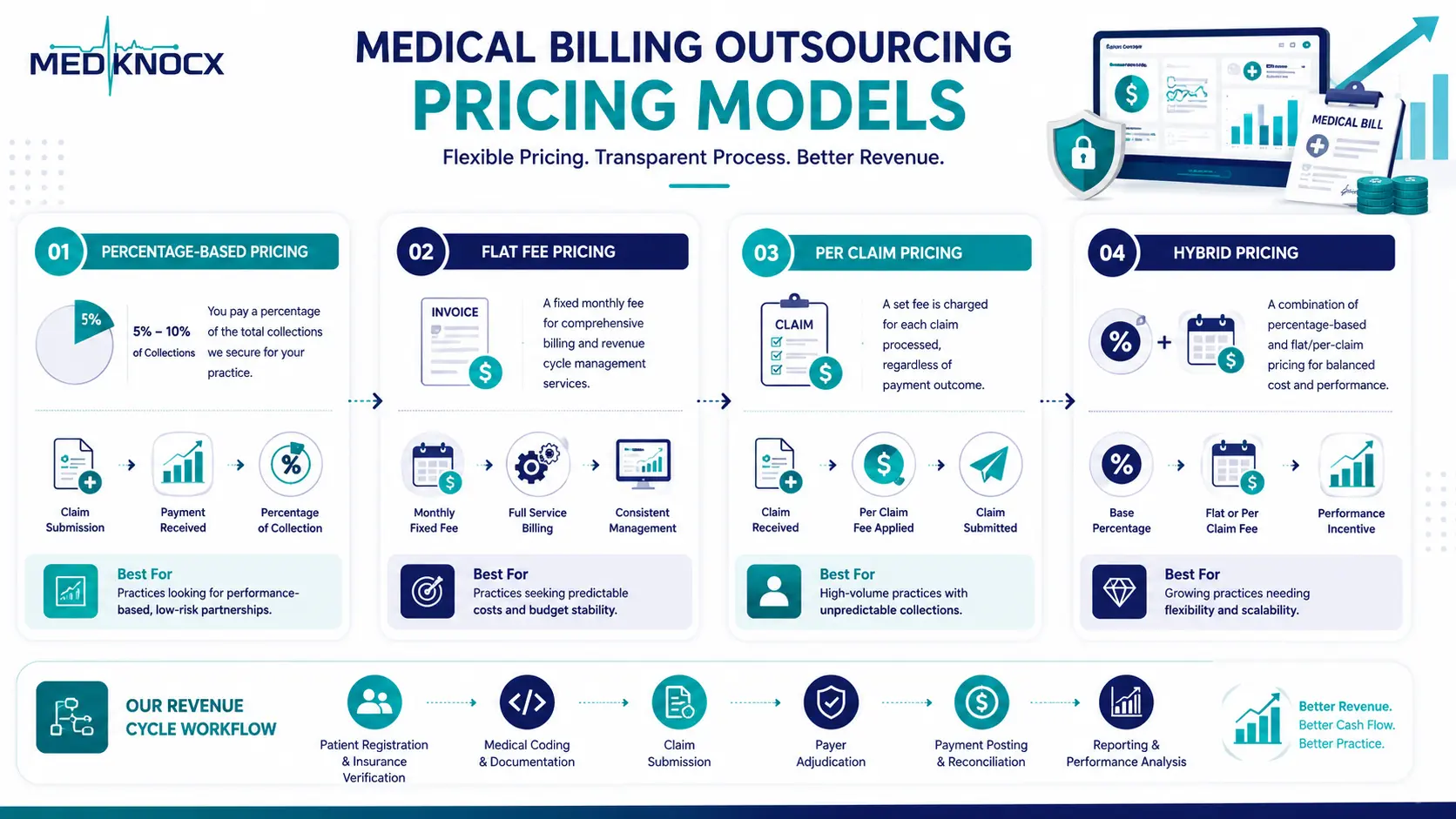
Common Medical Billing Outsourcing Pricing Models
Medical billing companies use different pricing models to meet the needs of various healthcare organizations. The right option depends on your practice size, patient volume, specialty, and revenue goals. Understanding how each model works can help you compare providers and choose a solution that delivers long-term value instead of focusing only on the lowest price.
Percentage-based pricing is the most common model in the medical billing industry. Instead of charging a fixed monthly fee, the billing company earns a percentage of the payments successfully collected from insurance companies and patients.
This model aligns the billing company's success with your practice's financial performance. When reimbursements improve, both parties benefit.
Best for:
Independent physician practices
Specialty clinics
Multi-provider practices
Organizations seeking full-service revenue cycle management
Advantages
Lower upfront costs
Performance-driven partnership
Scalable as your practice grows
Comprehensive billing support
Things to Consider
Monthly costs vary based on collections.
Review the service agreement to understand which services are included.
With a flat-fee pricing model, your practice pays the same amount every month regardless of claim volume or collections. This predictable pricing makes budgeting easier for practices with consistent patient volumes.
Best for:
Established practices
Clinics with stable monthly workloads
Organizations that prefer predictable operating expenses
Advantages
Consistent monthly billing costs
Easier financial planning
No fluctuations during high-revenue months
Things to Consider
A flat fee may not provide the same flexibility during periods of lower claim volume.
Additional services may incur separate charges.
Some medical billing companies charge a fixed amount for each claim submitted. This model is generally suitable for practices with lower patient volumes or organizations that only require claim submission rather than complete revenue cycle management. It is often considered by independent providers and medical billing services for small practices looking for predictable and scalable billing solutions.
Best for:
Small practices
New clinics
Low-volume providers
Advantages
Pay only for processed claims
Straightforward pricing
Suitable for practices with limited billing needs
Things to Consider
Costs may increase significantly as claim volume grows.
Additional revenue cycle services are often billed separately.
Hybrid pricing combines two or more billing models, such as a fixed monthly management fee plus a lower percentage of collections. Some companies also include optional services like denial management, coding audits, credentialing, or reporting for an additional fee.
This approach allows practices to customize services based on operational needs.
Best for:
Growing healthcare organizations
Multi-location practices
Clinics with complex billing workflows
Advantages
Flexible pricing structure
Customized service packages
Greater control over billing expenses
Things to Consider
Review the contract carefully to understand included services, optional fees, and billing terms.
There is no single pricing model that works for every healthcare provider. A small independent practice may benefit from per-claim or flat-fee pricing, while larger organizations often achieve better results with percentage-based billing supported by comprehensive revenue cycle management services.
Rather than comparing providers on price alone, evaluate the overall value they deliver. An experienced medical billing company that reduces claim denials, improves coding accuracy, accelerates reimbursements, and strengthens cash flow can generate a far greater return than a lower-cost provider with limited expertise.
Medical billing outsourcing costs are not determined by a single pricing formula. Two practices with similar monthly revenue may receive different quotes because their billing requirements, specialties, and operational complexity are not the same.
Understanding what influences pricing helps you compare providers fairly and choose a solution that delivers measurable value for your practice.

Practice Size
The size of your practice is one of the biggest pricing factors. A solo provider with a limited number of monthly claims typically requires fewer billing resources than a multi-provider clinic or healthcare organization.
As the number of providers, patients, and claims increases, the billing company may need additional specialists, account managers, and reporting resources to maintain performance.
Every specialty has unique coding guidelines, documentation requirements, and reimbursement challenges. Specialties with complex procedures, multiple payers, or higher denial rates often require more experienced billing professionals.
For example, cardiology, orthopedics, pain management, behavioral health, and surgery practices generally involve more complex billing workflows than primary care clinics. This additional complexity can influence outsourcing costs.
The number of claims submitted each month also affects pricing. High-volume practices often benefit from economies of scale and may qualify for more competitive rates. Lower-volume practices, on the other hand, may receive pricing based on minimum service requirements or per-claim fees.
Accurate information about your monthly claim volume allows billing companies to provide more precise pricing estimates.
Not every practice requires the same level of billing support. Some providers outsource only claim submission, while others rely on a billing partner to manage the entire revenue cycle.
Comprehensive services may include:
Insurance eligibility verification
Medical coding
Charge entry
Claims submission
Payment posting
Denial management
Accounts receivable follow-up
Patient billing
Financial reporting
A broader scope of services generally requires more resources, which can influence the overall cost.
Accurate coding is essential for clean claims and timely reimbursements. Healthcare providers rely on standardized coding systems such as Current Procedural Terminology (CPT®) to accurately report medical services and procedures. Practices that frequently report complex procedures, multiple modifiers, or specialty-specific codes often require certified coding professionals with advanced expertise. Regular medical billing and coding audit services can also help identify documentation gaps, coding errors, and compliance risks before they affect reimbursement accuracy.
Investing in experienced coding support can help reduce claim rejections, improve compliance, and minimize costly billing errors.
Practices with high denial rates or aging accounts receivable typically require additional follow-up and appeals. Recovering unpaid claims takes time, specialized knowledge, and consistent communication with insurance payers.
If your practice has a history of frequent denials, outsourcing costs may reflect the additional effort needed to improve revenue cycle performance.
Many healthcare organizations use different electronic health record (EHR) systems and practice management platforms. Integrating these systems with a medical billing company's workflow may require additional setup, data migration, staff training, or ongoing technical support.
Choosing a billing partner with experience working across multiple healthcare technologies can reduce implementation challenges and improve operational efficiency.
Healthcare providers must maintain compliance with HIPAA regulations and payer-specific billing requirements. Some practices also need customized financial reports, performance dashboards, and key revenue cycle metrics.
Advanced reporting and compliance support add value by improving financial visibility and helping practices make informed business decisions.
Key Takeaway: Medical billing outsourcing costs should be evaluated alongside the quality of service provided. A provider offering experienced billing specialists, proactive denial management, transparent reporting, and comprehensive revenue cycle support may deliver greater long-term value than a lower-priced company with limited capabilities.
One of the most important decisions when outsourcing medical billing is choosing the right pricing model. While both flat-fee and percentage-based pricing can be effective, the best option depends on your practice's size, claim volume, revenue goals, and billing complexity.
Understanding the differences between these models can help you make a more informed decision and avoid unexpected costs.
With a flat-fee model, your practice pays the same monthly amount regardless of the number of claims submitted or the revenue collected.
This pricing structure provides predictable operating costs, making it easier to plan monthly budgets. Healthcare providers know exactly what they will pay each month, even if claim volumes fluctuate slightly.
Flat-fee billing is often a good choice for practices with:
Stable patient volumes
Consistent monthly revenue
Simple billing workflows
Limited fluctuations in claim submissions
However, practices should carefully review the service agreement. Some companies charge additional fees for services such as denial management, credentialing, coding support, custom reporting, or patient billing.
Percentage-based pricing is the most widely used model because it aligns the billing company's success with your practice's financial performance.
Instead of paying a fixed monthly amount, the billing company receives an agreed percentage of the payments successfully collected.
This model encourages the billing team to focus on:
Clean claim submission
Faster reimbursements
Reduced claim denials
Timely follow-up on unpaid claims
Improved accounts receivable performance
For many healthcare providers, this creates a partnership where both parties work toward the same financial goals.
Percentage-based pricing is commonly recommended for:
Growing medical practices
Multi-provider clinics
Specialty practices
Organizations outsourcing their entire revenue cycle management
There is no universal answer. The right pricing model depends on your practice's operational needs rather than the lowest monthly cost.
If your practice has predictable billing activity and requires limited support, a flat-fee arrangement may provide greater cost certainty.
If your goal is to improve collections, reduce administrative workload, and scale your practice without expanding your internal billing team, percentage-based pricing often delivers greater long-term value because the billing company's performance is directly connected to your financial results.
When comparing medical billing companies, look beyond the pricing structure. Ask what services are included, how performance is measured, what reporting is provided, and how the company manages claim denials and payer follow-up.
A transparent pricing model combined with experienced billing professionals can produce a stronger return on investment than choosing the lowest-cost provider.
Many healthcare providers compare the cost of outsourcing medical billing with the monthly fee charged by a billing company. However, this comparison does not reflect the full financial picture. Managing billing in-house involves several direct and indirect expenses that can significantly increase operational costs over time.
An internal billing department requires continuous investment in staff, technology, compliance, and training. As your practice grows, these expenses often increase alongside claim volume and administrative responsibilities.
Outsourcing medical billing consolidates many of these responsibilities into a single service, allowing practices to reduce administrative burdens while benefiting from experienced billing professionals and established revenue cycle processes.
The visible costs of an internal billing department are only part of the equation. Many practices also face hidden expenses that affect overall profitability.
These may include:
Employee turnover and recruitment costs
Ongoing staff education and certification
Productivity losses during employee absences
Software licensing and maintenance fees
Claim resubmissions caused by billing errors
Delayed reimbursements due to staffing shortages
Increased administrative workload for physicians and office managers
Over time, these challenges can impact cash flow and reduce the efficiency of your revenue cycle.
Outsourcing allows healthcare providers to access a dedicated team of billing professionals without the overhead of maintaining an internal department.
A qualified medical billing partner can help your practice:
Improve claim accuracy
Reduce claim denials and rework
Accelerate reimbursement timelines
Strengthen accounts receivable performance
Maintain compliance with evolving payer requirements
Scale billing operations without increasing administrative staff
Instead of spending time managing billing operations, physicians and practice managers can focus on improving patient care and growing their practice.

Consider More Than Monthly Costs
The lowest monthly price does not always deliver the greatest value. When evaluating medical billing companies, consider the total impact on your revenue cycle rather than comparing service fees alone.
Ask questions such as:
Will this provider help reduce claim denials?
How quickly are claims submitted?
What is the average turnaround time for payment posting?
Does the company provide regular financial reporting?
How experienced is the team with my specialty?
What level of support is available when billing issues arise?
Choosing a medical billing partner based on expertise, transparency, and measurable performance often leads to stronger financial outcomes than selecting the lowest-cost option.
When evaluating medical billing outsourcing costs, it is important to look beyond the monthly fee. The real question is not "How much does outsourcing cost?" but rather "What value does it bring to my practice?"
A lower-cost service may seem attractive initially, but if it results in coding errors, delayed claim submissions, or poor denial management, it can negatively affect your revenue cycle. On the other hand, an experienced medical billing company can improve operational efficiency, strengthen cash flow, and help maximize reimbursements over time.

This is where return on investment (ROI) becomes an important factor.
Return on investment measures the financial value your practice receives compared to the cost of outsourcing medical billing services.
While every practice has different goals and financial outcomes, a positive ROI often comes from improvements in billing accuracy, reimbursement speed, and revenue cycle efficiency rather than simply reducing operating expenses.
Clean claims are more likely to be accepted on the first submission. Experienced billing professionals review documentation, coding, and payer requirements before claims are submitted, helping reduce preventable errors.
Fewer rejected claims mean less time spent on corrections and resubmissions.
Denied claims require additional administrative work, delay payments, and increase accounts receivable.
A professional billing partner provides comprehensive denial management services by monitoring denial trends, identifying recurring issues, appealing eligible claims, and implementing corrective actions to improve future claim performance.
Timely claim submission and proactive payer follow-up help shorten the reimbursement cycle. Faster payments improve cash flow and provide practices with more predictable revenue.
Outsourcing eliminates many of the expenses associated with maintaining an in-house billing department, including hiring, training, employee benefits, and software management.
This allows practices to allocate more resources to patient care and business growth.
Medical billing regulations, coding guidelines, and payer policies continue to evolve. An experienced billing company stays informed about updates published by the Centers for Medicare & Medicaid Services (CMS) and other healthcare authorities, helping practices reduce compliance risks and improve billing accuracy.
Many medical billing companies provide detailed reports and performance dashboards that help practices monitor key revenue cycle metrics, such as:
First-pass claim acceptance rate
Claim denial rate
Days in accounts receivable (A/R)
Collection rate
Outstanding balances
Payment turnaround time
These insights support better financial planning and operational decision-making.
Instead of evaluating a billing company based only on its pricing, consider asking these questions:
Has the claim denial rate improved?
Are reimbursements arriving more quickly?
Has accounts receivable decreased?
Are billing errors becoming less frequent?
Is staff spending less time on administrative tasks?
Has overall cash flow become more consistent?
The answers to these questions provide a clearer picture of the value a billing partner brings to your practice.
The lowest-cost provider is not always the best investment. A billing company that improves claim accuracy, strengthens revenue cycle performance, and provides transparent reporting can often deliver greater long-term value than a provider competing solely on price.
When choosing a medical billing partner, evaluate their experience, communication, technology, reporting capabilities, and commitment to improving your financial performance. If you're unsure how to compare providers or improve your current billing process, medical billing consulting services can help assess your revenue cycle and identify opportunities for better financial outcomes.
Medical billing outsourcing can reduce administrative costs and improve revenue cycle performance, but not every pricing proposal includes the full cost of the service. Some billing companies charge additional fees that may not be obvious during the initial consultation.
Before signing a contract, ask for a detailed breakdown of all charges. Understanding the complete pricing structure helps you compare providers accurately and avoid unexpected expenses.
Some medical billing companies charge a one-time setup fee to cover account configuration, workflow planning, data migration, and staff onboarding.
Ask whether implementation costs are included in the quoted price or billed separately. A transparent provider should explain what the onboarding process includes and whether any additional charges apply.
Not every billing company includes technology expenses in its pricing.
Depending on the service agreement, your practice may be responsible for:
Practice management software
Electronic health record (EHR) integration
Clearinghouse services
Electronic claim submission fees
Software licensing or user fees
Clarify which technology costs are covered and whether your existing systems are compatible with the billing company's workflow.
Some companies include medical coding services as part of their standard billing package, while others charge separately for certified coding specialists and advanced coding support.
If your practice performs complex procedures or requires specialty-specific coding expertise, confirm whether coding services are included in the quoted price.
Effective denial management is essential for maximizing reimbursements. However, not every medical billing company includes claim appeals and denial follow-up in its standard service package.
Ask whether the provider will:
Investigate denied claims
Submit corrected claims
Manage appeals
Track denial trends
Recommend process improvements
These services can significantly improve revenue cycle performance, making them an important part of the overall value.
Financial reporting provides visibility into the health of your revenue cycle. While many billing companies offer standard monthly reports, advanced dashboards or customized analytics may involve additional charges.
Confirm whether your service includes reports such as:
Collection summaries
Claim status reports
Accounts receivable aging
Denial analysis
Key performance indicators (KPIs)
Regular reporting helps practice owners make informed financial decisions and monitor billing performance over time.
Before entering a long-term agreement, review the contract carefully.
Pay attention to:
Minimum contract length
Automatic renewal clauses
Notice periods
Early termination fees
Data ownership and transfer policies
A transparent medical billing company should clearly explain its contract terms and provide flexibility that aligns with your practice's needs.
Some practices require services beyond standard medical billing. Depending on the provider, these may be billed separately.
Examples include:
Revenue cycle consulting
Patient billing and collections
Coding audits
Compliance reviews
Custom financial reporting
Understanding which services are included prevents confusion and helps you compare proposals more effectively.
Before choosing a medical billing company, ask these questions:
What services are included in the quoted price?
Are there any setup or onboarding fees?
Is medical coding included?
How are denial management and appeals handled?
Will I receive regular financial reports?
Are there additional software or clearinghouse charges?
What are the contract terms and cancellation policies?
A provider that answers these questions clearly and transparently demonstrates a commitment to building a long-term partnership rather than simply offering the lowest price.
Key Takeaway: The true cost of medical billing outsourcing is more than the monthly service fee. Evaluating pricing transparency, included services, and contract terms helps healthcare providers choose a billing partner that delivers long-term value without unexpected expenses.
Choosing a medical billing partner involves more than comparing pricing models. Healthcare providers need a company that understands the complexities of revenue cycle management, adapts to specialty-specific requirements, and delivers consistent support that helps improve financial performance.
At Mediknocx, we provide end-to-end medical billing outsourcing services designed to simplify billing operations while helping practices strengthen cash flow and reduce administrative workloads. Our approach combines experienced billing professionals, proven workflows, and transparent reporting to support sustainable revenue cycle improvements.

Comprehensive Revenue Cycle Support
Our team manages every stage of the billing process, from patient eligibility verification to final payment posting. By handling billing activities throughout the revenue cycle, we help practices reduce operational burdens and maintain efficient claim processing.
Our services include:
Insurance eligibility verification
Medical coding support
Charge entry
Claims submission
Payment posting
Denial management
Accounts receivable follow-up
Patient billing
Revenue cycle reporting
Every medical specialty has unique coding requirements, payer guidelines, and reimbursement challenges. Our billing professionals work with a wide range of healthcare providers and understand the importance of specialty-specific billing accuracy.
Whether you operate a primary care practice or a specialty clinic, our team follows established billing workflows designed to support accurate claim submission and efficient reimbursement processes.
Effective medical billing requires ongoing visibility into financial performance.
Mediknocx provides detailed reporting that helps practices monitor important revenue cycle metrics, including:
Claim submission status
Payment trends
Accounts receivable performance
Claim denial patterns
Collection activity
Revenue cycle performance indicators
These reports help healthcare providers make informed operational and financial decisions.
Protecting patient information is a critical part of every medical billing operation. Our billing processes follow the HIPAA Privacy Rule and industry best practices to support the secure handling of protected health information throughout the revenue cycle.
Medical billing is not simply about submitting claims. It is an ongoing process that requires continuous monitoring, timely follow-up, accurate coding, and effective communication with insurance payers.
At Mediknocx, we focus on building long-term partnerships with healthcare providers by delivering responsive support, transparent communication, and reliable billing services that align with each practice's goals.
Whether your practice is evaluating outsourcing for the first time or looking to improve an existing revenue cycle process, our team can help you identify opportunities to increase efficiency and strengthen financial performance.
Looking for transparent medical billing outsourcing solutions? Mediknocx offers customized medical billing services based on your specialty, claim volume, and operational requirements. Contact our team to discuss your practice's needs and learn how our billing experts can support your revenue cycle goals.
Medical billing outsourcing costs vary depending on factors such as practice size, specialty, claim volume, and the level of service required. While pricing is an important consideration, it should not be the only factor when selecting a billing partner.
A reliable medical billing company provides more than claim processing. It helps improve billing accuracy, reduce claim denials, accelerate reimbursements, and enhance overall revenue cycle performance. These long-term benefits often deliver greater value than choosing the lowest-priced provider.
Before making a decision, compare pricing models, review the services included, evaluate reporting capabilities, and understand the provider's experience with your specialty. Taking a value-driven approach will help you select a medical billing partner that supports your operational goals and financial growth.
If you're considering outsourcing your medical billing, partnering with an experienced team can simplify complex billing processes, improve efficiency, and allow your staff to focus on delivering exceptional patient care.
Medical billing outsourcing costs depend on factors such as your practice size, specialty, claim volume, and the services included. Most medical billing companies use percentage-based, flat-fee, per-claim, or hybrid pricing models. The best approach is to request a customized quote based on your practice's specific billing needs.
Percentage-based pricing is the most widely used model. Under this structure, the billing company charges a percentage of the payments collected. Some providers also offer flat monthly fees, per-claim pricing, or customized hybrid plans.
For many healthcare providers, outsourcing can reduce operational costs by eliminating expenses related to hiring, training, employee benefits, billing software, and ongoing compliance management. The overall value depends on your practice's size, billing complexity, and long-term financial goals.
Several factors influence pricing, including: Practice size Medical specialty Monthly claim volume Scope of billing services Coding complexity Claim denial rate Technology integration Reporting requirements These variables help billing companies determine the level of support your practice requires.
Most comprehensive medical billing providers offer services such as insurance eligibility verification, medical coding, charge entry, claims submission, payment posting, denial management, accounts receivable follow-up, patient billing, and financial reporting. Always confirm what is included before signing a service agreement.
The right pricing model depends on your practice's needs. Flat-fee pricing offers predictable monthly expenses, while percentage-based billing aligns the billing company's compensation with your collections. Consider your claim volume, revenue goals, and desired level of support when comparing both options.
Some providers may charge additional fees for onboarding, software integration, clearinghouse services, medical coding, custom reporting, or contract termination. Reviewing the pricing agreement carefully and asking detailed questions can help you avoid unexpected costs.
Measure ROI by tracking improvements in key revenue cycle metrics, including claim acceptance rates, denial rates, accounts receivable, reimbursement speed, collection performance, and administrative efficiency. A successful billing partnership should support measurable operational and financial improvements over time.
Look beyond pricing when comparing providers. Consider their experience with your specialty, service offerings, reporting capabilities, compliance practices, communication process, technology compatibility, and approach to denial management. Choosing a knowledgeable and transparent partner often delivers better long-term value than selecting the lowest-cost option.
Yes. Small and growing practices often outsource medical billing to reduce administrative workloads, improve billing accuracy, and gain access to experienced billing professionals without hiring additional in-house staff. Outsourcing can also provide the flexibility to scale billing operations as the practice grows.
Explore more medical billing guides, coding updates, and revenue cycle tips.
POS 22 marks on-campus hospital outpatient services. See how it differs from POS 19 and POS 11, how split bill...

POS 10 marks telehealth delivered to a patient's home. See how it differs from POS 02, which modifiers to use,...

CPT code 90791 covers the psychiatric diagnostic evaluation. See who can bill it, documentation rules, frequen...
Acupuncture Medical Billing Service
Allergy and Immunology Medical Billing Services
Anesthesia Medical Billing Services
Behavioral Health Billing Services
Psychiatry Medical Billing Services
Cardiology Medical Billing Services
Cardiovascular Medical Billing Services
Chiropractic Medical Billing Services
Dermatology Medical Billing Services
View All Specialities