Healthcare

Diarrhea ICD-10 Code (R19.7): Coding and Billing Guide
R19.7 is the ICD-10 code for diarrhea, unspecified. Learn when to use K52.9, A09, K58.0, K59.1, C. diff and tr...

Sep 25, 2026
1 min read

Jordan Taylor
August 11, 2026
Table of Contents
9
Medical billing costs vary from one practice to another. Your specialty, monthly collections, claim volume, payer mix, coding complexity, and required services can all affect the price.
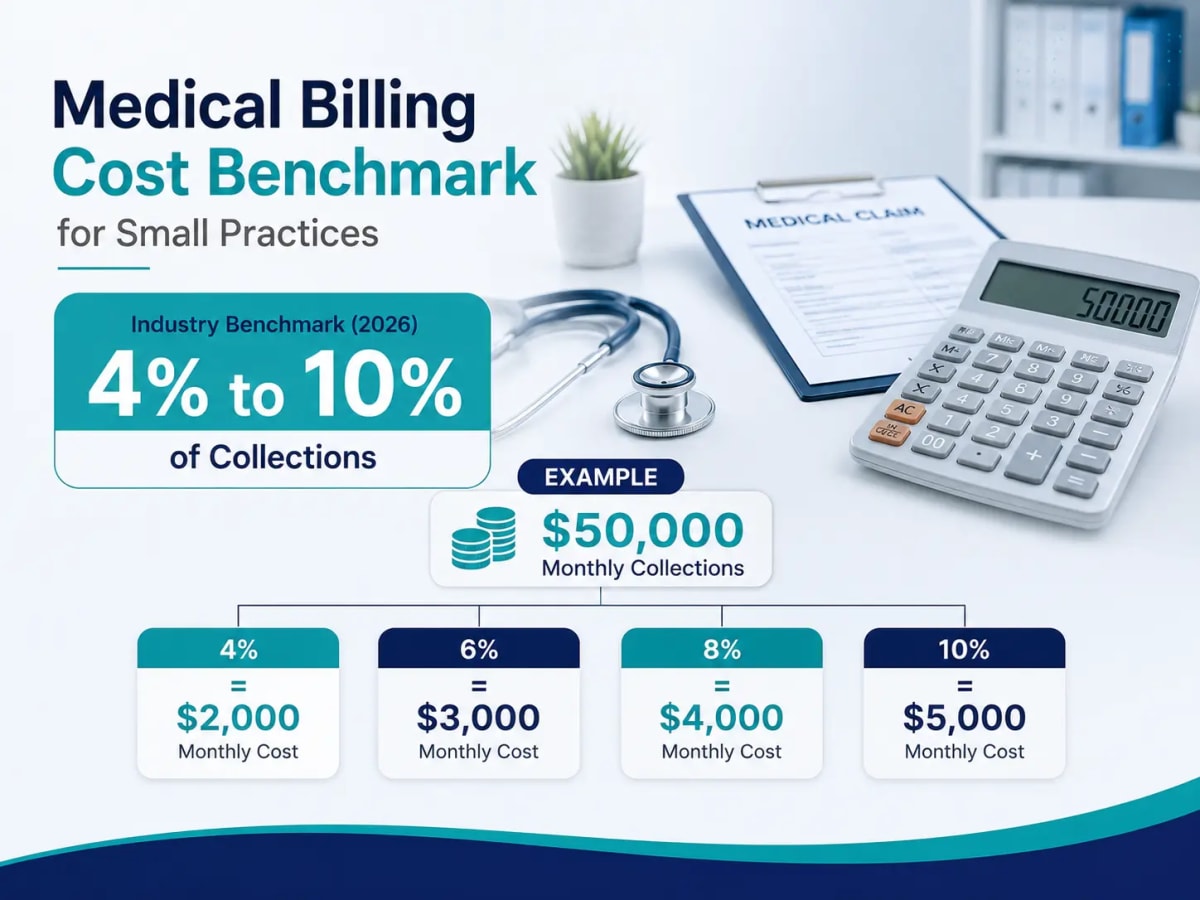
For 2026, industry pricing guides commonly report outsourced medical billing at roughly 4% to 10% of collections. Some small practices may fall within a narrower range depending on their size and billing complexity. Per-claim and flat-fee arrangements are also available. These figures are market benchmarks, not fixed industry rates.
For example, a practice collecting $50,000 per month would pay:
The percentage alone does not tell you whether a Medical Billing Service for Small Practices is affordable.
A 5% service that only handles claims may cost more overall than a 7% service that also handles coding, denials, A/R follow-up, payment posting, and reporting.
The better question is:
What am I paying, what services are included, and what financial value does the service provide?
There is no official national rate for outsourced medical billing.
Current 2026 industry sources commonly place percentage-based billing around 4% to 10% of collections. Other pricing models include per-claim fees and fixed monthly arrangements.
Recent discussions among practice owners also show that actual rates vary with specialty, volume, service scope, and whether denial and A/R work are included.
This makes the quoted percentage only one part of the decision.
Before accepting a quote, ask:
What is the percentage applied to?
Is it based on collections or charges?
Are patient payments included?
Is there a monthly minimum?
Is coding included?
Is denial management included?
Is A/R follow-up included?
Are there setup or technology fees?
Is legacy A/R included?
A transparent answer to these questions is more useful than an advertised percentage.
What Determines the Cost of Medical Billing Services?
Claim volume directly affects the amount of work required.
A solo physician submitting several hundred claims per month has different needs from a multi-provider practice processing thousands of claims.
Higher volume can require more resources for:
Claim submission
Payment posting
Claim status checks
Denial follow-up
A/R management
Patient billing
Some companies adjust pricing based on volume. Others use a percentage model that naturally changes with collections.
Specialty can have an even bigger impact than provider count.
A practice handling straightforward office visits may have simpler billing requirements than a practice submitting complex procedures or specialty-specific services.
Complex billing may require knowledge of:
Modifiers
Payer policies
Documentation requirements
Prior authorization
Specialty-specific reimbursement rules
For this reason, a quote should be evaluated against your actual specialty rather than a generic industry rate.
Your payer mix can affect billing workload.
Medicare, Medicaid, commercial insurers, Medicare Advantage plans, and other payers may have different claim and reimbursement requirements.
A practice working with multiple payers may require more eligibility checks, claim follow-up, documentation handling, and denial resolution.
Medical coding can significantly change the amount of work required.
Simple claims may require limited review. Complex procedures may require detailed documentation review, diagnosis selection, procedure coding, and modifier application.
If coding is part of the service agreement, ask whether the vendor provides dedicated medical coding services and whether specialty coding is included.
Your existing A/R can also affect pricing.
A practice with a large backlog of unpaid claims requires more work than one with clean and current A/R.
Ask whether the billing company handles:
Current A/R
A/R over 30 days
A/R over 60 days
A/R over 90 days
Legacy A/R
Do not assume old accounts are included in the standard fee.
There are several ways a billing company can charge a practice.
Percentage-based pricing is one of the most common models.
The billing company receives an agreed percentage of the collections covered by the contract.
For example:
$50,000 monthly collections × 6% = $3,000 monthly billing fee
The model can align the vendor's compensation with collections. However, the contract must clearly define what counts as collections.
Ask whether the percentage applies to:
Insurance collections
Patient collections
Net collections
Specific payer payments
Other revenue categories
Also ask whether the percentage changes when your collections increase.
Under a per-claim model, the practice pays a fixed amount for each claim processed.
Some current industry sources place common per-claim pricing around $4 to $10, although actual rates vary substantially by specialty and service scope.
This model can work well when claim volume is predictable.
However, ask whether corrected claims, rejected claims, secondary claims, and resubmissions are charged separately.
A flat monthly fee gives the practice a predictable billing expense.
This can work well for practices with consistent billing activity.
However, check whether the agreement includes:
Claim limits
Provider limits
Coding
Denial management
A/R follow-up
Patient billing
Reporting
A flat fee is only useful when the service scope is clear.
A hybrid arrangement combines different pricing structures.
For example, a vendor might charge a fixed monthly fee plus a percentage of collections. Another company might use per-claim pricing while charging separately for coding or credentialing.
This model can work when a practice wants a customized billing arrangement.
The important issue is not the model itself. It is whether the final cost is transparent and predictable.

What Should Be Included in the Billing Fee?
A comprehensive billing arrangement can include much more than claim submission.
This may include charge entry, claim preparation, electronic submission, rejection handling, and claim status follow-up.
Payment posting records insurance and patient payments and helps keep account balances accurate.
Denial management involves identifying why claims were denied, correcting appropriate issues, submitting appeals or corrected claims, and tracking unresolved denials.
If denials are a major problem for your practice, dedicated Denial Management Services may be more appropriate than basic claims processing.
A billing team should actively work unpaid claims rather than simply report them.
Ask how often aging A/R is reviewed and whether payer follow-up is included.
Some practices outsource billing and coding together.
If coding is included, confirm whether the agreement covers routine coding, specialty coding, coding reviews, and correction of coding-related claim problems.
Patient statements, payment processing, and patient balance follow-up may also be included.
Do not assume they are part of the base fee.
Useful reporting can include:
Collections
A/R aging
Denials
Claim status
Payment posting
Payer performance
Revenue trends
For practices that need broader revenue cycle support, Healthcare Revenue Cycle Management Services can cover more than basic medical billing.

Hidden Medical Billing Costs to Watch For
The advertised rate may not represent your complete expense.
Some companies charge for system setup, data migration, integration, or onboarding.
A percentage-based contract may include a minimum monthly fee. This can increase the effective rate for practices with lower collections.
Coding may be excluded from the basic billing percentage.
Some vendors include technology expenses. Others pass them to the practice.
Printed or electronic statements may have separate charges.
Older accounts may require a separate recovery arrangement.
Provider enrollment and payer credentialing may also be outside the standard billing package.
Review the notice period, early termination terms, data ownership, and A/R transition process.
Ask for a complete fee schedule before signing the agreement.
The percentage model becomes easier to understand when you look at annual collections.
Suppose a practice pays a 6% billing fee.
These are simple examples, not quotes.
The exercise is useful because a percentage-based fee increases as collections increase. That can be reasonable when the billing company is providing comprehensive support and helping the practice recover more revenue.
But it also means you should calculate the annual cost at your current and expected future collections before signing.
A recent discussion among practice owners raised the same concern: percentage fees can become substantially larger as collections grow, making it important to compare the total annual cost rather than focusing only on the percentage.
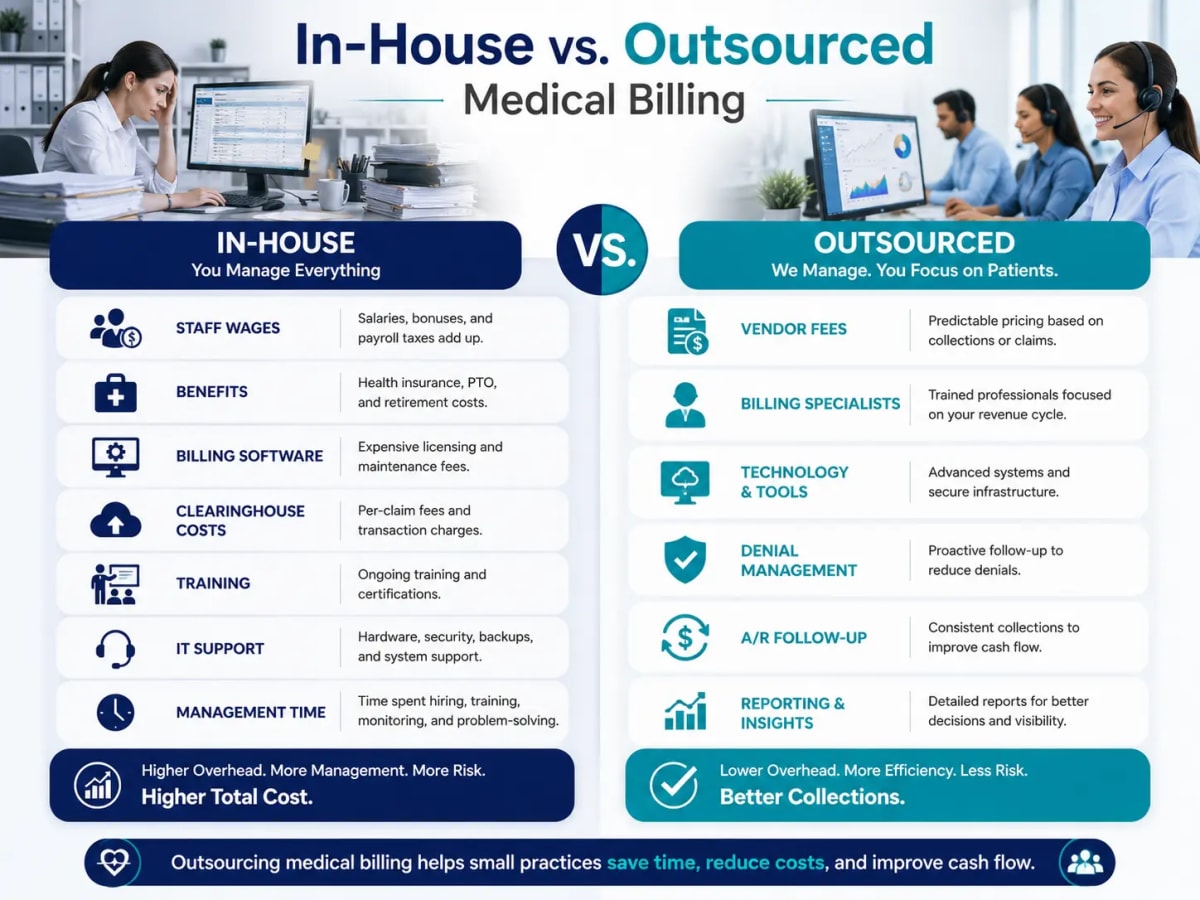
Comparing a vendor's percentage with an employee's salary is not an accurate comparison.
An in-house billing operation can include:
Employee wages
Payroll taxes
Benefits
Paid leave
Recruitment
Training
Billing software
Clearinghouse costs
Equipment
IT support
Management time
Outsourcing replaces many of these expenses with a vendor fee.
However, outsourcing is not automatically cheaper.
A practice with experienced staff, manageable claim volume, and strong internal processes may prefer in-house billing.
Outsourcing may be more attractive when the practice has:
Billing staff turnover
Growing A/R
Frequent denials
Limited coding expertise
Unworked claims
Poor reporting
Excessive administrative workload
Recent small-practice discussions also highlight the difficulty of maintaining consistent denial and A/R follow-up with limited internal staffing.
How to Calculate the True Cost of Medical Billing
Start with your complete internal billing expense.
In-House Cost = Staff + Benefits + Software + Clearinghouse + Training + Management + Other Operating Costs
For outsourcing:
Outsourced Cost = Vendor Fee + Additional Services + Technology Fees + Other Charges
Then compare those costs with billing performance.
You should also consider revenue that remains delayed or unpaid because of:
Denied claims
Missed charges
Coding errors
Delayed submissions
Underpayments
Unworked A/R
This is where the cost vs. value question becomes important.
A vendor charging 7% may provide more value than one charging 5% if the higher-priced service includes the revenue cycle work your practice actually needs.
Use the same checklist for every vendor.
Do not select a vendor simply because its percentage is the lowest.
Instead, calculate the effective annual cost and compare it with the services and performance you receive.
Outsourcing can make financial sense when billing problems are consuming staff time or affecting revenue.
It may be worth considering if your practice has:
Increasing A/R
Frequent denials
Slow payment posting
Billing staff turnover
Unworked claims
Limited reporting
Coding challenges
Too much administrative work
The value should be measured through actual revenue cycle performance.
Track metrics such as:
A/R aging
Denial trends
Collection performance
Outstanding claims
Payment posting turnaround
Revenue trends
The objective is not simply to find a cheaper billing service.
It is to create a billing process that manages claims efficiently, follows up on unpaid revenue, reduces avoidable problems, and gives the practice better financial visibility.
Before signing an agreement, ask:
What exactly is included in the billing fee?
How is your percentage calculated?
Do you handle medical coding?
Who works denied claims?
How do you manage aging A/R?
Are legacy accounts included?
Are there monthly minimums or setup fees?
What reports will we receive?
How will billing performance be measured?
What happens to our data and outstanding A/R if we end the contract?
Get the answers in writing.
A transparent agreement makes it much easier to calculate your actual cost and compare providers fairly.
The cost of medical billing for a small practice depends on more than a percentage or monthly fee.
In 2026, current industry sources commonly report outsourced percentage-based billing around 4% to 10% of collections, while per-claim and flat-fee models provide other options. Actual pricing depends on specialty, claim volume, payer mix, collections, A/R workload, and the services included.
Before choosing a billing company, calculate your complete internal cost, request a detailed outsourced quote, identify additional fees, and compare the services included.
The cheapest quote is not necessarily the best value.
The right billing partner should provide transparent pricing, clear responsibilities, reliable reporting, and the revenue cycle support your practice actually needs.
If you are evaluating your options, Mediknocx provides medical billing and revenue cycle support for healthcare providers.
Want to understand the right billing approach for your practice? Contact Mediknocx for Free Medical Billing Consultation service and find a solution based on your specialty, volume, and revenue cycle requirements.
Outsourced medical billing commonly falls around 4% to 10% of collections in current 2026 industry pricing guides. Actual rates vary by specialty, claim volume, collections, and service scope.
It can be, but not in every situation. Compare the complete cost of internal staffing, technology, training, and management with the vendor's total fees. Then evaluate the difference in billing performance.
Current industry sources commonly report approximately 4% to 10% of collections for percentage-based arrangements. The actual rate depends on the practice and services included.
Depending on the agreement, services can include claims submission, payment posting, denial management, A/R follow-up, coding, patient billing, eligibility verification, and reporting.
Potential additional costs include setup fees, monthly minimums, coding charges, technology fees, patient statement costs, legacy A/R recovery, credentialing, and contract termination charges.
Compare the effective annual cost, included services, denial and A/R processes, reporting, additional fees, technology, contract terms, and support. Do not compare percentages alone.
Explore more medical billing guides, coding updates, and revenue cycle tips.
R19.7 is the ICD-10 code for diarrhea, unspecified. Learn when to use K52.9, A09, K58.0, K59.1, C. diff and tr...

Learn what POS 19 means in medical billing, when to use it, POS 19 vs POS 11 and 22, Medicare billing, reimbur...

Modifier 24 reports an unrelated E/M service by the same physician or qualified healthcare professional during...