Healthcare
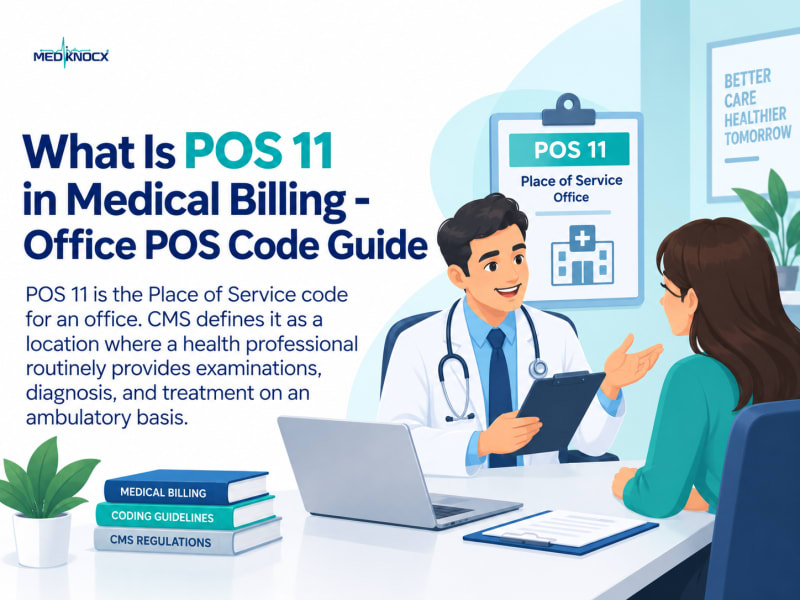
What Is POS 11 in Medical Billing - Office POS Code Guide
Learn what POS 11 means in medical billing, when to use the office POS code, how it affects claims, and common...

Sep 17, 2026
1 min read

Jordan Taylor
August 3, 2026
Table of Contents
19
Healthcare providers invest significant time and resources in delivering quality patient care, but reimbursement does not end when a claim is submitted. Every unpaid or partially paid claim represents revenue that can directly affect cash flow, operational efficiency, and the overall financial health of a practice. This is where AR Follow-Up in Medical Billing becomes an essential part of the Revenue Cycle Management (RCM) process.
AR follow-up focuses on identifying outstanding insurance claims, determining why payments have been delayed, and taking the necessary actions to secure reimbursement. Whether the issue involves coding errors, missing documentation, payer delays, prior authorization requirements, or claim denials, a structured follow-up process helps recover revenue before claims become uncollectible.
An effective Medical Billing AR strategy does more than reduce unpaid claims. It shortens Days in AR, minimizes write-offs, improves collections, and provides healthcare organizations with a predictable cash flow. When supported by accurate medical coding, timely claim submission, and proactive denial management, AR follow-up strengthens the entire revenue cycle while allowing providers to focus on patient care instead of administrative burdens.
This guide explains the complete AR Follow-Up Process in Medical Billing, common reasons claims remain unpaid, industry best practices, performance metrics, and practical strategies healthcare providers can use to improve their Healthcare Accounts Receivable and maximize reimbursements.
AR Follow-Up in Medical Billing is the process of tracking, investigating, and resolving unpaid or underpaid insurance claims after they have been submitted to a payer. The objective is to recover outstanding payments while ensuring every claim moves efficiently through the reimbursement cycle.
Unlike claim submission, which ends once a claim reaches the insurance company, Accounts Receivable Medical Billing begins when payment is delayed, partially processed, or denied. AR specialists monitor claim status, communicate with insurance payers, correct billing issues, submit appeals when necessary, and document every action until the claim is successfully resolved.
Within the broader Revenue Cycle Management framework, AR follow-up acts as the bridge between claim submission and final payment. Without continuous monitoring, even accurately coded claims may remain unpaid because of payer processing delays, missing documentation, eligibility issues, or administrative errors.
The primary goals of AR Management in Medical Billing include:
Recover outstanding insurance payments before timely filing deadlines expire.
Reduce the number of claims moving into aging accounts.
Improve overall cash flow and financial stability.
Minimize write-offs and bad debt.
Strengthen long-term reimbursement performance.
A proactive AR strategy transforms unpaid claims into recovered revenue while improving the overall efficiency of medical billing operations.
Submitting a clean claim does not guarantee timely reimbursement. Insurance companies may request additional documentation, identify eligibility issues, apply payment edits, or delay processing because of policy-specific requirements. Without consistent Outstanding Claims Follow-Up, these claims remain in accounts receivable and gradually become more difficult to collect.
Every unpaid claim affects more than a single patient encounter. As outstanding balances accumulate, healthcare organizations experience slower cash flow, reduced operating capital, and increasing administrative costs.
An effective Medical Billing Accounts Receivable Process helps healthcare organizations:
Timely follow-up accelerates reimbursements, providing practices with the financial resources needed to support staffing, equipment, and patient care.
Consistent monitoring prevents claims from remaining unresolved for extended periods, improving one of the most important revenue cycle performance indicators.
Many claims become permanent write-offs simply because they exceed payer filing deadlines. Regular follow-up identifies issues early enough for corrective action.
Recovering insurance payments before transferring balances to patient responsibility helps reduce bad debt while improving collection rates.
Resolving insurance issues quickly minimizes unexpected patient balances, billing confusion, and payment disputes.
A healthy accounts receivable portfolio allows healthcare providers to forecast revenue more accurately and invest confidently in practice growth.
Rather than viewing AR follow-up as a collection activity, successful healthcare organizations treat it as a continuous revenue recovery process that protects earned reimbursement throughout the claim lifecycle.
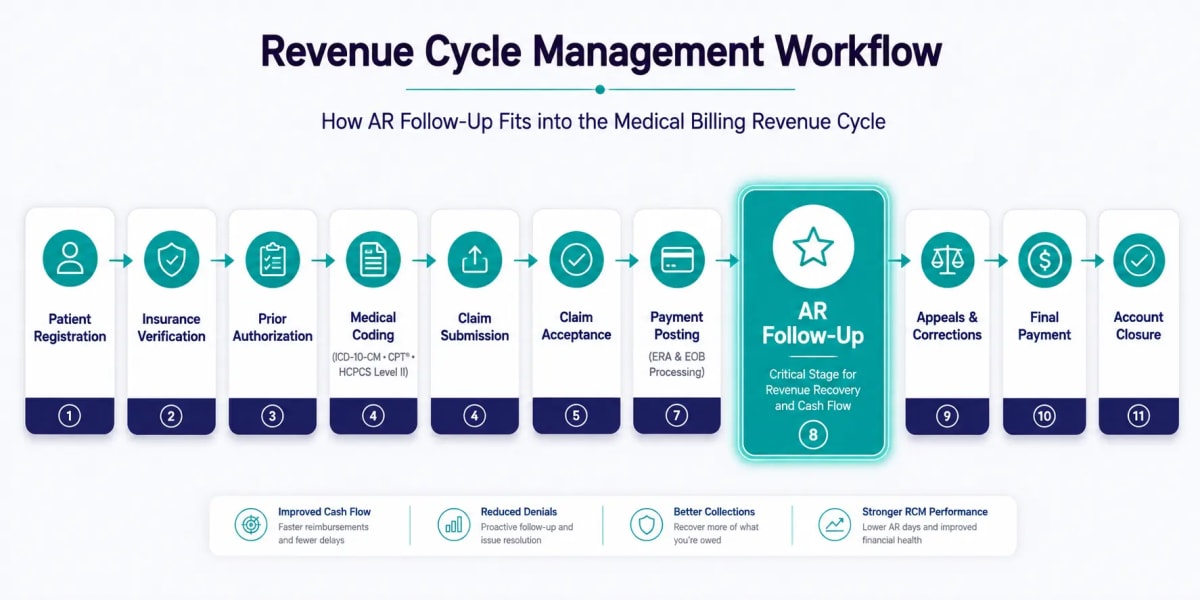
Where AR Follow-Up Fits in the Revenue Cycle
Every healthcare organization follows a structured revenue cycle that begins before the patient arrives and ends only after the final payment is received. Each stage influences the success of the next, making AR follow-up dependent on accurate front-end and mid-cycle processes.
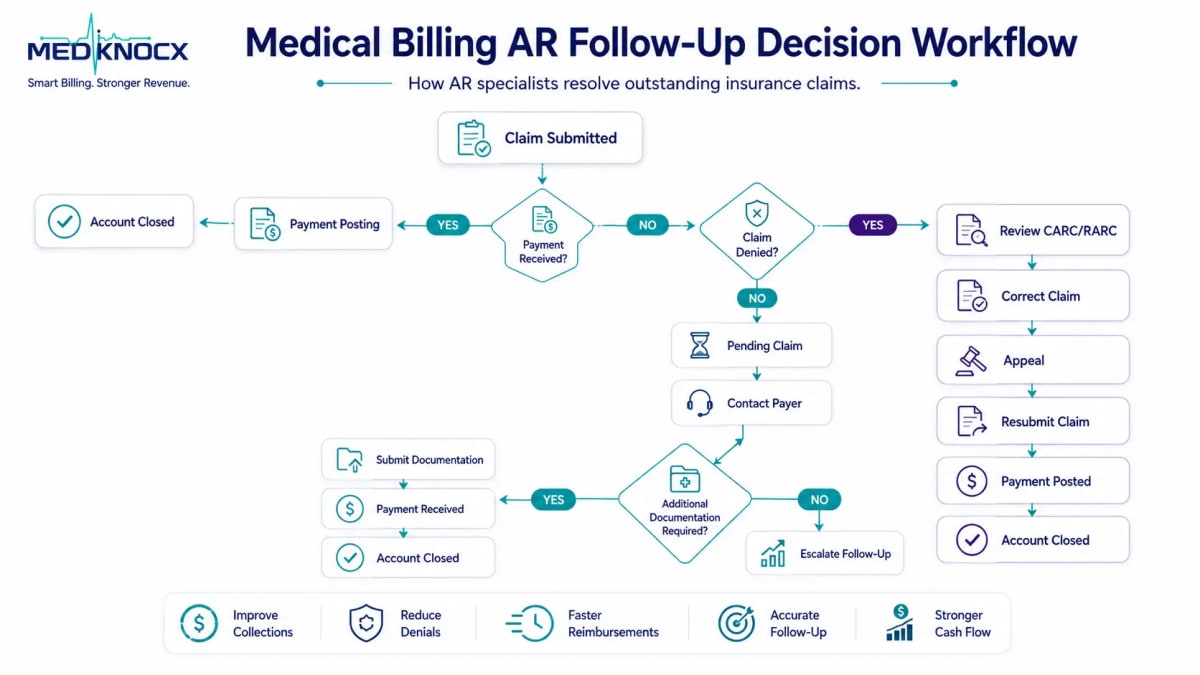
Even a perfectly coded claim can enter AR if a payer requests additional information or delays processing. For this reason, AR follow-up serves as the control point that ensures every submitted claim receives appropriate attention until reimbursement is complete.
Many healthcare professionals use these terms interchangeably, but each function serves a different purpose within the revenue cycle. Understanding these differences helps practices build more efficient reimbursement workflows.
Although these processes work together, AR Follow-Up in Medical Billing remains the central function that connects claim monitoring, denial resolution, payment recovery, and final account closure. A well-structured follow-up process ensures that fewer claims become write-offs, improving both reimbursement performance and overall financial health.
A structured AR Follow-Up Process in Medical Billing helps healthcare providers recover outstanding payments before claims become aged or uncollectible. Every follow-up activity should focus on identifying the root cause, resolving payer issues, and securing reimbursement as quickly as possible. The following workflow reflects industry best practices used by high-performing revenue cycle teams.
The process begins with reviewing the AR Aging Report, which categorizes outstanding claims based on the number of days they have remained unpaid. This report helps AR specialists prioritize claims that require immediate attention.
High-value claims and accounts approaching timely filing limits should receive the highest priority. Waiting too long to address older claims increases the risk of write-offs and lost revenue.
Goal
Identify unpaid claims that require immediate follow-up.
Common Mistake
Reviewing aging reports only once a month instead of monitoring them regularly.
Best Practice
Review aging reports every week and prioritize claims by payer, claim value, and aging category.
Once priority claims are identified, the next step is determining their current status. AR specialists review payer portals, clearinghouse reports, Electronic Data Interchange (EDI) transactions, or contact insurance representatives directly to understand where the claim stands.
A claim may be pending, rejected, denied, partially paid, or awaiting additional documentation. Understanding its exact status prevents unnecessary duplicate submissions.
Goal
Determine why payment has not been received.
Common Mistake
Assuming every delayed claim has been denied.
Best Practice
Use payer portals and EDI 276/277 claim status transactions to verify claim progress before taking corrective action.
Once the claim status is confirmed, the underlying issue must be identified. Many payment delays originate from coding inaccuracies, eligibility problems, missing documentation, prior authorization requirements, or coordination of benefits issues.
Review the Explanation of Benefits (EOB) or Electronic Remittance Advice (ERA) carefully. Claim Adjustment Reason Codes (CARCs) and Remittance Advice Remark Codes (RARCs) often explain why payment was delayed, reduced, or denied.
Goal
Identify the exact reason preventing reimbursement.
Common Mistake
Correcting symptoms instead of addressing the actual root cause.
Best Practice
Analyze denial patterns by payer and monitor recurring CARC and RARC codes to prevent similar issues in future claim submissions.
After identifying the issue, the claim should be corrected and resubmitted promptly. If the payer has denied the claim incorrectly, prepare a formal appeal with supporting documentation.
Depending on the issue, corrections may include updating diagnosis codes, modifying procedure coding, attaching missing clinical records, or providing prior authorization details.
Goal
Resolve claim errors and recover payment before filing deadlines expire.
Common Mistake
Submitting corrected claims without validating supporting documentation.
Best Practice
Maintain standardized correction checklists and document every resubmission or appeal.
Some claims require direct communication with insurance representatives or patients before payment can proceed. Conversations should remain professional, well documented, and fully compliant with HIPAA privacy requirements.
Insurance companies may request medical records, clarification of services, or additional documentation. Patients may need assistance understanding their financial responsibility after insurance processing.
Goal
Resolve outstanding issues through timely communication.
Common Mistake
Failing to document payer conversations or reference numbers.
Best Practice
Record every interaction, including representative names, reference numbers, follow-up dates, and agreed next steps.
After reimbursement is received, payments should be posted immediately using information from the ERA or EOB. Accurate payment posting ensures the patient's financial record reflects the correct balance and prevents duplicate follow-up activities.
Any remaining balance should be reviewed for secondary insurance processing or patient responsibility.
Goal
Maintain accurate financial records.
Common Mistake
Manual payment posting without reconciliation.
Best Practice
Automate ERA posting whenever possible and reconcile payments against submitted claims.
The final step is updating the account based on the outcome. Fully paid claims can be closed, while unresolved claims may require additional appeals, secondary billing, or patient collections. If every reimbursement opportunity has been exhausted, the claim may be written off according to organizational policy.
Goal
Ensure every claim reaches an appropriate financial resolution.
Common Mistake
Closing claims without documenting final actions.
Best Practice
Maintain a complete audit trail for every account and schedule follow-up reminders for unresolved claims.
Expert Tip: High-performing revenue cycle teams hold weekly AR review meetings to discuss aging trends, payer performance, and high-value outstanding claims. These meetings improve accountability and reduce unnecessary delays.
Most outstanding claims do not remain unpaid because of a single issue. Instead, multiple factors throughout the revenue cycle can delay reimbursement. Understanding these common causes helps healthcare providers strengthen their Medical Billing AR strategy and reduce preventable payment delays.
Rather than resolving claims individually, monitor denial trends by payer, specialty, and adjustment reason code. Identifying recurring patterns helps eliminate the underlying causes of delayed reimbursement and improves long-term AR Management in Medical Billing.
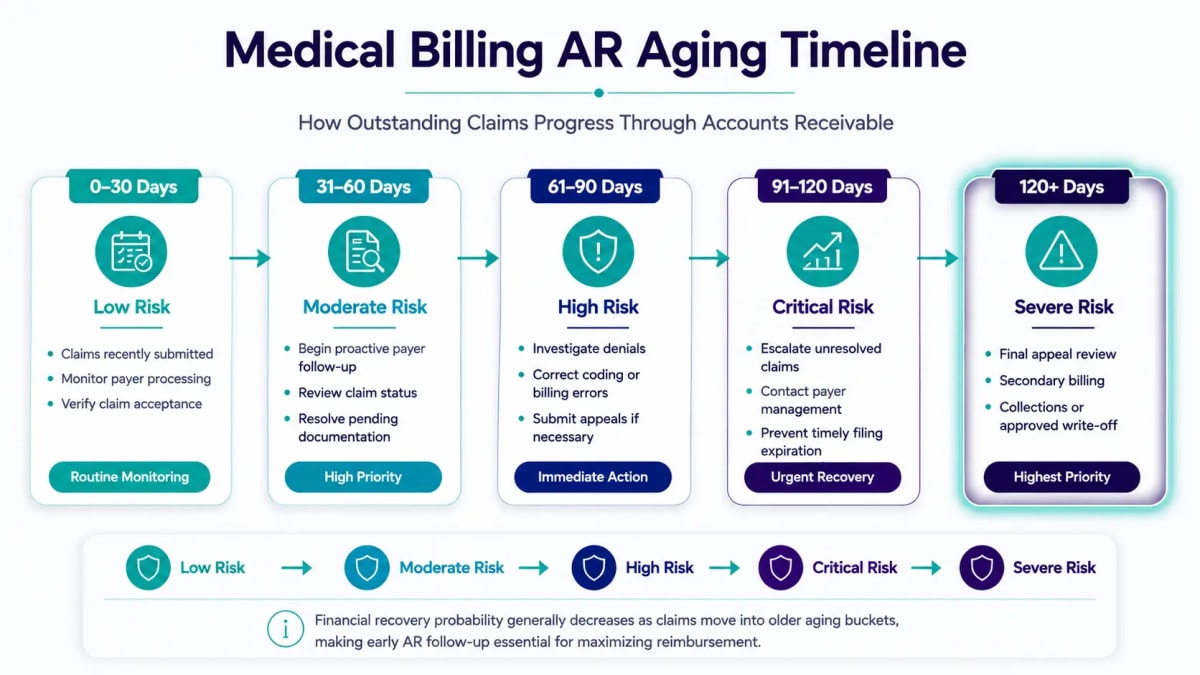
An AR Aging Report helps healthcare organizations evaluate outstanding claims based on how long they have remained unpaid. As claims move into older aging categories, the likelihood of full reimbursement decreases significantly.
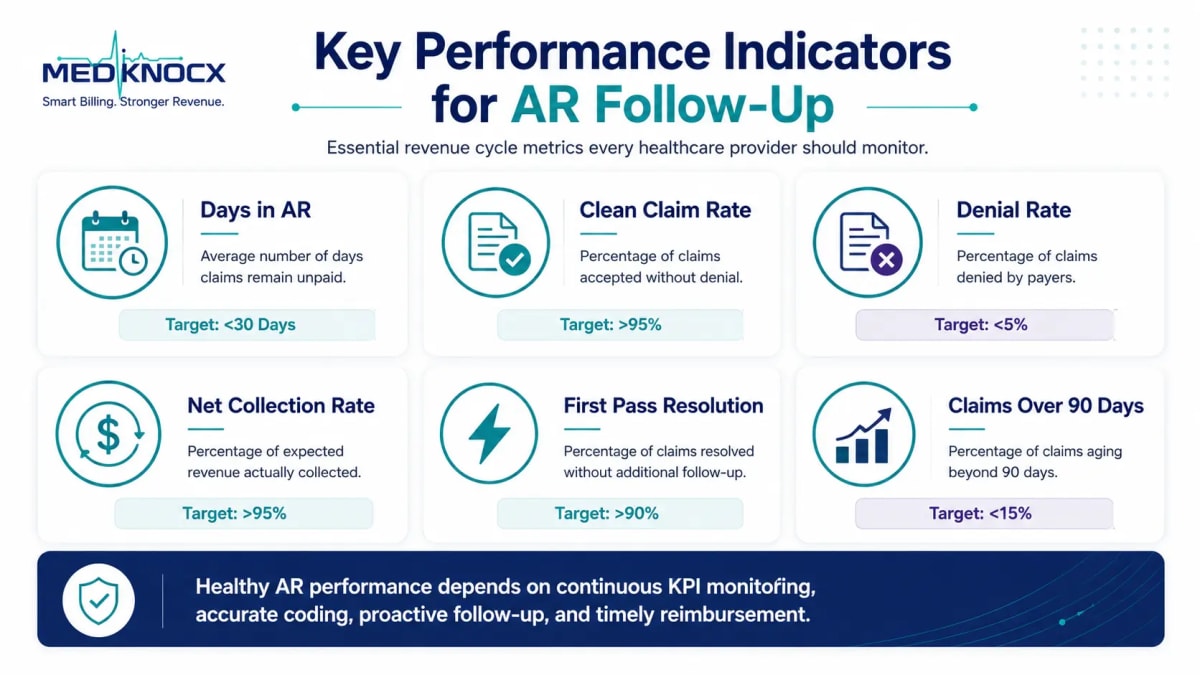
Key Performance Indicators (KPIs) for AR Follow-Up
Measuring the right performance indicators helps healthcare organizations evaluate the effectiveness of their Healthcare Accounts Receivable strategy and identify opportunities for continuous improvement.
Formula: Days in AR
Days in AR = Total Accounts Receivable ÷ Average Daily Charges
A lower Days in AR value generally reflects a healthier revenue cycle, stronger reimbursement performance, and more effective Medical Billing Collections. Healthcare providers should regularly compare their AR performance against recognized industry benchmarks, such as those published by the Medical Group Management Association (MGMA).
AR Follow-Up Best Practices for Faster Reimbursements
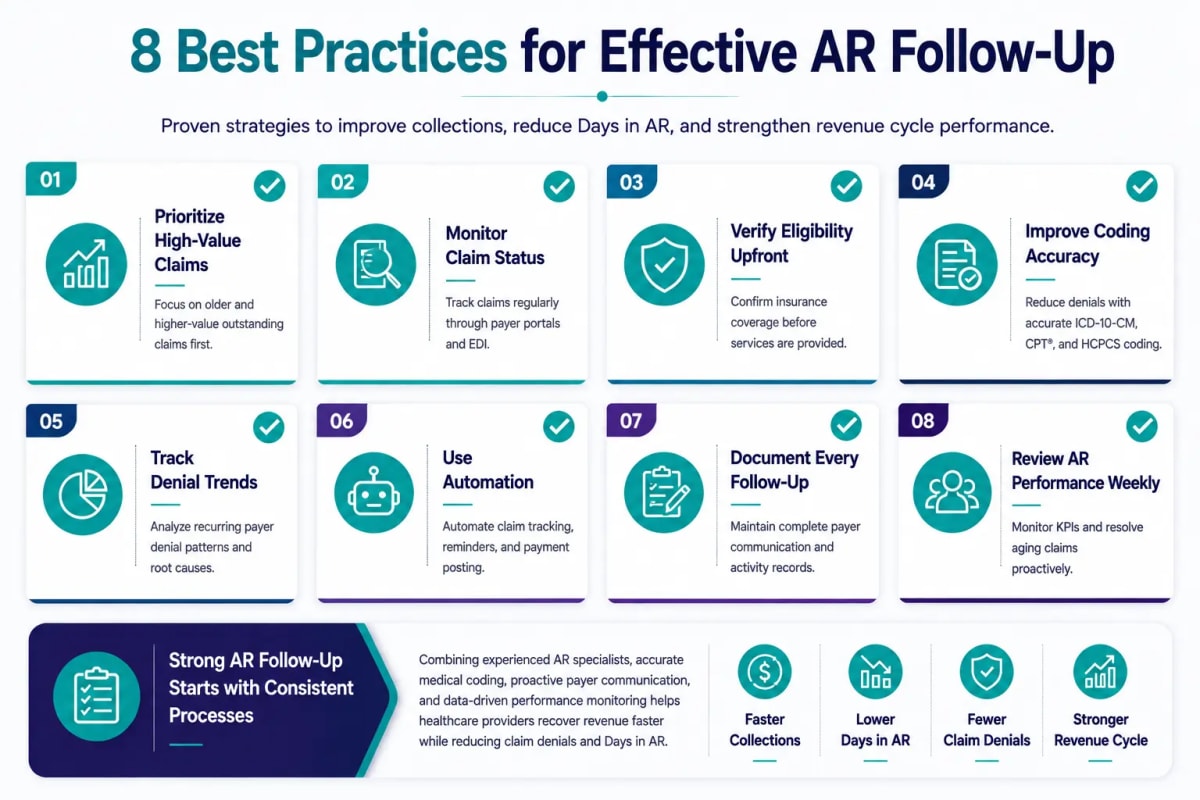
A successful AR Follow-Up in Medical Billing strategy goes beyond calling insurance companies about unpaid claims. High-performing healthcare organizations use standardized workflows, performance tracking, automation, and continuous process improvement to recover revenue faster while reducing administrative costs.
The following best practices can help healthcare providers improve Healthcare Accounts Receivable, reduce Days in AR, and strengthen overall Revenue Cycle Management.
Not every unpaid claim requires the same level of urgency. Claims approaching timely filing deadlines or those with higher reimbursement values should always receive immediate attention.
Prioritizing claims based on financial impact and aging prevents unnecessary revenue loss and improves collection efficiency.
Best Practice
Review AR aging reports weekly.
Prioritize claims over 60 days old.
Focus first on high-dollar commercial insurance claims.
Waiting for payers to respond often delays reimbursement unnecessarily. AR specialists should actively monitor claim status using payer portals, clearinghouse reports, and EDI 276/277 transactions.
Early identification of pending issues allows corrective action before claims enter older aging categories.
Best Practice
Create automated reminders for claims that remain pending beyond payer-specific processing timelines.
Many AR problems begin long before claims are submitted. Incorrect patient demographics, inactive insurance coverage, missing prior authorization, and incomplete documentation all contribute to payment delays.
Improving front-end accuracy reduces downstream AR workload.
Focus on:
Insurance verification
Eligibility confirmation
Prior authorization
Complete clinical documentation
Accurate patient registration
Accurate Medical Coding remains one of the strongest predictors of successful reimbursement. Incorrect diagnosis codes, procedure codes, or modifiers frequently result in rejected or denied claims.
Regular coding audits, provider education, and documentation reviews help improve clean claim rates while reducing follow-up workload.
Every denied claim provides valuable information. Integrating Denial Management Services with AR follow-up helps identify recurring reimbursement issues before they affect future claims.
Instead of resolving denials individually, healthcare organizations should analyze denial trends by:
Insurance payer
Denial reason
Medical specialty
Provider
Procedure type
This approach identifies recurring operational problems before they affect additional claims.
Every payer interaction should be documented carefully.
Include:
Date and time
Representative name
Reference number
Action taken
Follow-up date
Required documentation
Well-documented accounts improve continuity when multiple AR specialists work on the same claim.
Modern Medical Billing AR teams increasingly rely on automation to eliminate repetitive tasks.
Automation can assist with:
Claim status verification
Reminder notifications
Work queues
Payment posting
Reporting dashboards
Automation does not replace AR specialists. Instead, it allows them to focus on complex reimbursement issues requiring human expertise.
Continuous monitoring allows practices to identify reimbursement problems before they become significant financial risks.
Weekly AR meetings should review:
Days in AR
High-value outstanding claims
Denial trends
Aging distribution
Payer turnaround times
Collection performance
Visual Suggestion: Add a checklist-style infographic titled "8 Best Practices for Effective AR Follow-Up" with icons representing each recommendation
An AR Follow-Up Specialist serves as the link between claim submission and successful reimbursement. Their primary responsibility is recovering outstanding insurance payments while ensuring claims progress efficiently through the revenue cycle.
Rather than simply contacting insurance companies, AR specialists investigate payment delays, resolve billing issues, coordinate with internal teams, and monitor payer performance to improve reimbursement outcomes.
Review AR aging reports daily.
Track outstanding insurance claims.
Verify claim status with payers.
Investigate denials and payment delays.
Correct billing or documentation issues.
Prepare and submit appeals.
Follow up on underpaid claims.
Document every payer interaction.
Coordinate with medical coders and billing teams.
Maintain compliance with HIPAA and payer requirements.
Successful AR specialists combine technical knowledge with strong communication and analytical abilities.
Important skills include:
Medical billing knowledge
Insurance policy interpretation
Medical coding fundamentals
Problem-solving
Time management
Negotiation
Attention to detail
Documentation accuracy
Professional certifications such as CPC (Certified Professional Coder) or CCS (Certified Coding Specialist) can strengthen coding knowledge and improve reimbursement accuracy, especially when AR issues involve coding-related denials.
Successful AR specialists combine technical knowledge with strong communication and analytical abilities.
Important skills include:
Medical billing knowledge
Insurance policy interpretation
Medical coding fundamentals
Problem-solving
Time management
Negotiation
Attention to detail
Documentation accuracy
Professional certifications such as CPC (Certified Professional Coder) or CCS (Certified Coding Specialist) can strengthen coding knowledge and improve reimbursement accuracy, especially when AR issues involve coding-related denials.
Clearinghouses validate claims before submission, reducing preventable rejections and improving clean claim rates.
They also provide electronic claim status updates that support faster insurance claim follow-up.
Claim scrubbers identify coding errors, missing information, and payer-specific edits before claims are submitted.
Early error detection significantly reduces AR workload.
Artificial Intelligence is reshaping AR Management in Medical Billing.
Healthcare organizations increasingly use AI to:
Predict denial risk before submission.
Prioritize high-risk accounts.
Identify payer payment patterns.
Recommend next-best follow-up actions.
Automate repetitive claim status checks.
Generate performance dashboards.
Rather than replacing experienced AR professionals, AI enables teams to work more efficiently by reducing manual administrative tasks and improving decision-making.
Managing AR internally works well for some organizations, but growing practices often struggle with increasing claim volumes, staffing shortages, and changing payer requirements. Practices experiencing staffing shortages, growing claim backlogs, or payer-related challenges often outsource Medical Billing Services alongside Medical Credentialing Services to improve reimbursement performance and maintain compliance.
Outsourcing AR Follow-Up Services allows healthcare providers to access experienced reimbursement specialists without expanding internal staffing.
Days in AR continue increasing.
Claim backlogs exceed staff capacity.
Denial rates remain consistently high.
Internal hiring becomes difficult.
Multiple payer contracts require specialized expertise.
Revenue growth cannot keep pace with patient volume.
Before outsourcing, evaluate providers based on:
✔ Healthcare industry experience
✔ HIPAA compliance
✔ Transparent reporting
✔ Specialty expertise
✔ Performance metrics
✔ Data security
✔ Dedicated account management
A qualified AR partner should function as an extension of your internal revenue cycle team rather than simply providing collection services.
Case Study: Improving AR Performance Through Process Optimization
A multi-specialty physician practice experienced declining cash flow because outstanding insurance claims continued to accumulate. Their average Days in AR had increased to 46 days, and nearly 12% of submitted claims required additional follow-up.
After reviewing their workflow, the practice implemented several improvements:
Assigned dedicated AR specialists by payer.
Introduced weekly AR aging review meetings.
Used claim-scrubbing software before submission.
Automated claim status monitoring.
Strengthened collaboration between coding and billing teams.
Within six months, measurable improvements were achieved:
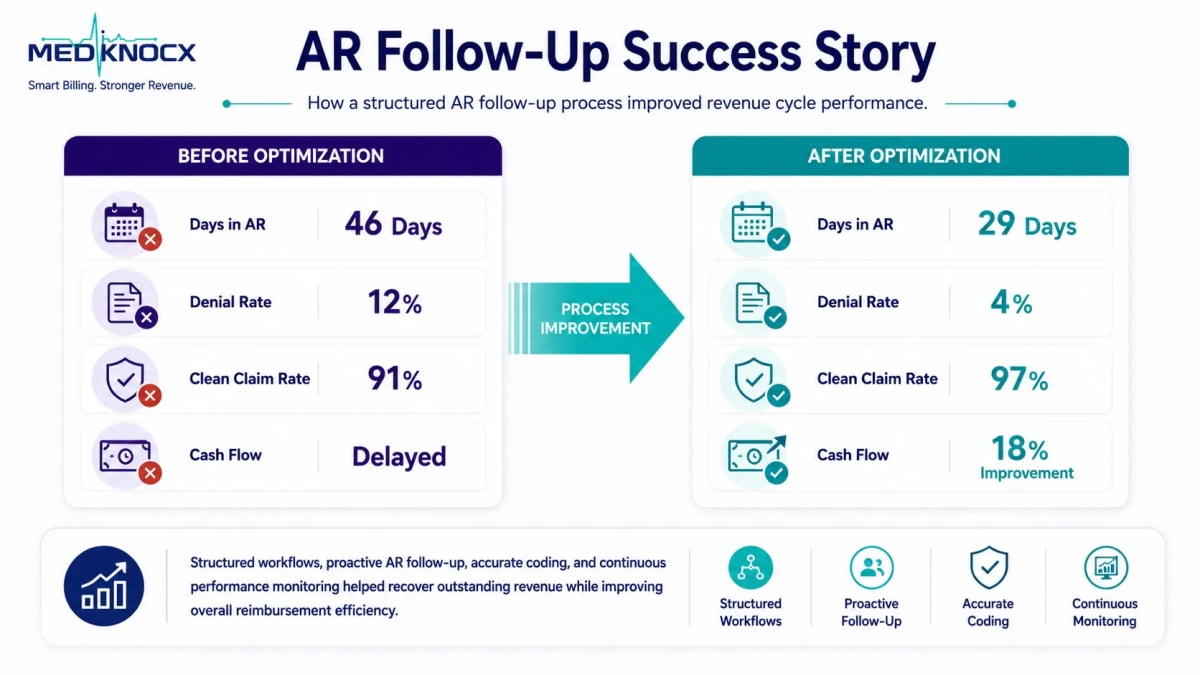
The result was faster reimbursements, improved cash flow, fewer preventable denials, and greater financial stability without increasing administrative staff.
Even well-established healthcare organizations lose revenue because of avoidable AR management mistakes. Identifying these issues early helps practices improve reimbursement, reduce administrative workload, and strengthen their overall Revenue Cycle Management (RCM) process.
Many practices wait until claims become 60 or 90 days old before initiating follow-up. By then, reimbursement becomes more difficult, and timely filing deadlines may be approaching.
Impact
Higher Days in AR
Increased write-offs
Slower cash flow
Best Practice
Review outstanding claims every week and establish payer-specific follow-up schedules.
An AR Aging Report provides a clear picture of unpaid claims, yet many organizations review it only at month-end.
Without regular monitoring, high-value claims may remain unpaid for weeks without any action.
Best Practice
Monitor aging reports weekly and prioritize claims based on payer, balance amount, and aging category.
An AR Aging Report provides a clear picture of unpaid claims, yet many organizations review it only at month-end.
Without regular monitoring, high-value claims may remain unpaid for weeks without any action.
Best Practice
Monitor aging reports weekly and prioritize claims based on payer, balance amount, and aging category.
Many of these issues can be prevented through professional Medical Coding Services, helping healthcare providers improve coding accuracy before claims are submitted.
Although AR specialists resolve many of these issues, preventing them through accurate Medical Coding significantly improves reimbursement performance.
Best Practice
Conduct regular coding audits and provide continuous education for coding teams.
Many organizations focus on correcting denied claims individually but fail to identify recurring denial trends.
Without analyzing denial patterns, the same billing issues continue affecting future claims.
Best Practice
Track denial trends by:
Insurance payer
Specialty
Provider
Procedure
Denial reason
This data supports continuous process improvement. Regular Medical Billing Audit Services help identify coding, documentation, and billing issues before they lead to denials or prolonged AR balances.
Every payer has strict appeal deadlines.
Waiting too long to submit corrected claims or appeals often results in permanent revenue loss.
Best Practice
Create standardized appeal workflows and monitor appeal deadlines through automated reminders.
Revenue cycle improvements require measurable performance indicators.
Without monitoring KPIs, organizations cannot determine whether AR performance is improving.
Regular performance reviews help identify operational bottlenecks before they affect cash flow.
Healthcare reimbursement continues to evolve as technology transforms revenue cycle operations. Modern AR teams increasingly rely on automation, predictive analytics, and artificial intelligence to recover payments more efficiently while reducing manual administrative work.
Several emerging trends are shaping the future of Healthcare Accounts Receivable.
AI-powered platforms analyze historical billing data to predict denial risks before claims are submitted. These insights help billing teams address potential issues earlier and improve clean claim rates. Many healthcare organizations combine these technologies with comprehensive Medical Billing Services to streamline reimbursement and improve operational efficiency.
Advanced reporting tools identify claims most likely to experience payment delays, allowing AR specialists to prioritize high-risk accounts and recover revenue faster.
RPA automates repetitive administrative tasks such as claim status checks, work queue updates, payment reconciliation, and follow-up reminders. This allows AR specialists to focus on complex reimbursement issues instead of routine activities.
Modern eligibility verification tools reduce front-end billing errors by confirming insurance coverage and patient benefits before services are provided.
Interactive dashboards provide real-time visibility into:
Days in AR
Denial trends
Collection rates
Aging distribution
Payer turnaround times
These insights support faster decision-making and continuous revenue cycle improvement.
As healthcare technology continues advancing, organizations that combine experienced reimbursement professionals with intelligent automation will be better positioned to reduce payment delays, improve collections, and maintain long-term financial stability.
AR Follow-Up in Medical Billing Services is more than a collections activity. It is a critical revenue recovery process that ensures healthcare providers receive accurate reimbursement for the services they deliver. Without a structured follow-up strategy, unpaid claims can quickly turn into aging accounts, write-offs, and lost revenue.
An effective AR follow-up program combines accurate medical coding, timely claim submission, proactive payer communication, consistent performance monitoring, and data-driven decision-making. Together, these practices reduce Days in AR, improve collection rates, strengthen cash flow, and support a healthier Revenue Cycle Management process.
As payer requirements become increasingly complex, healthcare providers need more than routine claim follow-up to protect their revenue. Mediknocx delivers reliable AR Follow-Up services backed by experienced billing professionals, structured workflows, and data-driven insights that help recover outstanding claims, reduce Days in AR, improve collections, and support a healthier revenue cycle while your team remains focused on patient care.
If your practice is experiencing growing claim backlogs, increasing denial rates, or delayed reimbursements, partnering with an experienced medical billing services provider can help streamline AR follow-up, improve collections, and optimize long-term financial performance.
AR Follow-Up in Medical Billing is the process of tracking, investigating, and resolving unpaid or underpaid insurance claims after submission. The goal is to recover outstanding reimbursements, reduce aging accounts, and improve cash flow.
An AR Aging Report categorizes outstanding claims based on how long they have remained unpaid, helping billing teams prioritize follow-up activities and reduce payment delays.
Healthcare organizations should review AR aging reports at least once a week. Regular reviews help identify overdue claims early and prevent unnecessary revenue loss.
Claims often remain unpaid because of coding errors, insurance verification issues, missing prior authorizations, incomplete documentation, payer processing delays, coordination of benefits problems, or timely filing violations.
Providers can reduce Days in AR by improving front-end registration, verifying insurance eligibility, submitting clean claims, monitoring aging reports regularly, tracking denial trends, and following up with payers promptly.
AR Follow-Up focuses on resolving unpaid or delayed claims, while Denial Management investigates denied claims, identifies root causes, and implements strategies to prevent similar denials in the future.
An AR Follow-Up Specialist reviews outstanding claims, communicates with insurance companies, resolves reimbursement issues, submits appeals, documents follow-up activities, and helps improve overall collection performance.
Key AR metrics include Days in AR, Clean Claim Rate, Denial Rate, Net Collection Rate, First Pass Resolution Rate, and the percentage of claims older than 90 days.
Practices should consider outsourcing when claim backlogs increase, denial rates remain high, staffing shortages occur, or internal resources cannot maintain timely reimbursement performance.
AI helps predict denial risks, automate claim status monitoring, prioritize high-risk accounts, identify payer trends, and provide real-time performance insights that improve reimbursement efficiency.
Explore more medical billing guides, coding updates, and revenue cycle tips.
Learn what POS 11 means in medical billing, when to use the office POS code, how it affects claims, and common...

Learn what POS 12 means in medical billing, when to use it, home visit CPT codes, POS 10 vs 12, documentation ...

POS 22 marks on-campus hospital outpatient services. See how it differs from POS 19 and POS 11, how split bill...