Healthcare

What Is POS 22 in Medical Billing - On-Campus Guide
POS 22 marks on-campus hospital outpatient services. See how it differs from POS 19 and POS 11, how split bill...

Aug 26, 2026
1 min read

Jordan Taylor
July 29, 2026
Table of Contents
1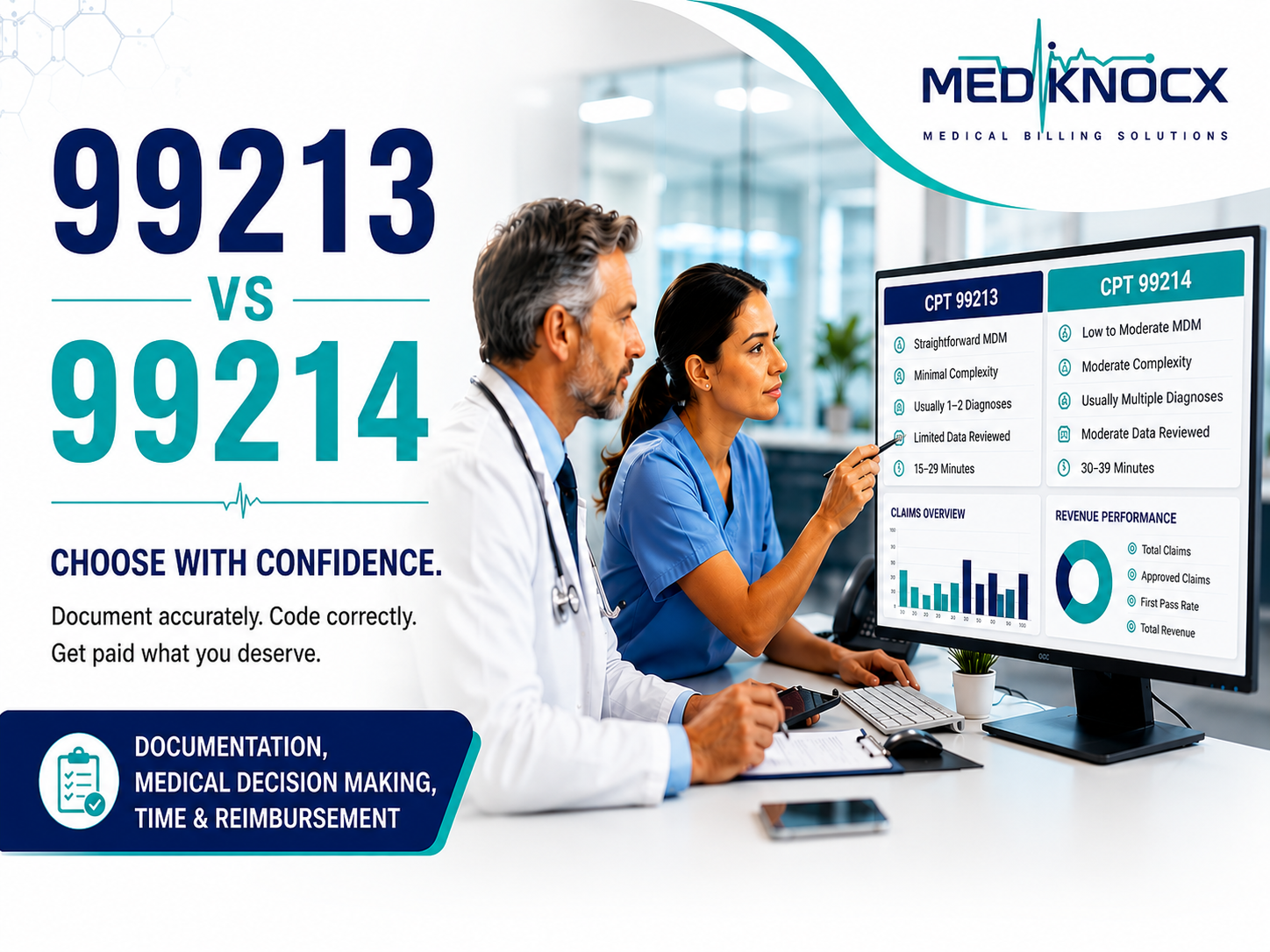
If you've spent any time coding outpatient E/M visits, you've probably paused over CPT 99213 and CPT 99214 more times than you'd like to admit. A patient comes in for a routine follow-up, the documentation looks complete, and everything seems straightforward until it's time to choose the correct code. That's where the second-guessing starts. If you need a deeper understanding of the higher-level visit requirements, our CPT Code 99214 guide explains the documentation, medical decision making, time, and billing rules in detail.
The two codes look similar, but the difference between them can affect reimbursement, compliance, and audit risk. Bill 99213 when the documentation supports 99214, and your practice may lose revenue that was legitimately earned. Bill 99214 without enough supporting documentation, and you increase the chances of downcoding, claim denials, or payer scrutiny.
The challenge isn't the code descriptions themselves. Most coding mistakes happen because providers and coders interpret the documentation differently. A patient may have multiple chronic conditions, medication adjustments, diagnostic test reviews, or a longer encounter, yet it isn't always obvious whether those details meet the requirements for low or moderate medical decision making.
That's why 99213 vs 99214 remains one of the most frequently discussed topics in outpatient Evaluation and Management (E/M) coding. The correct answer depends on what is documented in the medical record, not on how complex the visit felt or which code pays more.
This guide explains the key differences between CPT 99213 and CPT 99214, including documentation requirements, medical decision making, total time, reimbursement, common coding mistakes, and practical examples to help you report the correct code with confidence.
Every established patient follow-up visit doesn't require the same level of work. Some encounters involve a stable condition that needs a quick assessment, while others require medication changes, reviewing test results, coordinating care, or managing multiple chronic illnesses. That's why the CPT code set includes different Evaluation and Management (E/M) levels for established patient office visits.
CPT 99213 and CPT 99214 are office or outpatient E/M codes used for established patients. Both codes describe face-to-face care provided by physicians and qualified healthcare professionals, but they represent different levels of complexity.
CPT 99213 is reported when the visit supports low medical decision making (MDM) or when the provider spends 20 to 29 minutes on the date of the encounter. These visits often involve stable chronic conditions, uncomplicated acute illnesses, or straightforward treatment plans that require limited risk and moderate documentation.
CPT 99214 represents a higher level of service. It applies when the documentation supports moderate medical decision making or when the total provider time on the date of service is 30 to 39 minutes. Patients reported with this code often require more extensive evaluation, medication management, review of diagnostic data, or management of multiple chronic conditions.
The level of service should always reflect what is documented in the medical record. Neither code should be selected because it generates higher reimbursement or because a visit felt more difficult than usual. Accurate documentation remains the foundation of correct code selection.
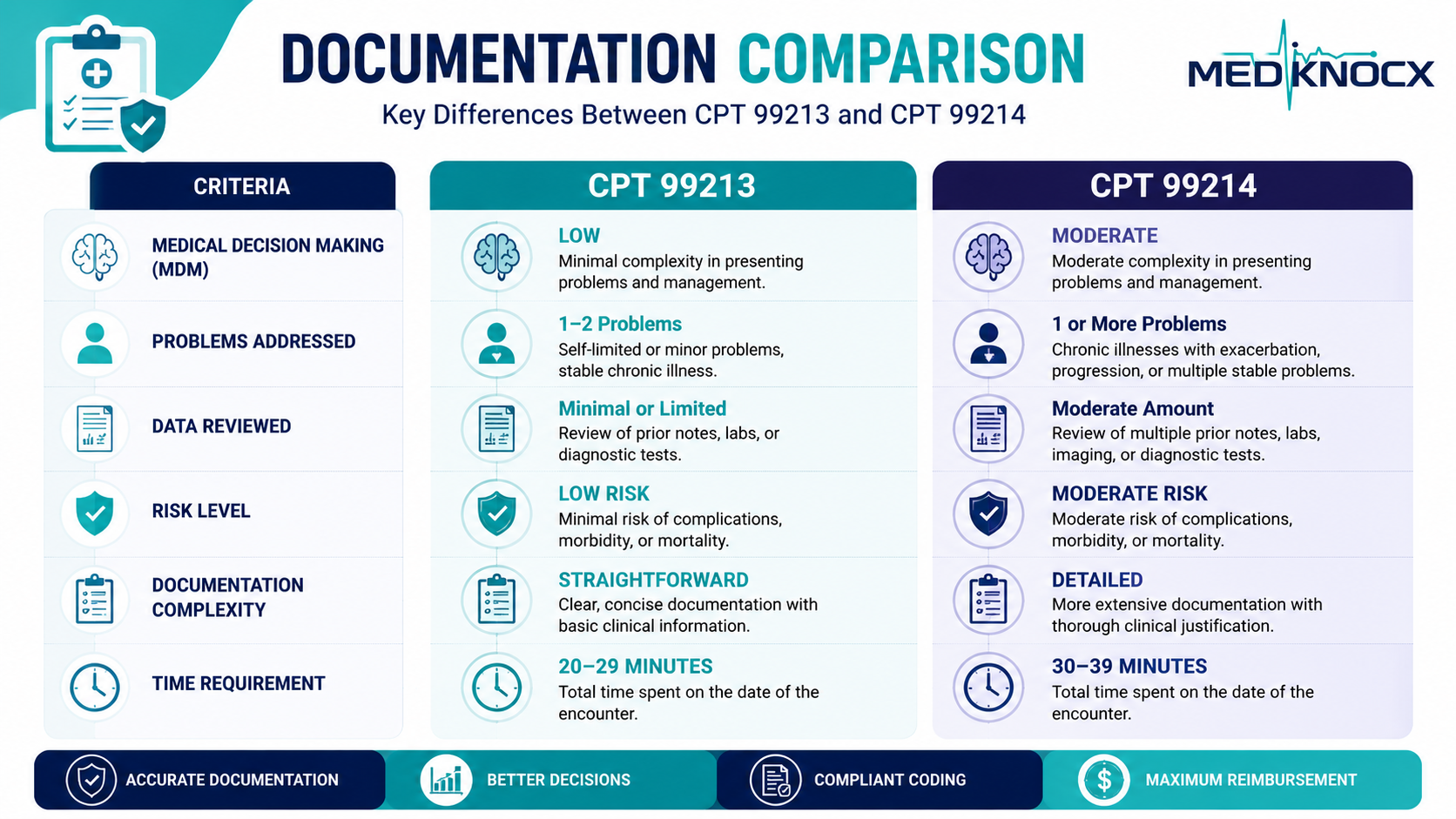
Documentation usually answers the question long before the claim is submitted. When coders struggle to decide between CPT 99213 and CPT 99214, the problem is rarely the code description. The medical record either supports the reported level of service or it doesn't.
Both codes require clear documentation, but 99214 demands stronger evidence that the encounter involved a higher level of physician work. The note should tell the complete clinical story, including the patient's condition, the provider's assessment, the treatment plan, and any factors that increased the complexity of the visit. Practices that experience recurring documentation issues often benefit from medical coding services, which help identify coding gaps and improve documentation accuracy before claims are submitted.
A 99214 visit usually reflects a more complex encounter. The provider may evaluate multiple chronic conditions, adjust prescription medications, review laboratory or imaging results, discuss management options, or address problems that carry a higher risk of complications. Those details should be clearly documented rather than assumed.
The length of the note isn't what determines the code. A three-page note filled with copied text doesn't justify 99214, and a concise note doesn't automatically support 99213. Payers, auditors, and Medicare contractors focus on whether the documentation supports the reported level of medical decision making or the total time when time is used for code selection.
When you're unsure which code applies, don't start by looking at the reimbursement. Start with the documentation. Ask one simple question:
Does the medical record clearly support low medical decision making or moderate medical decision making?
If the answer isn't obvious from the note, the documentation likely needs improvement before the claim is submitted.
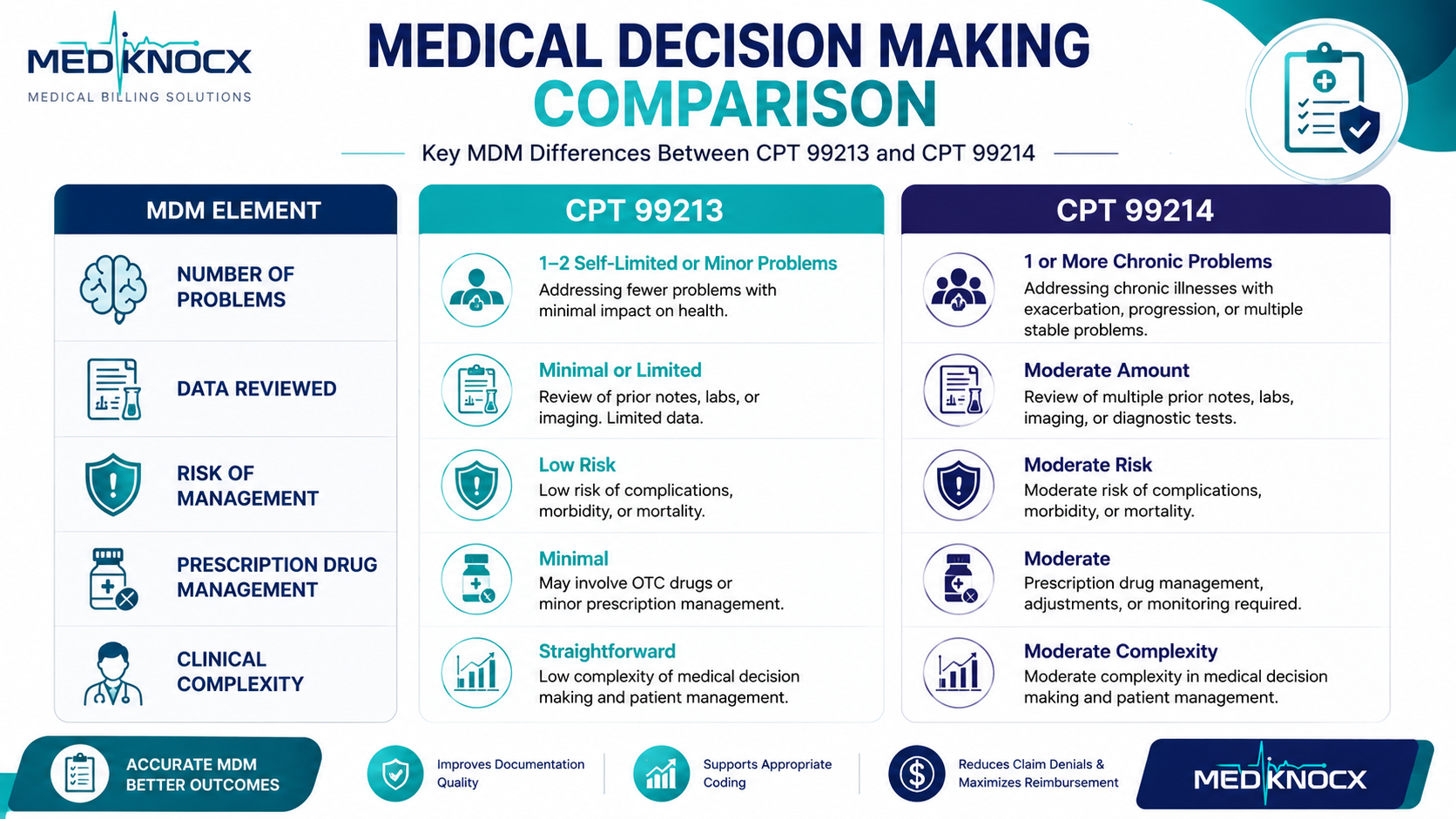
Medical decision making is where the biggest difference between CPT 99213 and CPT 99214 becomes clear. After the 2021 E/M guideline changes, providers can select the code based on the level of medical decision making (MDM) or the total time spent on the date of the encounter. In most established patient visits, MDM is the factor that determines the final code.
A 99213 visit requires low medical decision making. These encounters usually involve a stable chronic condition, a self-limited problem, or an uncomplicated acute illness. The provider evaluates the patient, develops a treatment plan, and the overall risk remains low.
A 99214 visit requires moderate medical decision making. Patients reported with this code often have multiple chronic conditions, worsening symptoms, medication adjustments, or problems that require closer monitoring. The documentation should show why the encounter involved a higher level of clinical judgment.
MDM isn't based on a single detail. It reflects the overall complexity of the encounter. Providers should consider the number and complexity of problems addressed, the amount of data reviewed or analyzed, and the risk associated with patient management before selecting the appropriate code.
A patient returns for a routine blood pressure follow-up. The condition is stable, no medication changes are made, and no additional testing is reviewed. The documentation generally supports CPT 99213.
Another patient presents with diabetes and hypertension. The provider reviews recent laboratory results, adjusts prescription medications, discusses treatment risks, and schedules close follow-up. The documented work may support CPT 99214, provided the medical record reflects moderate medical decision making.
Not every provider selects an E/M code based on medical decision making. Some visits are reported using total time, especially when the encounter includes activities that aren't fully reflected by MDM alone. In those cases, accurate time documentation becomes just as important as the clinical note.
For established patient office visits, CPT 99213 applies when the provider spends 20 to 29 minutes on the date of the encounter. CPT 99214 applies when the total time is 30 to 39 minutes. The reported time should include only the work personally performed by the physician or qualified healthcare professional on that date.
Total time isn't limited to the face-to-face visit. It may also include reviewing medical records before the encounter, documenting the visit, ordering tests, interpreting results, communicating with other healthcare professionals, counseling the patient, and coordinating care. Activities performed by clinical staff or time spent on services billed separately shouldn't be included.
Time alone doesn't justify a higher-level code. The documentation should clearly state the total time and support the work performed during the encounter. If the medical record doesn't support the reported time, the claim may be questioned during an audit.
A physician spends 24 minutes reviewing the patient's history, evaluating a stable chronic condition, counseling the patient, documenting the visit, and ordering routine follow-up care. If time is used for code selection, the encounter may support CPT 99213.
Another established patient visit requires 35 minutes because the provider reviews laboratory results, adjusts prescription medications, discusses treatment options, documents the encounter, and coordinates follow-up care. When the medical record clearly documents the total time, the visit may support CPT 99214.

Reimbursement is often the first difference people notice between CPT 99213 and CPT 99214, but it should never be the reason for choosing one code over the other. The level of service must always reflect what is supported by the medical record.
Because CPT 99214 represents a higher level of physician work, it generally reimburses more than CPT 99213. The exact payment varies by payer, geographic location, contract terms, and the annual Medicare Physician Fee Schedule. A practice may also see different reimbursement amounts from commercial insurance plans for the same service.
Consistently reporting 99213 when the documentation supports 99214 can reduce revenue over time. The opposite creates a much bigger risk. Reporting 99214 without documentation that supports moderate medical decision making or the required total time may result in downcoding, claim denials, refund requests, or audit findings.
The safest approach is simple. Complete the documentation first, determine the correct level of service based on the E/M guidelines, and let reimbursement follow the code that the medical record supports.
A higher-paying code isn't always the correct code. If an auditor cannot understand why the visit was reported as 99214 after reviewing the documentation, the claim becomes difficult to defend. Accurate documentation protects both reimbursement and compliance.
The right code becomes much easier to choose once you stop looking at reimbursement and focus on the visit itself. CPT 99213 is appropriate when the documentation supports low medical decision making or 20 to 29 minutes of total provider time on the date of the encounter.
Most 99213 visits involve stable or uncomplicated conditions that don't require extensive evaluation or high-risk management. The provider still performs a complete assessment, but the overall complexity of the encounter remains low.
You may report CPT 99213 when the visit includes:
Follow-up for a stable chronic condition, such as controlled hypertension or hypothyroidism.
Evaluation of a minor acute illness with a straightforward treatment plan.
Limited review of diagnostic data.
No significant changes to prescription medications.
Low-risk patient management supported by the documentation.
The final decision should always come from the medical record. If the documented problems, data reviewed, and management risk support low MDM, 99213 is generally the appropriate code.
Some follow-up visits require considerably more physician work. Patients may present with worsening symptoms, multiple chronic conditions, medication adjustments, or clinical decisions that increase the complexity of care. Those encounters often support CPT 99214 when the documentation reflects moderate medical decision making or 30 to 39 minutes of total provider time.
A higher-level code isn't justified simply because the visit lasted longer or the patient had several diagnoses. The documentation should clearly explain why the encounter required a greater level of evaluation and management.
You may report CPT 99214 when the visit includes:
Management of multiple chronic conditions.
Prescription drug management or medication changes.
Review and interpretation of laboratory or imaging results.
Moderate-risk clinical decision making.
Documentation that supports moderate MDM or the required total time.
Whenever there's uncertainty, review the documentation against the current E/M guidelines before submitting the claim. The documented service should determine the code, not the expected reimbursement.
Most coding errors don't happen because coders misunderstand the CPT code descriptions. They happen because the documentation and the reported level of service don't match. A few small mistakes can lead to claim denials, downcoding, delayed payments, or medical billing audit findings.
Here are some of the most common mistakes to avoid when reporting CPT 99213 and CPT 99214.
The reimbursement difference between 99213 and 99214 should never influence code selection. Always choose the code that accurately reflects the documented service.
A patient may have several chronic conditions, but that doesn't automatically support 99214. The documentation should show the complexity of the problems addressed and the work performed during the encounter.
Prescription drug management, diagnostic data review, and clinical risk should be clearly documented. If the note doesn't support moderate medical decision making, 99214 may not be appropriate.
When time is used to select the E/M code, the provider should document the total time spent on the date of service. Without that documentation, the reported code may not be supported.
Copying information from earlier visits without updating the assessment or treatment plan creates documentation risks. Every encounter should accurately reflect the patient's condition and the care provided on that date
Accurate diagnosis coding is just as important as selecting the correct E/M level. Reviewing the ICD-10-CM Official Coding Guidelines helps ensure that diagnosis codes support medical necessity and align with the documented services.
Decision between CPT 99213 and CPT 99214 doesn't have to be difficult when the documentation tells the complete clinical story. The patient's condition, the level of medical decision making, and the total provider time should guide every coding decision. If your practice continues to face coding uncertainty or documentation challenges, a medical billing consultation can help identify process gaps and improve coding accuracy.
Accurate code selection protects more than reimbursement. It helps reduce claim denials, supports compliance, and prepares the practice for payer reviews and audits. When the documentation clearly supports the reported level of service, providers and coders can submit claims with greater confidence.
If your practice regularly struggles with E/M coding, documentation reviews, or claim denials, a proactive coding audit can identify issues before they affect revenue or compliance.
At Mediknocx, we help healthcare providers improve coding accuracy, reduce claim denials, and strengthen documentation through professional medical billing and coding support. Our team reviews coding workflows, identifies compliance risks, and helps practices optimize revenue without compromising documentation standards.
MDM level and total time. 99213 covers low-complexity visits; 99214 covers moderate complexity or longer encounters.
Yes, current E/M rules allow either basis. If you're using time, document the total minutes and what filled them.
99213: 20–29 minutes. 99214: 30–39 minutes. Both include qualifying face-to-face and non-face-to-face work on the same date.
No. Length alone isn't enough. The documented time or the MDM level has to actually support it.
It can, as one piece of the MDM picture, but it's evaluated alongside the problems addressed and the data reviewed, not on its own.
Expect a possible downcode, a denial, a records request, or an audit flag. This is why the documentation has to come first.
Explore more medical billing guides, coding updates, and revenue cycle tips.
POS 22 marks on-campus hospital outpatient services. See how it differs from POS 19 and POS 11, how split bill...

POS 10 marks telehealth delivered to a patient's home. See how it differs from POS 02, which modifiers to use,...

CPT code 90791 covers the psychiatric diagnostic evaluation. See who can bill it, documentation rules, frequen...
Acupuncture Medical Billing Service
Allergy and Immunology Medical Billing Services
Anesthesia Medical Billing Services
Behavioral Health Billing Services
Psychiatry Medical Billing Services
Cardiology Medical Billing Services
Cardiovascular Medical Billing Services
Chiropractic Medical Billing Services
Dermatology Medical Billing Services
View All Specialities