Healthcare
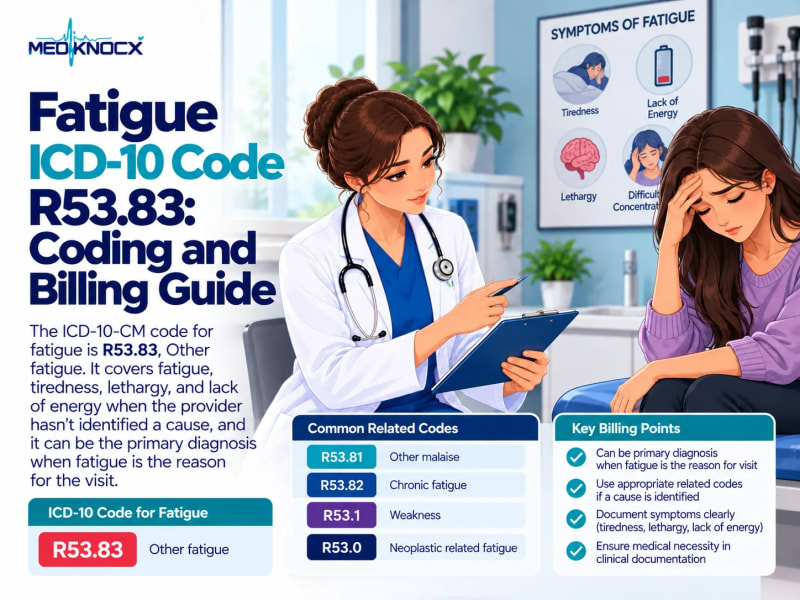
Fatigue ICD-10 Code R53.83: Coding and Billing Guide
R53.83 is the ICD-10 code for fatigue, tiredness, lethargy, and lack of energy. Learn R53.81 malaise, R53.82 c...

Oct 3, 2026
1 min read

Jordan Taylor
April 10, 2026
Table of Contents
13Learn what revenue codes are in medical billing, their importance, examples, and how to use them correctly to avoid denials and improve reimbursements.

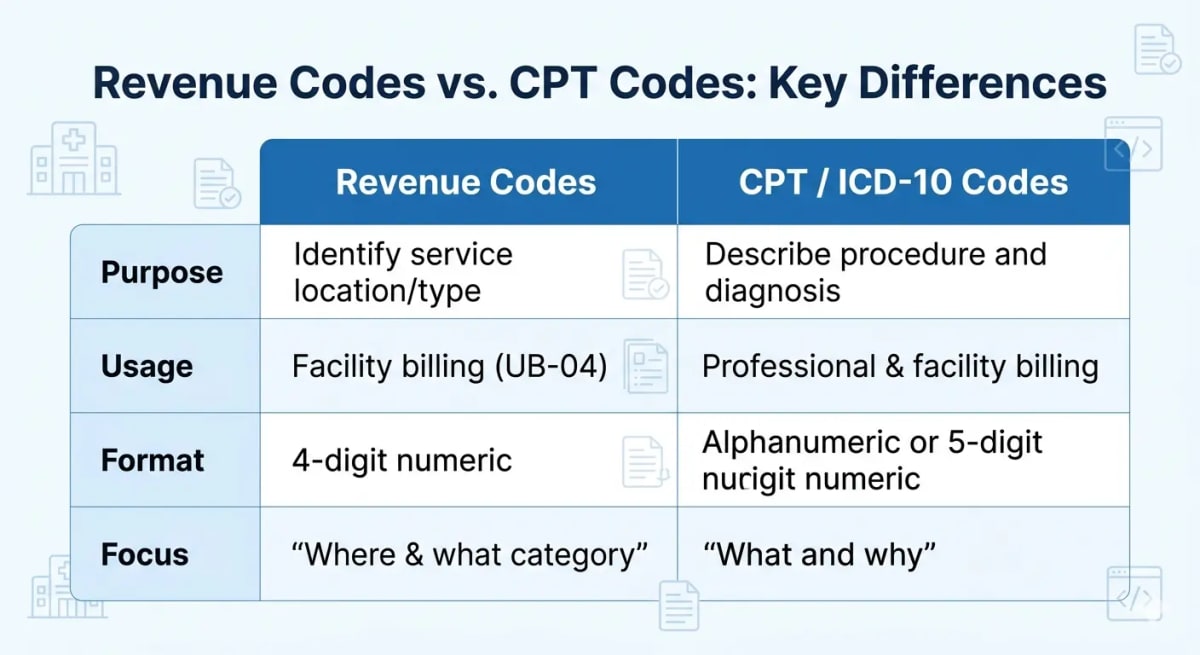
In healthcare billing, revenue codes are essential for accurately describing services provided within a facility. These four-digit numeric codes communicate critical details about:
Revenue codes are primarily used on the UB-04 claim form (CMS-1450) and play a key role in helping payers evaluate claims and determine reimbursement.
A revenue code in medical billing is a standardized four-digit number used to identify the specific department or service category within a healthcare facility.
These codes help payers understand:
Originally introduced by Medicare and maintained by industry standards, revenue codes are widely used across:
Revenue codes provide payers with the necessary context to process claims correctly. Missing or incorrect codes can lead to claim denials or delayed payments.
While CPT and ICD-10 codes describe what was done and why, revenue codes explain where the service occurred — which can affect reimbursement rates.
Healthcare facilities use revenue codes to group similar services, simplifying:
Revenue codes are standardized and maintained by the National Uniform Billing Committee, ensuring consistency across healthcare systems and compliance with payer requirements.
Revenue codes consist of four digits, structured as follows:
This structure allows for both high-level classification and detailed reporting.
Here are some widely used revenue codes in medical billing:
To ensure accurate billing and avoid denials, follow these best practices:
Incorrect or incomplete usage can result in claim rejection or underpayment
Yes. Revenue codes and procedure codes must align on claims. Together, they provide a complete picture of the service, ensuring accurate reimbursement.
Healthcare providers often face:
These issues can lead to denials, compliance risks, and revenue loss if not addressed properly.
To improve billing accuracy and financial performance:
Revenue codes are a foundational element of revenue cycle management (RCM). They:
When used correctly, they help healthcare organizations maximize revenue and minimize denials.
Revenue codes play a critical role in ensuring accurate, compliant, and efficient medical billing. By properly aligning them with procedural codes and maintaining updated billing practices, healthcare providers can significantly improve their reimbursement outcomes.
Partnering with an experienced RCM provider like Mediknocx can further streamline coding processes, reduce errors, and enhance overall financial performance — allowing your team to focus on delivering quality patient care.
A revenue code is a four-digit number used to identify the department and type of service provided in a healthcare facility.
They are used on the UB-04 (CMS-1450) claim form for facility billing.
Yes. Missing or mismatched revenue codes can result in claim denials or delayed payments.
Explore more medical billing guides, coding updates, and revenue cycle tips.
R53.83 is the ICD-10 code for fatigue, tiredness, lethargy, and lack of energy. Learn R53.81 malaise, R53.82 c...
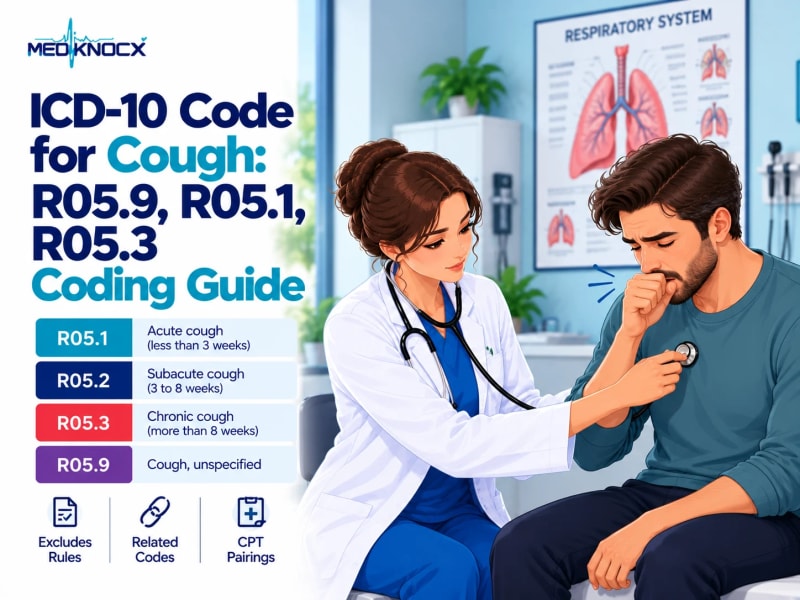
ICD-10 codes for cough by duration: R05.1 acute, R05.2 subacute, R05.3 chronic, R05.9 unspecified. Plus Exclud...

M25.512 is the ICD-10 code for left shoulder pain. See M25.511, M25.519, bilateral coding, scapula and clavicl...