Healthcare

Fatigue ICD-10 Code R53.83: Coding and Billing Guide
R53.83 is the ICD-10 code for fatigue, tiredness, lethargy, and lack of energy. Learn R53.81 malaise, R53.82 c...

Oct 3, 2026
1 min read

Jordan Taylor
February 11, 2026
Table of Contents
6
Medical billing reports are a critical component of revenue cycle management (RCM). They provide healthcare practices with clear visibility into financial performance, claim status, reimbursements, and operational efficiency.
Whether it’s a denial report, aging report, financial statement, or productivity analysis, these reports streamline operations, increase transparency, ensure compliance, and support smarter decision-making.
From a technical standpoint, medical billing reports:
Ensure regulatory compliance
Assist during audits
Track reimbursements and outstanding balances
Identify revenue leaks
Improve claim acceptance rates
Simply put, they transform raw billing data into actionable insights.
Medical billing reports are detailed documents containing billing and financial data from a medical practice, hospital, DSO, or healthcare facility. They capture essential information such as:
Patient and provider demographics
Services rendered and procedure codes (CPT/HCPCS)
Claim submission status
Payments received
Denials and adjustments
Outstanding balances
These reports help providers monitor financial health, detect patterns, correct errors, and make informed business decisions to optimize their revenue cycle.
They reveal how much revenue has been collected, how much is pending, and how much can be recovered after rework.
By analyzing recurring denial reasons, practices can improve documentation and coding accuracy.
Missed charges, coding errors, and unpaid claims are easier to identify and fix.
Historical data allows practices to track performance trends over time.
Clear financial insights enable smarter planning and expansion.
There are various types of medical billing reports. Today, we’re going to discuss the top seven. These are:
Let’s now briefly describe these reports and tell you why they are considered an essential part of revenue cycle management.
Denial reports list all rejected claims along with denial reasons.
Why they matter:
Identify recurring coding or documentation errors
Improve clean claim rates
Reduce denial turnaround time
Example: If most denials are due to eligibility issues, front-desk verification processes can be strengthened.
Payment reports track payments received from payors and patients.
Why they matter:
Monitor cash flow
Match payments with billed charges
Identify underpayments or missing payments
Automated payment posting systems help maintain accuracy and efficiency.
Aging reports categorize unpaid balances by timeframes (30, 60, 90+ days).
Why they matter:
Prioritize collections
Identify delayed payors
Improve follow-up strategies
If a large portion of receivables exceeds 90 days, collection workflows may need improvement.
These reports track how often CPT codes are used and the revenue they generate.
Why they matter:
Identify high-performing services
Detect underutilized procedures
Ensure accurate coding compliance
Regular coding audits improve revenue accuracy and reduce compliance risks.
AR reports show total unpaid balances categorized by payor, patient, or aging group.
Why they matter:
Evaluate financial stability
Prioritize high-value accounts
Strengthen AR management strategies
Strong AR management directly improves cash flow.
Productivity reports measure billing staff and provider performance.
Why they matter:
Track claims processed
Measure posting accuracy
Identify workflow inefficiencies
Clear KPIs and regular feedback improve operational performance.
Financial reports include income statements, profit & loss statements, and balance sheets.
Why they matter:
Provide a complete financial overview
Guide budgeting and forecasting
Support strategic planning
Integrated financial systems ensure data accuracy across departments.
Medical billing reports play a major role in streamlining the revenue cycle and enhancing your overall performance. Recording crucial data in the form of medical billing reports helps you in many ways.
Helps you achieve high profitability, optimize every step of the billing process, monitor your progress, track goals, simplify bottlenecks, eliminate denials, ensure patient satisfaction, and much more.
Here’s how it influences your administrative operations, like billing and collections.
Your Operations Are More Efficient
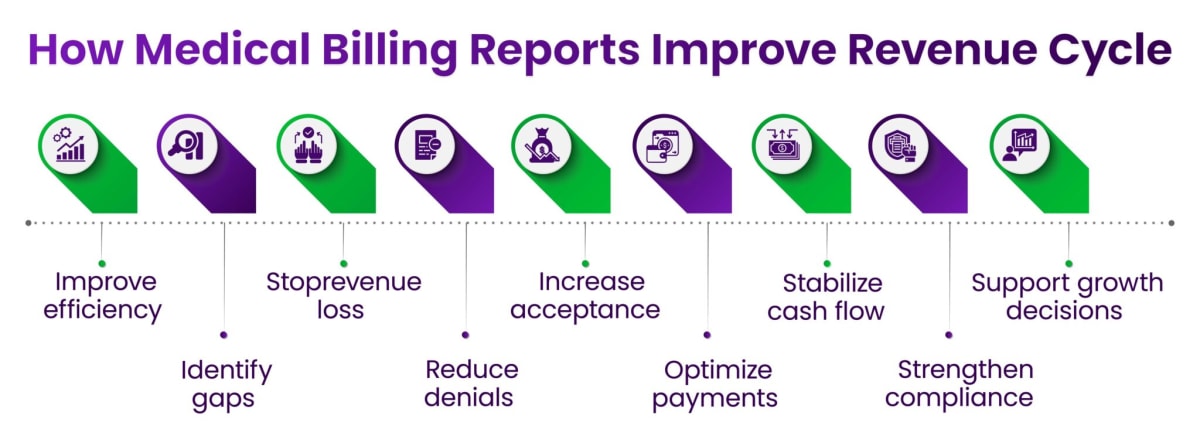
These reports identify the hurdles and shortcomings your practice is facing or has faced in the past. By signaling towards these vulnerabilities, these reports help future progress. They help you with seamless operations and uproot any inefficiency affecting smooth progress in billing.
Reports highlight bottlenecks and inefficiencies, enabling smoother billing operations.
They expose missed charges, incorrect coding, and unpaid claims before losses accumulate.
Denial trends help practices fix root causes and submit cleaner claims.
Regular monitoring of aging and denial reports supports timely reimbursements.
Detailed documentation supports HIPAA compliance and reduces audit risks.
Accurate financial data allows practices to allocate resources wisely and plan expansion confidently.
Medical billing reports are more than just administrative documents — they are powerful financial intelligence tools.
They help healthcare providers:
Track revenue performance
Reduce denials
Improve collections
Strengthen compliance
Make confident, data-driven decisions
With clear and consistent reporting, practices can optimize operations, stabilize cash flow, and achieve sustainable long-term growth — without guesswork.
Accurate medical billing reports are the backbone of a profitable healthcare practice. If you want better visibility into your revenue, fewer denials, and faster reimbursements, our expert billing team can help.
👉 Get a free revenue cycle analysis today and discover hidden opportunities to increase collections
Explore more medical billing guides, coding updates, and revenue cycle tips.
R53.83 is the ICD-10 code for fatigue, tiredness, lethargy, and lack of energy. Learn R53.81 malaise, R53.82 c...

ICD-10 codes for cough by duration: R05.1 acute, R05.2 subacute, R05.3 chronic, R05.9 unspecified. Plus Exclud...

M25.512 is the ICD-10 code for left shoulder pain. See M25.511, M25.519, bilateral coding, scapula and clavicl...